 In 1629, the county Justice of the Peace, who was appointed by means of a commisssion to ‘keep the peace’, appointed Constables. Constables in turn appointed common warders to apprehend rogues and vagabonds. The warders appear though, to have been over zealous and were asked later the same year to show greater respect to poor people. Beggars from outside the parish remained a problem in the 18th century and keeping them out of town was one of the duties of the crier in 1711.
There was a watch by 1646 and a watch house by 1678. Watch duty was a liability imposed on inhabitants, and in 1711 it was supervised by the crier. By 1723 the bellman was paid 10s. a year out of town lands money, and that was still his salary as night watchman in 1788. A night watch was established by subscription in 1793.
Burton vestry engaged a man in 1737 to drive out vagrants. His services were discontinued in 1747, most likely for financial reasons, but he was re-appointed in 1749, presumably because they discovered in his absence that he fulfilled a useful role.
A ‘bang beggar’ was employed by the Burton township in 1826, and his duties in 1828 were to remove street beggars, examine lodging houses, and assist the constables in apprehending prostitutes.
A treble bell was rung at St. Modwen’s church in the market place for 15 minutes at 7:00 am every morning in the earlier 1800s; this is thought to have been a curfew bell. When largely discontinued in 1867 it was still being rung at 5.45 am and 7.45 pm every evening between Michaelmas (Christmas Day) and Lady Day; Lady Day being New Year’s day but up until 1752 when the Julian Calendar was replaced by the Gregorian Calendar, this was actually January 14th.
From at least 1875 the feoffees of the town lands paid for the ringing of the morning bell, and continued to do so until 1916. The evening bell was again being rung on some weekdays between Michaelmas and Lady Day until the late 1880s.
In 1728 the vestry agreed to defray the costs of prosecuting felons by levying inhabitants in Burton townships in what was one of the earliest agreements of its type in England. The order, however, was revoked in 1730. Burton had a voluntary association for the prosecution of felons in 1802. From 1807 the vestry paid its clerk to assist the annually elected parochial constable.
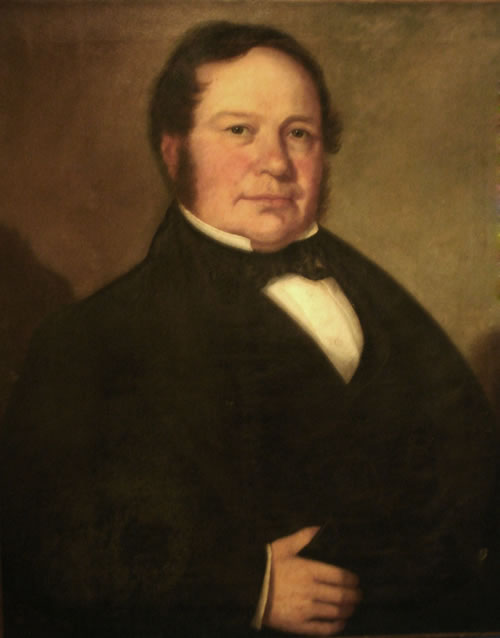
In 1819 it appointed its first salaried police officer, Richard ‘Dick’ Roe, who by all accounts, was a “tall powerful fellow” – an impression not easy to deduce from the most common portrait of him shown here.
His starting salary of 30 guineas a year; he also received £5 from the parochial constables out of their own pockets. The salary was increased to £70 in 1826, when the post was redefined as constable and police officer. This was an impressive salary at the time.
Dick Roe also a publican and used to keep the Wheatsheaf Inn, at the corner of Station Street and High Street. Tales are told of a large iron ring fastened into the fireplace to which he used to forcibly chain prisoners after they had been apprehended by him until they could be legally attended. Some concern was expressed however in 1836 about Dick Roe’s conflict of interest in his two roles. As a result, he was asked to stop selling alcohol at local race meetings and other public events and to concentrate on his police duties. He was described as ‘highly efficient’, however, in 1837 when the vestry applied to the feoffees of the town lands for financial help to pay his salary after the Poor Law Amendment Act of 1834 prevented him from being paid out of the ‘poor rate’.
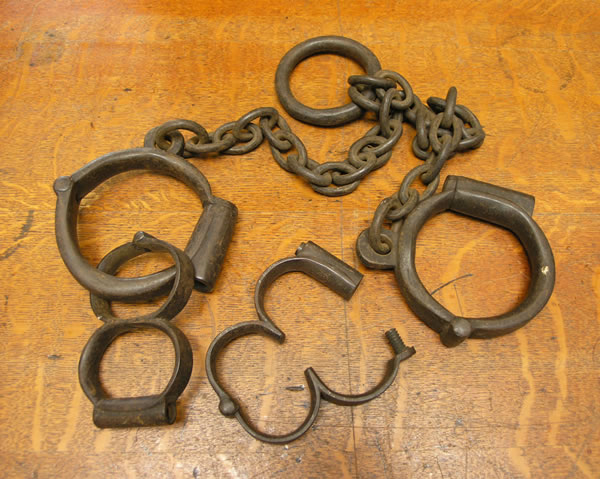
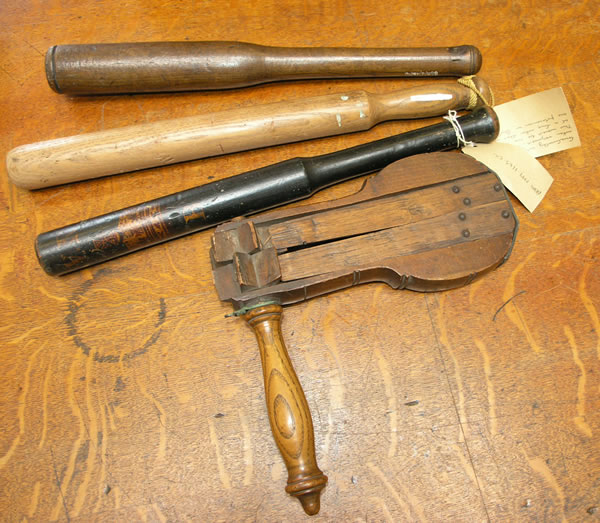
Some policing equipment of the time can be seen below. The images are courtesy of Arthur Roe, a local historian and actual descendent of Richard Roe. They show handcuffs of the time together with a variety of Burton police truncheons and a police rattle, a predecessor of the police whistle, used to call for help from other police officers. They were once on display in Burton Museum before it was closed
As one of Burton’s celebrated characters of the time, when he died in 1853, he was buried in the old churchyard, and a monument was erected to his memory by public subscription.
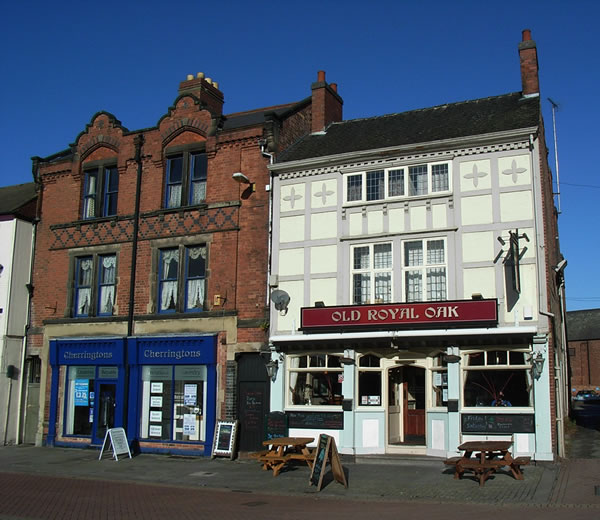
What was classed as the manorial gaol was situated below the Royal Oak public house in the market place. A few othe Burton pubs had 1d (one penny) a night cells that they made available.
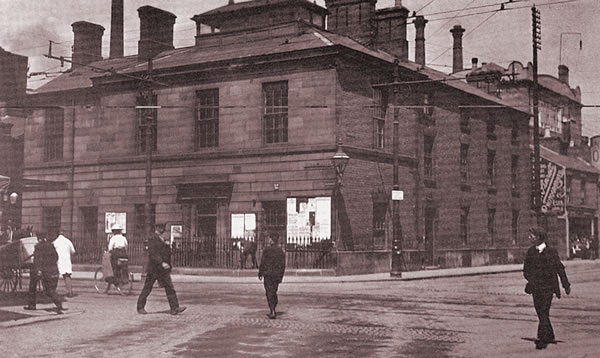
After the closure of the manorial gaol in the earlier 1830s, there was no secure place of detention until a police station with cells was built at the corner of Station Street and Guild Street. The Police Station was built by local builder, Thomas Lowe in 1848. It had already been implicated that all towns would have to provide a police station. This finally came into force in 1856.
The aformentioned Richard Roe was promoted from Town Constable to inspector and was provided with police constables.
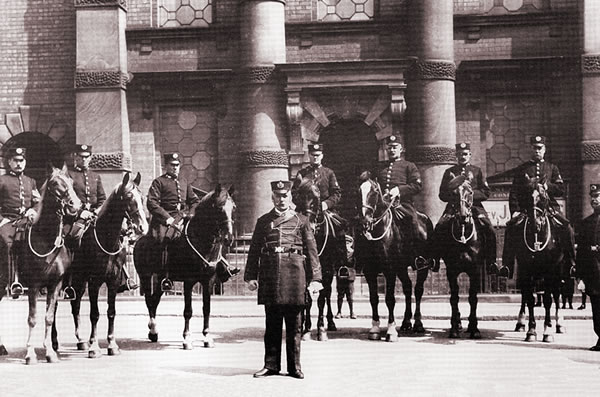
Before motorised transport became available, Burton Police used to patrol and attend incidents on horseback. By 1896, the Burton police force had grown to a Superintendent, James Gilbride, three sergeants and twenty-four constables.
The force can be seen above on parade in George Street at the rear of the Police Station around 1898. At the front is the recently appointed Police Superintendent W. Moss.
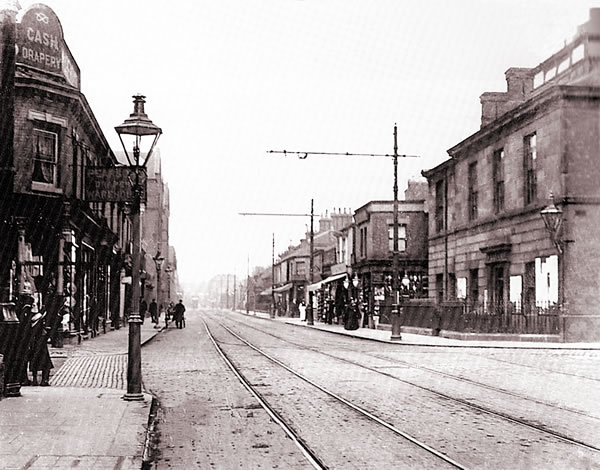
The Station Street, Guild Street, Union Street junction is just about recognisable here with tramway now running past the police station. The present day George Street entrance is just before the shops on the right.
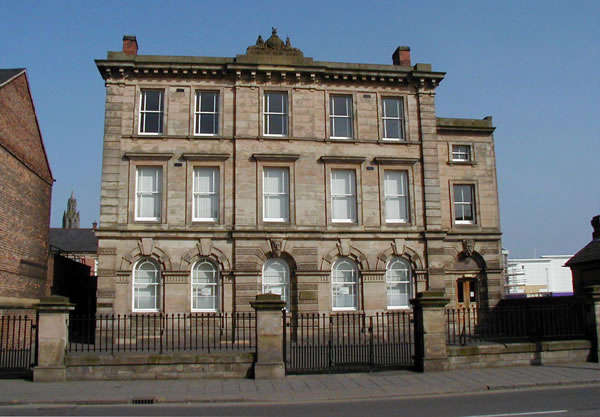
The Staffordshire county force continued to provide officers for Burton after the town became a county borough in 1901. A new police station with cells was opened behind the new magistrates’ court in Horninglow Street in 1910.
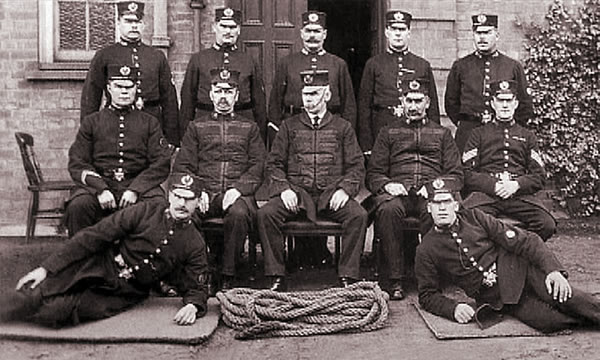
Few photos exist of the Burton Police force but the above one taken in 1920 gives a good flavour. Don’t worry, the rope is nothing to do with the penal system at the time; the picture is in fact, the Burton Police Force Tug-a-War Team. At the time, the was an annual battle between different factions of the town and the police team was always one of the most formidable.
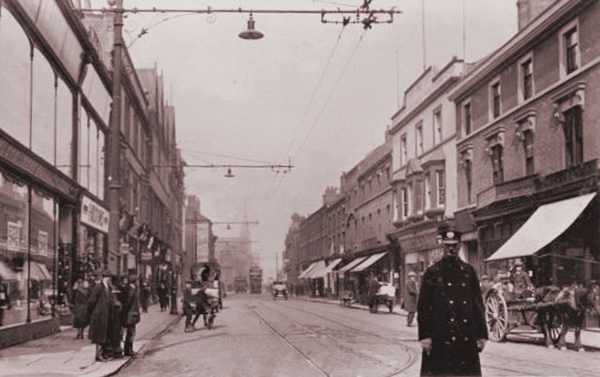
And another elusive shot of a Buron policeman on duty in a still very recognisable 1927 Station Street.
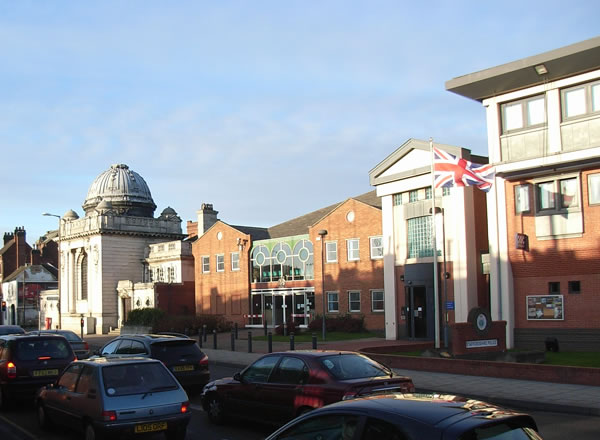
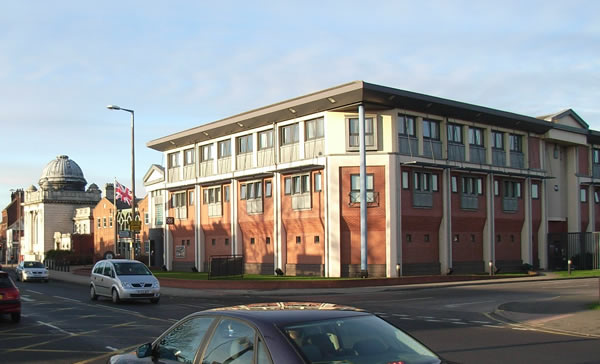
In the late twentieth century, the 1910 police station and magistrates court, having become an annex of a new modern complex but remain very much in use.
 Gallows and Instruments of Punishment