Menu Close

Saint Modwen History

Christianity was introduced to Mercia, one of the Kingdoms of the Anglo-Saxon Heptarchies, in 653 AD. A monastery was founded at its capital, Repton. Soon afterwards, a religious settlement was established at Burton by Saint Modwen who hence became its patron saint. She was an Irish noble woman who became an abbess and made a pilgrimage to Rome.

She, together with two other accompanying nuns Lazar and Althia, visited Burton on the way and founded a church dedicated to God and Saint Andrew on an island on the river Trent. She named the island Saint Andrew’s Isle, or Andressey. They stayed for seven years before continuing to Rome.

On her return journey, she built another church across the river at the foot of Mount Calvus, later known as Scalpcliffe Hill, this time dedicated to Saint Peter on the site of the current church in Stapenhill. She undertook further missionary work in Scotland, where she died at a place called Lanfortin near Dundee. A traditional story tells that on her death, her companions saw her soul taken to heaven by silver swans, which became her emblem, as depicted by the large White Swan in Stapenhill gardens. Her body was returned to Burton for burial; she was reputed to be 130 years old. A shrine to Saint Modwen was built at the church on Andressey but this was destroyed by the Danes in 874 AD who left their heritage on a number of place names, most notably, Broadholme and Horsholme which are the names of two of Burton’s other neighbouring islands; ‘holme’ being Danish for water meadow or island. Her remains were reputedly recovered and ended up at Burton Abbey when it was established in 1002 AD by Wulfric Spot, a Saxon nobleman. A new shrine was established in the Abbey church and was reputedly visited by William the Conqueror.

Some of Modwen’s alleged remains were transferred from the chapel on Andresey to Burton abbey and a shrine built there. The move evidently took place between 1008, when the abbey’s dedication was recorded as ‘St. Benedict and All Saints’, suggesting that Modwen’s bones were not then within the abbey church, and the abbacy of Leofric (1051-66) who despoiled the shrine.

There is known to have been an altar to Modwen in the abbey church by the time of Abbot Geoffrey Malaterra (1085-94). An undated grant by William I (1066-87) makes the strong suggestion that he visited her shrine. The Abbot promoted Saint Modwen and increasing her importance.

When Abbot Geoffrey took over Burton Abbey in 1114 he knew little about the saint whose bones his Abbey possessed and was very intrigued to find out more. He re-built the shrine and wrote to Ireland for information, he was sent a ‘Life of Modwenna’ written by Conchubranus  (or Conchobhar), an itinerant Irishman searching for materials about an Irish abbesses. Abbott Geoffrey edited this and added a few stories of Modwen’s time in Burton and telling of her posthumous miracles. It was called ‘Life of Saint Modwenna’.

Amazingly, the Conchubranus book still survives and has recently been edited and translated by Professor Robert Bartlett of Saint Andrew’s University. For the first time we know what the monks believed and taught about Modwen. Conchubranus’ book contains references to Modwen’s time in Burton, of her establishing both churches, and talks about the Burton monks possessed her bones and her name. In Conchubran’s time in Ireland,  Burton was also known as ‘Mudwennestow’, meaning ‘Modwen’s holy place’.

Some relics of Saint Modwen were re-discovered in 1201 which prompted a renewed interest in her cult. Additional miracles were attributed to her, and she was depicted on the seal of Abbot Nicholas (1216-22). A new shrine was built in the abbey church in the early 15th century, and it was probably that shrine which by the 1530s had an image of the saint with a red cow and a staff said to be helpful to women suffering labour pains.

By the late 13th century, Saint Modwen was known in monasteries with earlier links to Burton including Winchester, where Abbot Geoffrey of Burton had been prior; Reading, where Abbot William Melburne had been a monk; and Wherwell nunnery, Hants. near Winchester. In addition, the two cathedrals of Canterbury and Salisbury have relics of her. No other English parish church however, has been dedicated to her outside of Burton, although there was a small chapel dedicated to her in Offchurch, Warwickshire. In the 1530s there was an image to Modwen in Ashbourne church, Derbyshire; she was also depicted in medieval window glass, mentioned in 1798, at Pillaton Hall, in Penkridge.

When the chapel on Andresey was dedicated in the early 13th century by Bishop Geoffrey Muschamp, it was called Saint Andrew’s church, and its keeper was given 1s. a year by Abbot William Melburne. There was still an altar dedicated to Saint Modwen on the island by 1280. When the chapel was rebuilt by Abbot Thomas Feld in the late 15th century, it was known as St. Modwen’s and contained her supposed tomb.

In Tudor times, St Modwen’s Holy Well was in a chapel on Andrew’s Island between two branches of the River Trent at Burton. It was famous for the cure of King’s Evil and other extraordinary cures. The water had long been used by the monks for brewing the famous Burton Ale and pilgrims came to partake of the water and possibly the ale too. The offerings received from the pilgrims visiting the shrine in the 1530s just before the dissolution, was around £2 a year.
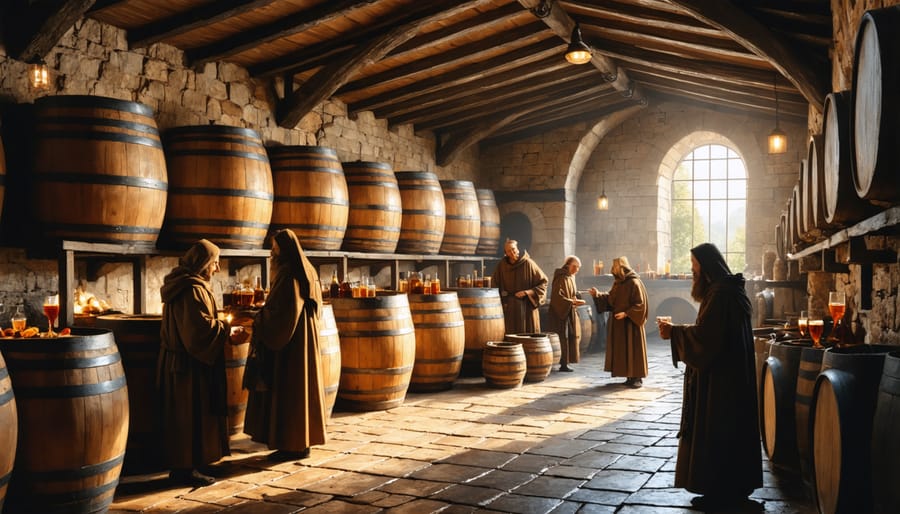
The Abbey was the centre of life in Burton until Henry VIIIs Dissolution in 1538. During this period, the Saint Modwen cult in Burton was officially suppressed.

Sir William Bassett was at Meynell Langley, Derbyshire, at the end of August 1538 when he received instructions from Thomas Cromwell “that such images as you know… so abused with pilgrimages or offerings… you shall for avoiding that most detestable offence of Idolatry forthwith take down”. Sir William carried out his task and replied to Cromwell, as follows:

Right honourable my inespecial good lord, according to my bounden duty and the tenor of your lordship’s letter lately to me directed, I have sent unto your good lordship by this bearer, my brother Francis Bassett, the images of St Anne of Buxton and St Modwen of Burton upon Trent which images I did take from the places where they did stand, and brought them to my own house within 48 hours after contemplation of your said lordship’s letter, in as sober manner as my little and rude wits would serve me. And for that there should no more idolatry and superstition be there used I did not only deface the tabernacles and places, where they stand but also did take away the crutches, shirts and sheets with wax offered, being things that did allure and intice the ignorant people to the said offerings, also giving the keepers of both places admonition and charge that no more offerings should be made in those places till the King’s pleasure and your lordships be further known in that behalf. My lord, I have locked up and sealed the baths and wells at Buxton and none shall enter to wash them till your lordship’s pleasure be further known. Whereof I beseech your lordship that I may be ascertained again at your pleasure and I shall not fail to execute your lordship’s commandment to the uttermost of my little witt and power. And the trust that they did put in those images and the vanity of the things, this bearer, my brother can tell your lordship better at large than I can write for he was with me at the doing of all and in all places, as knoweth good Jesus, whom ever good lordship in his blessed keeping. Written at Langley with the rude and simple hand of your assured and faithful orator and as one ever at your commandment, next unto the King to the uttermost of my little power.

Signed William Bassett (Knight)

On 1st September, Thomas Thacker, Steward to Cromwell, wrote to his Master telling him that Francis Bassett had delivered to Austin Friars (Thomas Cromwell’s main residence) in London, “the image of St Modwyn with her red cow and her staff which women labouring of child in those parts were desirous to have with them to lean upon and to walk with“. This is the best available description of the statue.

Thomas Cromwell fell from grace a few years later and was arrested being accused of many crimes, most significantly treason. Cromwell was condemned to death without trial and beheaded on Tower Hill on 28 July 1540 (the day of the King Henry VIII’s marriage to Kathryn Howard). Following his death, an inventory was taken of his belongings which showed an extensive collection of treasures that had been confiscated from the church for supposed destruction. It has not been possible to identify the images of St Anne and St Modwen mentioned in the letter from Sir William Bassett.

Following removal of the shrine, the keeper was ordered not to accept any more offerings. Some elements of the cult, however, persisted. The name Modwen, which had some popularity before the Reformation, continued to be given to girls in Burton until at least 1585. Saint Modwen’s well on Andresey Island was recorded in 1686, still there in at least 1738, was said to work great cures. There was a 16th century attempt to rename the Island, Saint Modwen’s Isle, but this did not stick and it reverted to Andresey (Andrew’s Island).

When the chapel on Andresey passed to the Pagets as lords of Burton manor in 1546, it measured 60 by 27 feet. It was still standing in 1699 and possibly as late as 1837, but by 1857 the chapel site had gone. The area around the chapel was known as St. Modwen’s Orchard by 1760, when it was marked by a water-filled ditch. The ditch can just be seen today next to what is now known as the Cherry Orchard.

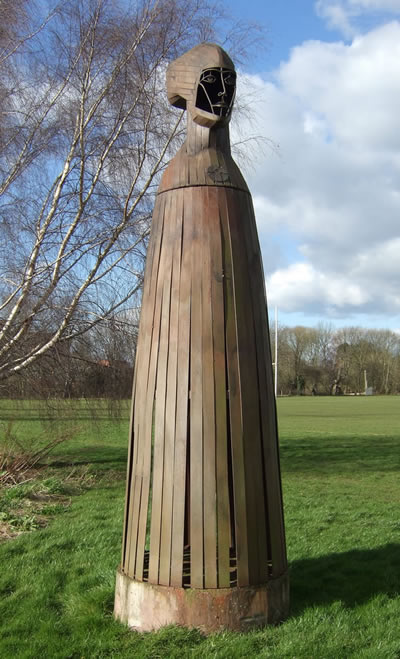
A modern monument to commemorate Saint Modwen was erected on Andressey Island at the end of the twentieth century. You may even have seen it but not registered who, or even what, is is supposed to depict. I certainly did! Strangely, it is half a mile away from where the original Saint Andrew’s Church and later Saint Modwen’s chapel stood.

The parish church still celebrates Saint Modwen’s day on 29th October (although the date appears to have been changed a number of times over the centuries).


One of Abbot Geoffrey’s stories in Professor Bartlett’s translation is included below.

A Miracle of St. Modwen – abridged from the ‘Life of Saint Modwenna’ by Abbot Geoffrey of Burton (c1120 AD), translated by Professor Robert Bartlett.

When St Modwen returned to England from Rome she came to the place called Scalpcliffe and saw there, by the hill, an island in the River Trent. It was secluded from men and had an isolated hermitage, and she loved the place very much. She stayed there for seven years and built a church dedicated to St. Andrew. To this day the island is known as Andressey, or Andrew’s Isle. At that time the area was a desolate wilderness, with woods and wild animals, but no people.

There lived at Breedon a saintly hermit who heard of Modwen’s reputation and used to visit her. He brought her writings on the lives of the saints which they read together, encouraging each other in their faith with the examples of the saints.

One day the hermit arrived but had forgotten the book. Modwen was grieved, and they decided to send for it. The hermit instructed two of Modwen’s companions where the book might be found, and Modwen instructed the two virgins to get into a boat and make all speed to fetch the book. They were rowing down the river when a strong wind sprang up which caused great waves on the Trent and filled the girls with fears of drowning and death.

When they reached a place called Leigh the wind got up further and they leant to one side and the boat overturned. They sank to the bottom of the river, and were trapped under the boat.

Modwen and the hermit began to grow anxious that they had been a long time. The thought occurred to Modwen that perhaps they had been drowned. She was desolate and blamed herself for having sent them and held herself responsible for their deaths. But the hermit consoled her, and suggested that they turned to prayer. They prostrated themselves on the ground and tearfully prayed to God for the lives of the girls. At length a bell rang and they rose, and noticed that a dry path had been miraculously opened up on the river bed. The water was divided in an astonishing manner into two parts, standing like a wall to the right and the left of the path.

Modwen and the hermit set off at once down the path on the river bed and came to the upturned boat. On one side of it the girls’ fingers were visible where they had clutched at the gunwale of the boat. The hermit tried to lift the boat but could not. It was as heavy and immovable as if it had grown roots into the river bed. He asked Modwen to try. She did so and the boat lifted as quickly and easily as if it had no weight at all. They found the two girls alive and well, safe and sound, preserved by the grace of God. There was mighty rejoicing and they all gave thanks to Almighty God for the miraculous saving of the girls, for his great wonders and the great marvels he had performed.

Once the boat was turned right way up they all climbed in and at once the waters rushed back into the river bed and bore them along with waves so that it should be clearly understood that God himself had divided the waters and saved the girls in answer to the prayers of the two saints.
Saint Modwen’s Church

Saint Modwen’s is probably Burton’s most significant church since it occupies part of what used to be the original abbey and hence has a history that dates back to that time.

Much of this section, photographs and text, is extracted from a booklet covering the history of Saint Modwen’s Church by kind permission of Dr Robin Trotter who produced it. The booklet is still available at the church.

Select page to view:

Stained Windows

The stained glass windows were added in 1865. They were given by the Marquis of Anglessey, Michael Thomas Bass and Henry Allsop.

(Photos awaiting sunshine!)

Sister Church

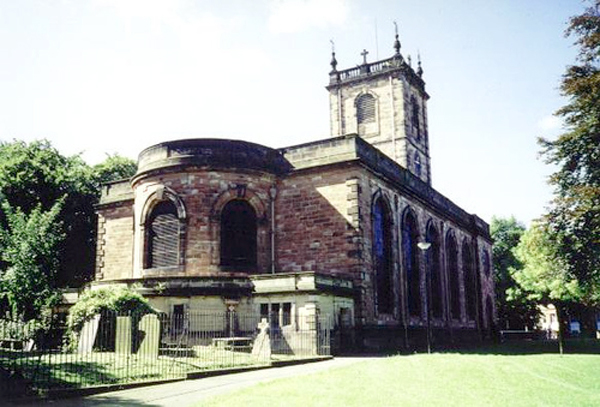
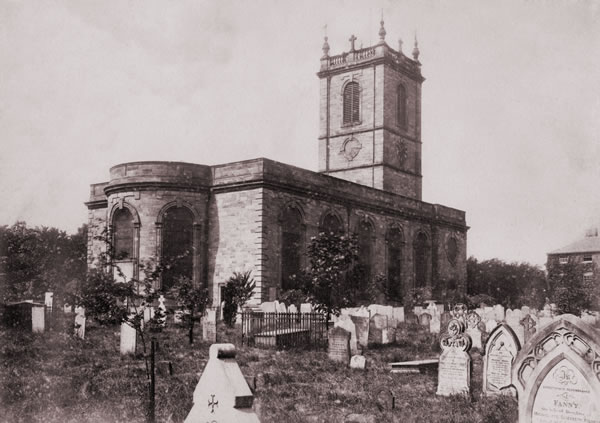
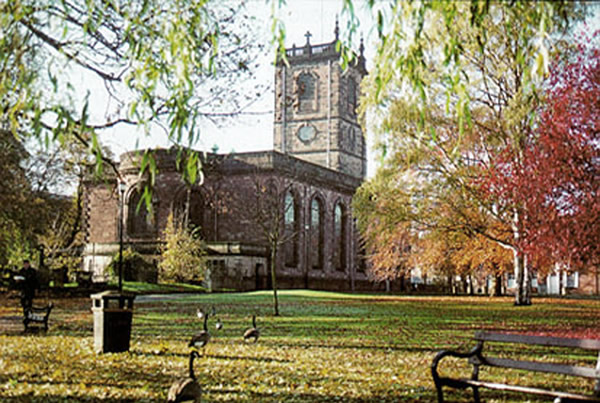
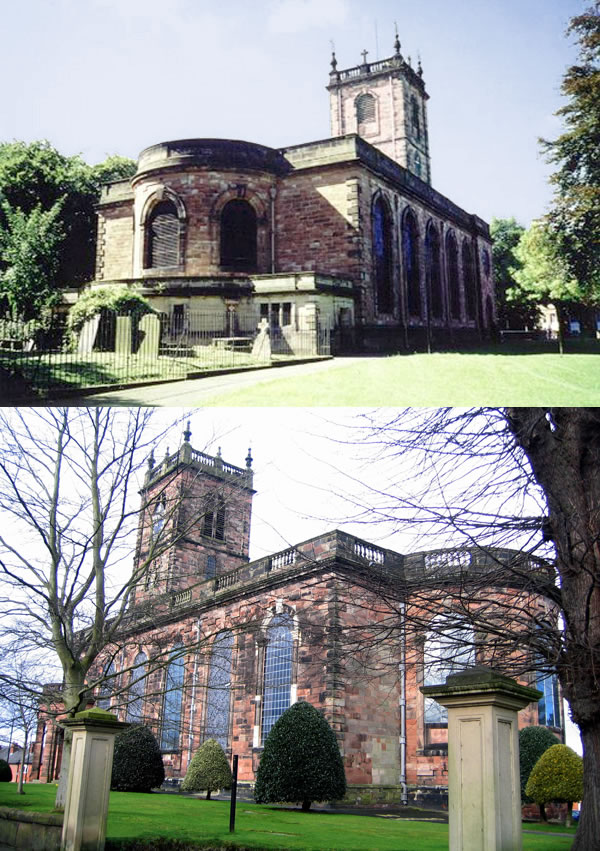
You would be forgiven for thinking that the two above pictures are the opposite sides of Saint Modwen’s church. In fact, whilst the top one is St Modwen’s but the bottom one is actually St Alkmund’s curch in Whitchurch, Shropshire.

They are almost identical, bar a few differences to suit their respective locations and a few additions over the years. Both were designed and built under the supervision of architect and builder William Smith, and his brother Richard. Saint Alkmund’s was completed first but William died before Saint Modwen’s was fully completed.

I had always imagined that churches were all unique so this was quite a revelation. In was strangely disappointing to find that Saint Modwen’s of all of Burton’s churches was a duplicate of an existing church being the mosty historically important church in Burton, and maybe even Staffordshire, occupying the site of Burton Abbey.

Present Saint Modwen’s Church

Saint Modwen’s Church was built between 1719 and 1728 but the church history goes back very much further. The present church stands on the site of the church of the Benedictine Abbey founded in 1002 by Wulfric Spot. The abbey had a very large cathedral-like church which served both the monks and the people of the town. After the dissolution of the monasteries by Henry VIII, Burton Abbey was one of the very few that was not destroyed.

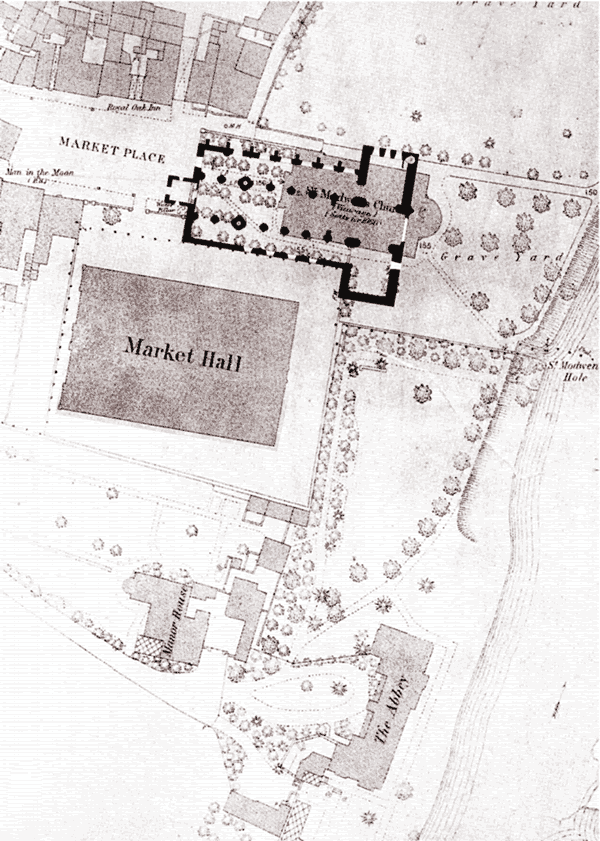
Over the next two centuries, it gradually fell into disrepair and disappeared as its stone was pillaged for other building work. Eventually, all that remained was the abbey church which continued to be used as a parish church, which can be seen in the below footprint. In its heyday, the enormous abbey extended down to include the current building labelled as The Abbey on the map.

By 1718, this too had become dilapidated and unsafe and it was decided to demolish it and build a replacement. The architect and builder William Smith, and his brother Richard, of Tettenhall were appointed by the parish vestry to build the new church. Smith had already worked on the impressive Saint Mary’s Church in Warwick and had built the church of Saint Alkmund in Whitchurch, Shropshire which was of very similar design. He was one of the most experienced church builders in the Midlands.

It was designed in a Classical style by the brothers Richard and William Smith of Tettenhall. The same design as Saint Alkmund’s was used which was based on a design of John Barker which itself was based on ideas by Sir Christopher Wren.

Work on the new church started in 1719. Their first job was to fit up a building known as the High Hall, which stood in the Market Place, for worship while the abbey came down and the new church was built. Unfortunately, neither William or Richard Smith lived to see the church completed; William died in 1724 and Richard in 1726. The church was completed by their younger brother Francis – ‘Smith of Warwick’, who had by now become more famous. He oversaw the completion of the church and addition of the churchyard walls. It was finally completed in 1928.

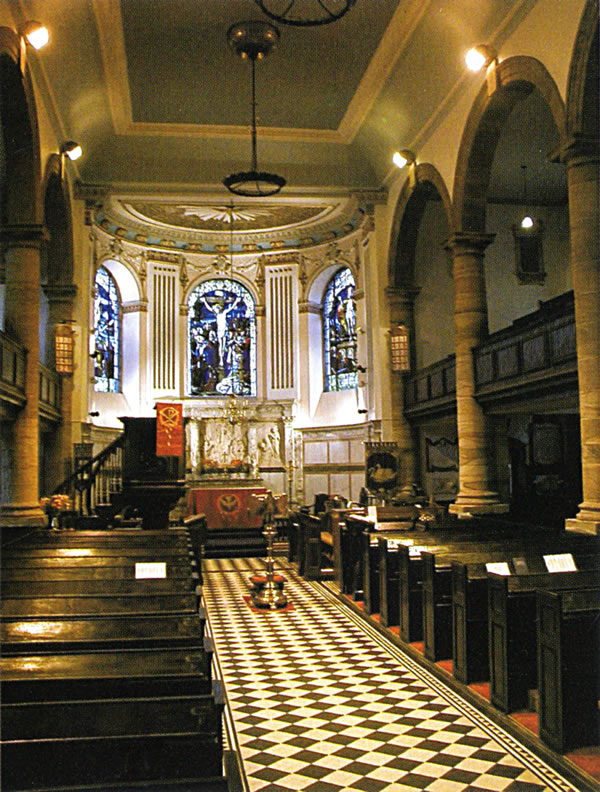
The church itself is built in red sandstone and comprises an aisled five-bay nave with galleries on the north, west, and south, an apse, and a western narthex with central tower, north and south gallery stairs, and internal porch. The west tower is of three stages and has a balustrade with urns and round windows with radial glazing bars. The apse has wide Doric pilasters at the opening and between the windows. The nave arcades have tall Doric piers without an entablature, the flat ceiling has a deep cove, and there are nave galleries cut across the high, arched windows of the aisles. The church retained its original altar rails and gated pews.

The main tower is 92 feet high to the parapet, over 100 feet to the top of the four vanes.

Churchyard
In the mid 16th century the graveyard lay to the south of the church. A lychgate mentioned in 1568 may be the church stile of 1682, and stone left over from the rebuilding of the church was used in 1727 to make a churchyard wall encompassing land to the south, east, and north of the church. In 1829 a railing fence was put up in front of the church. The same year the vestry leased land called the Arbour on the north side of the churchyard as an additional burial ground, and in 1830 an adjoining 1.5 acres was leased from the marquess of Anglesey.

In 1835 the churchyard covered 3 a. 25 p. New burials were restricted from 1856, and the churchyard was closed in 1866 when the municipal cemetery was opened. That part of the churchyard north of the church was vested in Burton corporation in 1939, and was converted in 1952 into a garden of remembrance for Burtonians who had died in the Second World War.

Alabaster Figure
An alabaster figure of a knight, dating from the late 15th or early 16th century, lay under the tower of the abbey church. Although already damaged, it was though important enough to preserve and move into the new church. When the church was completed, it stood under the west tower. Much admired, it was moved in the mid 19th century to a position where it could be clearly viewed from the market place.

By 1878 it had been moved to the garden of the Priory, a house in the south-west corner of the former monastic cloister. In 1924, it was presented to Burton museum but, when the museum was closed, like numerous items of Burton’s heritage, it mysteriously disappeared.

Pulpit
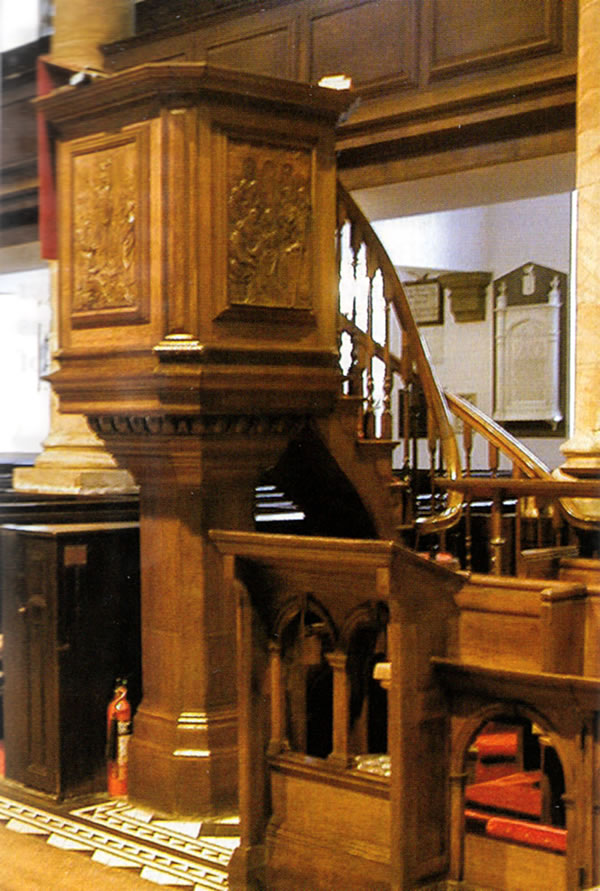
Christopher Wren had recommended that churches were planned so that everyone could see and hear the minister, especially when he was preaching. In accordance with this, the original pulpit was centrally placed. In this central position however, the pulpit completely obscured the Communion table from the rest of the church. That suited Anglican worship of the eighteenth century where communion was rarely celebrated and when it was, communicants would pass beyond the pulpit and gather round the table.

The galleries were part of Smith’s design and the pews are an integral part of the building. The columns stand on plinths that are panelled and integral with the seating. The church can seat over a thousand people in original Georgian pews!

A large chandelier was presented to the church by William Hawkins in 1725, in time for the completion. This, of course, was to be the only available lighting.

Font and Plate
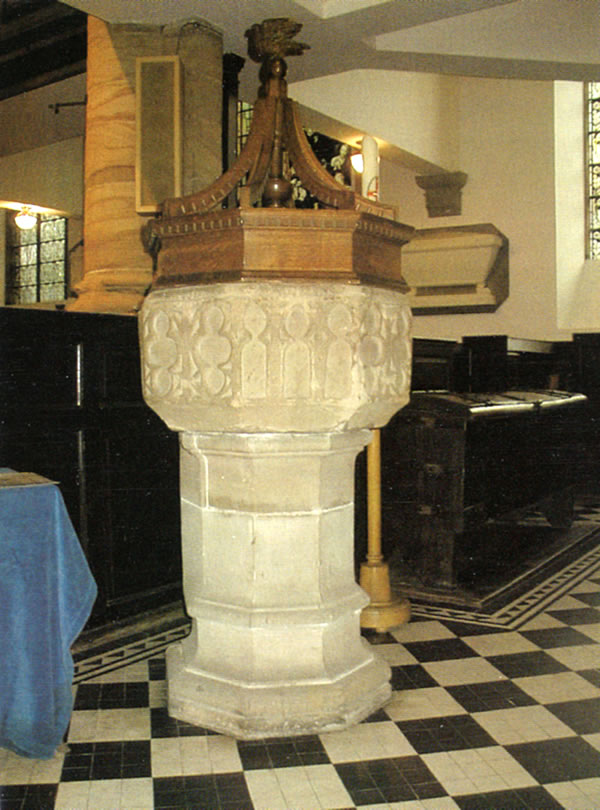
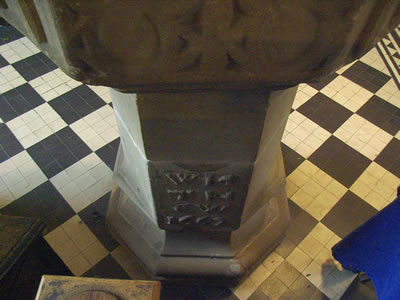
The font has survived from the abbey church. It has an octagonal bowl from the fifteenth century – during the Tudor period. It is one of the few survivals from the medieval church.

The plinth is newer, dating from 1662, and bears the initials of the vicar, Rev. William Middleton) and church wardens of the day. The basin was later lined with lead and is covered by a nineteenth century wooden cover.

The plate in 1549 included two chalices and two patens, but only one of each pair remained in 1552. A silver chalice and paten were acquired in 1662. Anne, wife of Sir Henry Every, gave a paten in 1705, and Mary, widow of Sir Robert Burdett of Bramcote, in Polesworth, Warwickshire, gave a flagon in 1726 when she was living in Burton. In 1727 the minister, William Browne, gave another flagon and his wife Ann gave a paten. A further chalice was acquired between 1795 and 1830.

Church Organ
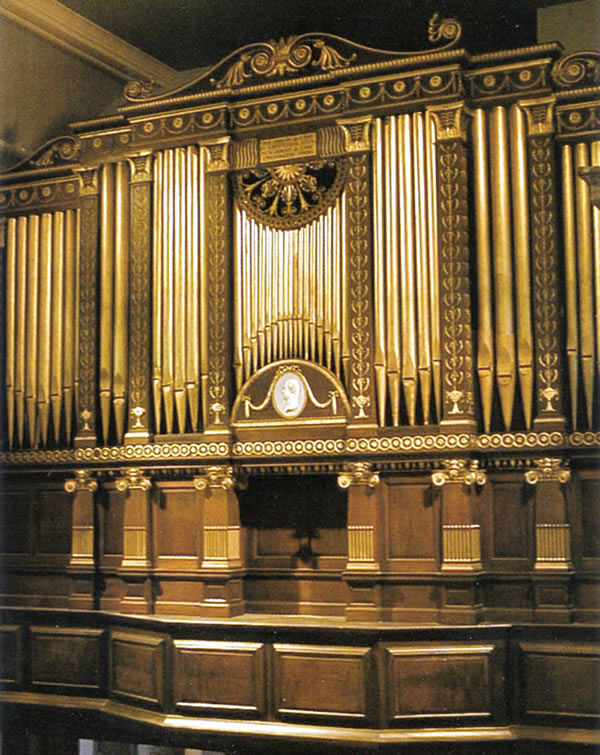
An organ was installed in the west gallery in 1771. It was built by Johann Snetzler who was one of the foremost organ builders of the time. The case was designed by James Wyatt. His design remains in the Royal Institute of British Architects. Iron columns were inserted into the west galley to bear the weight of the organ.

Anthony Greatorex (d. 1814) was appointed organist. His salary was met by public subscription until 1790, when, subscriptions falling off, it was met out of the church rates. Anthony was succeeded as organist by his son Thomas Greatorex (d. 1831), a distinguished musician, although his conducting and playing duties in London must have restricted his ability to perform in Burton. He resigned in 1828 and was succeeded by Charles Yates, who resigned in 1847 after the minister of St. Modwen’s had accused him of immoral conduct and professional incompetence and had employed a police constable to prevent him from playing in services.

A group of church singers under control of the organist was described in 1807 as “a set of industrious, hard working people, some of whom have large families and can ill afford any expense“. Consequently, their costs, estimated at 2 guineas a year, were to be raised by subscription, the Earl of Uxbridge pledged 1 guinea. They were replaced in 1847 by a volunteer church choir.

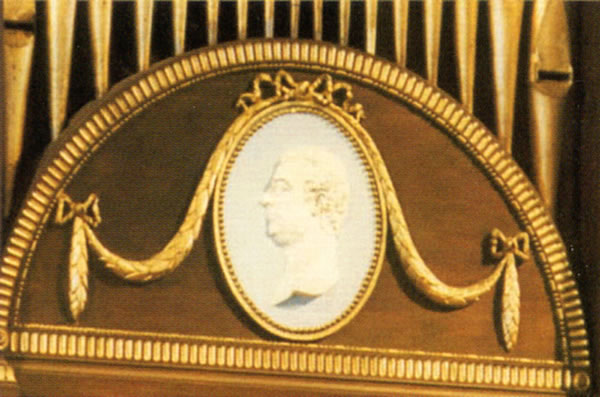
The cameo panel on the case, perhaps made by Josiah Wedgwood, is thought to represent the composer, George Frederic Handel, whose organ music was highly popular at the time. There is none of Snetzler’s original organ in the church today, although some of the pipes are believed to be in Trinity Methodist Church. The case was extended on each side to accommodate a larger organ which was installed in 1972, built by Hill, Norman and Beard.

An electrically operated organ was installed in 1900.

Clock and Bells
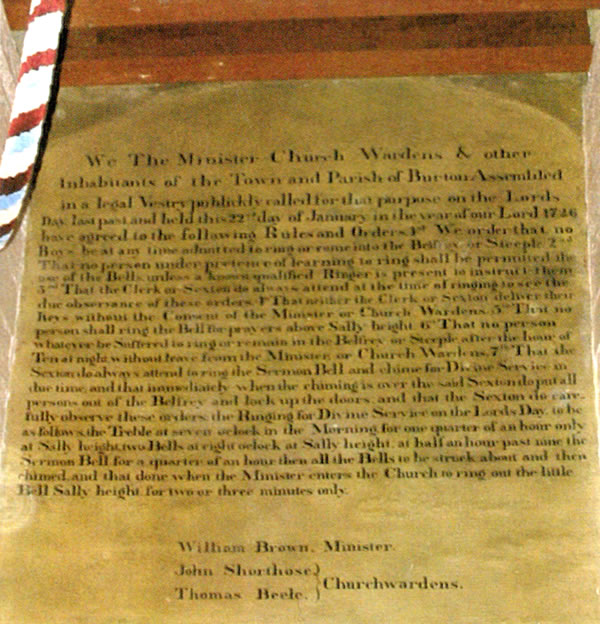
Five bells survived from the previous abbey church. These were re-cast into six in 1725, during the building of the new church, by Abraham Rudhall of Gloucester. The largest tenor bell weighs 18 cwt. Two new small bells were cast at the same time to make a ring of eight bells. The Ringers Rules dating from 1726 are painted on the wall of the ringing chamber. These date from when the bells were installed but before the church was complete.

Despite the conspicuous rules. Disturbances caused by bell ringers led to the adoption in 1727 of rules governing conduct in the belfry: no ringing was allowed after 10 pm and only known and qualified ringers were allowed in the belfry, and only the sexton was to ring for sermons and services.

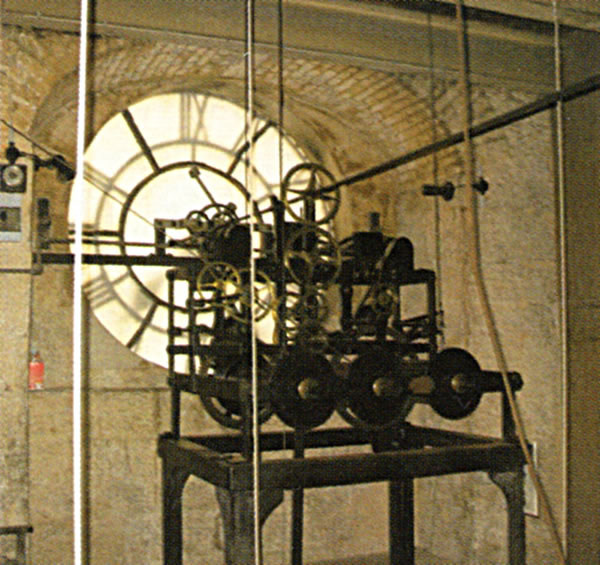
The tower clock was installed in 1785 at a cost of £203, half of which was donated by the Earl of Uxbridge. It was manufactured by the celebrated clock maker, John Whitehurst of Derby. The mechanism controls two clocks through a simple gearbox; one facing the market place, the other facing the memorial gardens.

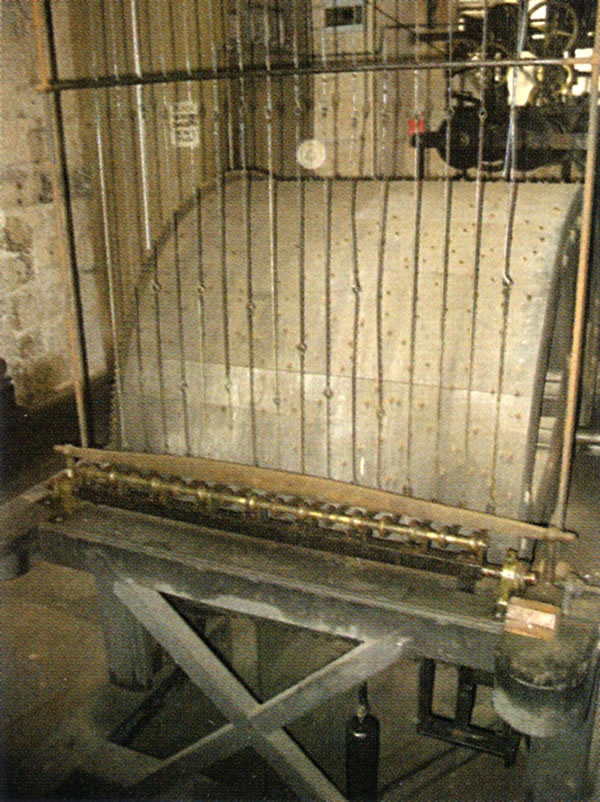
Also installed at the same time as the clock were eight bells and a Carillon; this resembles a huge musical box with pegs on a rotating drum which depress levers which in turn operate hammers against the bells. The Carillon was installed to play a variety of tunes on the bells at certain times. In the early 20th century the chimes played a different tune on each day of the week. After the Second World War it only chimed on market days. The Carillon remains functional but until recently were only heard on special occasions. In 2010 pleasingly, its use was restored to play a tune every day at midday.

In the early 19th century the ringers were threatened with losing a third of their fee because they would ring only for their own pleasure and not for the church’s services. In 1829 they were paid £7 4s for ringing at services, the appointments of churchwardens, and on national holidays, and between 1829 and 1838 they also received £1 for an annual feast. In 1865 their fee was raised from £10 to £15 a year. In 1895 Francis Charrington gave £60 to pay for the ringing of the bells each year on Trafalgar day (21 October).

Vicarage
In 1808, the minister is known to have had a house in High Street. The minister still resided in High Street in 1851 but some time before 1860, this had moved to a house called Trent Bank at Bond End. This was described in the 1890s as “anything but compatible with the dignity which one associates with the principal minister of the town“.

In 1893 a house called The Orchard in Orchard Street was purchased as a vicarage house with money raised by public subscription and a grant from Queen Anne’s Bounty. That house, which had formerly belonged to Martha Thornewill, mother of the vicar, C. F. Thornewill, was sold to a union of the benefices in 1982 but was demolished in 1989. A new vicarage house was built in Rangemore Street in 1983.

Financial support for an assistant curate was provided by the Additional Curates’ Society from 1844 until 1877, but the bulk of the assistant’s income came from voluntary local contributions. One or occasionally two curates were still employed until 1910; thereafter however, the de-population of the town centre meant that there was no curate until the later 1950s. In the late 1980s and early 1990s the curate lived in the former Christ Church vicarage house in Moor Street, renamed St. Modwen’s House. In 1994 the minister of St. Aidan’s in Shobnall Road, was appointed to serve also at St. Modwen’s as a town centre chaplain.

Parish Division
In 1824 the parish was divided into two districts, a southern one for the church of St. Modwen and a northern one for the newly built Holy Trinity church; the northern area was constituted a separate parish in 1842. Thereafter both parishes were subdivided by the creation of further ecclesiastical districts and parishes: Christ Church (1845); Horninglow (1867); Winshill (1867); Branston (1870); St. Paul’s (1873); Stretton (1873); All Saints’ (1898); St. Chad’s (1903); and Shobnall (1916). Holy Trinity and St. Modwen’s were united in 1969, as the parish of Burton-on-Trent, and in 1982 Christ Church and All Saints’ were united.

Despite the division of the parish, St. Modwen’s vestry continued to collect a single church rate for all the town churches. Compulsory church rates were abolished by an Act of 1868, and thereafter a voluntary rate was levied by St. Modwen’s vestry for St. Modwen’s, Christ Church, and Holy Trinity, with the addition of St. Paul’s from 1876. The system was changed in 1879 so that the churchwardens of each of those parishes collected their own rate from individuals, whilst the wardens of St. Modwen’s, on behalf of all four churches, continued to collect the rate from brewers and other firms in the town. Often known as the brewers’ rate, it raised over £411 in 1890, (but thereafter income began to decline as firms withdrew from the scheme and only a little over £209 was given in 1928. Bass, Ratcliff, and Gretton withdrew from the scheme that year to make individual contributions directly to each of the four churches, but St. Modwen’s continued to collect donations from other firms until at least 1954, when less than £23 was given in total.

Church Life from the Nineteenth Century
Services in 1829 were held on Sunday mornings and afternoons, with prayers on Wednesdays, Fridays, and saints’ days and the Boylston lecture on Thursdays. Communion was celebrated eight times a year, with about 70 attending at each occasion. The average Sunday attendance in 1851 was 400 at both morning and afternoon services, besides Sunday school children. A Sunday evening service started in 1860 was so well attended by 1892 that there were hardly enough seats. A children’s Sunday service, probably held weekly, began in 1871 but had ceased by 1892; by 1896 a monthly one had been reinstated. There was a harvest festival by 1877. Further liturgical changes were introduced from the late 1880s, and in 1887 the choir, which then numbered 38, was robed and provided with stalls and a vestry in the upper storey of the tower. Coloured stoles and a chalice veil were first used in 1889, when daily morning prayer was also begun. A New Year’s Eve watchnight service was held for the first time in 1892, and in 1895 or 1896 the celebration of communion was increased from two Sundays a month to weekly. A communicants’ guild, established in 1896, was reorganized in 1899 by the vicar, H. B. Freeman, as the Guild of the Ascension, modelled on one at Christ Church, Bath, where Freeman had been curate. It appears to have folded in 1918. In 1910 St. Modwen’s was described as having ‘a good medium service – not too high, and not too low’, a style still followed in the 1990s.

An unlicensed mission room was opened from St. Modwen’s in the mechanics’ institute in Guild Street in 1871. Run by a lay deacon from Lichfield Theological College, it was closed in 1876. A scripture reader was appointed in 1872, and was styled a lay assistant by 1893, when his duties included running weekly cottage meetings. The post was apparently abolished in 1902. A monthly service in what is called Wetmore Hall, a former Primitive Methodist chapel at the north end of Wetmore Road, began in the mid 1980s, after the transfer in 1969 of that area from Stretton ecclesiastical parish to the parish of Burton-on-Trent.

A parochial lending library of some 132 volumes was kept in the clergy vestry in 1829, but was little used. A monthly parish magazine was probably first started in 1872 and certainly existed by 1892; it continued in 2000.

A mothers’ meeting, begun by 1892, and a branch of the Mothers’ Union, in existence by 1899, were amalgamated in 1927. By 1893 there was a team of women district visitors whose duties included relieving the poor with money and medicines and ‘awaken[ing] the higher life of those they visit’; by 1924, however, they were employed mainly in distributing the parish magazine. A girls’ club, in existence by 1920 and known as the Guild of St. Modwen by 1937, was dissolved in 1970, when its membership included adult women.

A Church of England Young Men’s Association which was formed in Burton in 1846 was opened to all protestants in 1856. A Burton branch of the Church of England Young Men’s Society was formed c. 1878, with premises by 1889 in Friars Walk. Renamed the Parish Church Society in 1892, it was dissolved in 1913.

The former premises of Burton grammar school in Friars Walk were acquired in 1877 for use as Sunday schools and church rooms after the Grammar School was relocated to new premises in Bond Street.

Royal Arms
Royal Arms and Monuments Royal arms hung above the altar in 1829, and remained there until 1865. There were apparently two sets of royal arms in the church in 1869: those of Charles I (1625-1649) in the vestry, and those of George I (1714-1727) in the porch. Nothing further is known of the former, but the latter were still in the porch in 1962 but were later stored in the north gallery. A hatchment associated with the Peel family is also stored in the north gallery.

The Royal Arms were replaced in 1865 by coloured glass depicting the Crucifixion, given by the Marquess of Anglesey. At the same date new side chancel windows depicting the Annunciation, the Transfiguration, the Last Supper, and the Resurrection were given by the brewers Michael Thomas Bass and Henry Allsopp.

1865 Re-arrangement
There was a re-arrangement of the church in 1865. The apse was extended and three stained glass windows were installed. The pulpit was moved to one side and choir stalls were set up replacing the pews on either side of the old three-decker.

Lecturn
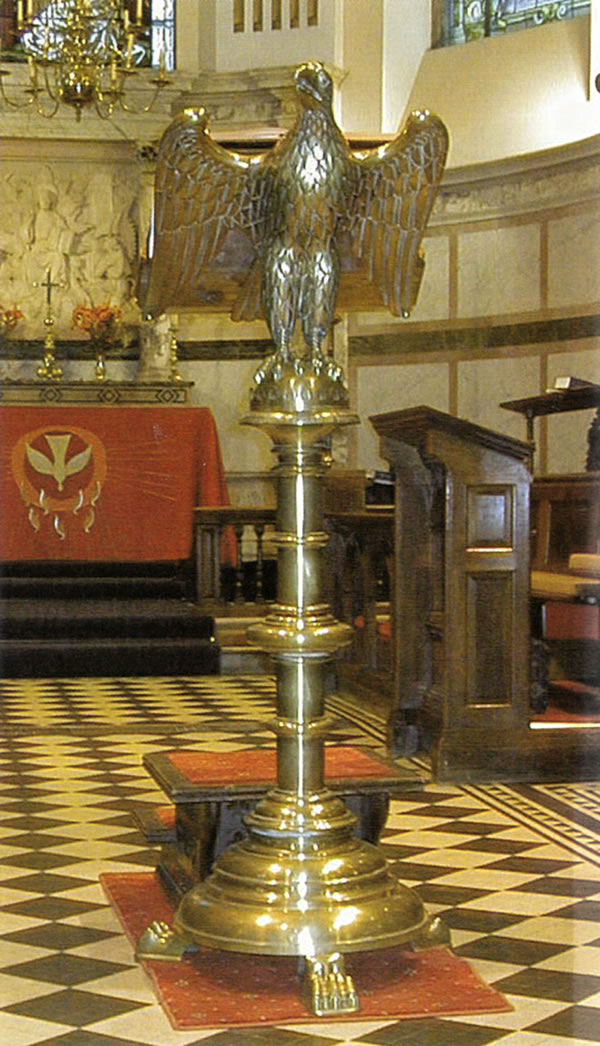
The fine eagle lecturn shown below standing in the isle, was given to Saint Modwen’s in 1886 in memory of Alderman John Yeomans.

Altar and Reredos
An Altar and Reredos (decorative screen behind the alter) was added in 1739 which required that the central east window be shortened. It was described after installation as “a beautiful altar piece of Italian marble“. It was gifted by Thomas Hixon, the manorial bailiff, who owned Sinai Park. He left £120 in his will for the purpose. It originally displayed the text of the Ten Commandments, The Apostles’ Creed and the Lord’s Prayer.

A new communion table was installed in 1879.

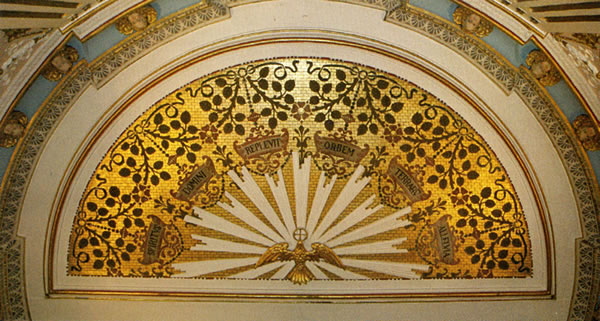
Alabaster panels were added in 1889. These show Christ in Majesty in the centre. Also depicted are Saint Chad, Saint Peter, Saint Martha and, of course, Saint Modwen, offering their churches to the Lord. At the same time that the alabaster panels were added to the reredos in 1889, the sanctuary ceiling above it was cleverly painted to look like a mosaic.

In 1870 the congregation was allowed to elect a vicar by secret ballot. Shortly after appointment of the new vicar in 1870, the lecture was moved to Wednesday evening because attendance rarely reached twenty, and most of them were comprised of a group of old women from the almshouses. Again held on a Thursday morning from 1933, the weekly lecture was replaced in 1968 by one given four times a year and the annual payment was directed towards cleaning the church. By a Scheme of 1978 the trusteeship of Boylston’s charity was transferred to the vicar and churchwardens of St. Modwen’s, and the lecture ceased to be delivered c. 1982.

In 1884 the advowson was purchased from the Marquess of Anglesey by public subscription and vested in the bishop of Lichfield. Under the terms of the union of the benefices in 1982 the presentation was to be exercised jointly by the bishop of Lichfield and Lord Burton who were both patrons.

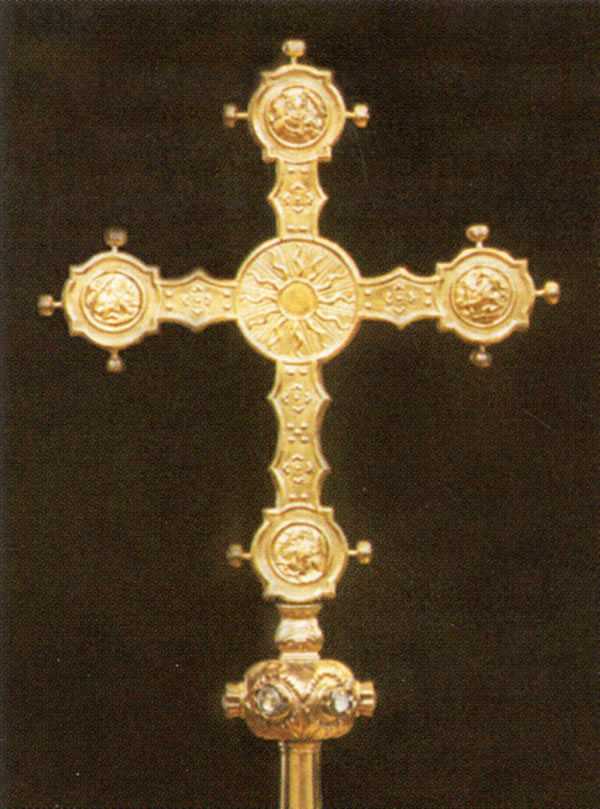
William Tate designed the brass altar cross given in 1889 as well as the candlesticks and processional cross given in 1895. At the end of each arm of the processional cross, seen below, are the Emblems of Evangelists.

In 1883 the three-decker pulpit was split in two: the pulpit was moved to the north-east end of the nave and the reading desk to the south-east end. Carved panels were added to the pulpit by Lord Burton in 1890. A new lectern was acquired in 1886. In 1887 stalls were made for the clergy and choir. In 1889-90 William Tate of London directed the redecoration of the whole interior of the church and the re-ordering of the sanctuary, including a mosaic ceiling in the apse and fluting to the apse pilasters. New furnishings included an oak altar and a brass altar cross; a reredos in alabaster and green marble, with carved panels showing Christ in glory flanked by various saints including St. Modwen, was given by the vicar, C. F. Thornewill, and his two brothers.

Despite its recent improvements, St. Modwen’s was described in the 1890s as “lonely and practically lamented“, lacking the patronage of the brewers that many of the newer churches in the town had attracted. In 1894, however, work began on restoring the church, including the removal of the font from the centre aisle to the south-west corner of the nave; much of the cost was defrayed by the brewers of the town. The architect, J. A. Chatwin of Birmingham, had proposed creating new vestries to replace the choir vestry on the first floor of the tower and the clergy vestry in the south porch, but the expense and local opposition meant that it was not until 1902 that new vestries were added, under the direction of Henry Beck, wrapping around the apse, and again paid for with brewers’ money. By 1904 the brewing families had given £13,000 for the restorations.

Vestries were added around the east end of the church in 1904. This resulted in the shortening of the remaining two apse windows and their glass was moved to the north and south aisles. At some time all the doors were removed from the pews, except for the wardens’ pews at the very back of the church.

A memorial to the dead of the First World War, in the form of a carved oak tympanum with bronze panels, made by Martyn & Company of Cheltenham, was erected in the west porch in 1920. It was extended in 1948 to a design by R. S. Litherland of Burton, as a memorial to the dead of the Second World War.

A Lady Chapel was created in 1956 at the east end of the south aisle.

In 1961 the decoration of the sanctuary was restored by Campbell Smith & Co. of London.

A sepulchral slab inscribed with a floriated cross, and dating possibly from the 14th century, was moved in 1968 from the south wall of the churchyard into the south porch.

Generally, the church has been altered little since it was completed and preserves nearly all its Georgian woodwork and is still a well used church in the centre of Burton.

Saint Modwen’s – Early Religion

ANGLO-SAXON CHURCH
The Life of St. Modwen references an Anglo-Saxon chapel dedicated to St. Andrew on Andresey, it is possible that it was associated with one of the foundations of the Northumbrian Bishop Wilfrid when he was exercising episcopal functions in Mercia between 666 and 669. Wilfrid founded a number of unidentified ‘monasteries’ in Mercia, and his devotion to St. Andrew is indicated by his churches at Hexham, Northumberland, and Oundle, Northants. The church on Andresey is thought to have been destroyed in a 9th century Danish invasion.

There is also evidence for a pre 11th century minster church serving an extensive parochia in Burton. In the 1120s the abbey was recorded as having the typical exemptions of an earlier minster church: it did not have to pay for ‘chrism or holy oil or any other parochial matter’, nor send a representative to chapter or synod. The extent of the parochia may be suggested by the abbot’s spiritual jurisdiction over Abbots Bromley and Mickleover (Derby) in the 13th century.

The endowment of a monastery on the west bank of the Trent by Wulfric Spot, an Anglo-Saxon nobleman, by a will dated between 1002 and 1004 presumably followed the conversion of the minster church to a Benedictine abbey in the late 10th century. That abbey is treated in an earlier volume of the History.

PAROCHIAL ORGANIZATION TO 1545
In the early 12th century the parish was served by a chaplain, presumably the man named Recelbert who received half the income of the parish altar, a corn render (or thrave), and the provisions of one monk, and who had a lodging house. The abbey supplied him with candles for the parish altar, presumably in the abbey church. He was probably assisted by a man known variously as Alwine the deacon, Alwine the priest, and, evidently in jest, Alwine ‘the bishop’. The abbey endowed Alwine with an annual payment of 2s., 4 bovates of land in Stapenhill worth 6s. a year, the provisions of one monk, fodder for one horse, and a house outside the abbey gate, probably the lodging house which Recelbert had previously held. Alwine’s son, also Alwine, later became chaplain for life with the same endowment as his father. Some time between 1160 and 1175 the younger Alwine was in turn succeeded by his son, a third Alwine, who held the post on similar terms. Vincent, son of the third Alwine, evidently followed in the office c1190.

The abbot and convent were said to be the rector of the parish in 1319, when the clergy included two parochial chaplains and four priests. There were two parochial chaplains in 1324, but probably only one in 1342 and 1383 (styled a perpetual vicar in 1391 but a parish priest in 1421), and still probably only one in 1434. Guild priests may have had some parochial responsibilities from the 15th century, although it is not known precisely how the parish was served when the abbey was dissolved in 1539.

The laity used the west end of the nave of the abbey church for their services probably from the rebuilding of the church in the early 12th century. The division between the upper church for the monks and the lower one for the laity was probably at the first nave pier west of the crossing, and services for the laity were probably taken at the Holy Cross altar, recorded in the early 13th century. In 1459 the pope granted permission for the celebration of a mass before dawn for laity who came to the abbey. A divinity lecture ordered by the abbot in 1537 to be read three times a week in the church by the schoolmaster of Burton may have been intended partly for the benefit of the laity.

Burton college, founded in 1541 after the abbey had been dissolved in 1539, maintained a single parish priest in 1544, whose stipend was £6 13s 4d a year. He was styled a curate in 1545, when the college was itself dissolved.

There was a graveyard for the laity separate from that for the monks by 1402.

GUILD
There is thought to have been a guild in Burton by the mid 13th century, when William ‘de Gildhus’ was recorded as holding land in Branston. He is probably the William ‘atte Gyldehus’ mentioned in 1270. The four priests who celebrated at Burton in 1319 may have been guild priests.

The first definite evidence for a guild is a bequest of 1465, when the guild evidently had more than one priest. By 1466 there were four priests, the normal complement, and the guild was often known as ‘the four guilds’. Each priest, who had his own clerk maintained by the guild, was assigned a part of the parish: Branston, Shobnall, and Sinai; Horninglow and Wetmore; Winshill and Stapenhill; and Stretton. In the 1540s there was lay master of the guild and a steward, who was also styled ‘the warden of the pyx’ of the borough of Burton. The guild presumably ceased to function on the dissolution of the chantries in 1547.

The Guild maintained a chapel dedicated to St. Luke, presumably in its hall; the chapel was probably founded in 1468 when the Crown granted a fair on St. Luke’s day. Each priest had a chest with a chalice, four suits of vestments, altar cloths, and hangings. In addition to its liturgical plate the guild had plate for guild dinners including a great standing cup of silver gilt, 25 silver spoons, 8 brass candlesticks, napkins, towels, and tablecloths. The guild priests also celebrated by turns in the chapel on the bridge over the river Trent, which had its own chalice and three suits of vestments.

Membership of the guild was presumably open to all parishioners, and several testators in the 1530s and 1540s left 3s. 4d. to be included in the guild book and for prayers to be said for their souls. Each guild priest had £4 13s. 4d. a year intended to be raised by the profit of four ‘ales’ (or dinners), to which parishioners brought ‘a dish of meat… to make merry’; any deficit was made up from income from the guild land. Each priest also had a chamber (cubiculum or camera) in what was evidently a row between the church and guild hall, which in 1550 stood on the south side of the market place.

In 1547 the guild held lands in Burton worth no more than £3 a year. In 1564, however, it was claimed that the guild had also held lands at Morrey, in Yoxall, and elsewhere, and in the late 16th century the total value of its lands was said to have been more than £14 a year. After 1547 some of the lands became part of the town lands.

PECULIAR JURISDICTION
Bishop Robert Peche (1121-6) confirmed to Burton abbey as ‘the mother church of Burton’ various rights then said to date from the church’s foundation. The church was free of payments for chrism, holy oil, and ‘any other parochial matter’, and it was not required to send a man or a woman to chapter or synod; moreover, it could hold its own court. The grant was confirmed by archbishops of Canterbury and diocesan bishops in the 12th and 13th centuries, and was acknowledged by archdeacons of Stafford in the 12th, 13th, and 14th centuries. In the 1140s the diocesan confirmed that the chaplain of Burton was exempt from paying any custom or exaction to the archdeacon of Stafford, and in 1280 the archbishop determined that the chaplain should pay nothing to the diocesan or archdeacon except 3 shillings for Peter’s pence.

The powers of the abbot’s court were confirmed in the 1120s by Bishop Peche ‘so long as justice is not wanting’, perhaps implying a right of appeal to the bishop. In a later confirmation by Archbishop Theobald (1150-61), however, the abbot’s court was said to be for ‘all causes’. In the mid 13th century the abbot claimed matrimonial jurisdiction, but the right appears to have been stopped by the pope.

In the 13th and 14th centuries the bishop’s right to visit Burton parish was contested by the abbot. The bishop, however, held a visitation of the parish in 1390, and by 1535 the abbey had acknowledged his visitation rights and paid procurations. Bishops and archdeacons continued to visit the parish church after the Reformation.

In the 18th century the peculiar jurisdiction was again contested. The Earl of Uxbridge resisted the bishop’s claim to exercise faculty jurisdiction in Burton when the parish church was pulled down in 1718, although in 1723 the churchwardens by-passed Uxbridge and appealed to the bishop to allot the pews in the new church. In 1751 there was a dispute over the bishop’s attempt to exercise the right of excommunication within Burton.

In the early 19th century it was stated that while the lord of the manor had the uncontested right to prove all wills in Burton, other matters such as licensing the perpetual curate, granting marriage licences, swearing in the churchwardens, and ‘all contentious jurisdiction whatsoever’ belonged to the bishop.

Probate of Wills
There was an official of the abbey’s spiritual jurisdiction in 1344. His functions are unknown, but the survival among the abbey’s muniments of a Burton will made in 1402 suggests that the abbey exercised probate jurisdiction by that date, and an official of the abbey’s jurisdiction was certainly granting probate of wills by 1465. After the dissolution of the abbey, probate jurisdiction passed first to Burton college and then to the Pagets as lords of the manor, and they continued to employ an official of the peculiar jurisdiction, also styled a commissary. Some wills, however, were in the mid 16th century proved in the bishop’s consistory court at Lichfield.

In 1728 the post of official of the peculiar was described as ‘an office of some dignity and trust, but of very little profit and advantage’. Wills were kept ‘in a loose promiscuous manner’ at Sinai Park House, the home of the Earl of Uxbridge’s bailiff; because many had been lost, the Earl appointed Richard Rider, then an officer of the episcopal registry at Lichfield and later chancellor of the diocese, as registrar or assistant to the Burton official, and he kept Burton wills with those proved at Lichfield. In 1729 Rider was succeeded by John Fletcher, who acted as registrar of several peculiar jurisdictions. In the late 18th century two probate courts were held each year in Burton by the official, although in the 19th century at least one will was proved at Lichfield by an attorney acting for the peculiar court of Burton. There may have been some confusion between the jurisdictions of the Burton peculiar court and the Lichfield consistory court: in 1820 a will was proved first at Burton and subsequently at Lichfield. Nevertheless, the lord of the manor still exercised probate jurisdiction in Burton in 1856. Under the Court of Probate Act of 1857 the Pagets’ probate jurisdiction was extinguished in 1858.

PAROCHIAL ORGANIZATION FROM 1545
After the dissolution of Burton college in 1545, the parishioners used the transepts and crossing of the church, in addition to the western arm, as their parish church. By 1687, and possibly from the 1650s, the parish was divided between the ‘town’ (Burton and Burton Extra) and the ‘country’ (Branston, Horninglow, Stapenhill, Stretton, and Winshill), an arrangement reflected in the appointment of two churchwardens for each division.

ST. MODWEN’S PARISH CHURCH FROM 1545

Benefice and Advowson
After the dissolution of Burton college in 1545, Sir William Paget as the lord of the manor was charged with maintaining a curate and a preacher to serve the parish; the two offices were combined from the mid 17th century. Described as a perpetual curacy in 1768, the living became a vicarage under the Incumbents Act, 1868. From 1957 it was held in plurality with Holy Trinity until 1969, when the two benefices were united as the benefice of Burton-on-Trent, and in 1982 St. Paul’s was included in the benefice.

On the dissolution of the college, the Crown appointed a ‘chief curate’, but shortly afterwards it granted the advowson to Sir William Paget and the advowson thereafter descended with the manor. The patron was occasionally susceptible to popular pressure: in the 1690s Lord Paget replaced the curate on the petition of the parishioners

Income and Property
The clergy originally received only what the lord of the manor allowed them. By the terms of the 1546 grant of Burton manor Sir William Paget received all the tithes and in return was charged with annual payments of £7 to the curate for administering the sacraments and £10 to another priest for preaching; there was no other endowment of the living. Paget initially raised the curate’s stipend to £10 and lowered the preacher’s to £7, and from 1558 he dispensed with the preacher and paid the curate £13 6s. 8d. a year. By 1585 there was once more both a curate, paid £14 10s,. and a preacher, paid £14. The salaries were confirmed when the Crown restored the Paget estates in 1597, the preacher then described as being for the borough of Burton. By 1639 the two offices had been combined and the minister was paid £28 10s. By 1689 the minister received £35 from the manor, and that remained the stipend until it was raised to £50 in 1777. Secured by the patron’s endowment of a £30 rent charge in 1826, that stipend was still received from the marquess of Anglesey in 1953 and probably continued until around 1972.

The lord of the manor also received the Easter dues, worth between £7 13s. 4d. and £11 2s. 8d. in the later 16th century, but by 1693 they had been granted to the minister.

The first endowment assigned to the curacy was a grant of £50 a year made by parliament in 1652 out of Hanbury rectory; it evidently ceased to be paid after the Restoration. In 1820 a benefaction of £200 was made by the executors of the Burton lawyer Isaac Hawkins. To meet that benefaction and the securing of the curate’s stipend in 1826, Queen Anne’s Bounty in 1827 made two grants of £300 each; it had already given £800 on account of population in 1825. In 1838 the living was worth only £217 18s. 5d.; by 1855 it had risen to £255. In 1897 the endowment was described as ‘miserable’. In 1902 parishioners devised a plan to guarantee a stipend of £350 a year, and in 1924 Fred Young gave £100 to endow an Easter offering for the vicar.

Incumbent’s House The ‘chamber of the parish priest’ which adjoined the graveyard in 1550 was probably one of the former guild priests’ houses. In 1585 the curate had a tenement (possibly the Earlier chamber) in High Street, provided by the lord of the manor, who was also paying to clothe him. By 1612 the curate occupied a room provided by Paget within the former monastic precinct, and by 1666 he had a house probably still within the precinct.

Lecture
By will proved in 1649 Thomas Boylston, a London clothier who was probably the son of John Boylston of Anslow, bequeathed to the London Company of Clothworkers £800 to establish a lecture in Burton every Thursday morning. The lecturer was to be appointed by the bailiff of Burton and between four and six of the chief inhabitants, on the advice of three local ministers, and he was to be paid £31 4s. a year. For tolling the sermon bell the parish clerk was to have 16s. By the 18th century it was customary for the incumbent of St. Modwen’s to be the lecturer, as a means of augmenting his stipend.

Clerical Provision
The curate appointed by the Crown after the dissolution of the college was Robert Baslowe, formerly a petty canon of the college; he was succeeded in turn by Bartholomew Francis (d. 1557) and Thomas Smith, a former guild priest. Another former guild priest, William Smith, officiated as ‘under curate’ in the 1550s. Anthony Gefscocke, who succeeded on Thomas Smith’s retirement in 1578, had been a scribe of wills in Burton since 1570.

William Browne, minister from the 1690s, was a pluralist with independent means; although he chiefly resided at Burton, he regularly employed an assistant curate from the 1720s. Thereafter there was usually an assistant curate.

Church Life after the Reformation
Under the terms of the 1546 grant of Burton manor, Sir William Paget as lord of the manor was expected to pay £1 a year for bread, wine, and other necessaries; in fact, he usually spent considerably more. Paget also paid for copies of the new Book of Common Prayer in 1549 and 1552. His son Thomas, Lord Paget, was an ardent recusant, and although John Tailor of Burton Extra had an English Bible in 1568 and the will of James Sutton, a Burton carpenter, made about the same time, suggests zealous godliness, committed protestantism failed to get a hold in Burton until after Paget’s flight in 1583. The subsequent influence in Burton of the godly Hastings family of Ashby-de-la-Zouch (Leics.), Earls of Huntingdon, allowed evangelical protestantism to grow.

Peter Eccleshall, the preacher at Burton by 1585 and the curate from 1587, was indicted in 1588, probably for not using the Book of Common Prayer, and it may have been the growth of puritanism in Burton which attracted Philip Stubbes, a godly pamphleteer, to settle briefly in the town in the early 1590s. Eccleshall and Arthur Hildersham, a celebrated godly minister of Ashby-de-laZouch, were conducting a ‘common exercise’ in Burton by 1596. After 1603 the exercise included William Bradshaw, another noted puritan and preacher at Stapenhill, and it rotated between Burton, Stapenhill, Repton, and Ashby until its suppression in 1611.

Eccleshall was one of those who supported the claim made in 1596 by a 13-year-old boy, Thomas Darling of Burton, that he had been bewitched by Alice Gooderidge of Stapenhill and diabolically possessed. Known as ‘the boy of Burton’, he had visions of green angels and a green cat, with convulsions and temporary paralysis. Darling continued a zealous puritan after being exorcized, and when a student at Oxford in 1602 he was sentenced to be whipped and to have his ears cropped for attacking the vice-chancellor’s campaign against puritans.

In 1609 Edward Wightman, a Burton draper and alehouse keeper who had helped record Darling’s fits and who had signed a testimonial of the boy’s character, attended the Burton exercise and began voicing heterodox views about the soul. After presenting James I with an heretical tract concerning the Trinity he was arrested in 1611, whereupon he claimed to be the Holy Spirit. He was executed at Lichfield in 1612, the last heretic to be burnt in England. It was because of its association with Wightman that the exercise was suppressed.

Music
The deacon assigned £4 a year for playing the organ under the terms of the 1546 grant of Burton manor may be identifiable as John Bradshaw, a singing man of Burton college, who was recorded as the organ player in 1557. The organ had probably been removed from the church by the 1580s when Bradshaw was paid the same salary but described as a sexton.

The purchase of a singing book in 1697 possibly indicates the existence of a society of psalm singers, but it is not known how they were organized nor for how long they existed.

Church Buildings
St. Modwen’s Old Church, predecessor of the current church, was part of the former abbey church which was reserved to the parish when the Crown granted the possessions of the dissolved Burton college to Sir William Paget in 1546. It comprised the aisled nave of seven bays, west tower, west porch, crossing with tower and spire, and trans epts. By 1603 the eastern arm, which had been granted to Paget, was in ruins and the arch separating it from the crossing was walled up. In the early 18th century the pulpit and font stood on the south side of the nave, and a ‘spread eagle in brass’ which then stood in front of the pulpit may have been the brass lectern bought by the parishioners from Burton college in 1545. There were three galleries, one each for the ‘town’ and the ‘country’ parts of the parish and a private one for the Every family of Burton and Egginton besides seats for the poor in the south aisle.

The parish registers date from 1538.

In 1545 the commissioners for dissolving Burton college gave one pair of organs and sold another to the parish church.

There were six bells ‘in the college steeple’ in 1545 but only two bells and a sanctus bell in the church in 1553. A ‘great bell’ and a hand bell were mentioned in 1570.

There was a clock in the early 1550s. A later mechanism with chimes was added which needed repairing in 1707.

Maintenance of the fabric was a problem, especially after 1643 when an explosion of gunpowder in the church destroyed the roof and blew out the windows. The church was again in disrepair in 1697 when props had to be inserted in the chancel. Further buttressing was needed in 1707 and in 1710, when all the doors on the south side had to be nailed shut ‘to prevent all danger’ and the dismantling of the spire was considered. It was then claimed that the minister and parishioners could not meet in the church for services ‘without hazard of their lives’, and a brief was obtained to raise money for repairs. In fact, without the consent of minister or churchwardens, and contrary to a resolution of a parishioners’ meeting, the church was dismantled in 1718.

The Earl of Uxbridge was said to have approved the demolition, which was supervised by two close associates, William Woodcock, rector of Egginton, and his relative George Hayne, lessee of the Trent navigation and a resident of the abbey precinct. The costs of demolishing the old church and building the new one, however, were met by levies on the parish.

A combined pulpit and reading desk was provided in 1722. It may also have included a clerk’s seat: in the mid 19th century a three-decker pulpit stood at the east end of the nave. Also in the mid 19th century the font was at the west end of the nave, and the centre aisle was filled with wooden benches; behind the altar were text panels and the royal arms, and the side windows of the chancel were filled with clear and coloured glass.