Menu Close

1002 Burton Abbey

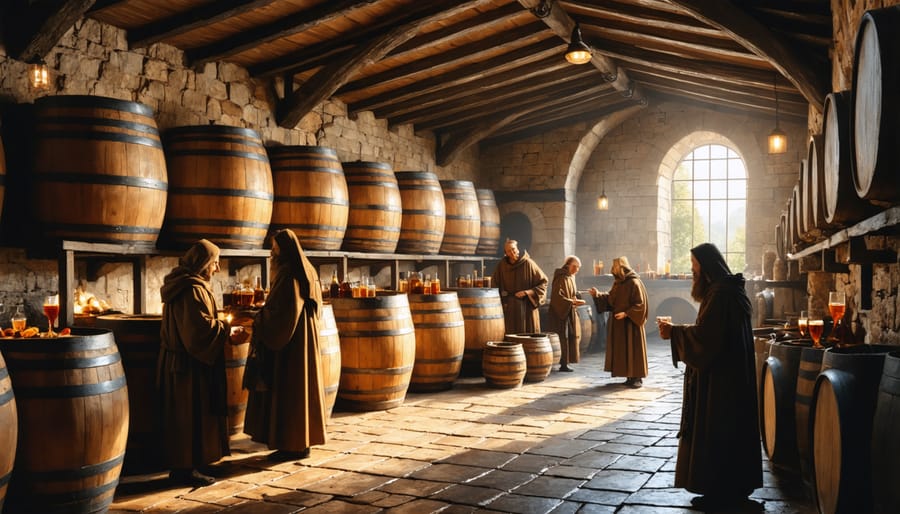
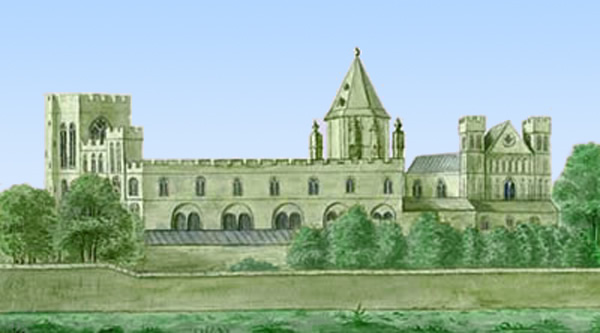
I was dumbfounded to first learn of the sheer scale of Burton Abbey which occupied a 14 acre site. I remain amazed that I could have lived in Burton for decades before discovering that such a huge structure ever existed. What I had always known as the Abbey was in fact, a relatively small annex which spent at least some of its time as an infirmary. The complete Abbey in fact extended to include all of what is now the Market Hall and Saint Modwen’s church.

Burton Abbey

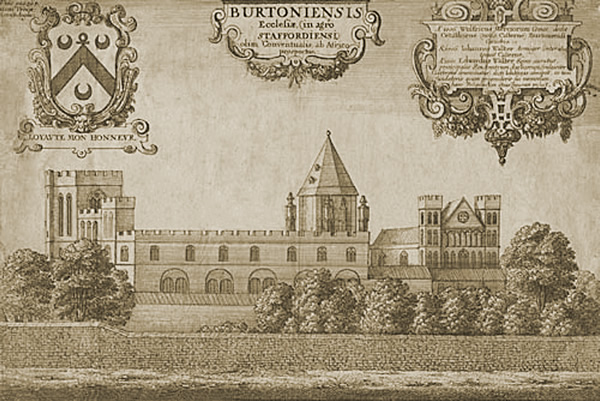
The above picture is my re-creation based on the below 1661 engraving by W. Hollar that appears in numerous sources and can be found on a plaque of the outside wall of the Coopers Shopping Centre close to the ‘Market Entrance’.

Burton Abbey Engraving

Select page to view:

Burton Abbey – Medieval History

Burton Abbey featured in the Domesday Book in 1086 where it appeared as the abbey of Saint Mary. It was recorded as also controlling lands outside of Burton, included Mickleover, Appleby Magna, Coton in the Elms, Caldwell and Ticknall.

By 1310, the abbey had been reduced to one of the smallest and poorest Benedictine monastery in England, suffering a number of severe financial difficulties often due to mismanagement and outright criminal behaviour. At this time, the number of monks had been reduced to around thirty. Even so, as an abbot, the holder of the position between 1295 and 1322 was summoned to attend the ‘Parliament of England’.

By the 1520s, the number of monks had been reduced to less than twenty but, almost contradictary, the abbey was the most important in Staffordshire and by the 1530s had the highest revenue. The abbot was both a secular lord and, “exercised an independent spiritual jurisdiction”. He was a figure of some standing, regularly serving on papal and royal commissions and acting as a collector of clerical taxes within the diocese.

There have been a number of Royal visits to the abbey. William I came on a visit to the shrine of St. Modwen; Henry II was at Burton in 1155, John in 1200, 1204, and 1208, Henry III in 1235 and 1251, Edward I in 1275 and 1284, and Edward II in 1322 during the campaign against Thomas Plantagenet, earl of Lancaster.

Burton Abbey – Tudor History

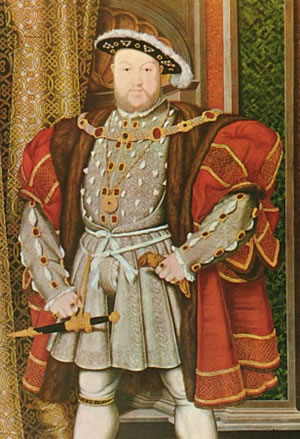
Henry

By the early 1530s the abbot was paying procurement fees to the bishop for Burton, Abbots Bromley, and Mickleover as well as for Ilam and Austrey; he also paid similar fees to the archdeacon for Abbots Bromley and to the bishop for visitations of the abbey.

Although there was general fear for the future of major religious establishments as Henry VIII wrangled with the pope over his ‘Great Matter’, this was temporarily overshadowed by the election of a new Burton abbot in 1533 following the promotion of the current Abbot de Bronston to Abbot of Westminster. This caused some excitement because it was the highest office ever attained by any monk of Burton.

Bishop Lee, under instructions from Thomas Cromwell, went to Burton in June with Richard Strete, Archdeacon of Derby, and David Pole, the vicar general, and “so sped the election” that the community agreed to leave the choice of a new abbot to the bishop and the archdeacon, stipulating only that one of themselves should be chosen before the 1st August. Cromwell’s original candidate seems to have been ‘the monk Baylye’, but William Edys, the ‘third prior’, was actually appointed.

By 1536, Henry was installed as Head of the Church of England and had laws, now known as the first dissolution, had been enacted to allow the King to seize any church building with an income of less than £200. Many were confiscated. Some were pillaged and destroyed, other smaller ones were turned into graineries, barns and stables.

Early in 1538 Francis, Lord Hastings, wrote to Thomas Cromwell to point out that Burton Abbey “lay very conveniently” for him, adding that he would have asked for it earlier but for an attack of measles. Later the same year the Crown tried to secure the tithes of Austrey for a royal official, but the abbot replied to Cromwell that the income was “so necessary to our house that we cannot do without it”. The Abbey was the centre of life in Burton; it was also a place of pilgramage to the shrine of Saint Modwen and received around £2 per year in offerings. The suppression of ‘Idolatry’ (worship of false idols) was one of the leverages used by the crown.

Sir William Bassett of Meynell Langley, a manor a few miles to the North-West of Derby, received instructions from Thomas Cromwell at the end of August 1538 “that such images as you know… so abused with pilgrimages or offerings… you shall for avoiding that most detestable offence of Idolatry forthwith take down”. Sir William carried out his task and replied to Cromwell in a letter, as follows:

Right honourable my inespecial good lord, according to my bounden duty and the tenor of your lordship’s letter lately to me directed, I have sent unto your good lordship by this bearer, my brother Francis Bassett, the images of St Anne of Buxton and St Modwen of Burton upon Trent which images I did take from the places where they did stand, and brought them to my own house within 48 hours after contemplation of your said lordship’s letter, in as sober manner as my little and rude wits would serve me. And for that there should no more idolatry and superstition be there used I did not only deface the tabernacles and places, where they stand but also did take away the crutches, shirts and sheets with wax offered, being things that did allure and intice the ignorant people to the said offerings, also giving the keepers of both places admonition and charge that no more offerings should be made in those places till the King’s pleasure and your lordships be further known in that behalf. My lord, I have locked up and sealed the baths and wells at Buxton and none shall enter to wash them till your lordship’s pleasure be further known. Whereof I beseech your lordship that I may be ascertained again at your pleasure and I shall not fail to execute your lordship’s commandment to the uttermost of my little witt and power. And the trust that they did put in those images and the vanity of the things, this bearer, my brother can tell your lordship better at large than I can write for he was with me at the doing of all and in all places, as knoweth good Jesus, whom ever good lordship in his blessed keeping. Written at Langley with the rude and simple hand of your assured and faithful orator and as one ever at your commandment, next unto the King to the uttermost of my little power.

Signed William Bassett (Knight)

William employed his brother, Francis Bassett – a servant to Thomas Cranmer, archbishop of Canterbury, to physically remove the statue. The statue was removed, its receptacle heavily defaced and further pilramages and offerings were outlawed.

On 1st September, Thomas Thacker, Steward to Cromwell, wrote to his Master telling him that Francis Bassett had delivered to Austin Friars (Thomas Cromwell’s main residence) in London, “the image of Saint Modwyn with her red cow and her staff which women labouring of child in those parts were desirous to have with them to lean upon and to walk with“. This is the best available description of the object.

Thomas Cromwell fell from grace a few years later and was arrested being accused of many crimes, most significantly treason. Cromwell was condemned to death without trial and beheaded on Tower Hill on 28 July 1540 (the day of the King Henry VIII’s marriage to Kathryn Howard). Following his death, an inventory was taken of his belongings which showed an extensive collection of treasures that had been confiscated from the church for supposed destruction. It has not been possible to identify the images of St Anne and St Modwen mentioned in the letter from Sir William Bassett.

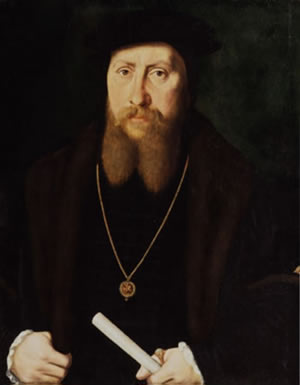
PagetAs the Dissolution continued, many great Abbeys such as Glastonbury, Shaftesbury and Canterbury which had flourished as pilgrimage sites were reduced to ruins. Some were gifted to the Kings most ‘loyal subjects’. In 1539, Abbot Edys was finally forced to surrender Burton Abbey. Rather than being destroyed like most abbeys, it was later gifted, together with extensive grants to lands including what is now Cannock Chase, to Sir William Paget (pictured) – a close adviser to Henry VIII who later became 1st Baron Paget of Beaudesert. This fortunate survival left the abbey one of the largest in the country. The abbot’s probate jurisdiction in Burton also passed to the Pagets, who continued to exercise it until 1858.

In February 1539 Dr. John London was at Burton and on 14th November the abbot and community surrendered their house and its possessions to Dr. Thomas Legh. Pensions ranging from £6 13s 4d to £2 were assigned to 7 monks: 5 priests, a deacon, and a novice. The abbot and probably four remaining monks became members of the new college at Burton which was already being planned, though it was not actually founded until 1541. Robert Heathcote, one of the deacons, and Humphrey Cotton, the novice, were recorded as in receipt of their pensions when they died in 1552 and 1563.

The chronology of the dissolution of Burton Abbey was as follows:

  • 1533 – William Edys appointed as abbot
  • 1535 – Burton Abbey surveyed and valued at £513 19s 5d (gross)
  • 1536 – Act dissolving lesser monastries due to siful, carnal and abominable living
  • 1538 – Thomas Cromwell instructs William Bassett to remove St Modwen statue to avert Idolatry (idol worship)
  • 1539 – Abbot Edys surrenders abbey to the crown under second act of dissolution
  • 1541 – New collegiate Church of Christ and Saint Mary established
  • 1545 – Collegiate dissolved and few remaining monks pensioned
  • 1546 – All former abbey lands and possessions awarded to William Paget

A descendent of William Paget became the 1st Marquess of Anglesey in 1815. The title still exists and the current Marquess still has title to most of the land in Burton.

Burton Abbey – Development History

The abbey precincts occupied an area bounded on the east by the River Trent and on the west by the present High Street and Lichfield Street. The whole site extended to 14 acres.

The church stood at the northern end of the site on ground now occupied by part of the Market Place and by the 18th century church of Saint Modwen. The cloister and the conventual buildings lay immediately south of the church, an area now largely covered by the current market hall. Further to the south and west was a walled courtyard with an outer court beyond. The latter was approached from the west through the gatehouse. South-east of the cloister and next to the river was a detached building thought to have been the infirmary.

There is very little remaining evidence of the monastic layout but there are a few surviving plans of the church and cloister drawn up in the mid 16th century. The church is known to have been divided into an upper and a lower church, that is, a monastic east end or choir and a non-monastic nave to the west, although the plan does not indicate any clear divide. It shows transepts on either side of the chancel with a tower above the crossing. A tower is also marked at the west end between two smaller transepts or porches. The nave extends westwards beyond the tower, and it has been suggested that this projection may have been a large porch.

Burton Abbey

The most famous image is the above 1661 engraving from the river by Wenceslas Hollar but this does not entirely agree with known records so contains ‘artistic license’ and is therefore, a partly speculative re-constructed from another Benedictine abbey of the time with better surviving plans.

The chancel (part of the church near the altar) had fallen into ruin after the dissolution, but a south leg of the transept (main cross-shape) ending with an ornate gable with angle turrets that most likely late date from the 13th century. There is a polygonal central tower as well as an embattled north-west tower with tall traceried windows. Any westward extension of the nave has either disappeared or is hidden by trees. It has been suggested that the curious fenestration of the south wall of the nave may be due to a lowering of the aisle roof after the dissolution, and the consequent exposure of a Norman  triforium (arcade above the arches of the nave) which was later glazed. The row of five arches, each enclosing a pair of round-headed openings, is typical of such a triforium. The clerestory (upper row of windows) and embattled parapet above appear to be of later medieval date.

It is possible to trace the history of several of these features. The early 11th century church seems to have been divided into an upper and a lower church. In 1114, at the end of his abbacy, Abbot Nigel (or Niel) began building at the western end of the church, and his successor Geoffrey (1114-50) erected an elegant tower, roofed with lead, over the choir. The central part of the church shown in the engraving most probably dates from this period. The east end was re-modelled in the late 13th and earlier 14th centuries.

The chancel was rebuilt under Abbot Packington (1281-1305) and the work was completed around 1293. A new high altar was dedicated by Abbot de Burton (1305-16) at the end of 1305, and Abbot Bryknell (1340-7) was responsible for a great window over the high altar. The bell tower mentioned in 1340 as adjoining the market-place would be the north-west tower of the church, and this is probably the tower mentioned early in the 14th century. Abbot Ibstock (1347-66), possibly while he was still almoner, rebuilt the northern side of the lower or parish church. Abbot Southam (1366-1400) recast the three great bells in the tower of the lower church. Under Abbot Sudbury (1400-24) Richard Creyhton while sacrist carried out some work in stone in the chancel and re-roofed the lower church. Richard Babe as prior and sacrist was responsible for some stone work in the tower of the upper church and also for new stalls in the choir. Under Abbot Henley (1433-55) the tower of the lower church was completed and a bell placed in it. In 1474-5 the tower of the upper church collapsed, causing extensive damage to that part of the building. Abbot Feld promptly repaired the damaged walls, rebuilt one of the four pillars of the choir and the arch between the upper and lower church, erected a new high altar with steps to it, re-roofed the upper church, and began a new tower.

There were several side chapels and altars in the church. The altar of Holy Cross is mentioned in the early 13th century and again in 1254. Abbot de Lisle (1222-9), having come from Bury St. Edmunds, built and endowed a chapel of St. Edmund. This was repaired by Prior Richard Lythum shortly before 1428 when the bishop granted an indulgence to all who said prayers and masses there for the dead, and especially for the souls of Richard and his parents. The chapel of St. Mary was begun under Abbot Laurence (1229-60), and in 1254 money was assigned to the sacrist for the maintenance of a lamp before the altar of St. Mary. Around the same time, a further gift was made for a candle before the statue of St Mary during the celebration of her daily mass. The chapel was evidently completed during the time of Abbot Stafford (1260-81) together with prior Michael. It was the most important of the chapels, with its daily mass, its own keeper and, by the 15th century, its own singers. In 1335, its revenue from endowments was £4 a year.

The altar of St. Nicholas is mentioned in 1254, and in 1305 Abbot Burton dedicated the altars of the Apostles and the Martyrs. Ex-Abbot Southam was buried in the chapel of the Martyrs in 1401. The chapel of the Confessors was built by Abbot Longdon (1329-40), and ex-Abbot Sudbury was buried there in 1425.

Some time after the foundation of the abbey the remains of Saint Modwen were transferred there from their previous resting place on the island of Andressey, near the current day ‘Cherry Orchard’. A replacement shrine was built in the abbey; decorated with gold, silver, and jewels, it was ‘satis preciosum’ by the time of Abbot Leofric (1051-66), who despoiled it to buy food for the poor during a famine. William I visited the shrine. It was rebuilt early in the 15th century by Prior Babe. 

Andressey, however, remained sacred to the memory of St. Modwen. A chapel of St. Andrew there was dedicated by the bishop early in the 13th century and endowed by Abbot Melburne. It had its own keeper, and in 1535 its income from offerings was £2. It was rebuilt by Abbot Feld (1473-93) and was by then known as the chapel of St. Modwen. It was evidently here that the statue of St. Modwen was kept ‘with her red cow and her staff which women labouring of child in those parts were very desirous to have with them to lean upon and to walk with it’. 

At the end of Friars walk was an inlet from the river that ran into a large pond called the Stew Pond and was also know as the Harbour. The lawns next to the present day library stand on the site of the original pond. This was where the monks kept their fish stocks. The Stew Pond ran into the Hay Ditch which was an artificial channel that ran from the Stew Pond to Bargates. It passed along the bottom of the gardens in the High Street and was crossed at intervals by small wooden bridges to gain access to the Hay Walk. The ditch served as both an irrigation ditch and as a way of keeping fresh water flowing into the Stew Pond.

Doors from the upper and lower church gave access to the cloister, which the 16th century plan show as exactly 100 feet square. Some rebuilding of the cloister was carried out in 1431, beginning at the corner against the almonry – probably the north western corner. Bishop Heyworth’s gifts to the abbey at his death in 1446 included £40 for building the cloister. The chapter-house led off the east walk and was rebuilt by Abbots Longdon (1329-40) and Bryknell (1340-7).

The few remains of the chapter house, cloister wall and parlour doorway are in the grounds of ‘The Abbey Inn’ (now The Winery) at the rear of the market hall. The remains of the doorways were re-discovered by Robert Thornewill, of Thornewill & Warham iron founders in 1850, when he rented the building as a private home.

According to the 16th century plan the east range continued southwards beyond the line of the cloister to support a dormatory above. A stairway shown at the east end of the south walk presumably gave access to it. It is not clear whether the plan depicts the east range at the same level throughout. The dormatory is shown separated from the south transept of the church by three chambers. These chambers may be intended to represent the sacristy, chapter-house, and parlour, or, alternatively, rooms above them, and this part of the east range was evidently roofed separately. The dormatory is shown with six ‘cells’ along each side with a larger one at its south end. The refectory occupied the south range.

The west range accommodated the abbot’s rooms. Abbot Ibstock (1347-66) added the abbot’s private chamber between the great hall and the ‘outward’ chamber, while Abbot Feld (1473-93) erected what was described as the Abbot’s Chamber. The ‘house of stone next to the church’ was given to the almoner by Abbot Laurence (1229-60) was for the reception of the poor.

Abbot de Burton (1305-16) erected a long building by the gates of the abbey, and in 1326 his successor Abbot Bromley assigned it to the chamberlain for use by the brethren as a common chamber.

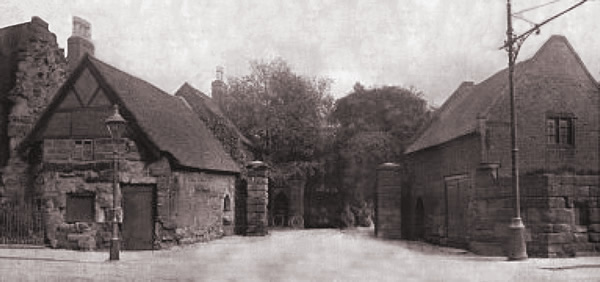
Abbey GatesAbbey Gates 1910

Abbey GatesAbbey Gates 1913

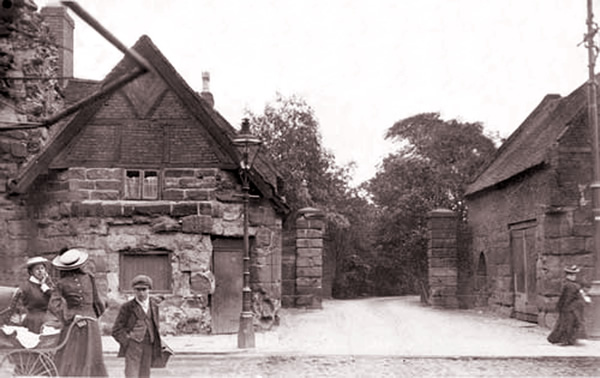
In 1428 Abbot Mathew began building the abbey gates on the west of the precinct. Abbot Henley (1433-55) further extended the work to them. These were situated at what is now the road to The Abbey Inn (now the Winery) between the Market Place and the Memorial Gardens, opposite the end of the present New Street. They are shown in the above late Victorian photo. The remains of the Abbey gates were finally demolished in 1927. Part of the gate and one of the arches were rebuilt in Newton Park where they still stand today.

The Abbey

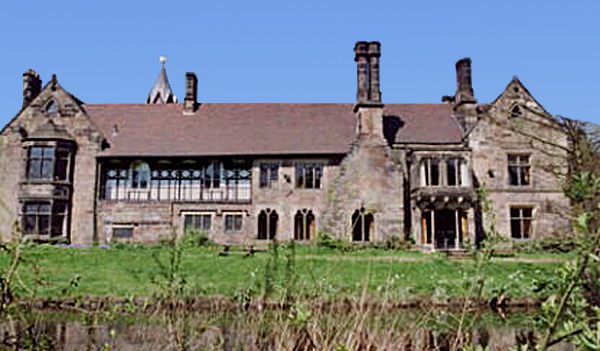
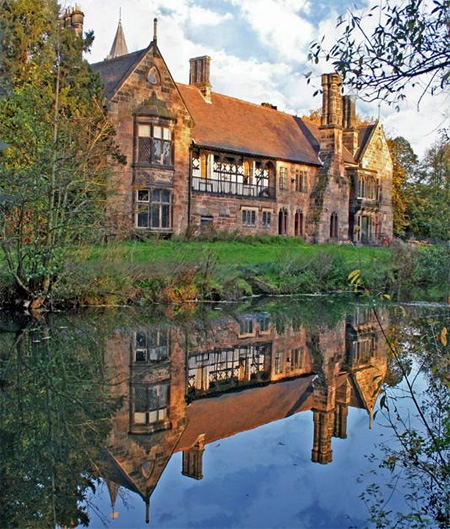
What I have always thought of as ‘The Abbey’ (now slightly frustratingly, known instead as The Winery’) was referred to as “The great hall by the water of the Flete (fleet?)”. It was a separate, detached annex built in the time of William de Bromley who was Burton Abbot from 1316 to 1329 (which included the time when Burton was attacked by Edward II). As well as a great hall, it is known to have included an infirmary. Remains of the medieval building are still incorporated into the present day building but most of what is now seen is a mock Tudor facing as a result of a major renovation.

The Abbey

Remains were excavated in the late 19th century which suggested a partly timber framed structure at right-angles to it.

Burton Abbots

There were 38 Abbots of Burton (although not to be caught out as with American Presidents, this includes one Abbot who served two non-consecutive terms making 37 different ones).

Abbot From Until Notes
Wulfgeat 1004 1027 Formerly of Winchester.
Brihtric I 1027 1050 Formerly of Winchester.
Leofric 1051 1066 Also Abbot of Peterborough (1052–1066), as well as Coventry, Crowland, and Thorney, he was the nephew of Leofric, Earl of Mercia.
Brihtric II 1067 1085 Formerly Abbot of Malmesbury, he was appointed by William the Conqueror soon after Abbot Leofric’s death in 1066.
Geoffrey de Mala Terra 1085 1094 Formerly of Winchester. Expelled for dissipating lands and goods of the abbey.
Niel (or Nigel) 1094 1114 Formerly of Winchester. Began building west end of church.
Geoffrey 1114 1150 Formerly of Winchester. Began building tower over choir. Wrote ‘Life of Saint Modwen’.
Robert I 1150 1159 Expelled for dissipating abbey lands but restored in 1176.
Bernard 1160 1174 Formerly Abbot of Cerne.
Robert I (Repeated!) 1176 1177 Restored but died within a year.
Roger Mal-Branche 1177 1182 Formerly prior of Great Malvern.
Richard 1182 1187 Formerly prior of Rochester.
Nicholas 1187 1197 Formerly prior of Abington. Founded burgage tenure; endowed chamberlain’s and kitchener’s departments.
William Melburne 1200 1213 Formerly of Reading. Endowed St Andrew’s chapel; received Royal Charter to establish the borough and began Horninglow Street.
Stephen de Lucy 1214 1214 Elected but resigned shortly afterwards.
Roger 1214 1216 Formerly prior of Winchester.
Nicholas de Wallingford 1216 1222 Formerly prior of Burton. Endowed almonry.
Richard de Insula 1222 1229 Formerly prior of Bury St Edmonds. Granted mills on Trent; established borough at Abbots Bromley. Returned to Bury St Edmonds to take up post of abbot.
Laurence de St Edward 1229 1260 Formerly kitchener of Burton abbey. Gave stone house next to the church to the poor; began building St Mary’s chapel. Summoned to King’s council in 1257.
John de Stafford 1260 1281 Formerly prior of Burton. Extended the borough; built Monk’s Bridge over the river Dove at Clay Mills.
Thomas de Packington 1281 1305 Formerly prior of Burton. Rebuilt chancel; enlarged borough.
John de Burton 1305 1316 Formerly prior of Burton. Built guest house between tower and sacristry; built Helle – house with paintings depicting heaven and hell.
William de Bromley 1316 1329 Formerly cellarer of Burton. Built a hall and infirmary annex.
Robert de Longdon 1329 1340 Formerly monk of Burton and Prior of Tutbury. Started the chapter-house.
Robert de Bryknell 1340 1347 Former prior of Burton. Completed chapter-house; built window over high alter and barn at Shobnall Grange.
John of Ibstock 1347 1366 Formerly almoner of Burton. Rebuilt north side of lower church.
Thomas of Southam 1366 1400 Formerly chaplain to abbot of Burton. Recast three bells in tower of the lower church.
John de Sudbury 1400 1424 Formerly sacrist of Burton. Pardoned in 1407 for violence and theft and found guilty of rape. Charged with mis-administration in 1422; found guilty of adultery; resigned amid financial crisis!
William Matthewe 1424 1430 Formerly almoner of Burton. Built abbey gates and constructed causeway.
Robert Ownesby 1430 1433 Formerly of St Albans – imposed by bishop for who he had been chaplain.
Ralph Henley 1433 1455 Formerly of Burton. Impoved abbey gates; suspended by bishop for mis-administration, absence, gambling and drunkeness.
William de Bronston 1455 1473 Formerly cellarer of Burton.
Thomas de Feld 1473 1493 Formerly of Burton. Repaired church after tower collapsed in 1474; built abbot’s chamber; built Guild Hall.
William Flegh 1493 1502 Formerly kitchener of Burton.
William Beyne 1502 1531 Formerly prior of Burton. Founded Burton Grammar School.
William Benson 1531 1533 Formerly of Peterborough. Friend of Thomas Cromwell. Became Abbot of Westminster.
John Beaton 1533 1534 Formerly prior of Burton.
William Edys 1534 1539 Formerly prior of Burton. Last abbot who surrendered the abbey as part of the dissolution by Henry VIII

Saint Modwen History

Christianity was introduced to Mercia, one of the Kingdoms of the Anglo-Saxon Heptarchies, in 653 AD. A monastery was founded at its capital, Repton. Soon afterwards, a religious settlement was established at Burton by Saint Modwen who hence became its patron saint. She was an Irish noble woman who became an abbess and made a pilgrimage to Rome.

She, together with two other accompanying nuns Lazar and Althia, visited Burton on the way and founded a church dedicated to God and Saint Andrew on an island on the river Trent. She named the island Saint Andrew’s Isle, or Andressey. They stayed for seven years before continuing to Rome.

On her return journey, she built another church across the river at the foot of Mount Calvus, later known as Scalpcliffe Hill, this time dedicated to Saint Peter on the site of the current church in Stapenhill. She undertook further missionary work in Scotland, where she died at a place called Lanfortin near Dundee. A traditional story tells that on her death, her companions saw her soul taken to heaven by silver swans, which became her emblem, as depicted by the large White Swan in Stapenhill gardens. Her body was returned to Burton for burial; she was reputed to be 130 years old. A shrine to Saint Modwen was built at the church on Andressey but this was destroyed by the Danes in 874 AD who left their heritage on a number of place names, most notably, Broadholme and Horsholme which are the names of two of Burton’s other neighbouring islands; ‘holme’ being Danish for water meadow or island. Her remains were reputedly recovered and ended up at Burton Abbey when it was established in 1002 AD by Wulfric Spot, a Saxon nobleman. A new shrine was established in the Abbey church and was reputedly visited by William the Conqueror.

Some of Modwen’s alleged remains were transferred from the chapel on Andresey to Burton abbey and a shrine built there. The move evidently took place between 1008, when the abbey’s dedication was recorded as ‘St. Benedict and All Saints’, suggesting that Modwen’s bones were not then within the abbey church, and the abbacy of Leofric (1051-66) who despoiled the shrine.

There is known to have been an altar to Modwen in the abbey church by the time of Abbot Geoffrey Malaterra (1085-94). An undated grant by William I (1066-87) makes the strong suggestion that he visited her shrine. The Abbot promoted Saint Modwen and increasing her importance.

When Abbot Geoffrey took over Burton Abbey in 1114 he knew little about the saint whose bones his Abbey possessed and was very intrigued to find out more. He re-built the shrine and wrote to Ireland for information, he was sent a ‘Life of Modwenna’ written by Conchubranus  (or Conchobhar), an itinerant Irishman searching for materials about an Irish abbesses. Abbott Geoffrey edited this and added a few stories of Modwen’s time in Burton and telling of her posthumous miracles. It was called ‘Life of Saint Modwenna’.

Amazingly, the Conchubranus book still survives and has recently been edited and translated by Professor Robert Bartlett of Saint Andrew’s University. For the first time we know what the monks believed and taught about Modwen. Conchubranus’ book contains references to Modwen’s time in Burton, of her establishing both churches, and talks about the Burton monks possessed her bones and her name. In Conchubran’s time in Ireland,  Burton was also known as ‘Mudwennestow’, meaning ‘Modwen’s holy place’.

Some relics of Saint Modwen were re-discovered in 1201 which prompted a renewed interest in her cult. Additional miracles were attributed to her, and she was depicted on the seal of Abbot Nicholas (1216-22). A new shrine was built in the abbey church in the early 15th century, and it was probably that shrine which by the 1530s had an image of the saint with a red cow and a staff said to be helpful to women suffering labour pains.

By the late 13th century, Saint Modwen was known in monasteries with earlier links to Burton including Winchester, where Abbot Geoffrey of Burton had been prior; Reading, where Abbot William Melburne had been a monk; and Wherwell nunnery, Hants. near Winchester. In addition, the two cathedrals of Canterbury and Salisbury have relics of her. No other English parish church however, has been dedicated to her outside of Burton, although there was a small chapel dedicated to her in Offchurch, Warwickshire. In the 1530s there was an image to Modwen in Ashbourne church, Derbyshire; she was also depicted in medieval window glass, mentioned in 1798, at Pillaton Hall, in Penkridge.

When the chapel on Andresey was dedicated in the early 13th century by Bishop Geoffrey Muschamp, it was called Saint Andrew’s church, and its keeper was given 1s. a year by Abbot William Melburne. There was still an altar dedicated to Saint Modwen on the island by 1280. When the chapel was rebuilt by Abbot Thomas Feld in the late 15th century, it was known as St. Modwen’s and contained her supposed tomb.

In Tudor times, St Modwen’s Holy Well was in a chapel on Andrew’s Island between two branches of the River Trent at Burton. It was famous for the cure of King’s Evil and other extraordinary cures. The water had long been used by the monks for brewing the famous Burton Ale and pilgrims came to partake of the water and possibly the ale too. The offerings received from the pilgrims visiting the shrine in the 1530s just before the dissolution, was around £2 a year.

The Abbey was the centre of life in Burton until Henry VIIIs Dissolution in 1538. During this period, the Saint Modwen cult in Burton was officially suppressed.

Sir William Bassett was at Meynell Langley, Derbyshire, at the end of August 1538 when he received instructions from Thomas Cromwell “that such images as you know… so abused with pilgrimages or offerings… you shall for avoiding that most detestable offence of Idolatry forthwith take down”. Sir William carried out his task and replied to Cromwell, as follows:

Right honourable my inespecial good lord, according to my bounden duty and the tenor of your lordship’s letter lately to me directed, I have sent unto your good lordship by this bearer, my brother Francis Bassett, the images of St Anne of Buxton and St Modwen of Burton upon Trent which images I did take from the places where they did stand, and brought them to my own house within 48 hours after contemplation of your said lordship’s letter, in as sober manner as my little and rude wits would serve me. And for that there should no more idolatry and superstition be there used I did not only deface the tabernacles and places, where they stand but also did take away the crutches, shirts and sheets with wax offered, being things that did allure and intice the ignorant people to the said offerings, also giving the keepers of both places admonition and charge that no more offerings should be made in those places till the King’s pleasure and your lordships be further known in that behalf. My lord, I have locked up and sealed the baths and wells at Buxton and none shall enter to wash them till your lordship’s pleasure be further known. Whereof I beseech your lordship that I may be ascertained again at your pleasure and I shall not fail to execute your lordship’s commandment to the uttermost of my little witt and power. And the trust that they did put in those images and the vanity of the things, this bearer, my brother can tell your lordship better at large than I can write for he was with me at the doing of all and in all places, as knoweth good Jesus, whom ever good lordship in his blessed keeping. Written at Langley with the rude and simple hand of your assured and faithful orator and as one ever at your commandment, next unto the King to the uttermost of my little power.

Signed William Bassett (Knight)

On 1st September, Thomas Thacker, Steward to Cromwell, wrote to his Master telling him that Francis Bassett had delivered to Austin Friars (Thomas Cromwell’s main residence) in London, “the image of St Modwyn with her red cow and her staff which women labouring of child in those parts were desirous to have with them to lean upon and to walk with“. This is the best available description of the statue.

Thomas Cromwell fell from grace a few years later and was arrested being accused of many crimes, most significantly treason. Cromwell was condemned to death without trial and beheaded on Tower Hill on 28 July 1540 (the day of the King Henry VIII’s marriage to Kathryn Howard). Following his death, an inventory was taken of his belongings which showed an extensive collection of treasures that had been confiscated from the church for supposed destruction. It has not been possible to identify the images of St Anne and St Modwen mentioned in the letter from Sir William Bassett.

Following removal of the shrine, the keeper was ordered not to accept any more offerings. Some elements of the cult, however, persisted. The name Modwen, which had some popularity before the Reformation, continued to be given to girls in Burton until at least 1585. Saint Modwen’s well on Andresey Island was recorded in 1686, still there in at least 1738, was said to work great cures. There was a 16th century attempt to rename the Island, Saint Modwen’s Isle, but this did not stick and it reverted to Andresey (Andrew’s Island).

When the chapel on Andresey passed to the Pagets as lords of Burton manor in 1546, it measured 60 by 27 feet. It was still standing in 1699 and possibly as late as 1837, but by 1857 the chapel site had gone. The area around the chapel was known as St. Modwen’s Orchard by 1760, when it was marked by a water-filled ditch. The ditch can just be seen today next to what is now known as the Cherry Orchard.

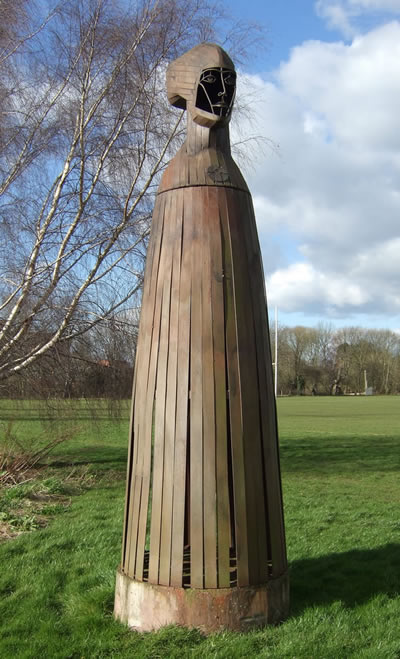
A modern monument to commemorate Saint Modwen was erected on Andressey Island at the end of the twentieth century. You may even have seen it but not registered who, or even what, is is supposed to depict. I certainly did! Strangely, it is half a mile away from where the original Saint Andrew’s Church and later Saint Modwen’s chapel stood.

The parish church still celebrates Saint Modwen’s day on 29th October (although the date appears to have been changed a number of times over the centuries).


One of Abbot Geoffrey’s stories in Professor Bartlett’s translation is included below.

A Miracle of St. Modwen – abridged from the ‘Life of Saint Modwenna’ by Abbot Geoffrey of Burton (c1120 AD), translated by Professor Robert Bartlett.

When St Modwen returned to England from Rome she came to the place called Scalpcliffe and saw there, by the hill, an island in the River Trent. It was secluded from men and had an isolated hermitage, and she loved the place very much. She stayed there for seven years and built a church dedicated to St. Andrew. To this day the island is known as Andressey, or Andrew’s Isle. At that time the area was a desolate wilderness, with woods and wild animals, but no people.

There lived at Breedon a saintly hermit who heard of Modwen’s reputation and used to visit her. He brought her writings on the lives of the saints which they read together, encouraging each other in their faith with the examples of the saints.

One day the hermit arrived but had forgotten the book. Modwen was grieved, and they decided to send for it. The hermit instructed two of Modwen’s companions where the book might be found, and Modwen instructed the two virgins to get into a boat and make all speed to fetch the book. They were rowing down the river when a strong wind sprang up which caused great waves on the Trent and filled the girls with fears of drowning and death.

When they reached a place called Leigh the wind got up further and they leant to one side and the boat overturned. They sank to the bottom of the river, and were trapped under the boat.

Modwen and the hermit began to grow anxious that they had been a long time. The thought occurred to Modwen that perhaps they had been drowned. She was desolate and blamed herself for having sent them and held herself responsible for their deaths. But the hermit consoled her, and suggested that they turned to prayer. They prostrated themselves on the ground and tearfully prayed to God for the lives of the girls. At length a bell rang and they rose, and noticed that a dry path had been miraculously opened up on the river bed. The water was divided in an astonishing manner into two parts, standing like a wall to the right and the left of the path.

Modwen and the hermit set off at once down the path on the river bed and came to the upturned boat. On one side of it the girls’ fingers were visible where they had clutched at the gunwale of the boat. The hermit tried to lift the boat but could not. It was as heavy and immovable as if it had grown roots into the river bed. He asked Modwen to try. She did so and the boat lifted as quickly and easily as if it had no weight at all. They found the two girls alive and well, safe and sound, preserved by the grace of God. There was mighty rejoicing and they all gave thanks to Almighty God for the miraculous saving of the girls, for his great wonders and the great marvels he had performed.

Once the boat was turned right way up they all climbed in and at once the waters rushed back into the river bed and bore them along with waves so that it should be clearly understood that God himself had divided the waters and saved the girls in answer to the prayers of the two saints.

Burton Abbey – Anglo-Saxon History

Burton Abbey

Burton Abbey was founded as a Benedictine abbey in 1002 by Wulfric Spot, the extremely wealthy earl of Mercia thought to be a descendent of King Alfred. In 1004, the abbey received its official confirmation when King Ethelred granted a charter of freedom.

Wulfric Spot died in October 1010 after fighting with with his ranks in support of Ulfrick Ealdorman of East Anglia against the Danes at Ringmere near Ipswich. He was mortally wounded and his body was returned to Burton Abbey where it was buried in the cloister under a stone arch near the door of church next to the body of his wife, Elswitha, who was already buried there. In later times Burton Abbey marked the occasion of his death on 22th October.

In his will Wulfric appointed the king, Aethelred (‘the Unready’), as lord of the abbey and archbishop Alfric and Alfhelm, Wulfric’s brother, as guardians. He also gave estates to senior churchmen and his nephew, Ufegeat, such that they would support the abbey when needed.

The first abbot and monks came from Winchester. This established a long relationship and over the next two hundred years, six of Burton’s abbots would also come from Winchester. The abbey was initially described as the monastery of Saint Benedict and All Saints in royal charters of 1008 and 1012 and appeared in the Domesday Book as the abbey of Saint Mary in 1086. Its dedication to Saint Modwen didn’t actually occur until the 12th century. The abbey was later to include Saint Mary’s chapel.

The surviving will of Wulfic Spot has proved to be an extremely valuable historic document listing in detail the vast estates under his control:

Staffordshire: Burton, Stretton, Bromley, ‘Bedintun’ (in Penkridge), Gailey, Whiston (in Penkridge), Darlaston (in Stone), Rudyard, ‘my little land at Cotwalton [in Stone]’,Leigh, Okeover, Ilam, Calton, Castern, and a hide at Sheen.

Derbyshire: Winshill (now of course, part of the borough of Burton), Sutton-on-the-Hill, Ticknall, Morley, Breadsall, Morton, Pilsley, Ogston, Wingfield, ‘Snodeswic’ (near Morton), ‘Niwantune’ (Newton Solney), and ‘that land at Appleby (Appleby Magna, now in Leicestershire) that I bought with my own money’.

Leicestershire: land at Shangton and Wigston Parva and a hide at Sharnford in Wigston Parva.

Shropshire: Longford, Stirchley, Romsley, Shipley, and ‘Suthtune'(Sutton Maddock);

Warwickshire: Weston-in-Arden, Burton Hastings, and Harbury.

Elsewhere or less certain: ‘Actune’ (probably Acton Round in Shropshire), ‘Halen’ (probably Halesowen,Worcs.), ‘Niwantun at the Wich’ (possibly Newton near Middlewich, Ches.), ‘Tathawyllan’ (possibly Tathwell, Lincs.), ‘Ealdeswyrthe’ (either Awsworth, Notts. or Aldsworth, Glos.), ‘Alfredingtune’ (either Alvington, Glos., or Alfreton, Derbys), and ‘Eccleshale’ (possibly Exhall, Warws., Ecclesall (Yorks or Staffs.), and ‘Waddune’ (possibly Whaddon, Glos.). ‘Waededun’ has not been identified at all.

The abbey was also given a reversionary interest in Elford and Oakley, both in Staffordshire, Wibtoft (Warws.), and ‘Twongan'(either Tong, Salop. or Tonge, Leics.). Half the usufruct of ‘Langandune’ (probably Longdon,Staffs.) was assigned to the monks, and also the enjoyment ‘of meat and of men and of all things’ on the land of the bishop at ‘Bubandune’ (Bupton, Derbys).

Wulfric’s lands between the Ribble and the Mersey and on the Wirral were left to Alfhelm and Wulfage ‘on the condition that when the shad shoals come in, each of them give 3,000 shad to the monastery at Burton’; similarly Conisbrough (Yorks) went to Alfhelm provided that the monks had a third of the fish every year.

Finally, Wulfric left the abbey 100 wild horses and 16 tame geldings ‘and besides this all that I possess in livestock and other goods except those which I have bequeathed’. Most of these lands were mentioned in the royal charter of 1004 confirming Wulfric’s endowment.

Either Wulfric’s intentions were never fully carried out, or else the abbey soon lost much of its original property, perhaps during the Danish Conquest in the early 11th century. Regardless, many of the estates given by Wulfric were not in the abbey’s possession at the end of the Edward the Confessor’s reign, and what remained was confined to Staffordshire and Derbyshire.

In Staffordshire the losses had not been great, and the property there still included Burton, Stretton, Bromley, ‘Bedintun’, Whiston, Darlaston, Leigh, and Okeover; Ilam, Calton, and Castern, though not mentioned in Domesday Book, were held by the abbey in the early 12th century and may have been included under Okeover in the Domesday Survey.

In Derbyshire only Winshill, Sutton, Ticknall, and Appleby remained. Ealdeswyrthe’ and ‘Alfredingtune’ had been exchanged by Abbot Wulfgeat in 1008 with king Aethelred (‘the Unready’) for Rolleston in Staffordshire, but Rolleston too was lost soon after.

1612 Last Heretic – Edward Wightman

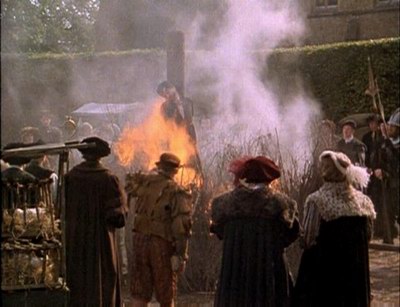
Edward Wightman of Burton-on-Trent was the last person to be executed by burning at the stake for heresy in England in 1612.

Early Life
Edward was born at Burbage, Leicestershire in 1566. He was the son of a schoolteacher and draper (cloth trader) but during his childhood he moved to Burton-on-Trent where he was educated at Burton Grammar School. After initially working in his mother’s drapery business, Edward was apprenticed by a wool cloth trader in Shrewsbury. Edward’s parents were members of the traditional Church of England with no known separatist or puritan leanings but, whilst in Shrewsbury, he became involved with, and strongly influenced by, a group of puritans headed by John Tomkys. The radical brand of Protestantism included the rejection of the trinity and the divinity of Jesus Christ as well as a complete rejection of the institutionalized Church of England. This would have been extremely dangerous in Tudor times, but still pretty thin ice in the times of James I.

In 1590, he was admitted as a master into the Shrewsbury Drapers’ Company, but within a few years, he returned to Burton-on-Trent to start a clothing business. He married Frances Darbye in 1593. They produced 2 sons and 5 daughters.

When Edward returned to Burton, the religious mood had changed quite dramatically from his childhood days there when religion in the town was dominated by the local noble, Lord Paget who still promoted Roman Catholicism.

In 1583, during the interim period, Lord Paget had fled England after ending up on the losing side of some political plotting involving Mary, Queen of Scots. Henry Hastings emerged as the new local noble and political leader, and he was a committed Protestant. Under his leadership, a new evangelical puritanism emerged in Burton. Peter Eccleshall, the Burton curate, was indicted in 1588 for not using the Book of Common Prayer. A puritan evangelist, Philip Stubbes, lived in Burton for a time during the early 1590’s, thus a modest form of puritanism quickly became well-established in Burton.

The clothiers and various influential business people in Burton were very much involved in the religious transformation so Edward’s turn to puritanism was part of a town-wide trend. In 1595, Lord Hastings died, and William Paget, son of the previous noble, was reinstated in the lands of Burton. Despite Paget’s establishment as Baron in 1604, he spent little time in the Burton area so there was no reverse of evangelical puritanism in the town. This paved the way for Edward eventually becoming a radical ‘lay leader’ in the religious community.

Stapenhill Witch
In February 1596, at a time when the country was obsessed with witchcraft, thirteen year old Thomas Darling accused Alice Goodridge of Stapenhill of being a witch and possessed him with a devil. Young Thomas exhibited the classic ‘Exorcist’ symptoms such as vomiting, paralysis, and hallucinations. During his fits of spiritual possession, he would apparently be possessed by the devil one moment and the Holy Spirit the next.

The new puritan minister in Burton, Rev. Arthur Hildersham, became interested in the case, and prayed with Darling, but was unable to exorcise the boy’s demons. Another puritan minister, Rev. John Darrell, who came from nearby Ashby-de-la-Zouch was finally able to exorcise Darling and drive off his possessor.

Alice Goodridge was jailed in Derby and interrogated at Burton town hall in May 1596. Under pressure, she confessed. Many who knew of the Darling case were not convinced of the truth of the boy’s possession. It soon became a symbol in the growing political struggle between the puritan and Anglican communities. The Burton puritans sought to document and prosecute the case aggressively.

Edward Wightman took a strong interest in the Darling case and when Alice Goodridge was interrogated in Burton, Edward was one of five men who ‘examined’ her showing that he was an important and well-respected public figure and religious authority. He was actively involved in documenting the boy’s possession and involved in the ecstatic prayers associated with the boy’s exorcism. The testimonials on the truth of the boy’s claim included the signatures of Edward, Rev. Eccleshall, most of the Burton clothier community, and many established and well-connected local individuals.

The case demonstrates Edward’s highly emotional and spiritual brand of puritanism and his position of authority and leadership despite his relative youth. His involvement in the Darling case proved a turning point in his life, making him entirely amenable to the possibility of unmediated spiritual intervention. Darling claimed not just to be possessed by the devil, but engaged in a series of ‘spiritual wars’ in which both demonic and angelic voices were said to emanate from him.

In the wake of the Darling case, there was a significant backlash against the puritans. Rev. Darrell, the minister who had finally succeeded in exorcising the boy, was convicted of fraud and went into hiding. The practice of group exorcisms was suppressed and soon afterwards died out.

Edward the Radical
Partly through circumstance, Edward was driven to an even more radical separatism. In the late 1590s, England suffered a severe economic downturn after a series of very bad harvests, and several bad aspects of the economy. The cloth trade was particularly badly hit and Edward’s business pursuits failed. By 1603, Edward had purchased an alehouse in Burton and was now a simple tavern keeper, impoverished and deeply in debt. His financial standing had taken a disastrous turn, close to ruin. His swift rise to prominence in Burton society during the 1590s followed by almost as fast a fall fuelled his religious extremism.

Edward was also involved in a court case over a dispute between him and his former apprentice, Samuel Royle, from November 1600 through January 1601. For whatever reason, Edward apparently failed to appear before the court in January 1601, which may have cost him a 40 pound bond. The loss of that sizeable sum might have finished Edward off in the clothing business. The justice who handled the Royle v Wightman dispute was Sir Humphrey Ferrers, and later events suggest that Edward harbored ill feelings toward the noble.

Despite Edward’s legal and financial woes, it is apparent that he retained some degree of significant stature among the new leading puritans in Burton and still closely associated with key figures in Burton’s religious society. They apparently thought well of him and perhaps still looked to him for religious leadership.

The first documented evidence of Edward’s descent into extremism came in early January 1608. Sir Humphrey Ferrers had recently died and Edward was entertaining company in his own home. The conversation turned to Ferrers’ death and Edward’s grudge against him from the 1601 case that may have helped precipitate Edward’s ruin. Edward stated to the assembled company that he believed that the soul does not leave the body upon death, but rather stays with the body until Judgment Day, at which point it either ascends to heaven or descends to hell. Though not too shocking now, this would have been shockingly heretical at the time.

Edward became more vocal about his view of the nature of the soul and death. He continued to argue the point with local clergy. Curate Henry Aberley of Burton opted to use his own pulpit to argue against such heretical ideas, but this apparently led to bitter, and sometimes public, arguments with Edward. As a result, Edward stopped attended the Burton parish church and began worshipping elsewhere.

Despite Edward’s theological split with the established religious community, he was not abandoned by religious leaders. This is consistent with the behavior of other puritanical communities in response to other heresies. Instead of prosecuting or excommunicating the errant individual they would try to reform his views. Chief among those who engaged Edward was Burton puritan minister Rev. Arthur Hildersham, who had probably played a major role in Edward’s ascendance in the religious community a decade earlier.

Hildersham, and Rev. Simon Presse of Egginton, Derbyshire, met with Edward privately and attempted to convince him to change or moderate his view. The obstinate Edward refused and Hildersham ultimately responded by preaching against Edward’s heretical views from his Burton pulpit on March 15, 1609. Hildersham continued to correspond with Edward for a time, but eventually tired of Edward’s stubbornness and cut off the debate. Edward apparently interpreted this as a victory and became all the more convinced of the righteousness of his heterodoxy.

From 1609 to 1611, the process of engaging and attempting to ‘correct’ Edward’s view continued, but Edward became increasingly radicalized and spent his energies writing manuscripts outlining his views. He was a prolific writer, although none of his writings have survived. He was known to never leave home without a number of his books which he read and preached to anyone who would listen. Edward was only ever a ‘lay leader’ in the religious community and never held an official ministerial position. Although enjoying a number of followers for a time, by 1611 he was increasingly avoided and eventually became something of a loner.
King James I Condemnation
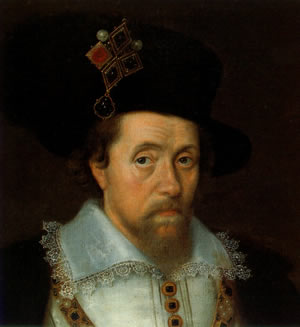
England had become a relatively tolerant nation under Elizabeth I but the religious and political situation changed when James I took the throne in 1603. Although King James was tolerant toward Catholics and helped liberalize the Church of England, with the famous English translation of the bible bearing his name, he saw Protestant dissenters, such as Puritans, Baptists, and Quakers, as a major problem and challenge. Among James’ great religious interests was support of catholic orthodoxy, which includes adherence to the major creeds. He took his title of ‘Defender of the Faith’ seriously and since 1607 he had been engaged with Roman Catholics over the ‘Oath of Allegiance’. Edward’s views were therefore, very much opposed to the King’s view.

Wightman set about putting together a compendium of his theology for his upcoming hearing and defense. Perhaps thinking that he would at least be allowed time to plead his case, he delivered copies of it to members of the clergy in an effort to gain support.

Now completely deluded, believing in his own righteousness and persuasiveness, he delivered a manuscript detailing his radical theology (thought to have originally been intended for Anthony Wotton) to King James I despite being fully aware of the King’s religious stance. This was a dubious move to say the least, particularly since the King had recently ordered the execution of Bartholomew Legate for heresy.

The manuscript consisted of eighteen leaves (pages). To give a flavour, it began, “A letter written to a learned man to discover and confute the doctrine of the Nicolaitanes very mightily defended with all the learned of all sorts, and most of all hated and abhorred of God himself, because the whole world is drowned therein: And seeing he hath promised to answer he knew not to what, and least he should also deal with me as the men of that faction have done already…”. The document concluded, “… and say glory be to God alone which dwelleth in the high heavens, whose good will is such towards men that he will now at the last, plant peace on the earth, and let all people say, Amen”. You may be relieved to know that almost the remainder of the document has not survived.

In February 1611, Edward interrupted Lent worship services in Burton with loud outbursts. It took significant effort to get him to quiet down. Finally, the Burton religious community had had enough. The Burton minister involved and others from Burton presented the case against Edward at the ecclesiastical visitation of Bishop Richard Neile of Westminster within a few weeks of Edward’s February 1611 disruptions. In early March 1611, Edward was summoned by Neile to Curborough, near Lichfield. Neile promptly returned to London and reported his findings to King James. The King was set on dealing with this troublesome heretic.

In April 1611, by order of the King, local church authorities issued a warrant for his arrest. The order instructed the church constables of Burton to immediately take him before Bishop Richard Neil at the Consistory Court at Lichfield Cathedral for interrogation of his religious views and for conformation to the established Anglican order. Neile’s Chaplain, who assisted in prosecuting Wightman, was William Laud, the future Archbishop of the Church of England, who was later executed himself!

The Trial
The first day of the trial was held on November 19, 1611. On the second day of the trial on November 26, the crowd was so large that the trial had to be moved to the larger space of the Chapel of the Blessed Virgin. On December 5, Edward was brought before the court for his final appearance. Throughout the trial, Edward did not attempt to defend himself. Instead, he attempted to educate them on the righteousness and intellectual rigor of his arguments, ‘clarifying’ the court’s conception of his heresies.

Sentence was pronounced on December 14, 1611. The charges brought against him included eleven distinct heresies. Part of the charge was that he believed “that the baptizing of infants was an abominable custom; that the doctrine was a total fabrication and that Christ was only a mere man and not the son of God; that the Lord’s Supper and baptism were not to be celebrated; and that Christianity was not wholly professed and preached in the Church of England, but only in part.” Other charges included several equally radical opinions.

After months of being subjected to a series of conferences with ‘learned divines’, Wightman was finally brought before Bishop Neil for the last time. Having refused to change any of his views, he was sentenced to be excommunicated and condemned to be burned at the stake following approval by King James I. Prior to his execution, he was to be placed in a public open place as an example to others who might harbour similar beliefs.
The Execution
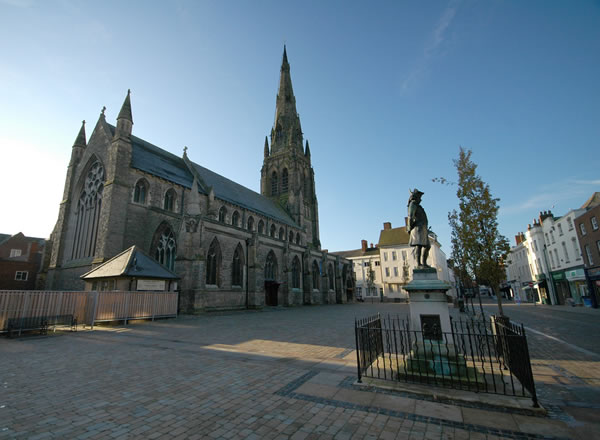
When the execution day arrived on March 20, 1612, Edward was tied to a post on the square in Lichfield next to Saint Mary’s church and the fire was lit under him. On feeling the heat, Edward screaming out in recantation and he was pulled down, already badly burned. A written retraction was hurriedly prepared and Edward, in pain and weakness, orally agreement as it was read to him. Later, however, no longer fearing the flames, he refused to sign the retraction and blasphemed louder than before.

King James re-approved his execution and a few weeks later on April 11th, he was once more led to the stake. Once again, on feeling the intense heat of the fire, Wightman cried out in recantation again but this time, the sheriff told him he would cost him no more and commanded more faggots (bundles of thin sticks) to be thrown on to make the flames roar. Edward was burned to ashes.

Conclusion
Seeing that heresy still survived with a number of religious radicals still emerging, King James I lost faith in burning heretics. After the case of Edward Wightman, it was decided that those found guilty of heresy should instead silently and privately waste away in prison rather than excite others with a public execution.

It was not until 1677 that an act of Parliament expressly forbade the burning of heretics, securing once and for all, Wightman’s dubious position in history as ‘The last person in England to be burned at the stake for heresy’.
1643 Civil War

Burton in the English Civil War
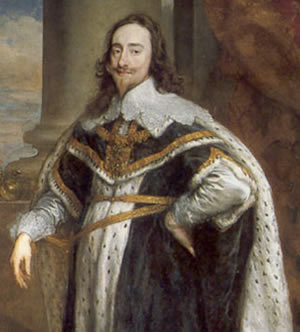
The English Civil War started in 1642 when Charles I (pictured) raised his royal standard in Nottingham. England was split between those that supported the King and those that supported Parliament. In the case of Burton, support was fairly strongly parliamentarian. One of the most prominent Burton paliamentarian was Daniel Watson of Nether Hall. Before the outbreak of the civil war, he was a lawyer but he became a captain of dragoons in the Derbyshire cavalry.
Burton’s allegiance was largely a result of its puritan following. There was some unrest in the town at the outset of the war with rumours of gunpowder being hoarded to support rebellion. Although investigations by Lord Paget concluded that this was unfounded, in 1643, there was a large explosion in Saint Modwen’s church in the Market Place which destroyed the roof and blew out the windows.

Lord Paget, Burton’s most senior figure, was clearly undecided on where his loyalties should lie. Initially, in 1642, he declared support for Parliament but in June of the same year, he switched allegiance to the King. In September 1644, he reverted back to supporting parliament, clearly trying to hedge his bets in his own interest

With its highly strategic river crossing that was noted at the time as “the chief passage from South to the North”, and situated between parliamentary Stafford and Derby and royalist Lichfield, Tutbury, and Ashby-de-la-Zouch, Burton was destined to be fought over throughout the civil war and lacking walls or natural defences, it changed hands many times.

Burton was the rendezvous for the royalist forces of the Earl of Chesterfield and his son Ferdinando Stanhope late in 1642, but the establishment of a parliamentarian garrison at Derby brought Burton to the attention of the conservative parliamentarian Sir John Gell and the rest of the Derbyshire county committee. In February 1643 Gell placed an artillery company in Burton under Major Johannes Molanus, a Dutchman who had actually come to England to assist with drainage projects in Lincolnshire. The garrison withdrew later the same month with orders to support an attack on the royalist stronghold of Newark in Nottinghamshire.

After capturing Lichfield for the king at the end of April 1643, Prince Rupert also placed a garrison at Burton, but it was promptly driven out by the forces of Gell and Lord Grey of Groby, commander-in-chief of the East Midlands Association. They installed Captain Thomas Sanders with a garrison of 200 foot, 60 dragoons, and one cannon drawn from the forces of Derbyshire. Sanders quickly deserted Gell’s command and placed himself and his troops under another parliamentarian officer, Col. Richard Houghton, and the Staffordshire county committee. Sanders was more radical than Gell, and may have feared that his appointment with only a small force in poorly defended Burton was Gell’s way of removing a potential rival.

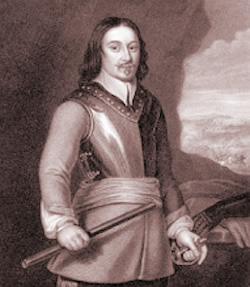
On 4th July, 1643, that garrison was stormed in what was probably the most famous local battle of the war – ‘The Battle of the Bridge’. An army under Queen Henrietta Maria, wife of Charles I, was commanded by Thomas Tyldesley (pictured), a supporter of Charles I and a Royalist commander from Lancashire, at the time having the rank of Colonel, led a cavalry charge across the bridge to attack Burton. It was a very bloody confrontation in which the church was damaged and the town was, according to Gell, “most miserably plundered and destroyed”. At the end of the battle, so much booty was taken that the Queen, who witnessed the battle, recorded that her soldiers “could not well march with their swollen bundles”.
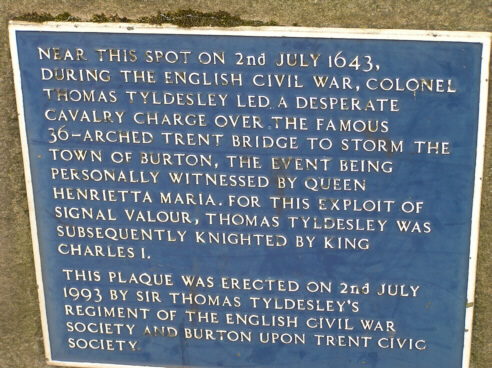
After the battle, Burton became an important Roundhead stronghold and, largely because of the success of this attack against the odds, Thomas Tyldesley was knighted. A plaque to commemorate the event was erected on the replacement (current) bridge by the Burton Civic Society in 1993. It is still there today but goes largely unnoticed.

The royalists remained in control for the next six months and fortified the bridge, but were again driven out by Gell’s troops in January 1644. No garrison appears to have been established, and Burton was soon again under royalist control, although it was attacked and ‘plundered’ in a parliamentarian raid in April 1644.

The King’s forces from Lichfield were quartered in the town in July 1644 but they were driven out by Gell’s troops. A fresh parliamentary garrison of both Derbyshire and Staffordshire troops was installed in the town in November 1644, but by February 1645 Burton was once more under royalist control, and it was there that Charles I made his headquarters briefly at the end of May 1645. It was firmly and finally under parliamentarian control by early 1646, when the town contributed both money and beer to the parliamentarian forces besieging Tutbury and Lichfield.

A later list made in 1662 recorded that 127 former Burton parliamentarians. This was the largest count in Staffordshire with the esception of Stafford.

After the Restoration, Burton was a dissenting centre, with large Presbyterian and Baptist conventicles meeting there with five excluded ministers. This raised some doubt with Anglicans over the loyalty of the town’s population. Nonconformity remained strong in the town until the early 18th century. Within ten years of the passing of the Toleration Act in 1689, six houses were registered for dissenters and there were Presbyterian, Baptist and Quaker meetings in Burton.

A plaque to commemorate the event, erected by Burton Civic Society in conjunction with Sir Thomas Tyldesley’s regiment of the English Civil War Society, can be found on the current Trent Bridge.

NEAR THIS SPOT ON 2nd JULY 1643, DURING THE ENGLISH CIVIL WAR, COLONEL THOMAS TYLDESLEY LED A DESPERATE CAVALRY CHARGE OVER THE FAMOUS 36-ARCHED TRENT BRIDGE TO STORM THE TOWN OF BURTON, THE EVENT BEING PERSONALLY WITNESSED BY QUEEN MARIA [wife of Charles I]. FOR THIS EXPLOIT OF SIGNAL VALOUR, THOMAS TYLDESLEY WAS SUBSEQUENTLY KNIGHTED BY KING CHARLES I.

THIS PLAQUE WAS ERECTED ON 2nd JULY 1993 BY SIR THOMAS TYLDESLEY’S REGIMENT OF THE ENGLISH CIVIL WAR SOCIETY AND BURTON UPON TRENT CIVIC SOCIETY.

1322 Battle of Burton Bridge

The 10th March, 1322 was not a great for Burton; it came under heavy attack and much of it was destroyed. Even so, it is quite an exciting thought that the invasion troops were led by the King Edward II of England himself and of him riding into Burton on his charger.

The story starts with Thomas Plantaganet, earl of Lancaster (1278-1322), who was the grandson of King Henry III. After marrying Alice, daughter and heiress of the Earl of Lincoln, the earldom of Derby was added to those he already owned and with it came Tutbury Castle.

Thomas didn’t much like his cousin Edward II and felt that he would make a much better King himself. He became one of the leaders of the baronial opposition to the King; he also sided with the Scots against him. This was confirmed to the King when Robert Bruce ravaged the north of England but the Earl of Lancaster’s lands were among those spared.

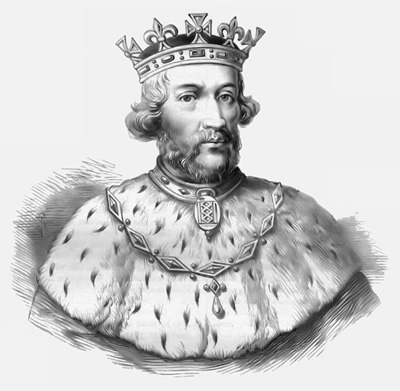
In retaliation, King Edward II (pictured) decided that he would lead an attack against Tutbury Castle and assembled an army in London.
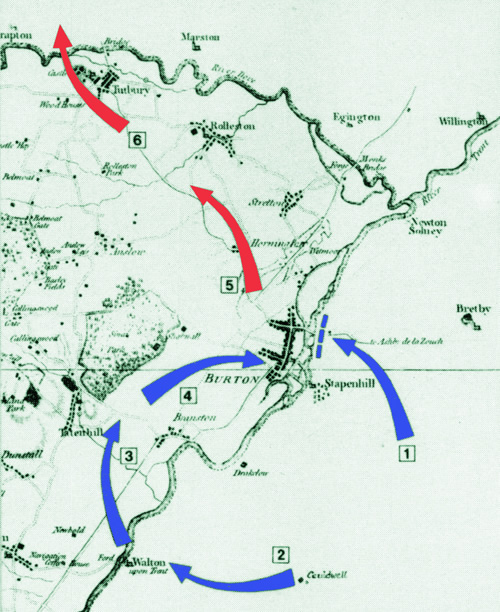
Hearing of this, Thomas returned to Tutbury with his own army of 30,000 men. Knowing that Burton Bridge was the only crossing over the river Trent for many miles in either direction and therefore sure to be the route taken by the King, he put much of his defensive effort into fortifying it on the Burton side. The King however, received the advice that there was a little known passable ford at Walton a few miles upstream. He therefore sent a decoy force to look as large as possible while the main body of soldiers crossed at Walton to lauch an attack on Burton from the direction of Branston.

Thomas was caught by surprise and was heavily defeated at the Battle of Burton Bridge on 10th March, 1322 and retreated to Tutbury Castle, leaving most of Burton in flames. Tutbury Castle was later looted and damaged but not destroyed.

Thomas was expecting reinforcements from his Scottish allies to join him at Tutbury but they didn’t show up so he was forced to escape over the Dove and flee north back to his seat and main residence at Pontefract Castle.

On 16 March, Lancaster and his army had reached Boroughbridge by the River Ure. There they were cut off by the forces of Sir Andrew Harclay, a veteran from the Scottish wars, who had gathered the levies from the counties of Cumberland and Westmorland.

With no more than 700 knights and men-at-arms in the rebel army and over 4,000 soldiers in the royal army, Lancaster initially tried to negotiate, but Harclay could not be swayed. The ‘Battle of Boroughbridge’ ensued but the battle was short and one-sided.

The captured earl of Lancaster was escorted back to Pontefract where he was condemned to death as a traitor and beheaded by sword in front of a jering crowd on 22nd March, 1322, just twelve days after his battle at Burton. This might have been considered a lenient sentence because traitors were more commonly drawn and quartered first!

Battle Map Key:
1: On the 5th/6th of March, 1322, the first royal troops build up and attack of the bridge which was successfully repulsed. Edward II arrived in person via Cauldwell on 10-11 March.

2, 3, 4: Learning of the crossing at Walton, a diversory force was left to appear as large as possible while the main force, including Edward II, crosses at Walton to attack Burton from the West.

5: The surprised earl of Lancaster’s troops set fire to as much of the Burton as they can before fleeing North.

6: Lancaster’s troops cross the river Dove retreating back towards Pontefact, losing or hiding a chest reputedly containing a large proportion of 300,000 coins intented to pay the army.

The unfortunate Burton was left sacked, requiring it to be almost completely re-built.

Thomas was remembered as a defender of popular liberties and buried in a tomb at Pontefract. There was also an effigy of him in St Paul’s Cathedral, London. He left no children and his titles and estates were forfeited to the crown but in 1323, his younger brother, Henry Plantaganet, successfully petitioned to take over the earldom of Leicester.

King Edward II was deposed and murdered in 1327 (although modern history favours that this was a ‘fake death’). Regardless, the throne was passed to his son, Edward III, who wrote to the pope numerous times requesting the canonisation of Thomas but this was rejected.

After Edward II’s death, Edward III’s parliament posthumously reversed Thomas’s conviction so Henry Plantagenet  took possession of the Earldoms of Lancaster, Derby, Salisbury and Lincoln making him the new owner of, among many things, Tutbury Castle.

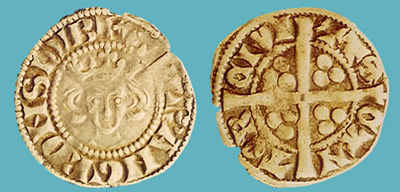
A large hoard of gold and silver coins hidden in three small barrels was discovered by workmen in 1831, the equivalent of well over £250,000 today, is thought to have been the payment from the Earl to his troops and Scottish allies, hidden in the bank of the river Dove as he fled for Pontefract where they remained undiscovered for over 500 years. The above example coin was one of the newest and depicts Edward II’s father King Edward ‘Longshanks’ I.