Civic Arms and Regalia
Select page to view:
Civic Arms and Regalia
Select page to view:
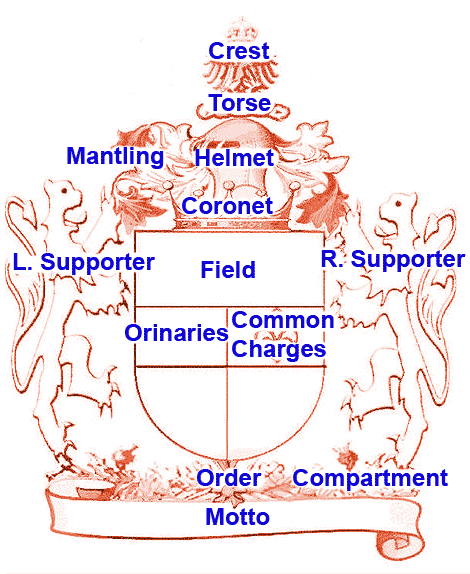 In the 12th Century, defensive body armour used by knights had reached the level where the complete body was fully encase in armour, complete with full facial helmet. The downside of this is that it was not easily possible to identify anyone on the battlefield.
The practice was soon established of wearing ‘colours’ that could easily be recognised; most particularly, a large shield. Initially, simple shield designs making use of two or so colours were used but soon, shields began to bear symbols or ‘Charges’ such as an Eagle or Lion. Matching colour ‘Crests’ worn by a knight on top of his helmet also became of great significance.
The design featured on the Shield was ‘blazoned’ on a colourful fabric ‘Tabard’ worn over the Knight’s armour from which the expression ‘Coat of Arms’ was derived.
Heralds were soon established, around 1150 AD, as experts who kept records of all such ‘Bearings’ and who they officially belonged to allowing knights to be recognised by the arms they bore on their shields and the crests they wore on their helmets. Heralds soon acquired an expert knowledge of these and became responsible for recording arms, and then later for regulating and controlling their use.
Heraldry, under official control, became the means of identification of leading combatants in mediaeval warfare. Initially, only the higher nobility used Armorial Bearings but gradually, the practice spread downwards through the ranks and the Mediaeval Crusades and frequent wars did much to spread the usage and popularity of Armorial Bearings and it quickly spread through the whole of Europe.
By the 16th Century, the use of body armour had greatly declined as foot-soldiers were replaced by artillery and firearms. The golden age of military heraldry had been and gone but heraldry was by then well embedded in the class system and Arms had become very elaborate and extended to ‘Regalia’.
Civic arms eventually became established with Arms being granted to cities or towns rather than to individuals for civic usage.
Burton upon Trent Municipal Borough was formed in 1878 and was comprised of Burton, Burton Extra (Bond End), Horninglow, Stapenhill and Winshill though each retained their existing civil parish. A coat-of-arms was sought to commemorate the new Borough.
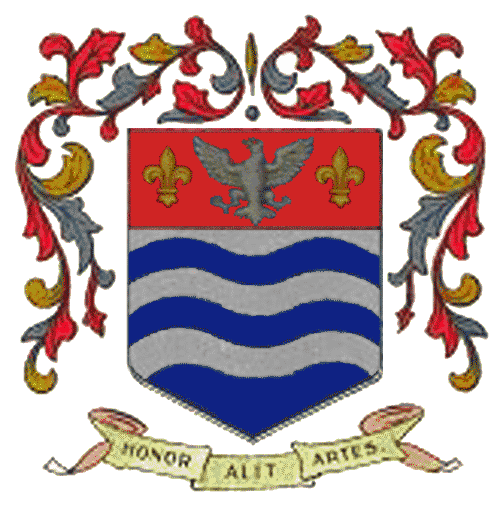
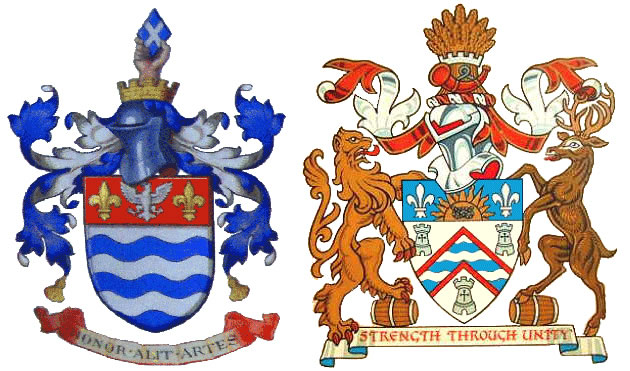
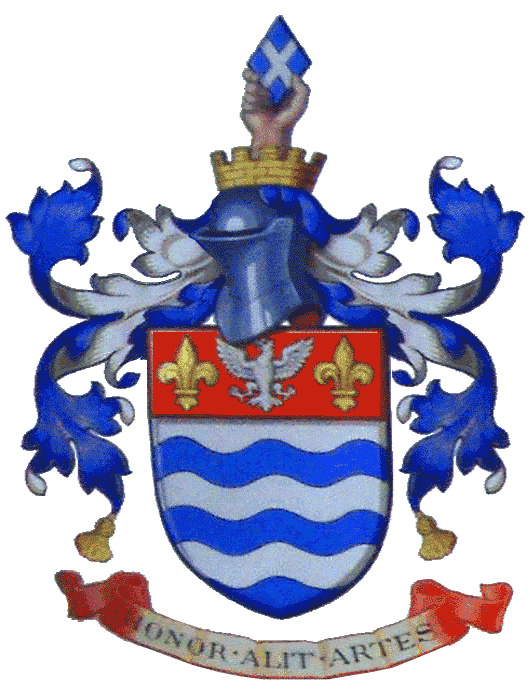
The new Burton upon Trent County Borough was granted a coat of arms by Norroy, King of Arms at the College of Arms after its incorporation in 1878 depicted the spread eagle from the Paget family arms, fleur-de-lys from those of the Bass family. The two wavy blue lines represent the rivers Trent and Dove, which meet near Burton. The motto ‘Honor Alit Artes’ is a quotation by Roman Statesman, Cicero, meaning ‘Honour Sustains the Arts’.
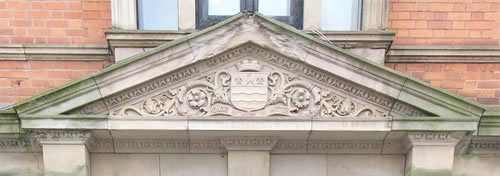
In 1879 the first Mayor of Burton County Borough, W.H. Worthington, was presented with a Mayoral Chain and Badge of Office which proudly incorporated the new Borough’s Civic Arms. An impressive stonemasonary Coat-of-Arms was also commissioned for incorporation into the newly proposed Market Hall which was opened in 1883.
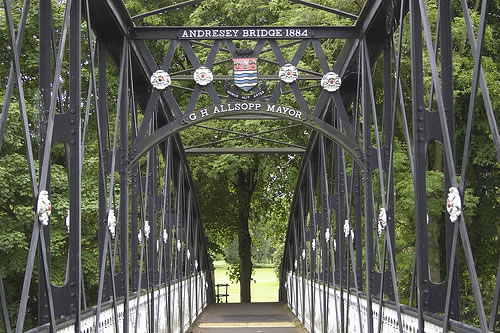
The following year, in 1884, the Burton Arms were incorporated into the Andresey Bridge built by local Engineers, Thornewill & Warham but, for some reason, not featured on the Ferry Bridge built by the same company five years later.
County Boroughs were introduced in the United Kingdom in 1889 to allow a borough or city to manage itself independently of County Council control. Burton upon Trent borough, which still came under Staffordshire County Council, became a County Borough in 1901 when it met the criteria of having an area population of 50,000. The Coat-of-Arms was retained.
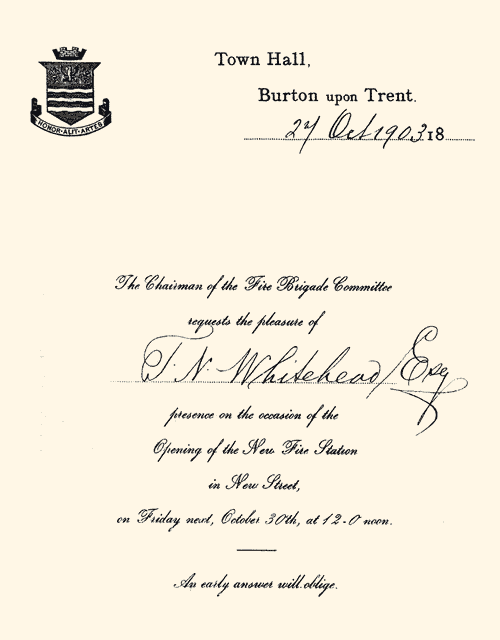
The Arms also became the official ‘Seal’ and featured on all official correspondence as in this very elaborate(?!) letterhead dating from 1903.
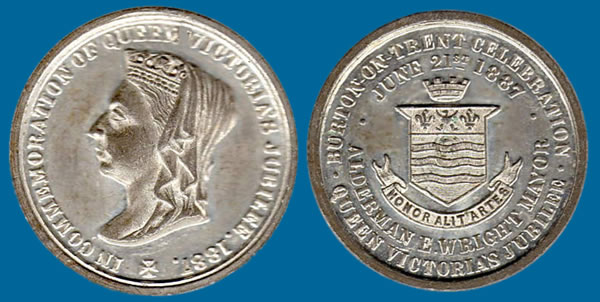
In 1887, a medallion was issued in Burton bearing the civic arms to commemorate the jubilee of Queen Victoria.
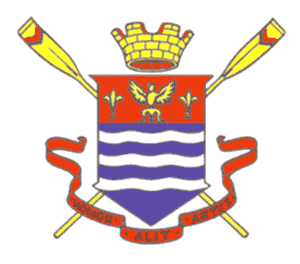
A number of clubs and societies formed in Burton incorporated the Civic Arms into their own ‘unofficial’ arms. An example was the Burton Leander Rowing club with a badge that remains unchanged over a hundred years later, quite happy to stick with the link back to the days of Burton being a County Borough to make the point of how long established it is.
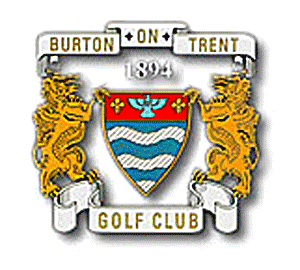
Neither is it difficult to spot the influence on the new unofficial arms of the Burton Golf Club, situated on Ashby Road, with its timely inauguration in 1894.
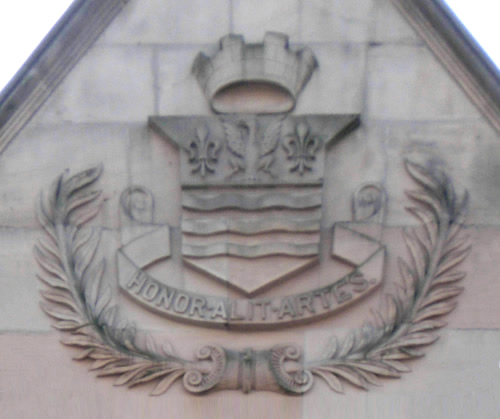
The Civic Arms were incorporated into many of Burton’s most significant buildings in the form of stone masonary. A separate page shows several of these examples, all of which are still in evidence. They are very much taken for granted and overlooked and you will almost certainly have walked past this example on many occassions without even noticing… but hopefully, you will now look for them with new interest!
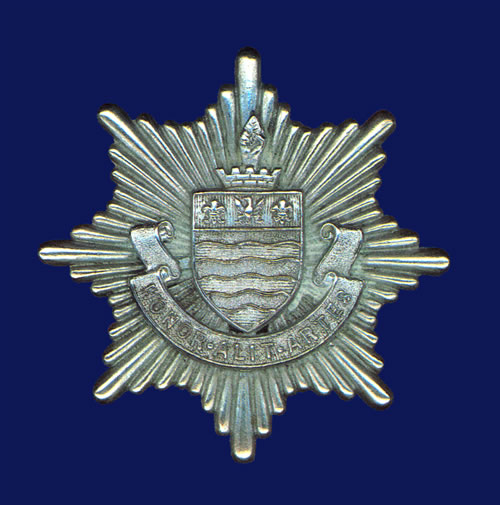
The Borough Arms also featured on much of the regalia of organisations that fell under the Borough Council’s control such as this official badge of the Burton Fire Brigade.
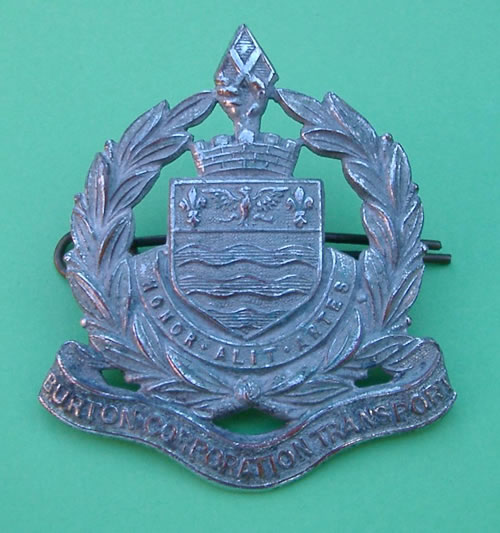
In 1903 the Town found itself in major disruption as tram tracks were and cables were constructed for the new public tramway system to handle a fleet of 24 double-decker trams. Thus, Burton Corporation Transport came into being to run them. To continue the trait, a new emblem was created, incorporating the Civic Arms. It can be seen below in a corporation badge and was also featured on the actual tram cars livery.
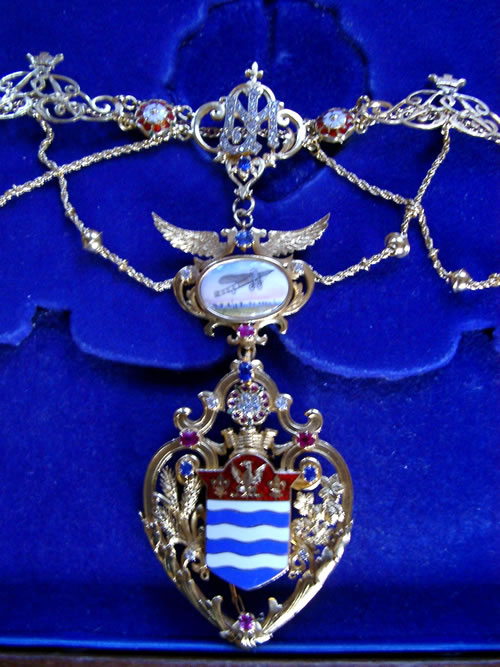
In 1910, proceeds from an aviation display which took place on Bass’ Meadows and organised by the Council’s Entertainments Committee, were used to purchase a chain and badge for the Mayoress at the time, Mrs Mary Jenkins. Her initials are incorporated in the chain. Besides a large badge featuring the Borough’s Arms, there is an enamel medallion depicting an aeroplane.
In 1928 the County Borough added as a Crest to the Arms which included a hand holding the saltire of Saint Andrew as an allusion to the early medieval chapel on Andresey island founded by Saint Modwen. The revised design was submitted to the College of Arms for approval and registration.
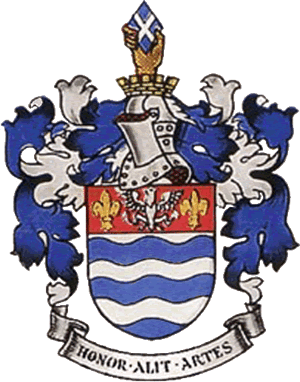
This resulted in what was to be the final update to the ‘Grant of Arms’ which hangs which still hangs in the Council Chamber in Burton Town Hall.
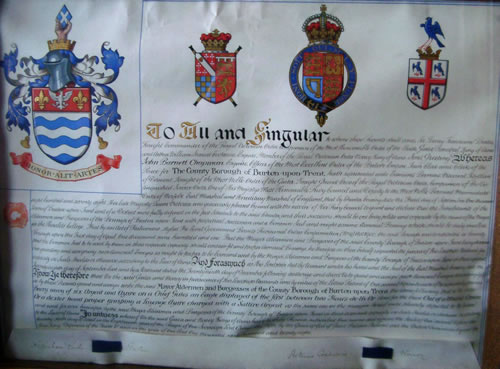
Transcription:
TO ALL AND SINGULAR to whom these Presents shall come, Sir Henry Farnham Burke Knight Commander of the Royal Victorian Order Companion of the Most Honourable Order of the Bath Garter Principal King of Arms and Arthur William Stuart Cochrane Esquire, Member of the Royal Victorian Order Norroy King of Arms, Send Greeting: Whereas John Barnett Chapman Esquire, Officer of the Most Excellent Order of the British Empire, Town Clerk and Clerk of the Peace for The County Borough of Burton-upon-Trent, hath represented unto Edmund Bernard, Viscount FitzAlan of Derwent, Knight of the Most Noble Order of the Garter, Knight Grand Cross of the Royal Victorian Order, Companion of the Distinguished Service Order One of His Majesty’s Most Honourable Privy Council and Deputy to the Most Noble Bernard Marmaduke Duke of Norfolk, Earl Marshal and Hereditary Marshal of England, that by Charter bearing date the Third day of September One thousand eight hundred and seventy eight, Her late Majesty Queen Victoria was graciously pleased by and with the advice of Her Privy Council to grant and declare that the Inhabitants of the Town of Burton-upon-Trent and a District more fully defined in the first Schedule to the said Charter, and their successors should be one body politic and corporate by the name of the Mayor Aldermen and Burgesses of the Borough of Burton-upon-Trent, with perpetual succession and a Common Seal and might assume Armorial Bearings which should be duly enrolled in the Heralds’ College: That by an Act of Parliament, styled The Local Government Boards Provisional Orders Confirmation (No9) Act 1900, the said Borough was constituted a County Borough upon the First day of April One thousand nine hundred and one: That the Mayor Aldermen and Burgesses of the said County Borough of Burton-upon-Trent being desirous that the Common Seal to be used by them in their corporate capacity should contain fit and proper Armorial Bearings, he therefore on their behalf requested the favour of His Lordship’s Warrant for Our granting and assigning such Armorial Ensigns as might be proper to be born and used by the Mayor, Aldermen and Burgesses of the County Borough of Burton-upon-Trent in their corporate capacity on Seals Shields or otherwise, according to the Laws of Arms: And forasmuch as His Lordship did by Warrant under his hand and the Seal of the Earl Marshal bearing date the Twenty eighth day of September last and by a Warrant dated the Twenty ninth day of December following authorize and direct Us to grant and assign such Armorial Ensigns accordingly: Know Ye Therefore that We the said Garter and Norroy in pursuance of His Lordship’s Warrants and by virtue of the Letters Patent of Our several Offices to each of Us respectively granted do by these Presents grant and assign unto the said Mayor Aldermen and Burgesses of the County Borough of Burton-upon-Trent the Arms following that is to say:-Barry wavy of six Argent and Azure on a Chief Gules an Eagle displayed of the first between two Fleurs-de-lis Or And for the Crest Out of a Mural Crown Or a dexter hand proper grasping a Lozenge Azure charged with a Saltire Argent as the same are in the margin hereof more plainly depicted to be borne and used forever hereafter by the said Mayor Aldermen and Burgesses of the County Borough of Burton-upon-Trent in their corporate capacity on Seals Shields or otherwise accordingly to the Laws of Arms: In witness whereof We the said Garter and Norroy Kings of Arms have to these Presents subscribed Our names and affixed the Seals of Our several Offices this twenty sixth day of April in the Eighteenth year of the Reign of Our Sovereign Lord George the Fifth, by the Grace of God of Great Britain Ireland and the British Dominions beyond the Seas. King, Defender of the Faith & c and in the year of Our Lord One thousand nine hundred and twenty eight.
The final approved and registered design, as featued on the new ‘Grant of Arms’ can be seen below and was to become the official Burton County Borough Coat-of-Arms until eventually being absorbed by East Staffordshire Distric Council.
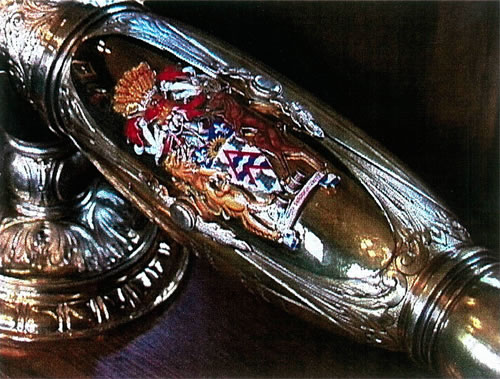
A Mace was donated to the Borough in 1935 by the first woman Mayor, Mary Goodger, to mark the silver jubilee of George V. It has an enamel medallion with the Borough’s Arms. In 1992, a medallion featuring the Arms of East Staffordshire Borough Council was added. This Mace replaced a much older one which was re-discovered when the old Town Hall which stood in the Market Place was demolished in 1770. The Mace was lost/stolen in 1848 before Burton was awarded County Borough status.
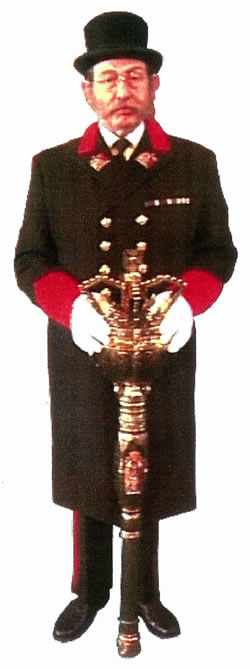
Mace Bearers originate from the times when a mace was a formidable weapon. Bearers were effectively there to offer protection so were in fact, an early form of bodyguard and usually a member of the guard corps. Their modern day counterparts are not usually particularly fearsome!
Following the Anglo-Saxon tradition, there is usually a single post of mace-bearer per mace. Nowadays, it is of course purely ceremonial and the duty of the mace-bearer is to carry the mayor’s great mace in front of him when performing official business.
A chain and badge for the Deputy Mayor of Burton Borough was given by the town’s Freemasons in 1955. It can be seen below as supplied in its equally attractive display box. Note that it now incorporates the revised Coat-of-Arms.
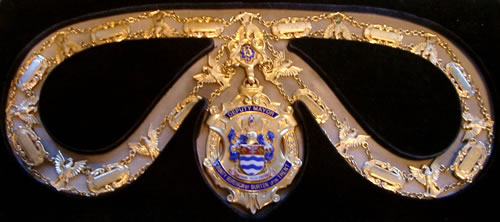
In 1973 the Civic Arms were replaced as Burton Borough was absorbed into the new East Staffordshire District Council.
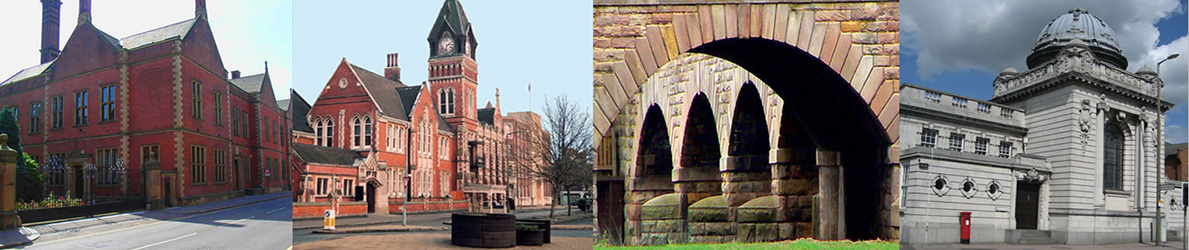
The Civic Arms of Burton County Borough have been incorporated into many official buildings.
All of the examples featured here exist today and are still in excellent condition. Almost for certain, many of you will have passed them many times without a second look… hopefully, you will now see them with new interest!
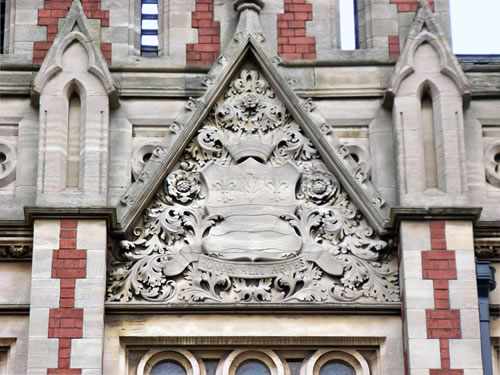 The Town Hall – Saint Paul’s Square
The Old Firestation – New Street
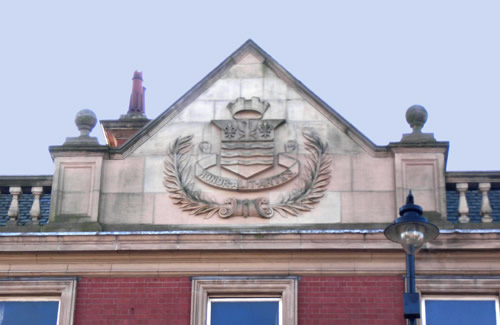 The Old Firestation – New Street
The Market Hall – Main Entrance
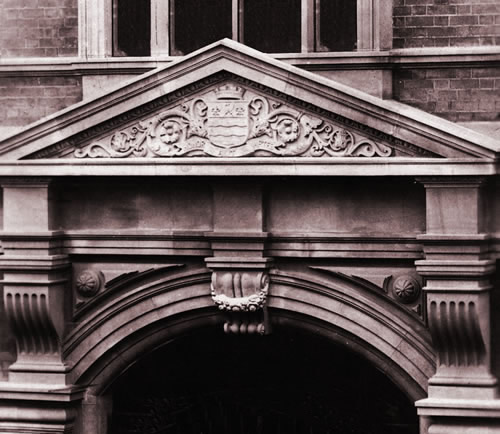 The Market Hall – Main Entrance
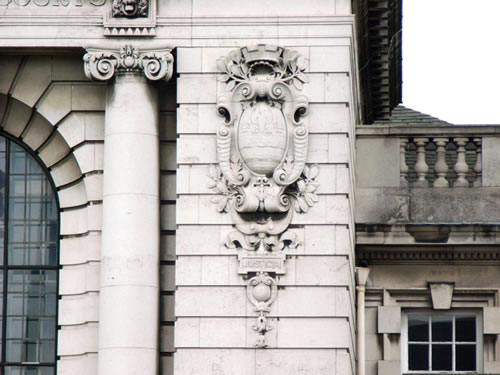 Burton Magistrates Court
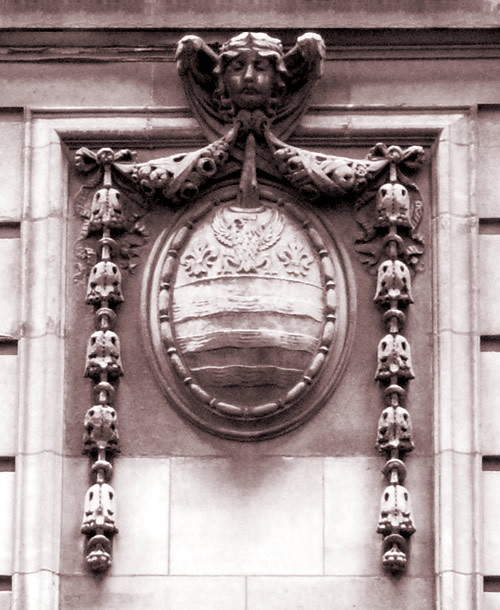 Burton Museum – Station Street / Guild Street Corner
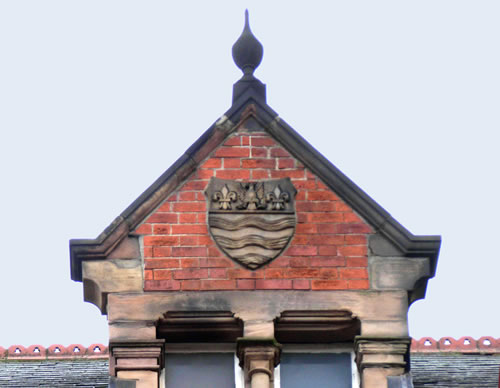 Education Offices – Guild Street
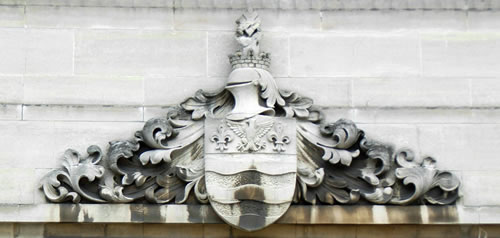 Burton Council Offices – Adjacent to Town Hall
Much ‘crested ware’ hit the town, in varying degrees of quality, to celebrate the Town’s new status. For a while at least, almost every Burtonian knew what ‘Honor Alit Artes’ meant and could therefore claim to speak at least some Latin.
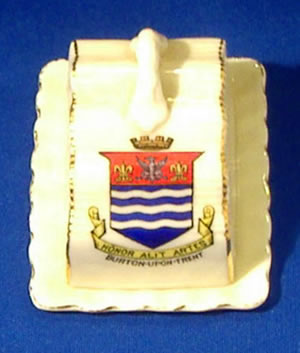
This cheese/butter dish, for example, would grace many larders and would probably only make an outing when guests came for tea.
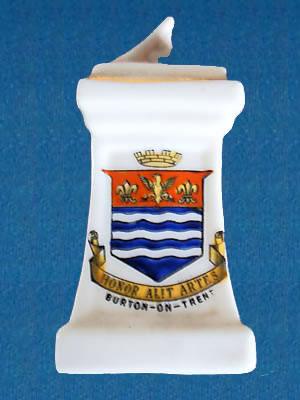
Or better/worse still, depending on your disposition, this handsome shaker.
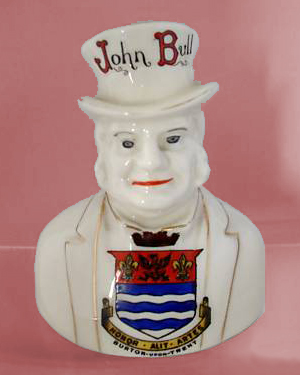
Of course, you could have saved your money on both and opted for this highly desirable crested John Bull figure.
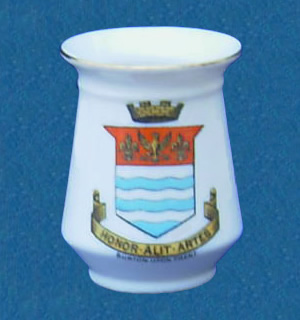
This elegant vase makes the point that you don’t necessarily have to stick to the registered colours – if you prefer, simply ignore them and use your own.
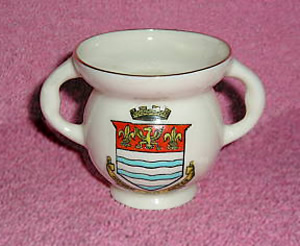
… a sentiment extended to this highly desireable cup, carefully crafted to ensure that the Arms remain in view during use for both the left and right handed.
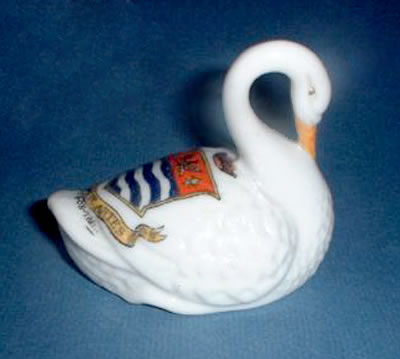
Were the crested swans carefully crafted to proudly represent one of Burton’s best known features; or did interest in the new coat-of-arms provide the ideal opportunity to accelerate sales of an otherwise dubious ornament?
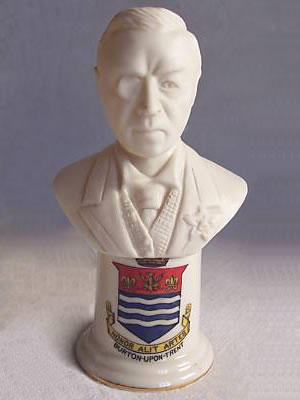
Now this one, I do actually quite like. It stands around four and a half inches tall and the only thing I would need in order to buy it, is to have some confirmation that it is someone that actually relates to Burton in some way. It looks nothing like Lord Burton, the Marquis of Anglessey or any Town Mayor that I have ever seen so I am intriqued as to who it might be.
As part of the Local Government Act, 1972, it was decided that the County Borough of Burton upon Trent should be merged with Uttoxeter Urban District Council, Uttoxeter Rural District Council and Tutbury Rural District Council to form the new East Staffordshire District Council with its main headquarters at Burton Town Hall.
This meant that the old Burton County Borough Arms would no longer be valid and an application was made for new ones. These were granted on June 8, 1973.
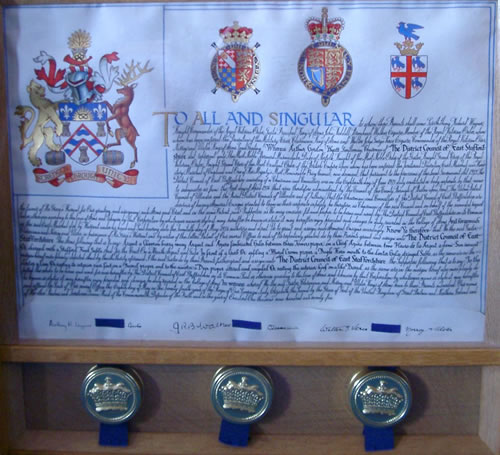
Transcription:
TO ALL AND SINGULAR to whom these Presents shall come. Sir Anthony Richard Wagner Knight Commander of the Royal Victorian Order Garter Principal King of Arms John Riddell Bromhead Walker Esquire members of the Royal Victorian Order upon whom has been conferred the Decoration of the Military Cross, Clarenceaux King of Arms and Walter John George Verco Esquire Commander of the Royal Victorian Order Norray and Ulster King of Arms send greeting! Whereas Arthur Gordon Wyatt Gentleman, Chairman of the District Council of East Staffordshire did represent unto The Most Noble Bernard Marmaduke, Duke of Norfolk, Knight of the most Noble Order of the Garter, Knight Grand Cross of the Royal Victorian Order, Knight Grand Cross of the Most Excellent Order of the British Empire, upon whom has been conferred the Territorial Decoration Earl Marshal and Hereditary Marshal of England and One of Her Majesty’s Most Honourable Privy Council, now deceased, that pursuant to the provisions of the Local Government Act 1972 The District Council of East Staffordshire consisting of a Chairman and Councillors was on the Eighteenth Day of June 1973 duly constituted a body corporate by that name to administer as from the First day of April 1974 that area theretofore administered by the Council of the County Borough of Burton upon Trent, The Urban District Council of Uttoxeter and the Rural District Councils of Uttoxeter and of Tutbury that the Chairman and the Councillors of the District Council of East Staffordshire are desirous of having Armorial Ensigns granted to them in their corporate capacity, he therefore, as Chairman of the said Council and on behalf of the same did request the favour of His Grace’s Warrant for Our granting and assigning such Arms and Crest and in the same Patent such Supporters as We may consider fit and proper to be borne and used by The District Council of East Staffordshire on its Common Seal or otherwise according to the Laws of Arms and likewise by that Corporation by whatsoever name or style it may hereafter be known or status it may hereafter enjoy provided such changes be duly recorded in the College of Arms and Foreasmuch as the said Earl Marshal did by Warrant under his hand and Seal bearing date the Twentieth day of May 1974 authorize and direct Us to grant and assign such Armorial Ensigns accordingly Know Ye therefore that We the said Garter Clarenceux and Norroy and Ulster in pursuance of His Grace’s Warrant and by virtue of the Letters Patent of Our several Offices to each of Us respectively granted do by these Presents grant and assign unto The District Council of East Staffordshire the Arms following that is to say:- Argent a Chevron barry wavy Argent and Azure fimbriated Gules between three Towers proper on a Chief Azure between two Fleur de lis Argent a demi-Sun issuant Or charged with a Stafford Knot Sable And for the Crest On a Wreath Argent and Gules In front of a Garb Or enfiling a Mural Crown proper a Bugle Horn mouth to the dexter Gules stringed Sable, as the same are in the margin hereof more plainly depicted And by the Authority aforesaid I the said Garter do by these Presents further grant and assign unto The District Council of East Staffordshrie the Supporters following that is to say:- To the dexter a Lion Or resting its interior rear foot on a Barrel proper and to the sinister a Deer proper attired and unguled Or resting the interior hoof on a like Barrel, as the same are in the margin hereof also more plainly depicted the whole to be borne and used forever hereafter by The District Council of East Staffordshire on its Common Seal or otherwise according to the Laws of Arms and likewise by that Corporation by whatsoever name or style it may hereafter be known or status it may hereafter enjoy provided such changes be duly recorded in the College of Arms In witness whereof We the said Garter Clarenceux and Norroy and Ulster King of Arms have to these Presents subscribed Our names and affixed the Seals of Our several Offices this Eighth day of May in the Twenty-fourth year of the Reign of Our Sovereign Lady Elizabeth the Second by the Grace of God of the United Kingdom of Great Britain and Northern Ireland and of hwer other Realms and Territories Queen, Head of the Commonwealth, Defender of the Faith and in the year of Our Lord One thousand nine hundred and seventy-five.
The new Coat-of-Arms was established as below.
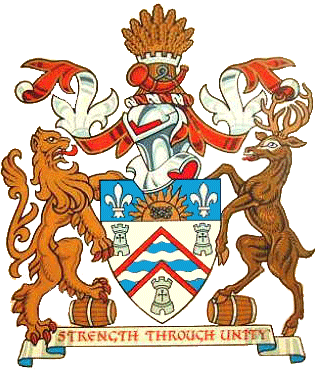
The white and blue waves, carried forward from the arms of the County Borough of Burton-upon-Trent, represent the rivers Trent and Dove. The towers allude to Tutbury. The rising sun depicts the direction “East” and the Staffordshire knot represents the County.
The fleurs-de-lys, also taken from the Burton arms, are from the arms of the Bass family which included Lord Burton, which inturn refer back to the dedication of the Abbey to Saint Mary.
The wheatsheaf represents the whole rich agricultural area around Uttoxeter, and the mural crown, symbol of civic government, is common to the crests of Burton and the County Council. The hunter’s horn symbolises Needwood Forest.
The lion is one of the County Council and England Supporters and the buck denotes the parkland and forest of East Staffordshire. The barrels or tuns are a further reference to Burton, the centre of British brewing.
In 1992, the District Council became a Borough Council. Sadly, the Coat-of-Arms has now largely fallen into disuse today and in all places where it would have traditionally appeared, when tradition stood for anything, it has now been replaced by the more ‘modern’ East Staffordshire Borough Council seen below.