Paget Family
Select page to view:
Paget Family
Select page to view:
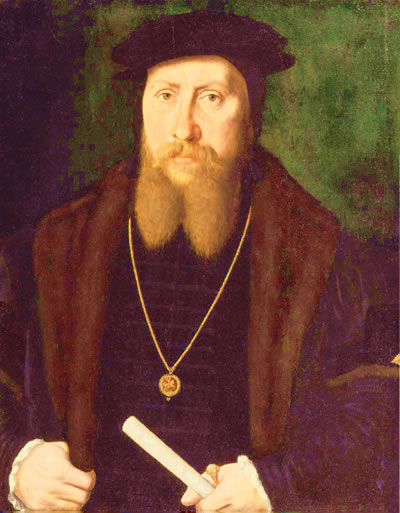 In Tudor times, William Paget was one of the most prominent men in England. Son of John, one of the serjeants-at-mace of the city of London, he was born in London in 1506. His father was said to have been of humble origin from Wednesbury, Staffordshire. Educated at St Paul’s School, and at Trinity Hall, Cambridge, proceeding afterwards to the university of Paris.
Probably through the influence of Stephen Gardiner, who had early befriended Paget, he was employed by Henry VIII in several important diplomatic missions; in 1532 he was appointed clerk of the signet and soon afterwards of the privy council. He acquired large estates from Henry VIII on the dissolution of the monasteries. He became secretary to Queen Anne of Cleves in 1539, and in 1543 he was sworn of the privy council.
A letter written by William Paget, clerk to the Privy Council, to Sir Thomas Wriothesley, Garter King-at-arms, dated 27 Jun 1541, only two days before Lord Dacre’s execution, tells that the Lord Chancellor and the Lords Sussex, Hertford and St. John, with Mr. Baker, consulted in the Star Chamber upon Lord Dacre’s case:
Sir, I am sent for to the Council, and must stay my writing until soon.
At my coming to the Star Chamber there I found a11 the lords, to the number of xvij assembled for a conference touching the lord Dacre’s case;. . . To Council they went, and had with them present the Chief Justices, with others of the King’s learned Counsel; and albeit I was excluded, yet they ‘spake so loud, some of them, that I might hear them notwithstanding two doors shut between us. Among the rest that could not agree to wilful murder, the Lord Cobham, as I took him by his voice, was vehement and stiff: Suddenly and softly they agreed, I wot not how, and departed to the Kings Bench together; whereas the lord Chancellor executing the office of High Steward, the lord Dacre pledd not guilty to the indictment, referring himself to the trial of his peers, and declaring, with long circumstances, that he intended no murder, and so purged himself to the audience as much as he might. And yet nevertheless afterward, by an inducement of the confession of the rest already condemned, declared unto him by the judge, he refused his trial, and, upon hope of grace (as I took it), confessed the indictment; which he did not without some insinuation. His judgment was to be hanged. It was pitiful to see so young a man by his own folly brought to such a case, but joyful to hear him speak at the last so wisely and show himself so repentant. . . . To-day after dinner the Council was with the King to declare lord Dacre’s humble submission, hoping thereby to move his Majesty to pardon him, which took no effect, for to-morrow shall. . . Mantel, Roydon, and Frowdes suffer, and the lord Dacre upon Wednesday. God have mercy upon them and give them grace to repent their evil doings and to take patiently their deaths.
He was Secretary of State with Thomas Wriothesley, Earl of Southampton, 1543 and 1544, and again with Sir William Petre, 1544 to 1547. Henry VIII in his later years relied much on his advice, named him as one of the executors of his will, and appointed him one of the council to act during the minority of Edward VI.
Influential in Edward Seymour’s plot to become Protector of Edward VI, Paget at first vigorously supported the Protector Somerset, while counselling a moderation which Somerset did not always observe. In 1547 he was made comptroller of the King’s household, Chancellor of the Duchy of Lancaster, and a Knight of the Garter; and in 1549 he was summoned by writ to the House of Lords as Baron Paget de Beaudesert. About the same time he obtained extensive grants of lands, including Cannock Chase and Burton Abbey in Staffordshire, and in London the residence of the bishops of Exeter, afterwards known successively as Lincoln House and Essex House, on the site now occupied by the Outer Temple in the Strand. He also obtained Beaudesert in Warwickshire, which remained the chief seat of the Paget family. Paget shared Somerset’s disgrace, being committed to the Tower in 1551 and degraded from the Order of the Garter in the following year, besides suffering a heavy fine by the Star Chamber for having profited at the expense of the Crown in his administration of the duchy of Lancaster. He was, however, restored to the King’s favour in 1553, and was one of the twenty-six peers who signed the device of King Edward; was one of Jane Grey’s Privy Councillors, but signed a proclamation in support of Mary shortly after. He made his peace with Queen Mary, who reinstated him as a Knight of the Garter and in the privy council in 1553, and appointed him Lord Privy Seal in 1556. William Paget openly suggested to marry Edward Courtenay to Elizabeth; but Courtenay had rejected it, on the grounds that it would be beneath the dignity of one of his unblemished lineage. On the accession of Elizabeth I in 1558 Paget retired from public life.
By his wife Anne Preston he had six daughters and five sons, the two eldest of whom, Henry and Thomas, succeeded in turn to the peerage. The Pagets’ marriage was close, and William’s fellow-councillors had on occasion appealed to her influence with him, just as she had appealed to them on his behalf in 1552. Lady Paget was not an especial favourite of Queen Mary, though she was chosen to escort her in the coronation procession.
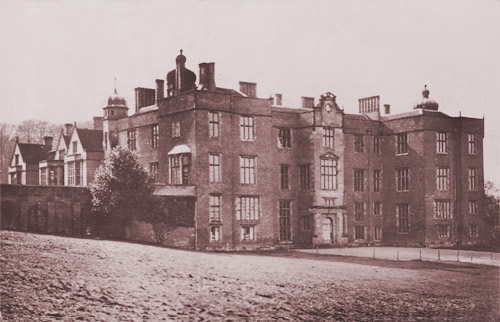
The Paget family’s main residence was Beaudesert House in Cannock Chase. But before this was built, they often occupied the Manor House within the precincts of the former Burton abbey.
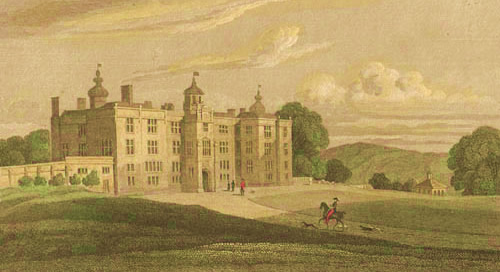
When they stayed there, they lived in grand style. An inventory of c. 1580 shows that there were over 60 rooms, many handsomely furnished. On occasion, the household staff numbered 75 persons, and in the first week of Jan of that year, there were 14 guests staying in the house, including the sheriff of Staffordshire.
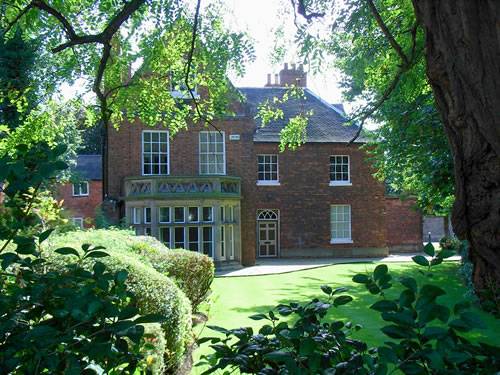
When Burton Abbey was granted to its new owner in 1546, William Paget began planning to expand the Manor House, known to have existed since at least 1514, into a grand mansion. A plan of 1562 shows that the house was to have three storeys and a long gallery. To provide the materials for this project, the old abbey buildings were to be cannibalised. There were major alterations to the house over the next three centuries. The present building, still very much in evidence close to the Market Place, is mainly of brick but was formerly of stone, and timber-framed. The attic probably has the most exceptional medieval roof in Burton. The early 19th century range probably occupies the site of a medieval open hall, and parts of the building still date back to the original building.
Sir William died in 1563. After his death, after being implicated in Catholic plots against the Queen, the manor house along with most of the family estates were confiscated, ended the Pagets’ interest in the Manor House.
It was leased to Richard Almond in 1612 by which time some of the former Abbey buildings incorporated into the house were in a very bad state of repair.
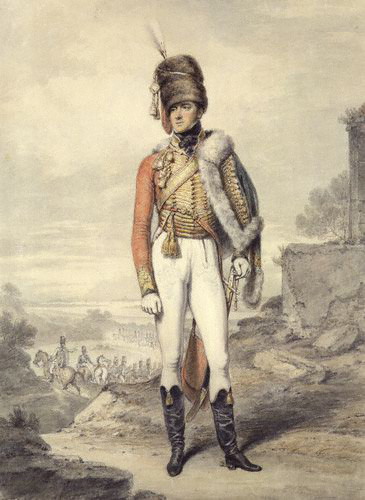 Field Marshal Henry William Paget, 1st Marquess of Anglesey KG, GCB, GCH, PC (17 May 1768 – 29 April 1854), known as Lord Paget from 1784 to 1812 and as the Earl of Uxbridge from 1812 to 1815, was a British military leader and politician, now chiefly remembered for leading the charge of the heavy cavalry against d’Erlon’s column during the Battle of Waterloo. He also served twice as Master-General of the Ordnance and twice as Lord Lieutenant of Ireland.
Born in London, as Henry Bayly (his father assumed the name Paget in 1770), he was the eldest son of Henry Paget, 1st Earl of Uxbridge, by his wife Jane, daughter of the Very Reverend Arthur Champagné, Dean of Clonmacnoisie, Ireland. The Hon. Sir Arthur Paget, General the Hon. Sir Edward Paget and Vice-Admiral the Hon. Sir Charles Paget were his younger brothers. He was educated at Westminster School and Christ Church, Oxford.
Paget entered parliament in 1790 as member for Carnarvon, a seat he held until 1796, and then represented Milborne Port between 1796 and 1804 and again between 1806 and 1810.
At the outbreak of the French Revolutionary Wars, Paget raised the regiment of Staffordshire volunteers and was given the temporary rank of lieutenant-colonel in 1793. As the 80th Foot, the corps took part in the Flanders campaign of 1794 under Paget’s command. In 1795 he was made a lieutenant-colonel of the 16th Light Dragoons; in that same year, he married the daughter of the Earl of Jersey. In 1796 he was made a colonel, and by 1801 he had become colonel of the 7th Light Dragoons. In 1802 he was promoted major-general, and six years later lieutenant-general. He commanded the cavalry for Sir John Moore’s army during the Corunna campaign, wherein his troopers provided excellent rear-guard defence during the long retreat. The British cavalry showed a distinct superiority over their French counterparts at the action of Sahagun and routed the Chasseurs a Cheval of the Imperial Guard at Benevente.
This was his last service in the Peninsular War, because his liaison with Lady Charlotte, the wife of Henry Wellesley, afterwards Lord Cowley, made it impossible subsequently for him to serve with Wellington, Wellesley’s brother. His only war service from 1809 to 1815 was in the disastrous Walcheren expedition (1809), in which he commanded a division. In 1810 he was divorced and then married Lady Charlotte Wellesley, who had about the same time been divorced from her husband.
In 1815, he was appointed cavalry commander in Belgium, under the still resentful eye of Wellington. On the eve of Waterloo, Paget had his command extended by Wellington so as to include the whole of the allied cavalry and horse artillery. He handily covered the retirement of the Anglo-Allies from Quatre Bras to Waterloo on 17 June, and on 18 June led the spectacular cavalry charge of the British centre, which checked and in part routed D’Erlon’s corps d’armée (see Waterloo campaign).
One of the last cannon shots fired that day hit Paget in the right leg, necessitating its amputation. According to anecdote, he was close to Wellington when his leg was hit, and exclaimed, “By God, sir, I’ve lost my leg!” — to which Wellington replied, “By God, sir, so you have!” According to his aide-de-camp, Thomas Wildman, during the amputation Paget smiled and said, “I have had a pretty long run. I have been a beau these 47 years and it would not be fair to cut the young men out any longer.”
He was to have an articulated artificial limb fitted by James Potts. Lord Uxbridge’s amputated leg had a somewhat macabre after-life.
Paget was appointed a Knight Grand Cross of the Order of the Bath in January 1815, and on 4 July 1815, just over two weeks after Waterloo, the Prince Regent created him Marquess of Anglesey. He was also made a Knight of the Order of St George of Russia and a Knight of the Order of Maria Theresa of Austria the same year. In 1816 he was also apppointed a Knight Grand Cross of the Royal Guelphic Order and in 1818 he was made a Knight of the Garter. A 27m high monument to his heroism (designed by Thomas Harrison) was erected at Llanfair PG on Anglesey, close to his country retreat at Plas Newydd, in 1816. A separate monument to his leg was erected at Waterloo but the bones were later disinterred and put on display.
In 1819 Anglesey became full general, and at the coronation of George IV, he acted as Lord High Steward of England. His support of the proceedings against Queen Caroline made him for a time unpopular, and when he was on one occasion beset by a crowd, who compelled him to shout “The Queen!”, he added the wish, “May all your wives be like her.” In April 1827, he became a member of the Canning administration, taking the post of Master-General of the Ordnance and becoming a member of the Privy Council. Under the Wellington administration, he accepted the appointment of Lord Lieutenant of Ireland (March 1828).
In December 1828, he addressed a letter to the Roman Catholic primate of Ireland stating his belief in the need for Catholic emancipation, which led to his recall by the government; on the formation of Earl Grey’s administration in November 1830, he again became lord-lieutenant of Ireland. In July 1833, the ministry resigned over the Irish question, he spent thirteen years out of office, then joined Lord John Russell’s administration in July 1846 as master-general of the ordnance, finally retiring in March 1852 with the rank of field-marshal and colonel of the Royal Horse Guards. He also held the honorary posts of Lord Lieutenant of Anglesey between 1812 and 1854 and Lord Lieutenant of Staffordshire between 1849 and 1854.
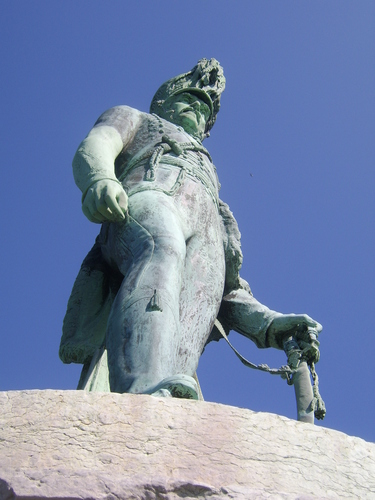
As well as the long name, the village of Llanfairpwll on the island of Anglesey is also locally famous for the Marquess of Anglesey Column. It is 90 feet high and was erected as a tribute in 1817.
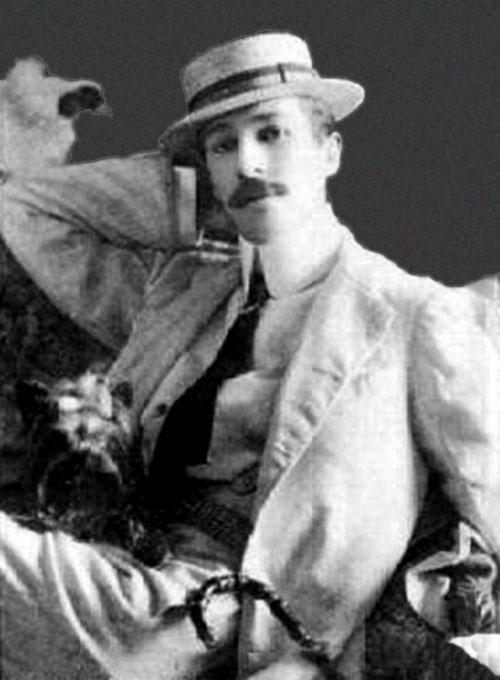 (known until 1880 by the courtesy title of Lord Paget de Beaudesert and from 1880 until 1898 as Earl of Uxbridge)
(16 June 1875 – 14 March 1905) was a British Peer who was notable during his short life for squandering his inheritance on a lavish social life and accumulating massive debts. Regarded as the “black sheep” of the family, he was nicknamed “the dancing marquess” for his habit of performing “sinuous, sexy, snake-like dances”. He blew the equivalent of half-a-billion pounds on jewelled costumes and lavish lifestyle.
The Complete Peerage says that he “seems only to have existed for the purpose of giving a melancholy and unneeded illustration of the truth that a man with the finest prospects, may, by the wildest folly and extravagance, as Sir Thomas Browne says, ‘foully miscarry in the advantage of humanity, play away an uniterable life, and have lived in vain.'”
Paget was the eldest son of the 4th Marquess by his father’s second wife, Blanche Mary Boyd. Rumors persisted, however, that his biological father was the French actor Benoît-Constant Coquelin, a rumor that gained currency when, after the death of his mother in 1877, when he was two years old, Paget was raised by Coquelin’s sister in Paris until he was eight. His stepmother, from 1880, was an American, Mary Livingston King, the widow of the Hon Henry Wodehouse.
He attended Eton College, later receiving private tuition, and enlisted as a Lieutenant in the 2nd Volunteer Battalion of the Royal Welsh Fusiliers; on 20 January 1898 he married his cousin Lilian Florence Maud Chetwynd (1876—1962). Upon the death of his father on 13 October 1898, he inherited his title and the family estates with about 30,000 acres in Staffordshire, Dorset, Anglesey and Derbyshire, providing an annual income of £110,000.
Paget swiftly acquired a reputation for using his money to throw lavish parties and even more extravagant theatre performances. The most notable of these was a performance of Shakespeare’s Henry V, in which Paget himself played the title role. His wife disapproved of his lifestyle and obtained a decree nisi of divorce on 7 November 1900; it was later annulled due to nonconsummation, according to Lady Anglesey’s grandson by her second marriage, the historian Christopher Simon Sykes. The breakdown of his marriage effectively gave Paget more freedom to enjoy his self-indulgent lifestyle. By this stage he had already begun to mortgage his estates to raise money.
On 10 September 1901, Paget’s French valet Julian Gault took the opportunity of his employer’s absence at the theatre to steal jewellery to the value of £50,000. At the time, Paget was living in the Walsingham House Hotel in London. Gault, who was later arrested at Dover, testified in court that he had been instructed to steal the jewels by a French woman of his acquaintance called Mathilde (who had taken the jewels to France and was never found). Although Gault’s testimony was believed to be true, he pleaded guilty at the Old Bailey on 22 October and was sentenced to five years imprisonment.
By 1904, despite his inheritance and income, Paget had accumulated debts of £544,000 and on 11 June was declared bankrupt. His lavish wardrobe and jewels were sold to pay creditors, the jewels alone realising £80,000.
In 1905, Paget died in Monte Carlo following a long illness, with his ex-wife by his side, and his remains were returned to Llanedwen for burial. The Times reported that despite all that was known of him, he remained much liked by the people of Bangor who regretted to hear of his death. Lilian, Marchioness of Anglesey, married, in 1909, John Francis Grey Gilliat, a banker, by whom she had three children.
The title was passed down to his cousin Charles Henry Alexander Paget; subsequent holders of the title attempted to suppress the story of the “dancing marquess”.