Menu Close

1322 Battle of Burton Bridge

The 10th March, 1322 was not a great for Burton; it came under heavy attack and much of it was destroyed. Even so, it is quite an exciting thought that the invasion troops were led by the King Edward II of England himself and of him riding into Burton on his charger.

The story starts with Thomas Plantaganet, earl of Lancaster (1278-1322), who was the grandson of King Henry III. After marrying Alice, daughter and heiress of the Earl of Lincoln, the earldom of Derby was added to those he already owned and with it came Tutbury Castle.

Thomas didn’t much like his cousin Edward II and felt that he would make a much better King himself. He became one of the leaders of the baronial opposition to the King; he also sided with the Scots against him. This was confirmed to the King when Robert Bruce ravaged the north of England but the Earl of Lancaster’s lands were among those spared.

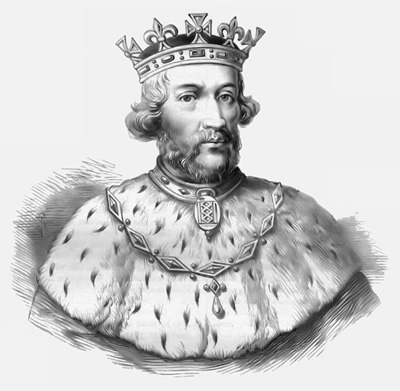
In retaliation, King Edward II (pictured) decided that he would lead an attack against Tutbury Castle and assembled an army in London.

Hearing of this, Thomas returned to Tutbury with his own army of 30,000 men. Knowing that Burton Bridge was the only crossing over the river Trent for many miles in either direction and therefore sure to be the route taken by the King, he put much of his defensive effort into fortifying it on the Burton side. The King however, received the advice that there was a little known passable ford at Walton a few miles upstream. He therefore sent a decoy force to look as large as possible while the main body of soldiers crossed at Walton to lauch an attack on Burton from the direction of Branston.

Thomas was caught by surprise and was heavily defeated at the Battle of Burton Bridge on 10th March, 1322 and retreated to Tutbury Castle, leaving most of Burton in flames. Tutbury Castle was later looted and damaged but not destroyed.

Thomas was expecting reinforcements from his Scottish allies to join him at Tutbury but they didn’t show up so he was forced to escape over the Dove and flee north back to his seat and main residence at Pontefract Castle.

On 16 March, Lancaster and his army had reached Boroughbridge by the River Ure. There they were cut off by the forces of Sir Andrew Harclay, a veteran from the Scottish wars, who had gathered the levies from the counties of Cumberland and Westmorland.

With no more than 700 knights and men-at-arms in the rebel army and over 4,000 soldiers in the royal army, Lancaster initially tried to negotiate, but Harclay could not be swayed. The ‘Battle of Boroughbridge’ ensued but the battle was short and one-sided.

The captured earl of Lancaster was escorted back to Pontefract where he was condemned to death as a traitor and beheaded by sword in front of a jering crowd on 22nd March, 1322, just twelve days after his battle at Burton. This might have been considered a lenient sentence because traitors were more commonly drawn and quartered first!

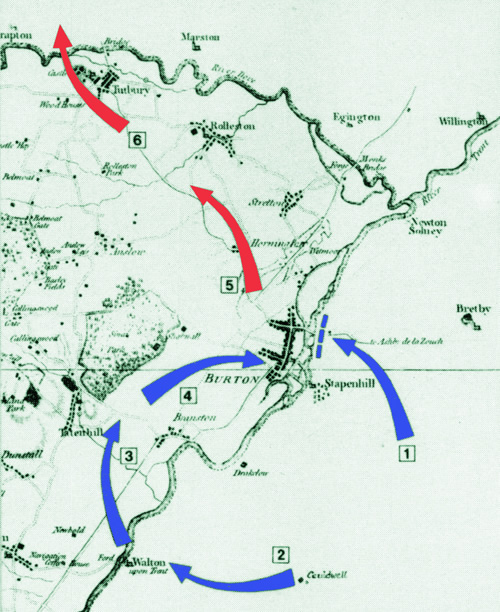
Battle Map Key:
1: On the 5th/6th of March, 1322, the first royal troops build up and attack of the bridge which was successfully repulsed. Edward II arrived in person via Cauldwell on 10-11 March.

2, 3, 4: Learning of the crossing at Walton, a diversory force was left to appear as large as possible while the main force, including Edward II, crosses at Walton to attack Burton from the West.

5: The surprised earl of Lancaster’s troops set fire to as much of the Burton as they can before fleeing North.

6: Lancaster’s troops cross the river Dove retreating back towards Pontefact, losing or hiding a chest reputedly containing a large proportion of 300,000 coins intented to pay the army.

The unfortunate Burton was left sacked, requiring it to be almost completely re-built.

Thomas was remembered as a defender of popular liberties and buried in a tomb at Pontefract. There was also an effigy of him in St Paul’s Cathedral, London. He left no children and his titles and estates were forfeited to the crown but in 1323, his younger brother, Henry Plantaganet, successfully petitioned to take over the earldom of Leicester.

King Edward II was deposed and murdered in 1327 (although modern history favours that this was a ‘fake death’). Regardless, the throne was passed to his son, Edward III, who wrote to the pope numerous times requesting the canonisation of Thomas but this was rejected.

After Edward II’s death, Edward III’s parliament posthumously reversed Thomas’s conviction so Henry Plantagenet  took possession of the Earldoms of Lancaster, Derby, Salisbury and Lincoln making him the new owner of, among many things, Tutbury Castle.

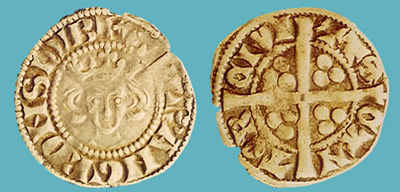
A large hoard of gold and silver coins hidden in three small barrels was discovered by workmen in 1831, the equivalent of well over £250,000 today, is thought to have been the payment from the Earl to his troops and Scottish allies, hidden in the bank of the river Dove as he fled for Pontefract where they remained undiscovered for over 500 years. The above example coin was one of the newest and depicts Edward II’s father King Edward ‘Longshanks’ I.

1643 Battle of Burton Bridge

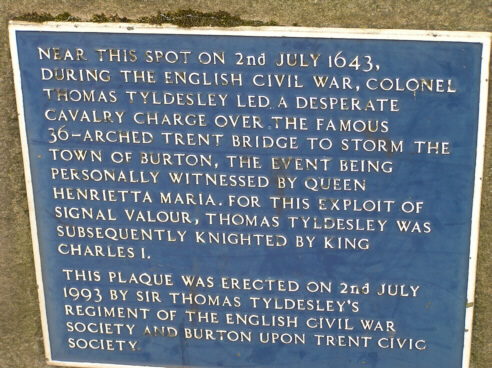
In 1643, during the English Civil War, Burton Bridge was the scene of what is probably the most famous local battle; ‘The Battle of the Bridge’. Thomas Tyldesley, a supporter of Charles I and a Royalist commander at the time having the rank of Colonel, led a cavalry charge across the bridge to attack Burton, which had become a Roundhead stronghold.

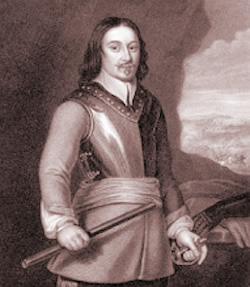
The event is reported to have been witnessed by Queen Henrietta Maria, wife of Charles I. It is largely because of the success of this attack against the odds that Thomas Tyldesley (above) was knighted. A plaque to commemorate the event was erected on the replacement bridge by the Burton Civic Society in 1993. It is still there today but goes largely unnoticed.

The bridge was also documented to be the site of a battle in 1322, between Thomas Plantaganet, Earl of Lancaster, who owned among other things Tutbury Castle, and the forces of Kind Edward II.

The medieval bridge, described by Robert Plot in the 1680s as ‘the most noteworthy example of civil building in Staffordshire, or perhaps even, the whole of England’. By 1790 this had changed to ‘a bridge of not very stately appearance’. There was no footpath, but at every buttress of the wall there was a recess to provide a passing place which was becoming an increasing problem.

Old Trent Bridge

The Nineteenth Century


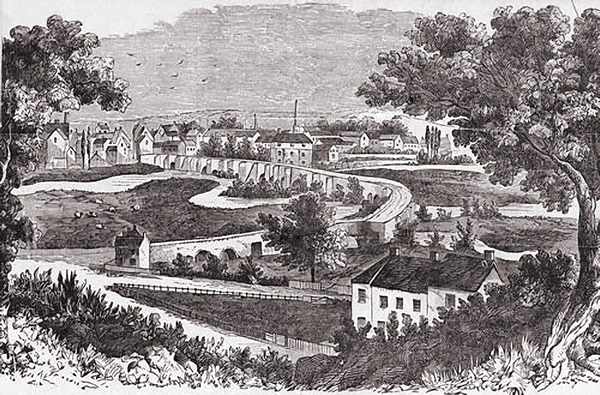
The first picture has made its way into many publications and, though a pictorial representation from 1800, it has proved to be a useful resourse in tracing the course of the old bridge, famous in its heyday for its thirty-six arches. The course of the river can also be seen to have changed quite a lot since this time.

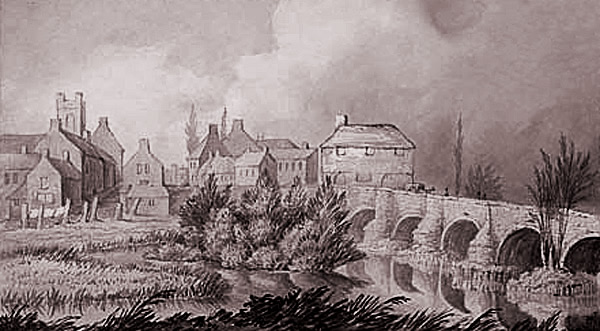
The above painting of them Old Trent Bridge was painted in 1840 and, although anonymous, provides an excellent insight. Most of what is there can be authenticated so it seems to offer a fairly accurate picture of how the bridge appeared at the time viewed from the Stapenhill end.

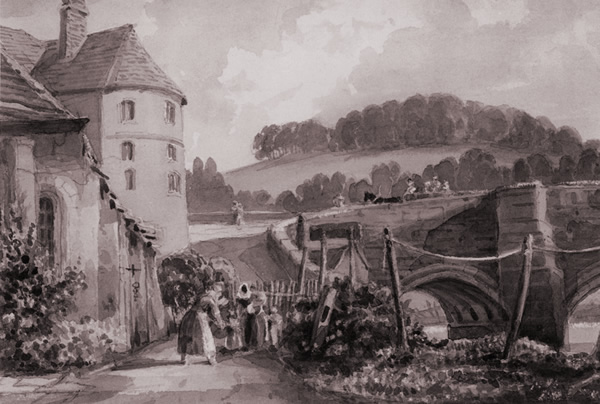
The above image shows the painting ‘Burton Bridge’ by John Harden (1772-1847). Although quite a lot of artistic license has been applied with, for example, Scalpcliffe hill being completely relocated and wooded, the fact that it is accurately dated as 1844 makes it a nice inclusion here.

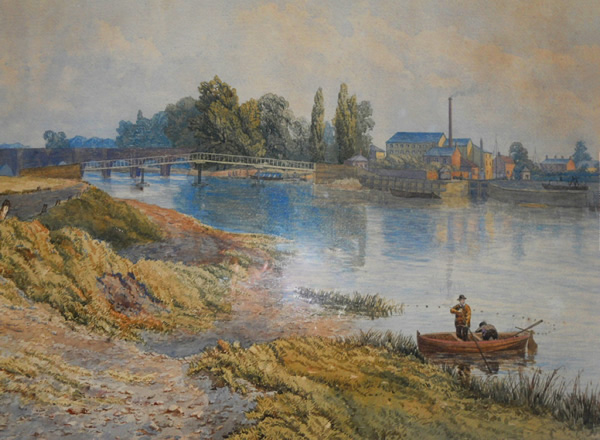
The above 1857 painting of Burton Bridge by William Wilde, though not very detailled, illuminates a couple of very interesting features. Firstly, the separate footbridge, and secondly, the lock gate with a few boats in a key on the other side.

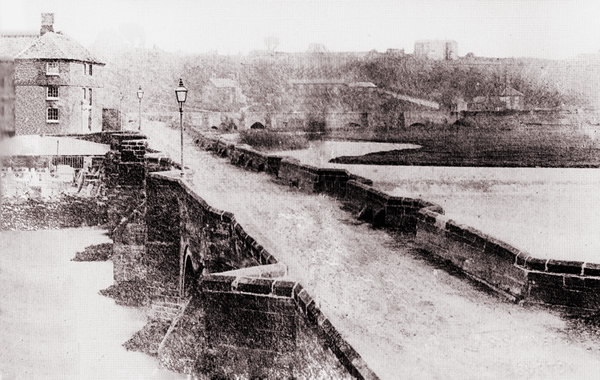
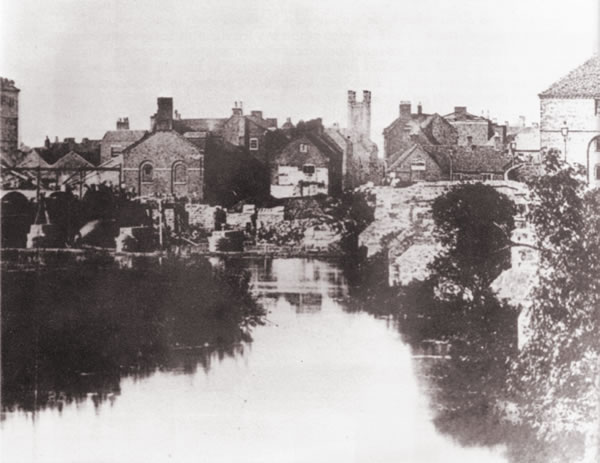
Although not of great quality, the above image shows an excellent view of the Old Trent Bridge and is one of the earliest surviving actual photographs.

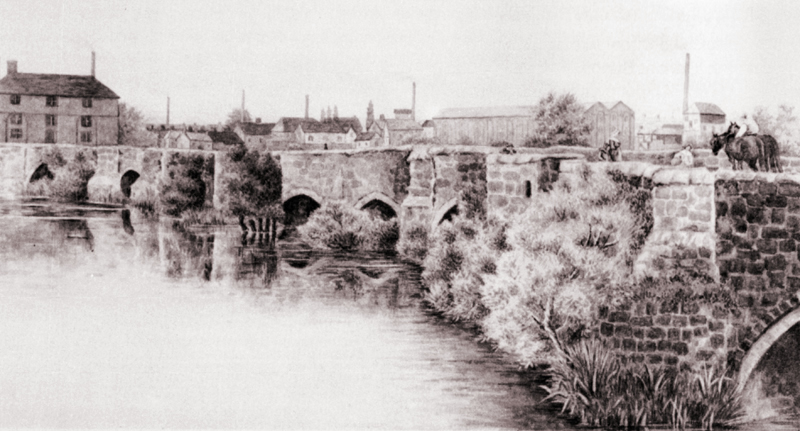
The above is one of the most illustrative paintings of the ‘old’ Burton Bridge.

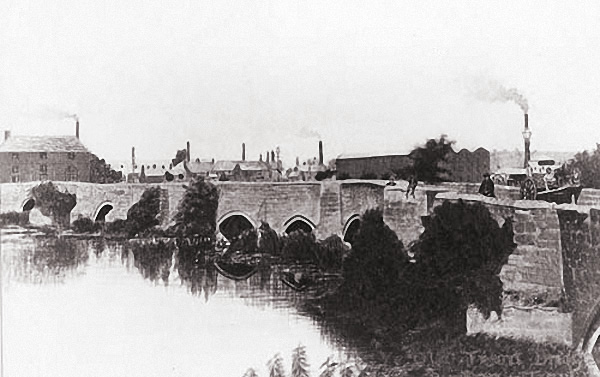
…and the orignal picture on which the painting is based, which provides one of the best surviving images of the bridge towards the end of its life.

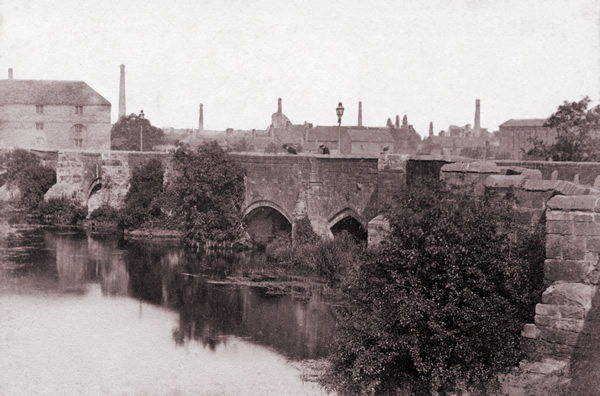
Above, a lovely picture thanks to Robin Clay that shows the bridge perfectly as it approached the end of its life.

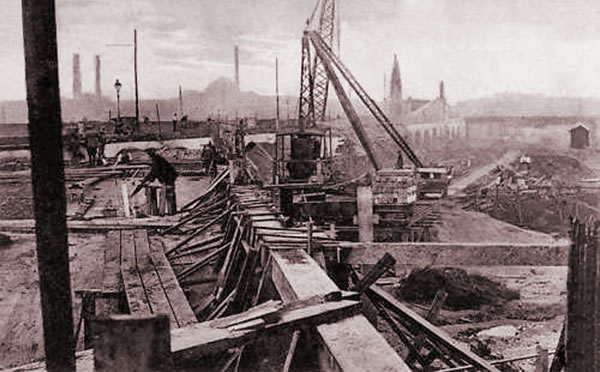
Above shows the commencement of the new replacement bridge in 1863. The foundation stone close to the initial site, which can just be made out on the left, was laid by Mr John Richardson, the High Bailiff of Burton. To the right is the old bridge still in use. In-between is Bridge Steet with building which still exist.

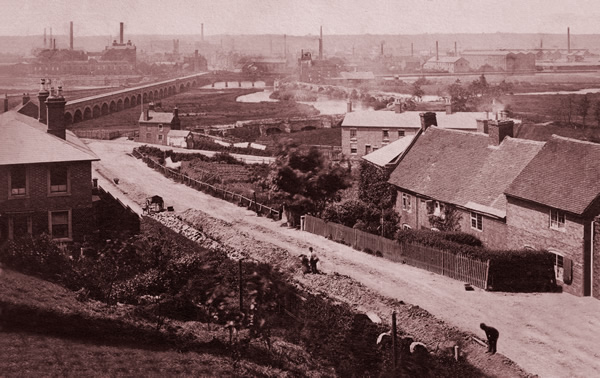
Finally, a remarkable photo capturing the brief period when both Trent Bridges co-existed. The newly finished straight bridge can be seen in its familar place, although only 40 feet wide before being later widened to twice its width.  On the north side, to its right in the photo, the old bridge with its much less direct course can be clearly seen.

New Trent Bridge (1864)

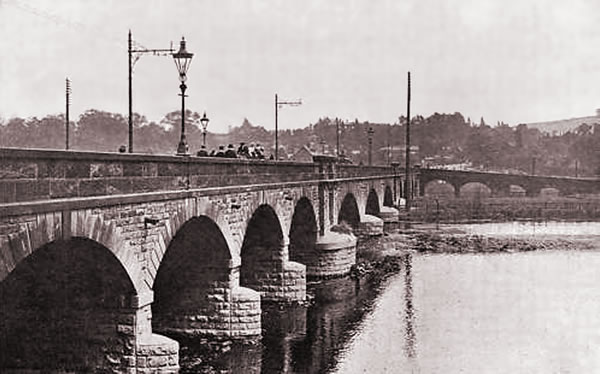
A new bridge was apparently under consideration in 1840, and in 1853 plans for one were submitted by the county surveyor, James Trubshaw, who described the existing bridge as enjoying ‘the threefold distinction of being the longest, the most ancient, and the most inconvenient structure of its kind in the United Kingdom’. Nothing was done until 1859 when the Midland Railway Company, which wanted to lay tracks across the west end of the bridge, promoted an Act which authorised its demolition and the construction of a new bridge, forming a straight line between the existing ends and straddling Broad holme. The medieval bridge was gradually dismantled after the new bridge was opened in 1864.

Designed by the Midland Railway Company engineer, J.S.Crossely, the 1864 bridge was paid for by the Marquis of Anglesey, as lord of Burton manor, and the Midland and other railway companies. Under the 1859 Act responsibility for its maintenance passed from the Marquis to the counties of Staffordshire and Derbyshire, and it remained their joint responsibility until the Derbyshire side of the river was transferred to Staffordshire in 1894. The burden later passed to Burton corporation under an Act of 1896.

On the 23rd of February, 1863, the foundation stone of our present Trent Bridge was laid, and on the 22nd of June, 1864, a general holiday was proclaimed and the opening ceremony was performed by the Marquis of Anglesey at the head of a long and imposing procession, consisting of the yeomanry, the volunteers, principal inhabitants of the town, followed by many others. The bridge, unlike its predecessor, ran in a straight line across the river. It is 460 yards long, and consists of two causeways each five feet wide, and a roadway 20 feet wide. Each side of the bridge has a wall 3 feet high. There are 29 arches.

For a very brief period after the new bridge was completed, both bridges existed before the old bridge was demolished. The below photo shows BOTH bridges with the brand new one just completed and the old one to its right.

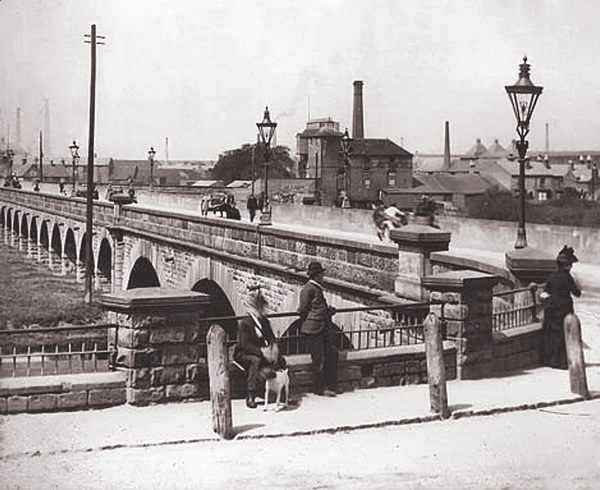
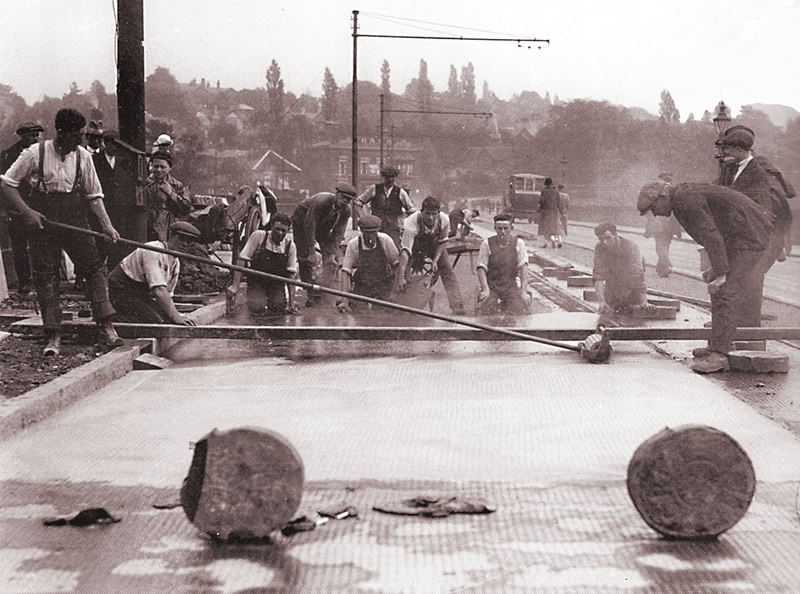
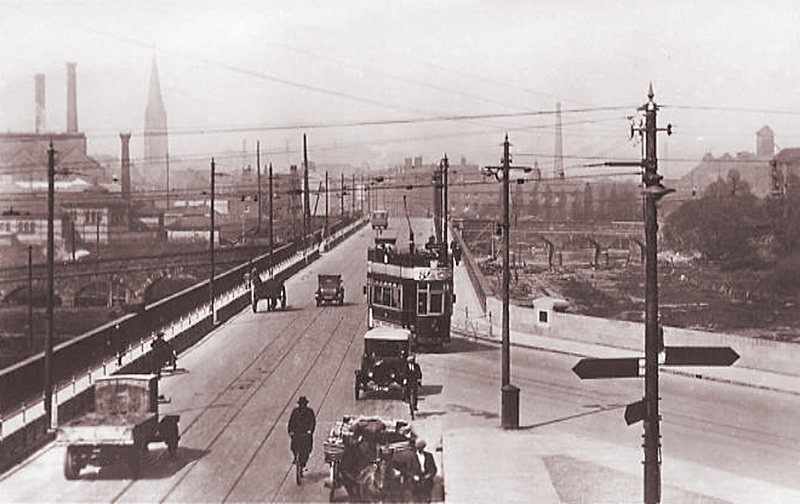
Originally 40 feet wide, including footways of five feet on either side of the road. The bridge was widened on its north side; this was completed in 1926.

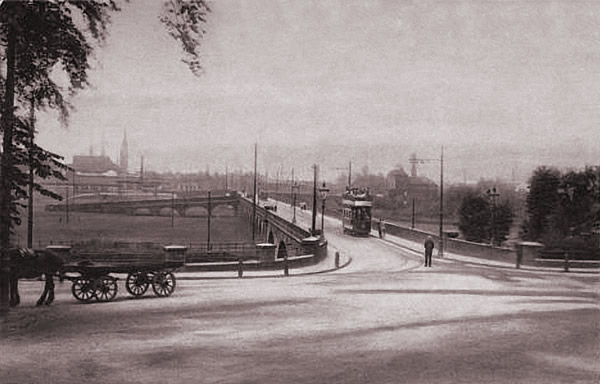
The bridge as shown above, shows Burton before the arrival of the tramway system. This photograph is also taken a few years before the Ferry Bridge was built making it the only option to the Stapenhill Ferry for crossing the river.

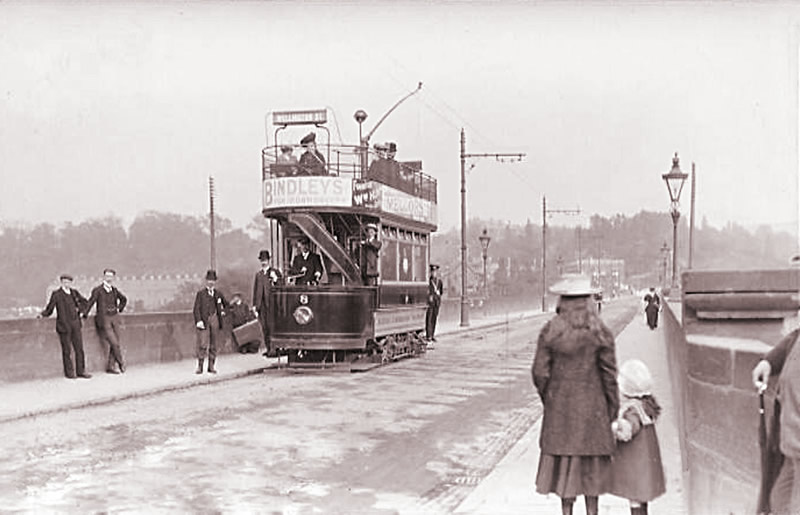
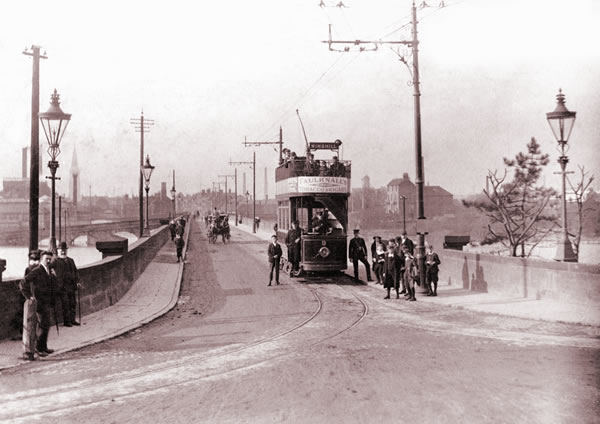
The trams arrived, making for this proud posed photo which later became the subject of a Burton postcard.

Notice that there is only one set of tracks. Winshill and Stapenhill trams had to co-ordinate in both directions so as not to end up in an embarassing head-to-head.

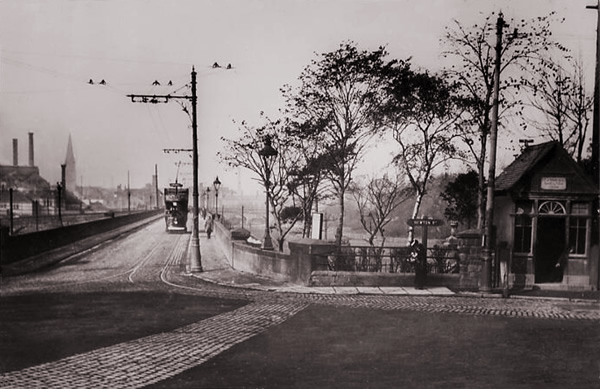
The above photo from 1908 shows what a tranquil place the ‘Swan Junction’ could be.

The tram is clearly approaching, but will it suddenly veer for Stapenhill or Winshill?

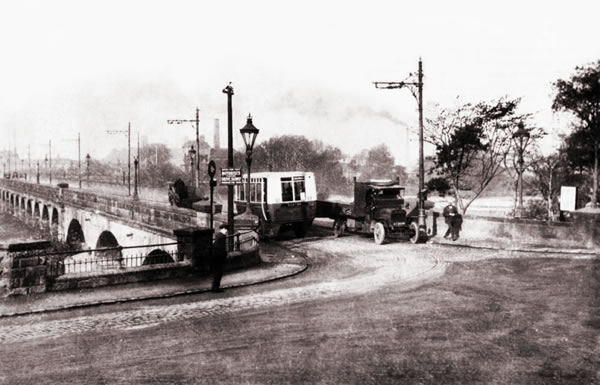
Before the bridge was widened and with the trams still in service, the increasing variety of modes of transport added to the confusion.

… and the bridge still remained much used by pedestrians.

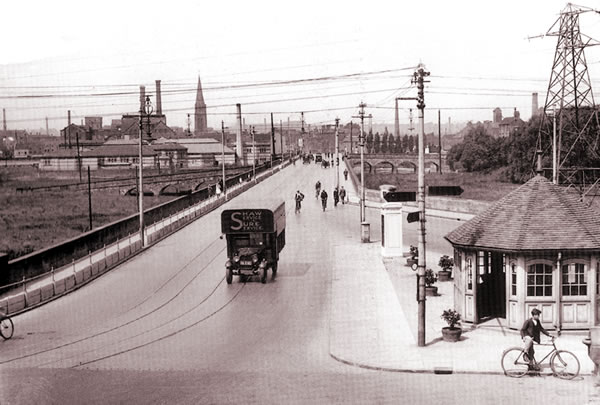
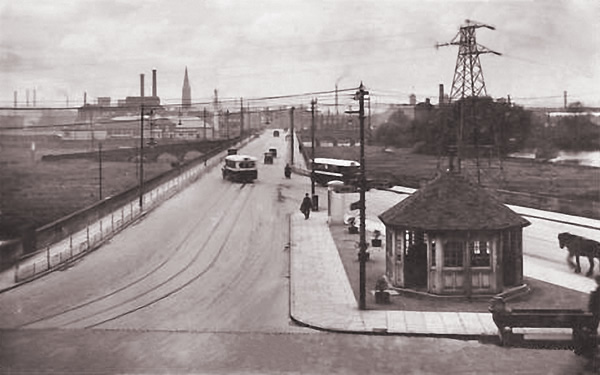
The much needed bridge widening was completed in 1926 making it twice as wide.

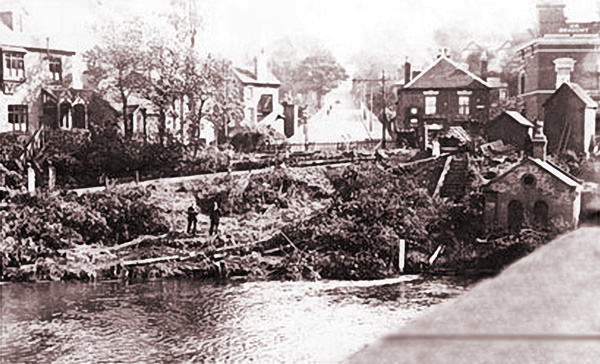
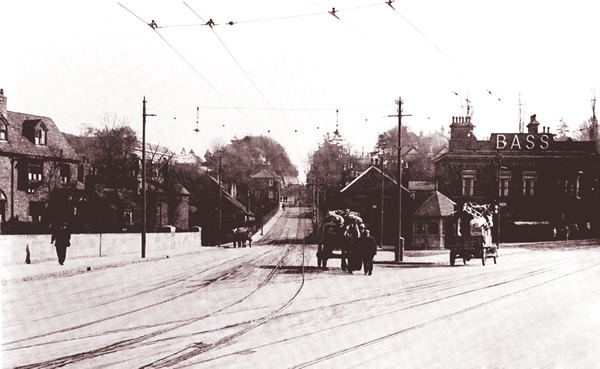
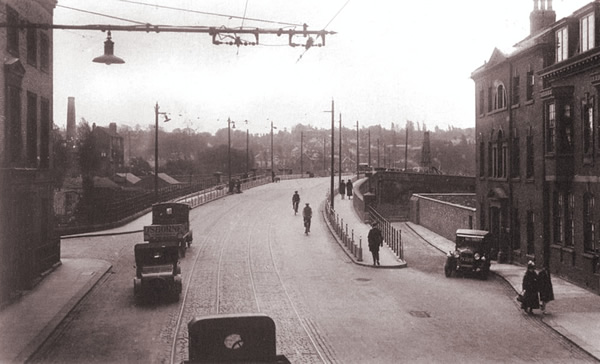
The above photo shows the view from the bridge looking up Bearwood Hill in 1910

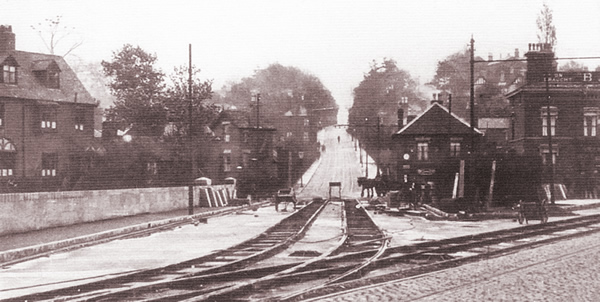
Following a serious tram accident in 1919 where a tramcar ran out of control down Bearwood Hill over-turned after being de-railed at the sharp corner at the bottom, the Winshill end of the Trent Bridge was modified to provide a straight run.

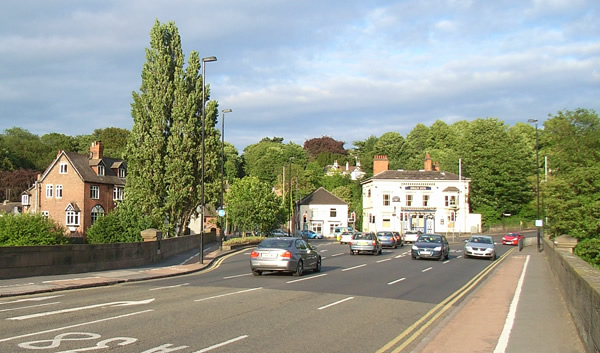
For many years, Bearwood Hill up into Winshill felt like an extension of the bridge.

The widening is simply taken for granted now as today’s traffic simply flows into the Winshill filter lane. Trees and pedestrian area now effectively break up the view up Bearwood Hill making it feel like a much more minor route.

From bicycle delivery boy to boy racers in ‘modern’ sports cars – everyone enjoyed the space just after the widening. Some must have questioned whether it was really necessary.

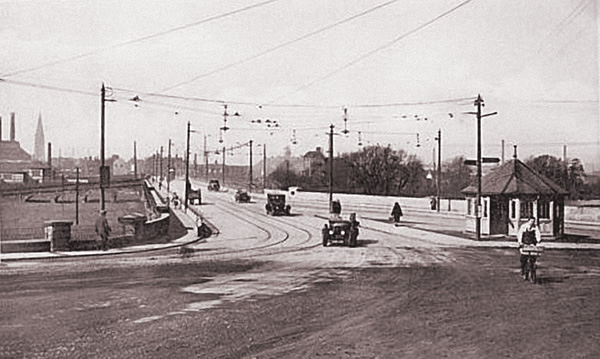
As time went on, it got busier and can be seen here being shared by bicycles, hand carts, horse drawn cars, motor cars, early lorries and electric trams.

Note also, the substancial barriers to protect foot pedestrians from such a commotion.


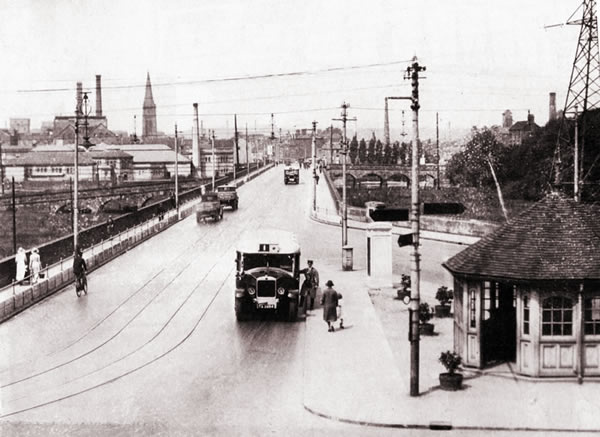
Even I can just about remember the distinctive shelter as a boy, and on rainy days, timing a dart across the road to catch an approaching number 3 or 4 bus up into Winshill, although everything around it was a little different. The overall impression is that this end of the Trent Bridge used to me much wider than currently which of course, it can’t have been.

By far the majority of photos of the Trent bridge are taken at the more picturesque Winshill end. Below is a much rarer photo from the Bridge Street end in taken in 1928 in the short period between the widening of the bridge in 1926 and closure of the Tramway system in 1929. It is still a very recognisable view.


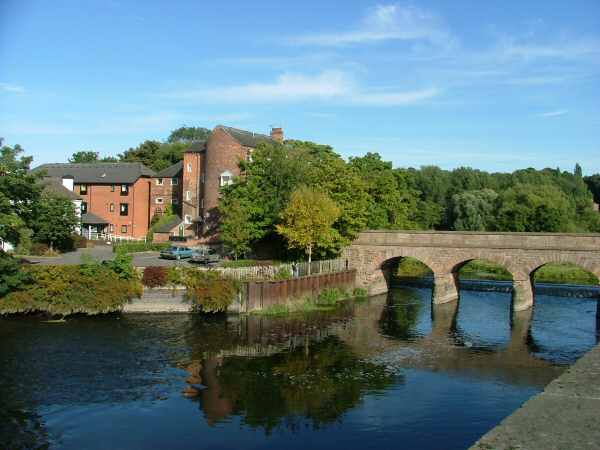
The bridge remains one of Burton’s most characteristic features.

Burton General Post Office

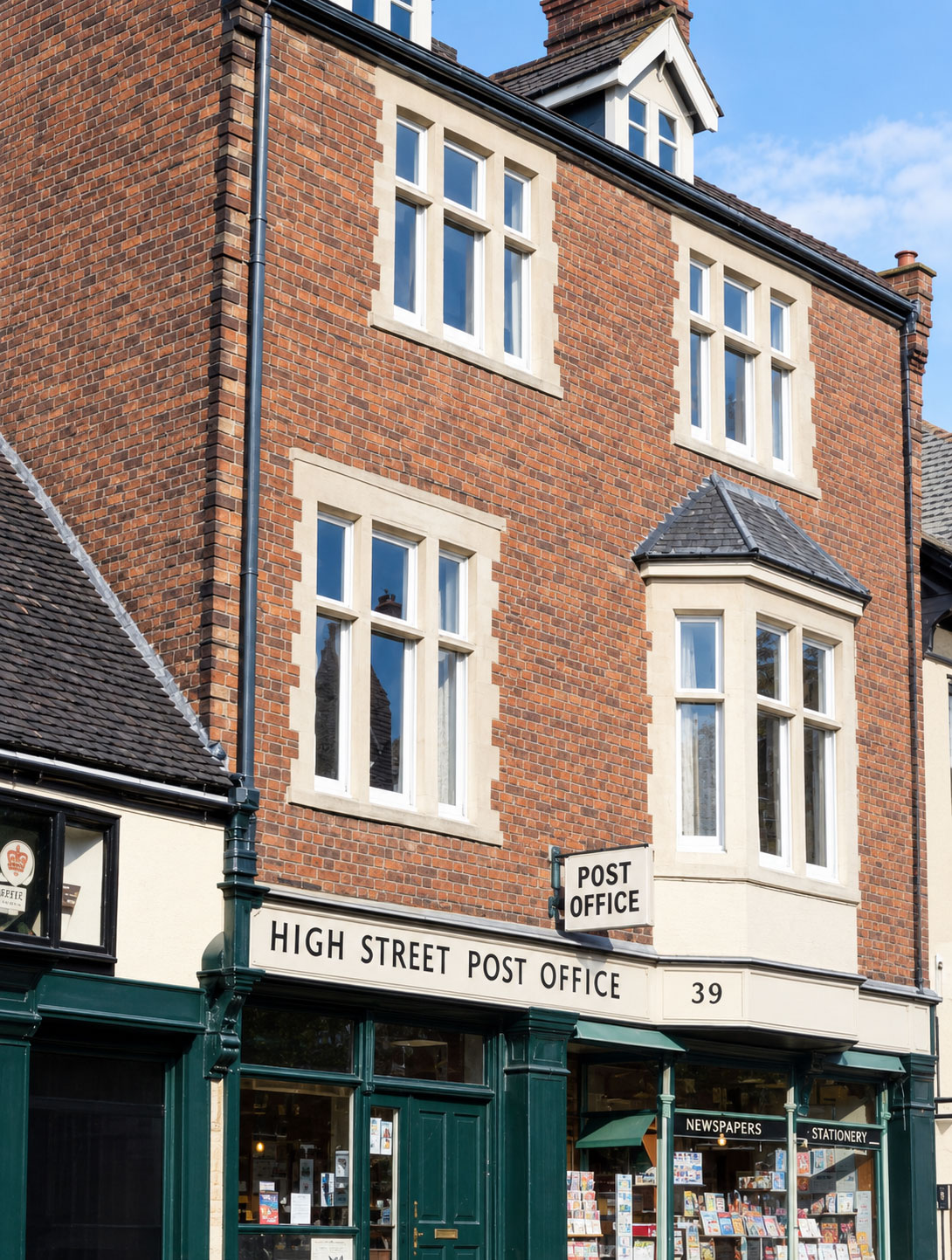
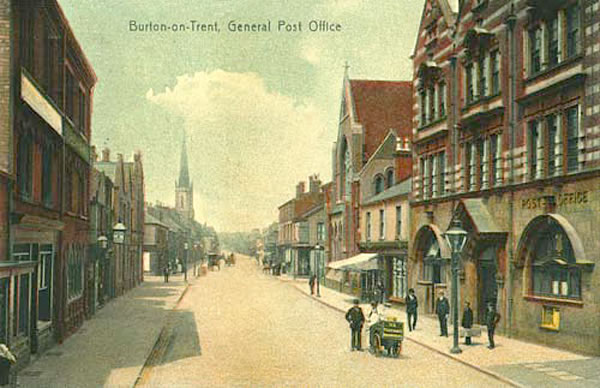
The first recorded Burton postmark was in 1722 although the nearest sorting office was in Lichfield. Burton would not get its own until Post Office for well over another hundred years! The first Post Office was established at 39 High Street.

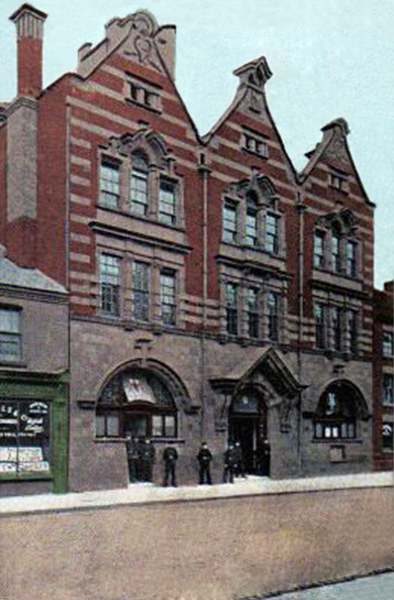
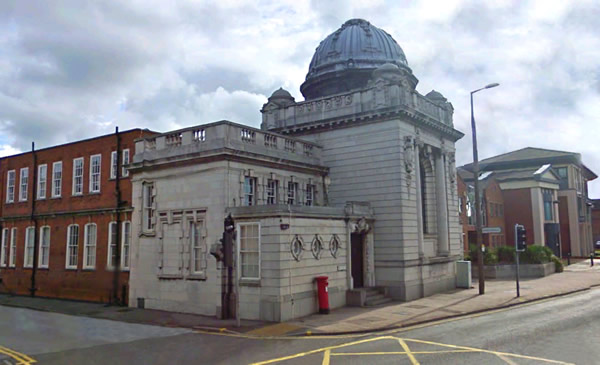
The first public telephone service available in Burton was 1895 when the National Telephone Company speculatively rented a shop in New Street. The National Telephone Company was eventually absorbed by the GPO and the combined exchange finally moved into new premises in New Street in 1905, built by R.Kershaw Limited which, just two years earlier, had built the Fire Station across the road.

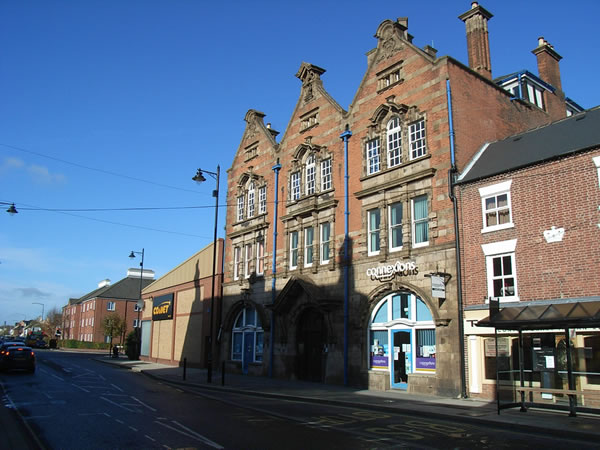
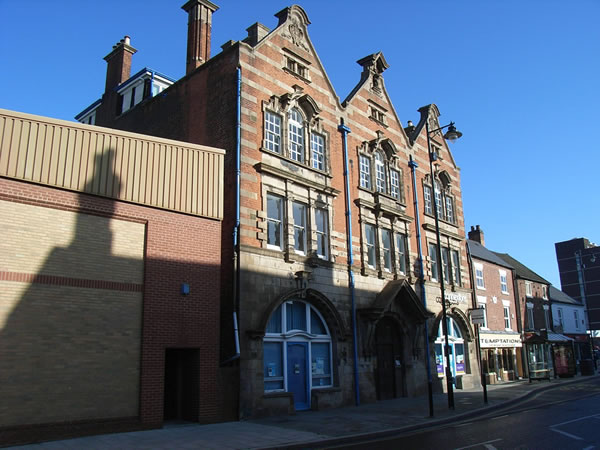
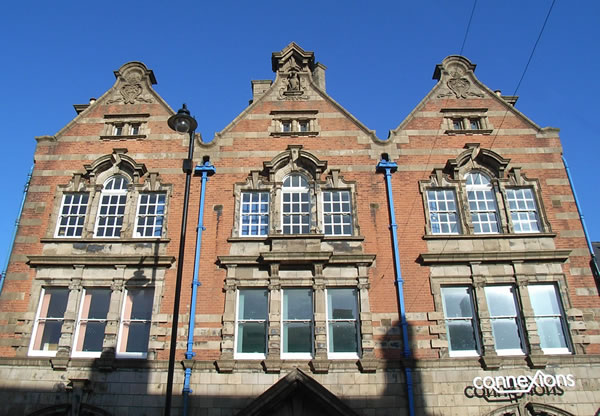
The 1905 building still survives but has struggled to find modern usage.

Postal Service History

The first recorded Burton postmark was 8th October 1722. It arrived at its destination in London two days later. The postage cost, based on mileage, was sixpence (6d) which the recipient had to pay on delivery.

The postmark appeared as BURTON REF 1, which continued to be used until 1768.

Up until 1765, Burton mail from London only travelled as far as Lichfield where it had to be sorted.

In 1765, a number of Staffordshire Members of Parliament, including the MP for Burton, presented a petition to the General Post Office in London complaining both about the service and the high charges added by Burton postmaster, William Stratham. The London to Lichfield postal charge was 4d, but Mr Stratham applied a 2d charge from Lichfield to Burton which was thought of as very unreasonable. It was customary at the time to reply the same day and a further 1d was charged for the return journey. This meant that Burtonians were paying 3d more for the same service available in Lichfield or Derby. In 1765 therefore, the Post Office conceded and introduced a new sorted bag for Burton, avoiding the excess charge. The new bag however, still had to be collected and returned to Lichfield although postmaster Stratham was allowed an extra £60 a year to provide a man and two horses for both Lichfield and Derby.

Horse delivery continued until the Mail Coach System was introduced in 1796 when Burton at last enjoyed its own direct mail service. The route ran through Lichfield-Burton-Derby-Nottingham-Newark; Newark provided the link to the Great North Road which ran up to Edinburgh. The coaches ran to a tight schedule and postmasters at each office signed for each collection and despatch, recording the time.

The earliest recorded local collection service within Burton was 1816. It did not however, prove to be viable and was fairly short-lived.

The post office in 1818 was at the George Inn in High Street. In 1834 it moved to the Three Queens Inn in Bridge Street but was moved back to High Street in 1841. It still stood next to the George in the later 1850s.

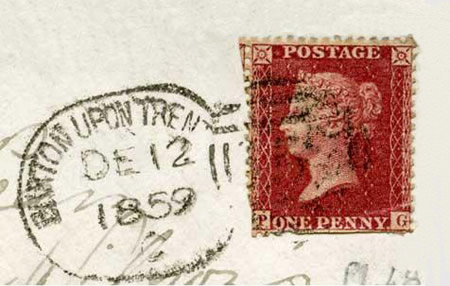
Above shows an 1859 Buron upon Trent postmark and a One Penny stamp of the time. With several collections a day, this was probably being sent to someone else within the town to be read later the same day.

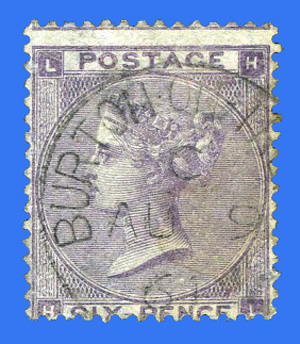
The above stamp, with a Burton postmark dated 9th August 1861, is a Six Penny ‘Lilac’. For half a shilling, this would almost certainly be for a package rather than a letter.

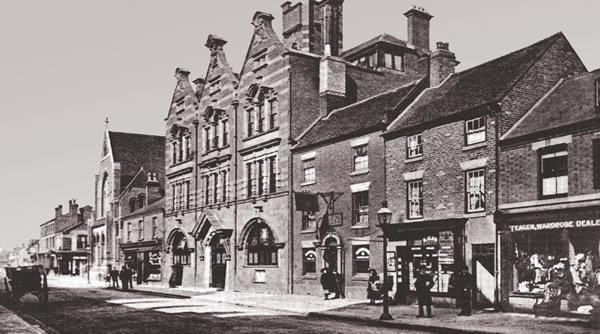
In 1874 the main post office at 162 High Street had Mr Gibson Bowie as Postmaster, William Stone as chief clerk, nine clerks, two stampers, one porter, eight letter carriers and nine rural messangers on the staff. By this time, aside from the main post office, there were ten ‘receiving houses’. These were situated at Newton Road (bottom of Bearwood Hill), Bridge Street, Horninglow Street, Derby Turn, Victoria Cresent, Station Street, Moor Street, Uxbridge Street, Orchard Street and Branston Road.

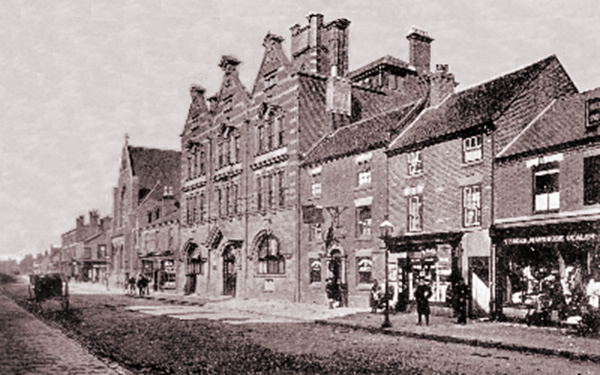
In 1877 the office was moved to a new building on the site of Parker’s Almshouses on the east side of High Street which was later to become the Constitutional Club.

In 1905, it moved again to new premises in New Street. These were built by R.Kershaw Limited which, just two years earlier, had built the Fire Station across the road. At the time, there were 12 sub-postoffices in Burton.

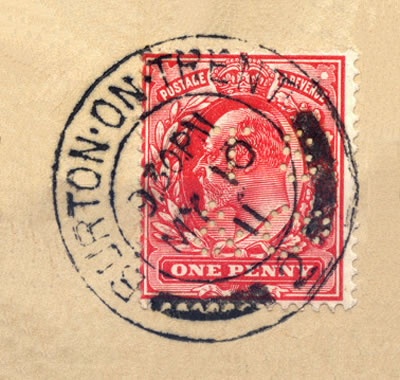
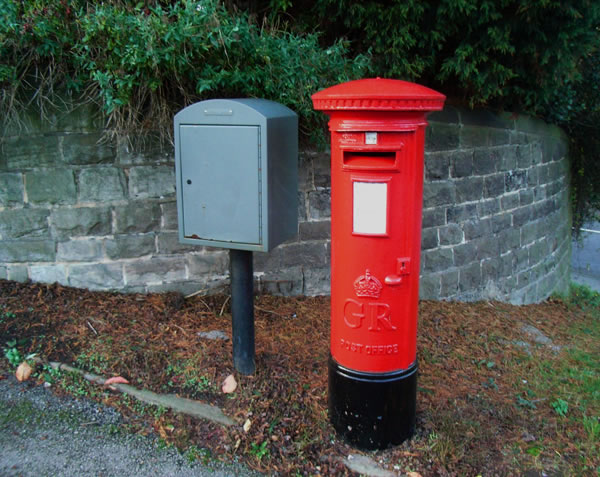
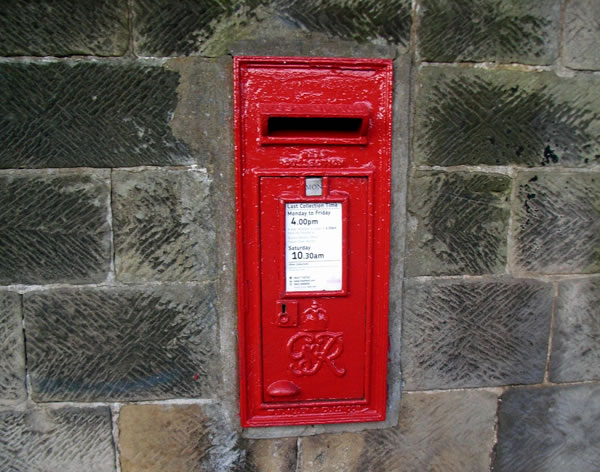
By 1912, there were 19 sub-postoffices distributed around the town but also, a combination of 38 wall and pillar boxes strategically distributed around the town. A few original ones survive characterised by having the Edward VII insignia on the front. Though most of the original sites are still in use, most boxes have been replaced. It was not uncommon for someone to call for the doctor by sending a postcard! Before you scoff however, there were eight collections every day except Sunday, when there were only two. Letters posted in the morning would often reach their local destination before lunchtime and very often, replies were received on the same day. No local post would of course, ever leave Burton unlike todays logistics.


Messenger boys were also available for delivering urgent messages or parcels for which they would receive three farthings.

The building can still be seen little changed over 100 years later, alongside some delighful modern architecture (?!).

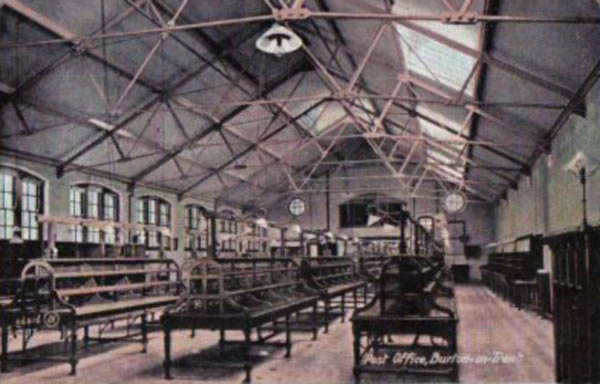
The General Post Office has been the subject of a number of early Burton postcards.


Telephone Service History

There was at the time of course, a much stronger relationship between the postal and telephone services. The first public telephone service available in Burton was 1895 when the National Telephone Company rented a shop in New Street. In 1898, the General Post Office opened an exchange for trunk calls, enabling calls to other towns, when it was still in High Street. The first local telephonist, Miss Clifton, transfered to the Post Office at this time but there was not enough work to have her full-time employed for telephones alone so she also worked as telegraph operator – there were after all, only around 150 telephones in Burton! The annual subscription for a telephone service was £3 3s and calls cost 1d each making them too expensive for the vast majority.

The first telephone system installed in Burton aside from the telephone exchange was incidentally, the Fire Station whilst still in Union Street. Although it is not enormously useful to have the only telephone at least their telephone number was easy to remember; it was ‘1’.

The service was moved to the New Street with the GPO. A few years later, the National Telephone Company was absorbed by the GPO and a combined exchange was opened in New Street across the road from the main post office building.

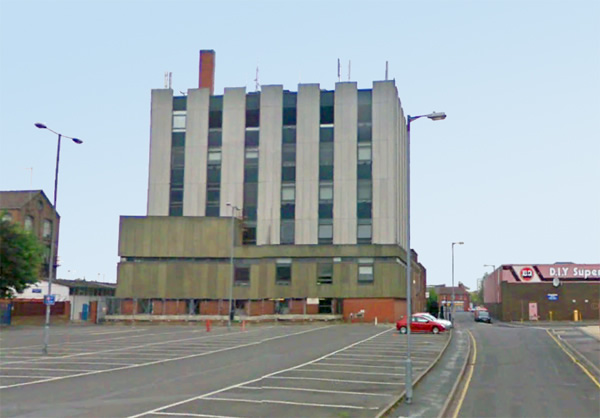
In time, the telephone exchange outgrew the New Street premises and a new large exchange was established in Fleet Street.

Present Saint Modwen’s Church

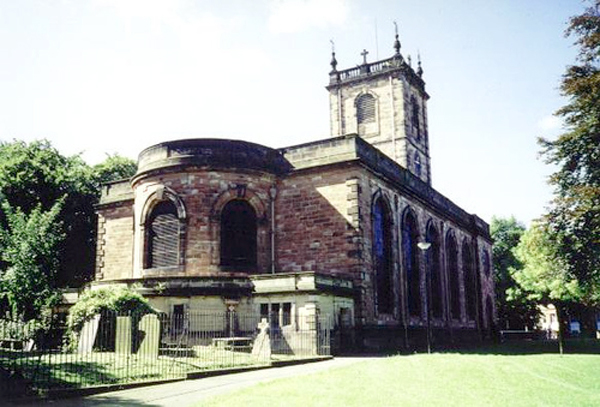
Saint Modwen’s Church was built between 1719 and 1728 but the church history goes back very much further. The present church stands on the site of the church of the Benedictine Abbey founded in 1002 by Wulfric Spot. The abbey had a very large cathedral-like church which served both the monks and the people of the town. After the dissolution of the monasteries by Henry VIII, Burton Abbey was one of the very few that was not destroyed.

Over the next two centuries, it gradually fell into disrepair and disappeared as its stone was pillaged for other building work. Eventually, all that remained was the abbey church which continued to be used as a parish church, which can be seen in the below footprint. In its heyday, the enormous abbey extended down to include the current building labelled as The Abbey on the map.
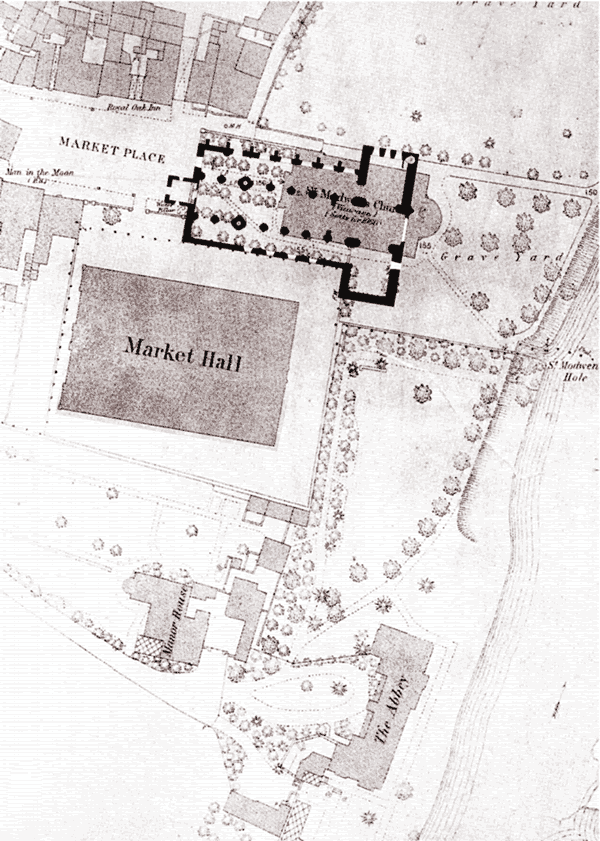
By 1718, this too had become dilapidated and unsafe and it was decided to demolish it and build a replacement. The architect and builder William Smith, and his brother Richard, of Tettenhall were appointed by the parish vestry to build the new church. Smith had already worked on the impressive Saint Mary’s Church in Warwick and had built the church of Saint Alkmund in Whitchurch, Shropshire which was of very similar design. He was one of the most experienced church builders in the Midlands.

It was designed in a Classical style by the brothers Richard and William Smith of Tettenhall. The same design as Saint Alkmund’s was used which was based on a design of John Barker which itself was based on ideas by Sir Christopher Wren.

Work on the new church started in 1719. Their first job was to fit up a building known as the High Hall, which stood in the Market Place, for worship while the abbey came down and the new church was built. Unfortunately, neither William or Richard Smith lived to see the church completed; William died in 1724 and Richard in 1726. The church was completed by their younger brother Francis – ‘Smith of Warwick’, who had by now become more famous. He oversaw the completion of the church and addition of the churchyard walls. It was finally completed in 1928.

The church itself is built in red sandstone and comprises an aisled five-bay nave with galleries on the north, west, and south, an apse, and a western narthex with central tower, north and south gallery stairs, and internal porch. The west tower is of three stages and has a balustrade with urns and round windows with radial glazing bars. The apse has wide Doric pilasters at the opening and between the windows. The nave arcades have tall Doric piers without an entablature, the flat ceiling has a deep cove, and there are nave galleries cut across the high, arched windows of the aisles. The church retained its original altar rails and gated pews.

The main tower is 92 feet high to the parapet, over 100 feet to the top of the four vanes.

Churchyard
In the mid 16th century the graveyard lay to the south of the church. A lychgate mentioned in 1568 may be the church stile of 1682, and stone left over from the rebuilding of the church was used in 1727 to make a churchyard wall encompassing land to the south, east, and north of the church. In 1829 a railing fence was put up in front of the church. The same year the vestry leased land called the Arbour on the north side of the churchyard as an additional burial ground, and in 1830 an adjoining 1.5 acres was leased from the marquess of Anglesey.
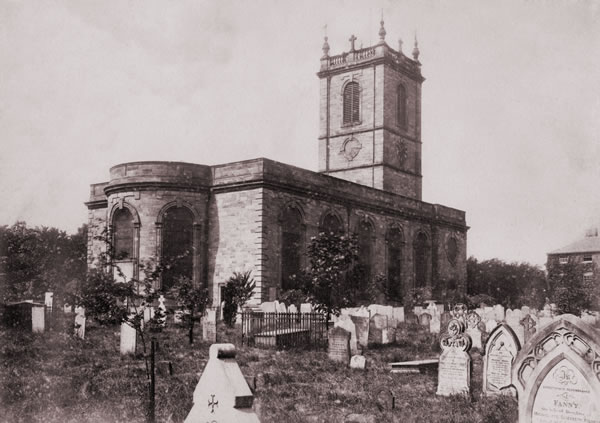
In 1835 the churchyard covered 3 a. 25 p. New burials were restricted from 1856, and the churchyard was closed in 1866 when the municipal cemetery was opened. That part of the churchyard north of the church was vested in Burton corporation in 1939, and was converted in 1952 into a garden of remembrance for Burtonians who had died in the Second World War.

Alabaster Figure
An alabaster figure of a knight, dating from the late 15th or early 16th century, lay under the tower of the abbey church. Although already damaged, it was though important enough to preserve and move into the new church. When the church was completed, it stood under the west tower. Much admired, it was moved in the mid 19th century to a position where it could be clearly viewed from the market place.

By 1878 it had been moved to the garden of the Priory, a house in the south-west corner of the former monastic cloister. In 1924, it was presented to Burton museum but, when the museum was closed, like numerous items of Burton’s heritage, it mysteriously disappeared.

Pulpit
Christopher Wren had recommended that churches were planned so that everyone could see and hear the minister, especially when he was preaching. In accordance with this, the original pulpit was centrally placed. In this central position however, the pulpit completely obscured the Communion table from the rest of the church. That suited Anglican worship of the eighteenth century where communion was rarely celebrated and when it was, communicants would pass beyond the pulpit and gather round the table.
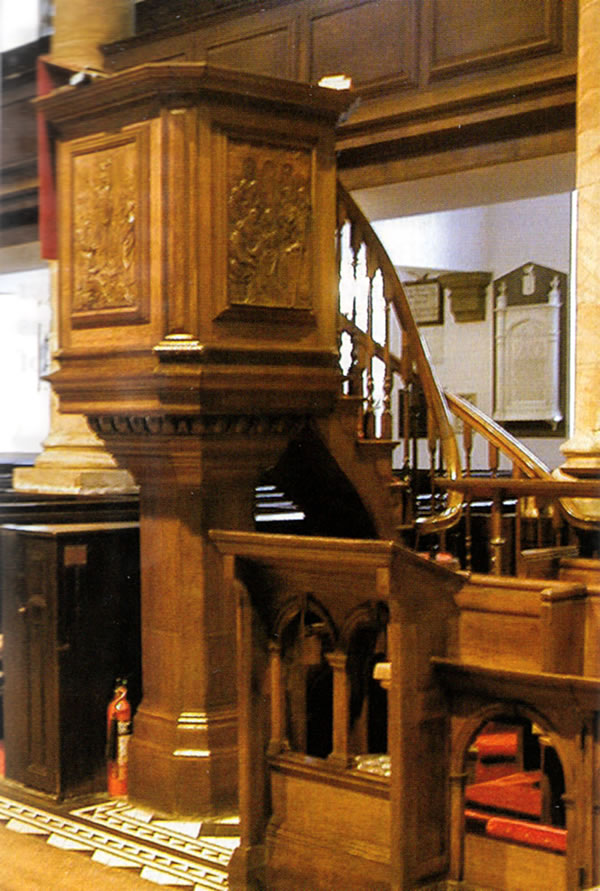
The galleries were part of Smith’s design and the pews are an integral part of the building. The columns stand on plinths that are panelled and integral with the seating. The church can seat over a thousand people in original Georgian pews!

A large chandelier was presented to the church by William Hawkins in 1725, in time for the completion. This, of course, was to be the only available lighting.

Font and Plate
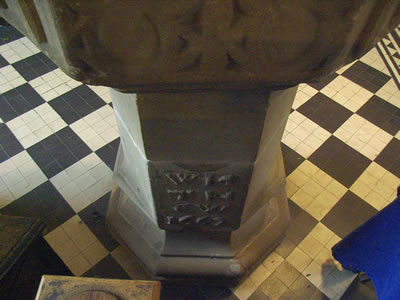
The font has survived from the abbey church. It has an octagonal bowl from the fifteenth century – during the Tudor period. It is one of the few survivals from the medieval church.
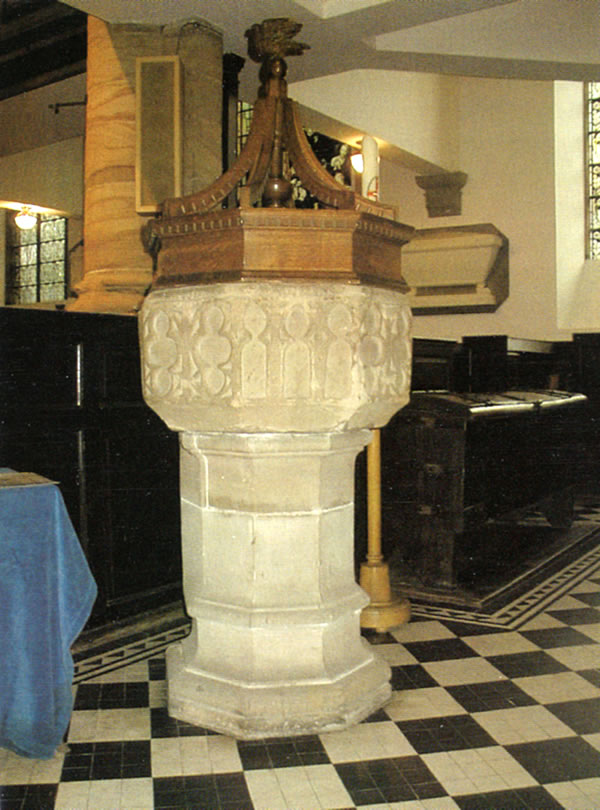
The plinth is newer, dating from 1662, and bears the initials of the vicar, Rev. William Middleton) and church wardens of the day. The basin was later lined with lead and is covered by a nineteenth century wooden cover.
The plate in 1549 included two chalices and two patens, but only one of each pair remained in 1552. A silver chalice and paten were acquired in 1662. Anne, wife of Sir Henry Every, gave a paten in 1705, and Mary, widow of Sir Robert Burdett of Bramcote, in Polesworth, Warwickshire, gave a flagon in 1726 when she was living in Burton. In 1727 the minister, William Browne, gave another flagon and his wife Ann gave a paten. A further chalice was acquired between 1795 and 1830.

Church Organ
An organ was installed in the west gallery in 1771. It was built by Johann Snetzler who was one of the foremost organ builders of the time. The case was designed by James Wyatt. His design remains in the Royal Institute of British Architects. Iron columns were inserted into the west galley to bear the weight of the organ.

Anthony Greatorex (d. 1814) was appointed organist. His salary was met by public subscription until 1790, when, subscriptions falling off, it was met out of the church rates. Anthony was succeeded as organist by his son Thomas Greatorex (d. 1831), a distinguished musician, although his conducting and playing duties in London must have restricted his ability to perform in Burton. He resigned in 1828 and was succeeded by Charles Yates, who resigned in 1847 after the minister of St. Modwen’s had accused him of immoral conduct and professional incompetence and had employed a police constable to prevent him from playing in services.

A group of church singers under control of the organist was described in 1807 as “a set of industrious, hard working people, some of whom have large families and can ill afford any expense“. Consequently, their costs, estimated at 2 guineas a year, were to be raised by subscription, the Earl of Uxbridge pledged 1 guinea. They were replaced in 1847 by a volunteer church choir.
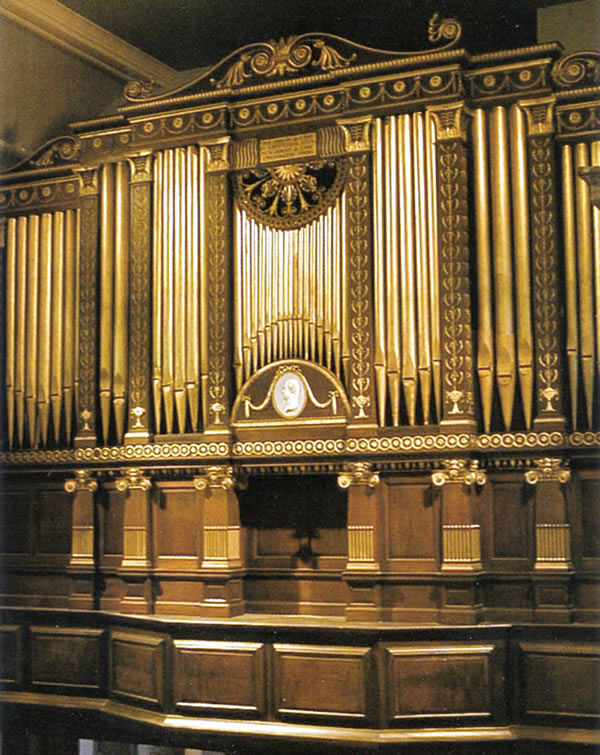
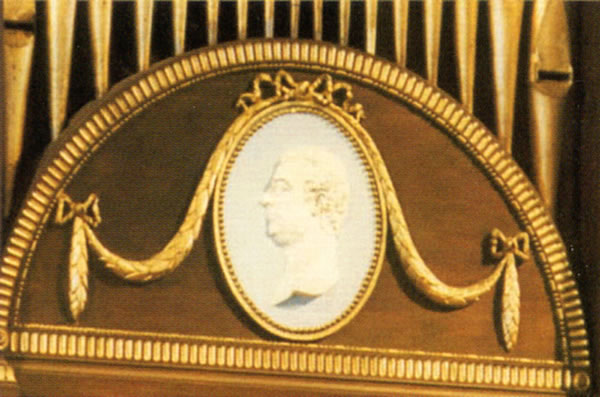
The cameo panel on the case, perhaps made by Josiah Wedgwood, is thought to represent the composer, George Frederic Handel, whose organ music was highly popular at the time. There is none of Snetzler’s original organ in the church today, although some of the pipes are believed to be in Trinity Methodist Church. The case was extended on each side to accommodate a larger organ which was installed in 1972, built by Hill, Norman and Beard.

An electrically operated organ was installed in 1900.
Clock and Bells
Five bells survived from the previous abbey church. These were re-cast into six in 1725, during the building of the new church, by Abraham Rudhall of Gloucester. The largest tenor bell weighs 18 cwt. Two new small bells were cast at the same time to make a ring of eight bells. The Ringers Rules dating from 1726 are painted on the wall of the ringing chamber. These date from when the bells were installed but before the church was complete.
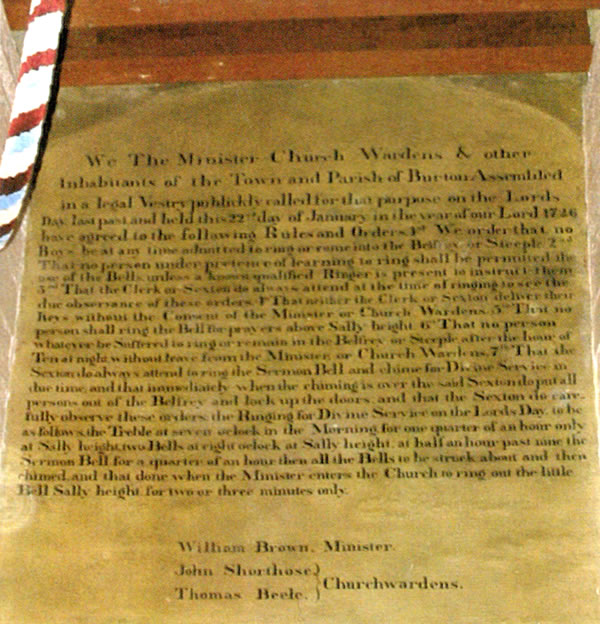
Despite the conspicuous rules. Disturbances caused by bell ringers led to the adoption in 1727 of rules governing conduct in the belfry: no ringing was allowed after 10 pm and only known and qualified ringers were allowed in the belfry, and only the sexton was to ring for sermons and services.

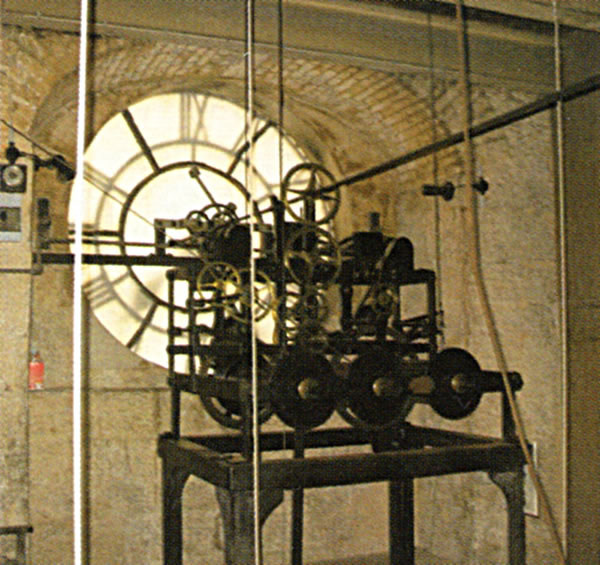
The tower clock was installed in 1785 at a cost of £203, half of which was donated by the Earl of Uxbridge. It was manufactured by the celebrated clock maker, John Whitehurst of Derby. The mechanism controls two clocks through a simple gearbox; one facing the market place, the other facing the memorial gardens.
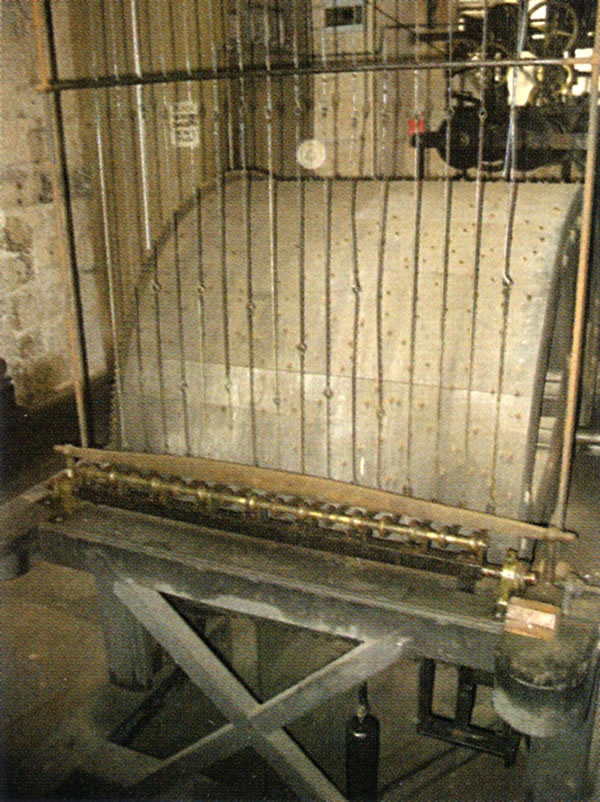
Also installed at the same time as the clock were eight bells and a Carillon; this resembles a huge musical box with pegs on a rotating drum which depress levers which in turn operate hammers against the bells. The Carillon was installed to play a variety of tunes on the bells at certain times. In the early 20th century the chimes played a different tune on each day of the week. After the Second World War it only chimed on market days. The Carillon remains functional but until recently were only heard on special occasions. In 2010 pleasingly, its use was restored to play a tune every day at midday.
In the early 19th century the ringers were threatened with losing a third of their fee because they would ring only for their own pleasure and not for the church’s services. In 1829 they were paid £7 4s for ringing at services, the appointments of churchwardens, and on national holidays, and between 1829 and 1838 they also received £1 for an annual feast. In 1865 their fee was raised from £10 to £15 a year. In 1895 Francis Charrington gave £60 to pay for the ringing of the bells each year on Trafalgar day (21 October).

Vicarage
In 1808, the minister is known to have had a house in High Street. The minister still resided in High Street in 1851 but some time before 1860, this had moved to a house called Trent Bank at Bond End. This was described in the 1890s as “anything but compatible with the dignity which one associates with the principal minister of the town“.

In 1893 a house called The Orchard in Orchard Street was purchased as a vicarage house with money raised by public subscription and a grant from Queen Anne’s Bounty. That house, which had formerly belonged to Martha Thornewill, mother of the vicar, C. F. Thornewill, was sold to a union of the benefices in 1982 but was demolished in 1989. A new vicarage house was built in Rangemore Street in 1983.

Financial support for an assistant curate was provided by the Additional Curates’ Society from 1844 until 1877, but the bulk of the assistant’s income came from voluntary local contributions. One or occasionally two curates were still employed until 1910; thereafter however, the de-population of the town centre meant that there was no curate until the later 1950s. In the late 1980s and early 1990s the curate lived in the former Christ Church vicarage house in Moor Street, renamed St. Modwen’s House. In 1994 the minister of St. Aidan’s in Shobnall Road, was appointed to serve also at St. Modwen’s as a town centre chaplain.

Parish Division
In 1824 the parish was divided into two districts, a southern one for the church of St. Modwen and a northern one for the newly built Holy Trinity church; the northern area was constituted a separate parish in 1842. Thereafter both parishes were subdivided by the creation of further ecclesiastical districts and parishes: Christ Church (1845); Horninglow (1867); Winshill (1867); Branston (1870); St. Paul’s (1873); Stretton (1873); All Saints’ (1898); St. Chad’s (1903); and Shobnall (1916). Holy Trinity and St. Modwen’s were united in 1969, as the parish of Burton-on-Trent, and in 1982 Christ Church and All Saints’ were united.

Despite the division of the parish, St. Modwen’s vestry continued to collect a single church rate for all the town churches. Compulsory church rates were abolished by an Act of 1868, and thereafter a voluntary rate was levied by St. Modwen’s vestry for St. Modwen’s, Christ Church, and Holy Trinity, with the addition of St. Paul’s from 1876. The system was changed in 1879 so that the churchwardens of each of those parishes collected their own rate from individuals, whilst the wardens of St. Modwen’s, on behalf of all four churches, continued to collect the rate from brewers and other firms in the town. Often known as the brewers’ rate, it raised over £411 in 1890, (but thereafter income began to decline as firms withdrew from the scheme and only a little over £209 was given in 1928. Bass, Ratcliff, and Gretton withdrew from the scheme that year to make individual contributions directly to each of the four churches, but St. Modwen’s continued to collect donations from other firms until at least 1954, when less than £23 was given in total.

Church Life from the Nineteenth Century
Services in 1829 were held on Sunday mornings and afternoons, with prayers on Wednesdays, Fridays, and saints’ days and the Boylston lecture on Thursdays. Communion was celebrated eight times a year, with about 70 attending at each occasion. The average Sunday attendance in 1851 was 400 at both morning and afternoon services, besides Sunday school children. A Sunday evening service started in 1860 was so well attended by 1892 that there were hardly enough seats. A children’s Sunday service, probably held weekly, began in 1871 but had ceased by 1892; by 1896 a monthly one had been reinstated. There was a harvest festival by 1877. Further liturgical changes were introduced from the late 1880s, and in 1887 the choir, which then numbered 38, was robed and provided with stalls and a vestry in the upper storey of the tower. Coloured stoles and a chalice veil were first used in 1889, when daily morning prayer was also begun. A New Year’s Eve watchnight service was held for the first time in 1892, and in 1895 or 1896 the celebration of communion was increased from two Sundays a month to weekly. A communicants’ guild, established in 1896, was reorganized in 1899 by the vicar, H. B. Freeman, as the Guild of the Ascension, modelled on one at Christ Church, Bath, where Freeman had been curate. It appears to have folded in 1918. In 1910 St. Modwen’s was described as having ‘a good medium service – not too high, and not too low’, a style still followed in the 1990s.

An unlicensed mission room was opened from St. Modwen’s in the mechanics’ institute in Guild Street in 1871. Run by a lay deacon from Lichfield Theological College, it was closed in 1876. A scripture reader was appointed in 1872, and was styled a lay assistant by 1893, when his duties included running weekly cottage meetings. The post was apparently abolished in 1902. A monthly service in what is called Wetmore Hall, a former Primitive Methodist chapel at the north end of Wetmore Road, began in the mid 1980s, after the transfer in 1969 of that area from Stretton ecclesiastical parish to the parish of Burton-on-Trent.

A parochial lending library of some 132 volumes was kept in the clergy vestry in 1829, but was little used. A monthly parish magazine was probably first started in 1872 and certainly existed by 1892; it continued in 2000.

A mothers’ meeting, begun by 1892, and a branch of the Mothers’ Union, in existence by 1899, were amalgamated in 1927. By 1893 there was a team of women district visitors whose duties included relieving the poor with money and medicines and ‘awaken[ing] the higher life of those they visit’; by 1924, however, they were employed mainly in distributing the parish magazine. A girls’ club, in existence by 1920 and known as the Guild of St. Modwen by 1937, was dissolved in 1970, when its membership included adult women.

A Church of England Young Men’s Association which was formed in Burton in 1846 was opened to all protestants in 1856. A Burton branch of the Church of England Young Men’s Society was formed c. 1878, with premises by 1889 in Friars Walk. Renamed the Parish Church Society in 1892, it was dissolved in 1913.

The former premises of Burton grammar school in Friars Walk were acquired in 1877 for use as Sunday schools and church rooms after the Grammar School was relocated to new premises in Bond Street.

Royal Arms
Royal Arms and Monuments Royal arms hung above the altar in 1829, and remained there until 1865. There were apparently two sets of royal arms in the church in 1869: those of Charles I (1625-1649) in the vestry, and those of George I (1714-1727) in the porch. Nothing further is known of the former, but the latter were still in the porch in 1962 but were later stored in the north gallery. A hatchment associated with the Peel family is also stored in the north gallery.

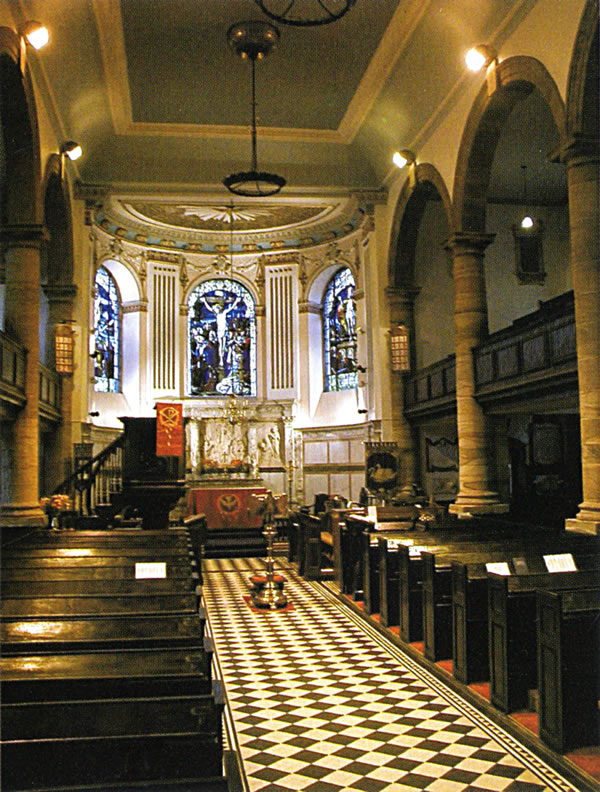
The Royal Arms were replaced in 1865 by coloured glass depicting the Crucifixion, given by the Marquess of Anglesey. At the same date new side chancel windows depicting the Annunciation, the Transfiguration, the Last Supper, and the Resurrection were given by the brewers Michael Thomas Bass and Henry Allsopp.

1865 Re-arrangement
There was a re-arrangement of the church in 1865. The apse was extended and three stained glass windows were installed. The pulpit was moved to one side and choir stalls were set up replacing the pews on either side of the old three-decker.

Lecturn
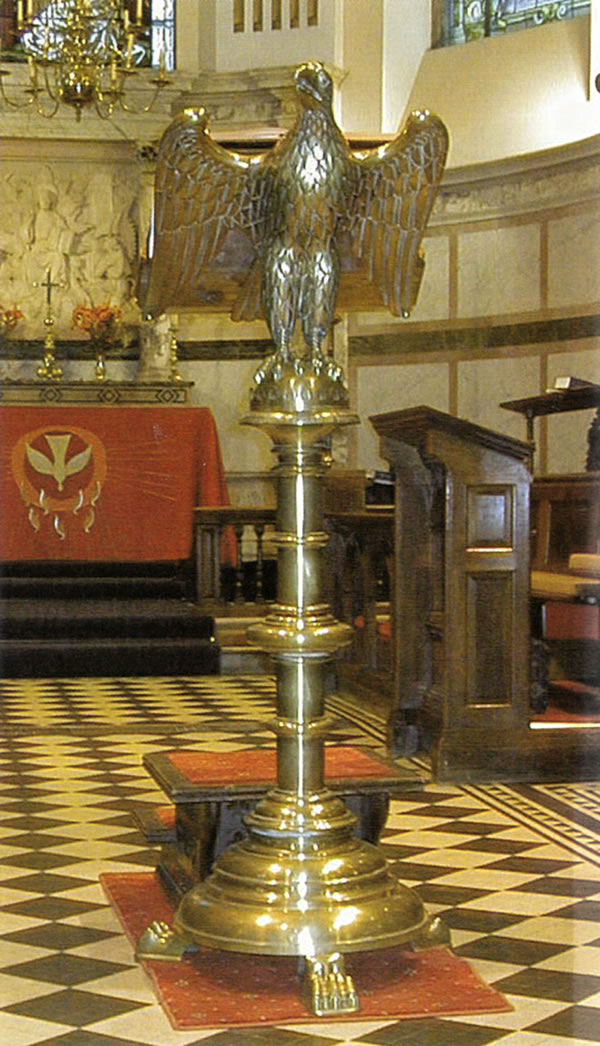
The fine eagle lecturn shown below standing in the isle, was given to Saint Modwen’s in 1886 in memory of Alderman John Yeomans.
Altar and Reredos
An Altar and Reredos (decorative screen behind the alter) was added in 1739 which required that the central east window be shortened. It was described after installation as “a beautiful altar piece of Italian marble“. It was gifted by Thomas Hixon, the manorial bailiff, who owned Sinai Park. He left £120 in his will for the purpose. It originally displayed the text of the Ten Commandments, The Apostles’ Creed and the Lord’s Prayer.

A new communion table was installed in 1879.

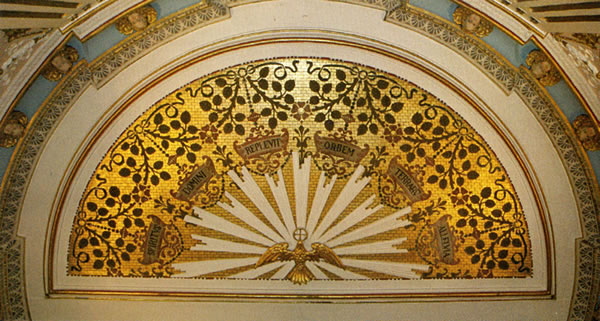
Alabaster panels were added in 1889. These show Christ in Majesty in the centre. Also depicted are Saint Chad, Saint Peter, Saint Martha and, of course, Saint Modwen, offering their churches to the Lord. At the same time that the alabaster panels were added to the reredos in 1889, the sanctuary ceiling above it was cleverly painted to look like a mosaic.
In 1870 the congregation was allowed to elect a vicar by secret ballot. Shortly after appointment of the new vicar in 1870, the lecture was moved to Wednesday evening because attendance rarely reached twenty, and most of them were comprised of a group of old women from the almshouses. Again held on a Thursday morning from 1933, the weekly lecture was replaced in 1968 by one given four times a year and the annual payment was directed towards cleaning the church. By a Scheme of 1978 the trusteeship of Boylston’s charity was transferred to the vicar and churchwardens of St. Modwen’s, and the lecture ceased to be delivered c. 1982.

In 1884 the advowson was purchased from the Marquess of Anglesey by public subscription and vested in the bishop of Lichfield. Under the terms of the union of the benefices in 1982 the presentation was to be exercised jointly by the bishop of Lichfield and Lord Burton who were both patrons.

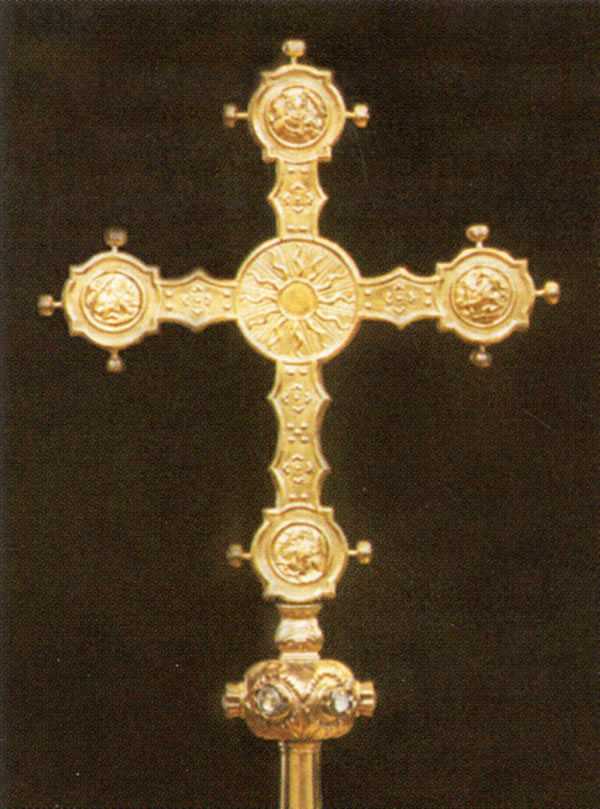
William Tate designed the brass altar cross given in 1889 as well as the candlesticks and processional cross given in 1895. At the end of each arm of the processional cross, seen below, are the Emblems of Evangelists.
In 1883 the three-decker pulpit was split in two: the pulpit was moved to the north-east end of the nave and the reading desk to the south-east end. Carved panels were added to the pulpit by Lord Burton in 1890. A new lectern was acquired in 1886. In 1887 stalls were made for the clergy and choir. In 1889-90 William Tate of London directed the redecoration of the whole interior of the church and the re-ordering of the sanctuary, including a mosaic ceiling in the apse and fluting to the apse pilasters. New furnishings included an oak altar and a brass altar cross; a reredos in alabaster and green marble, with carved panels showing Christ in glory flanked by various saints including St. Modwen, was given by the vicar, C. F. Thornewill, and his two brothers.

Despite its recent improvements, St. Modwen’s was described in the 1890s as “lonely and practically lamented“, lacking the patronage of the brewers that many of the newer churches in the town had attracted. In 1894, however, work began on restoring the church, including the removal of the font from the centre aisle to the south-west corner of the nave; much of the cost was defrayed by the brewers of the town. The architect, J. A. Chatwin of Birmingham, had proposed creating new vestries to replace the choir vestry on the first floor of the tower and the clergy vestry in the south porch, but the expense and local opposition meant that it was not until 1902 that new vestries were added, under the direction of Henry Beck, wrapping around the apse, and again paid for with brewers’ money. By 1904 the brewing families had given £13,000 for the restorations.

Vestries were added around the east end of the church in 1904. This resulted in the shortening of the remaining two apse windows and their glass was moved to the north and south aisles. At some time all the doors were removed from the pews, except for the wardens’ pews at the very back of the church.

A memorial to the dead of the First World War, in the form of a carved oak tympanum with bronze panels, made by Martyn & Company of Cheltenham, was erected in the west porch in 1920. It was extended in 1948 to a design by R. S. Litherland of Burton, as a memorial to the dead of the Second World War.

A Lady Chapel was created in 1956 at the east end of the south aisle.

In 1961 the decoration of the sanctuary was restored by Campbell Smith & Co. of London.

A sepulchral slab inscribed with a floriated cross, and dating possibly from the 14th century, was moved in 1968 from the south wall of the churchyard into the south porch.

Generally, the church has been altered little since it was completed and preserves nearly all its Georgian woodwork and is still a well used church in the centre of Burton.
Police Force – General History

In 1629, the county Justice of the Peace, who was appointed by means of a commisssion to ‘keep the peace’, appointed Constables. Constables in turn appointed common warders to apprehend rogues and vagabonds. The warders appear though, to have been over zealous and were asked later the same year to show greater respect to poor people. Beggars from outside the parish remained a problem in the 18th century and keeping them out of town was one of the duties of the crier in 1711.
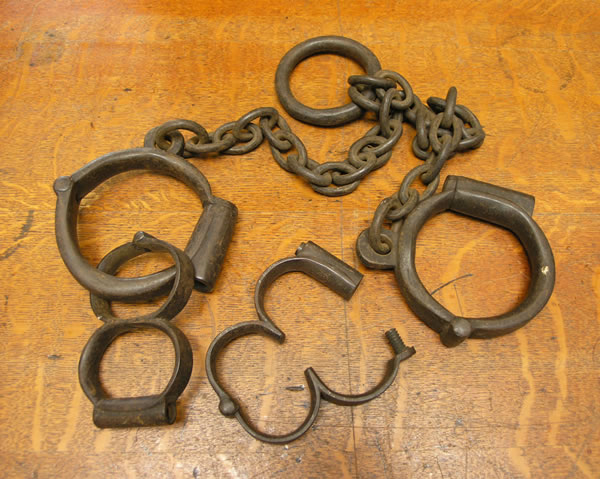
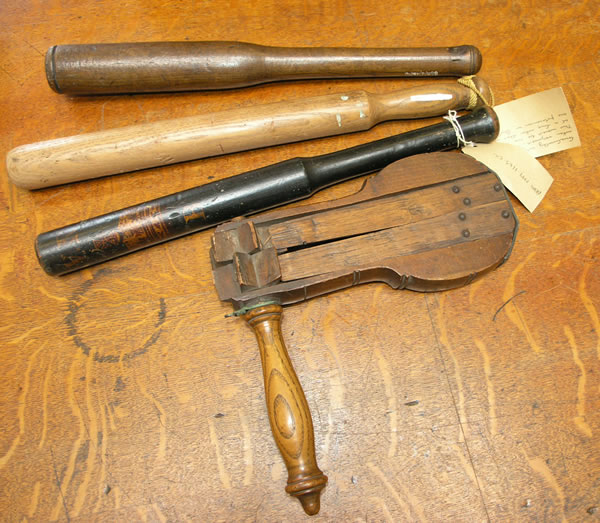
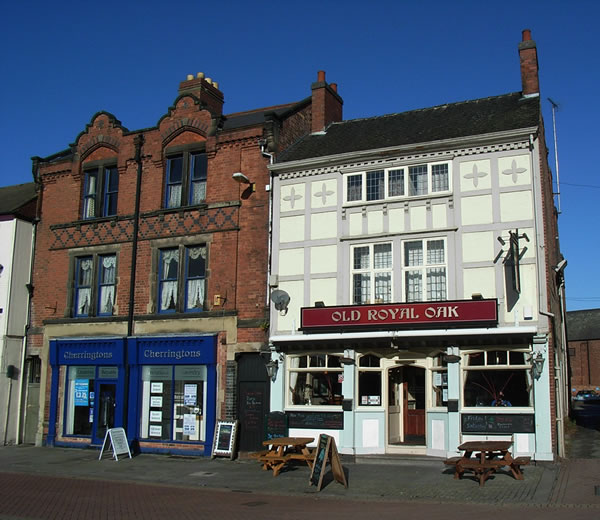
There was a watch by 1646 and a watch house by 1678. Watch duty was a liability imposed on inhabitants, and in 1711 it was supervised by the crier. By 1723 the bellman was paid 10s. a year out of town lands money, and that was still his salary as night watchman in 1788. A night watch was established by subscription in 1793.

Burton vestry engaged a man in 1737 to drive out vagrants. His services were discontinued in 1747, most likely for financial reasons, but he was re-appointed in 1749, presumably because they discovered in his absence that he fulfilled a useful role.

A ‘bang beggar’ was employed by the Burton township in 1826, and his duties in 1828 were to remove street beggars, examine lodging houses, and assist the constables in apprehending prostitutes.

A treble bell was rung at St. Modwen’s church in the market place for 15 minutes at 7:00 am every morning in the earlier 1800s; this is thought to have been a curfew bell. When largely discontinued in 1867 it was still being rung at 5.45 am and 7.45 pm every evening between Michaelmas (Christmas Day) and Lady Day; Lady Day being New Year’s day but up until 1752 when the Julian Calendar was replaced by the Gregorian Calendar, this was actually January 14th.

From at least 1875 the feoffees of the town lands paid for the ringing of the morning bell, and continued to do so until 1916. The evening bell was again being rung on some weekdays between Michaelmas and Lady Day until the late 1880s.

In 1728 the vestry agreed to defray the costs of prosecuting felons by levying inhabitants in Burton townships in what was one of the earliest agreements of its type in England. The order, however, was revoked in 1730. Burton had a voluntary association for the prosecution of felons in 1802. From 1807 the vestry paid its clerk to assist the annually elected parochial constable.

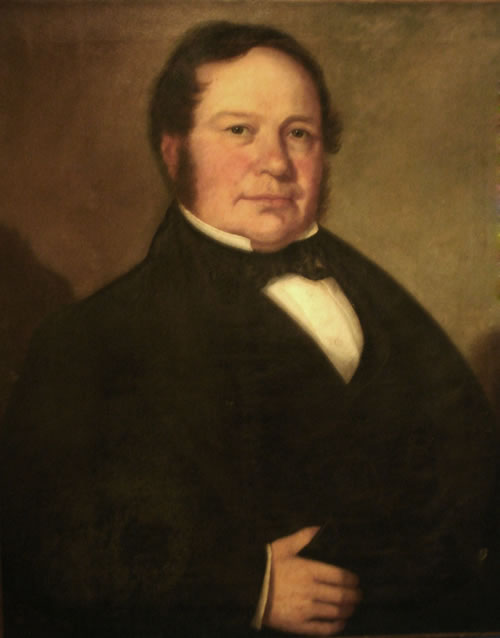
In 1819 it appointed its first salaried police officer, Richard ‘Dick’ Roe, who by all accounts, was a “tall powerful fellow” – an impression not easy to deduce from the most common portrait of him shown here.

His starting salary of 30 guineas a year; he also received £5 from the parochial constables out of their own pockets. The salary was increased to £70 in 1826, when the post was redefined as constable and police officer. This was an impressive salary at the time.

Dick Roe also a publican and used to keep the Wheatsheaf Inn, at the corner of Station Street and High Street. Tales are told of a large iron ring fastened into the fireplace to which he used to forcibly chain prisoners after they had been apprehended by him until they could be legally attended. Some concern was expressed however in 1836 about Dick Roe’s conflict of interest in his two roles. As a result, he was asked to stop selling alcohol at local race meetings and other public events and to concentrate on his police duties. He was described as ‘highly efficient’, however, in 1837 when the vestry applied to the feoffees of the town lands for financial help to pay his salary after the Poor Law Amendment Act of 1834 prevented him from being paid out of the ‘poor rate’.

Some policing equipment of the time can be seen below. The images are courtesy of Arthur Roe, a local historian and actual descendent of Richard Roe. They show handcuffs of the time together with a variety of Burton police truncheons and a police rattle, a predecessor of the police whistle, used to call for help from other police officers. They were once on display in Burton Museum before it was closed

As one of Burton’s celebrated characters of the time, when he died in 1853, he was buried in the old churchyard, and a monument was erected to his memory by public subscription.

What was classed as the manorial gaol was situated below the Royal Oak public house in the market place. A few othe Burton pubs had 1d (one penny) a night cells that they made available.

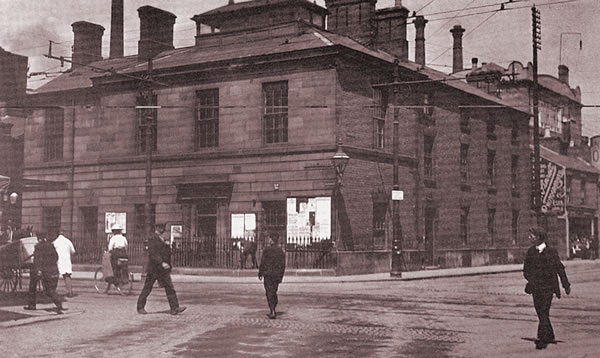
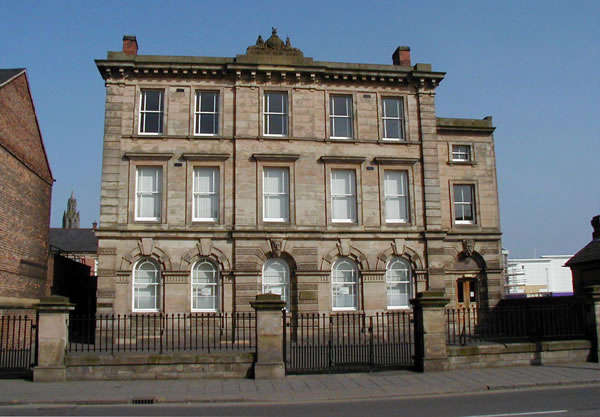
After the closure of the manorial gaol in the earlier 1830s, there was no secure place of detention until a police station with cells was built at the corner of Station Street and Guild Street. The Police Station was built by local builder, Thomas Lowe in 1848. It had already been implicated that all towns would have to provide a police station. This finally came into force in 1856.

The aformentioned Richard Roe was promoted from Town Constable to inspector and was provided with police constables.

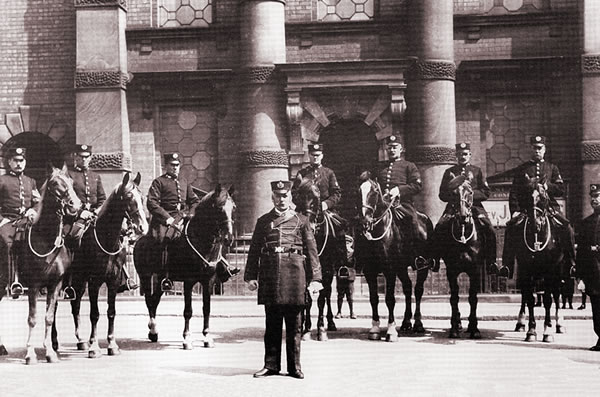
Before motorised transport became available, Burton Police used to patrol and attend incidents on horseback. By 1896, the Burton police force had grown to a Superintendent, James Gilbride, three sergeants and twenty-four constables.

The force can be seen above on parade in George Street at the rear of the Police Station around 1898. At the front is the recently appointed Police Superintendent W. Moss.

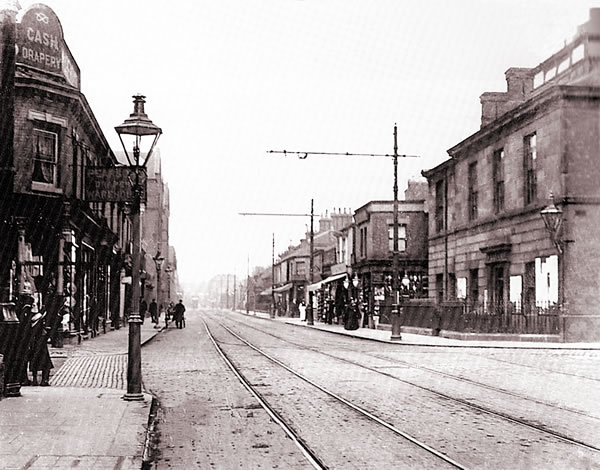
The Station Street, Guild Street, Union Street junction is just about recognisable here with tramway now running past the police station. The present day George Street entrance is just before the shops on the right.

The Staffordshire county force continued to provide officers for Burton after the town became a county borough in 1901. A new police station with cells was opened behind the new magistrates’ court in Horninglow Street in 1910.

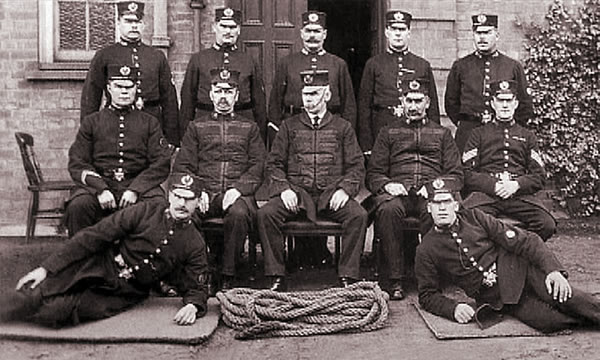
Few photos exist of the Burton Police force but the above one taken in 1920 gives a good flavour. Don’t worry, the rope is nothing to do with the penal system at the time; the picture is in fact, the Burton Police Force Tug-a-War Team. At the time, the was an annual battle between different factions of the town and the police team was always one of the most formidable.

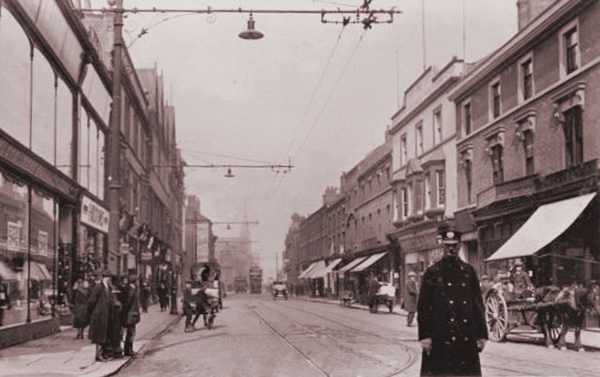
And another elusive shot of a Buron policeman on duty in a still very recognisable 1927 Station Street.

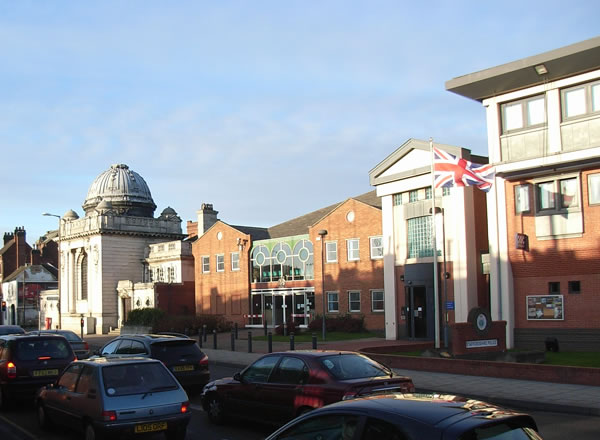
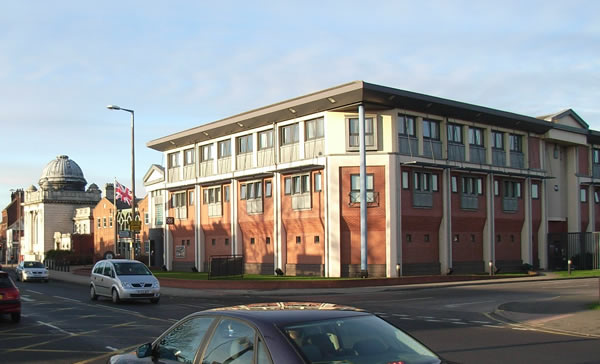
In the late twentieth century, the 1910 police station and magistrates court, having become an annex of a new modern complex but remain very much in use.