Menu Close

Branch Lines

A reminder that much of the out-lying community of Burton made good use of the train.

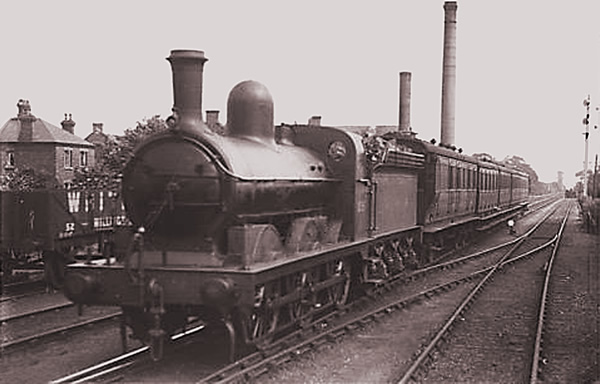
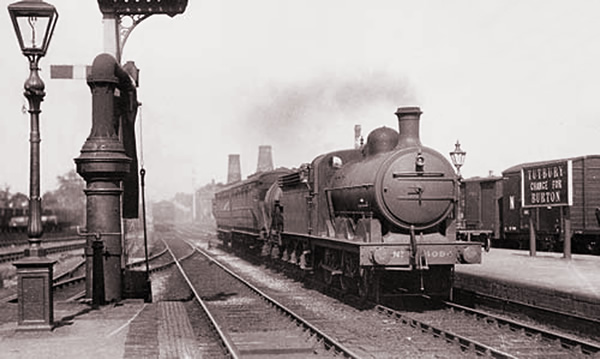
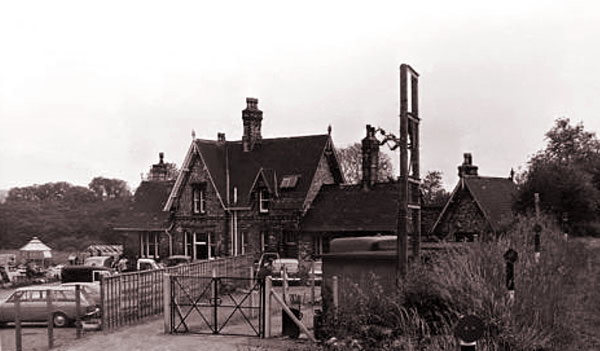
Tutbury Station
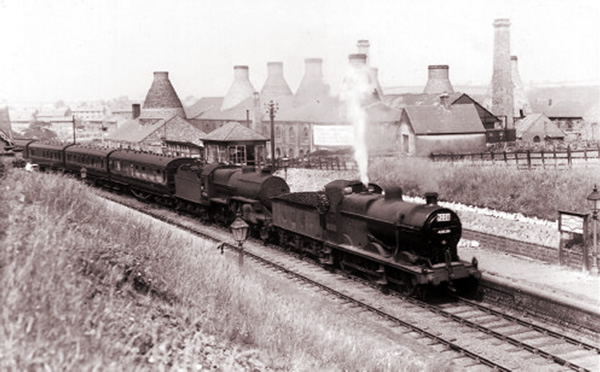
Tutbury Station, probably the most famous of Burton’s out-lying stations because of the revered Tutbury Jinny.

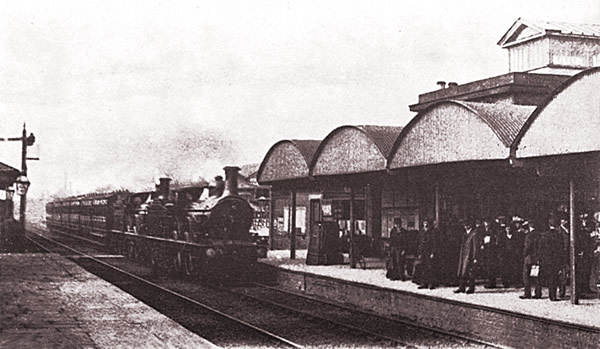
Tutbury Station was built on the Burton upon trent to Uttoxeter branch line and was opened in 1849. The smoking chimney was Nestle on the same site as the existing plant. On the right is a goods shed behind which was a grain warehouse and cattle pen.

In its heydey, the ‘Tutbury Jinnie’ provided eight trains each way on weekdays and two on Sundays. However, as the motor car became more accessible, a survey in 1960 revealed that the service was only carrying an average of twelve passengers and running at a loss of around £7000, which was quite a significant sum at the time. The service managed to survive until it was withdrawn in 1960 when a ceremonious packed last train left Tutbury at 8:12pm on 11th June.

The station was fully closed in 1966 but was re-opened by popular request in 1990 and remains in use today.

Willington Station
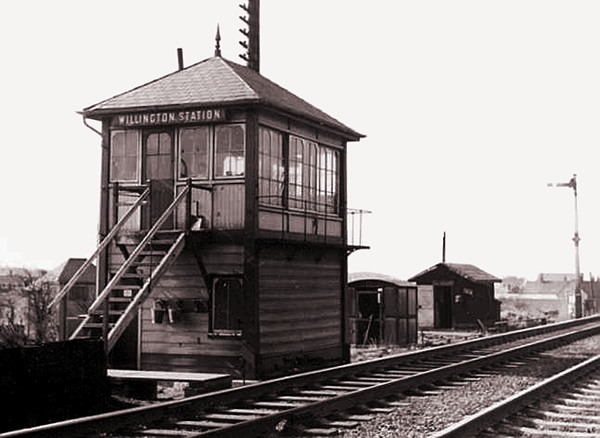
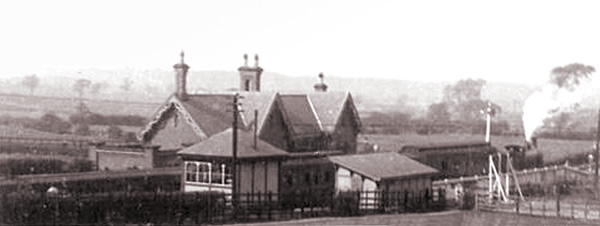
The station at Willington, was built on the Derby line which opened in 1859, has also managed to survive and a station on the same site remains in use today.

Willington signal box has of course, long gone. The main Derby line from Burton still goes over Willington bridge but just before Willington on the Derby side, a branch survives which runs over the modern Willington crossing on its way to Tutbury and Uttoxeter.

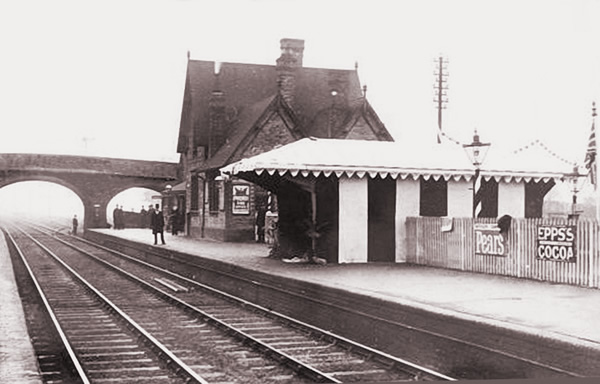
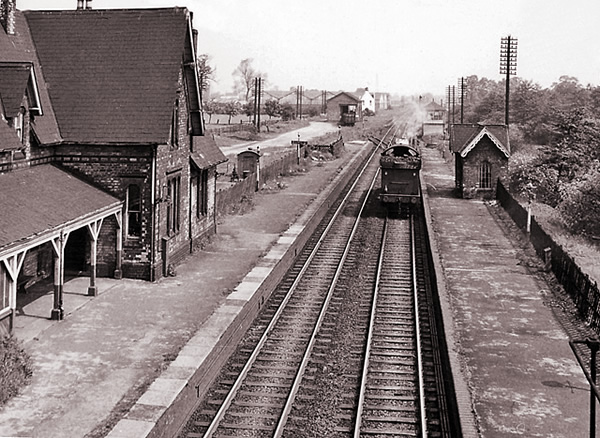
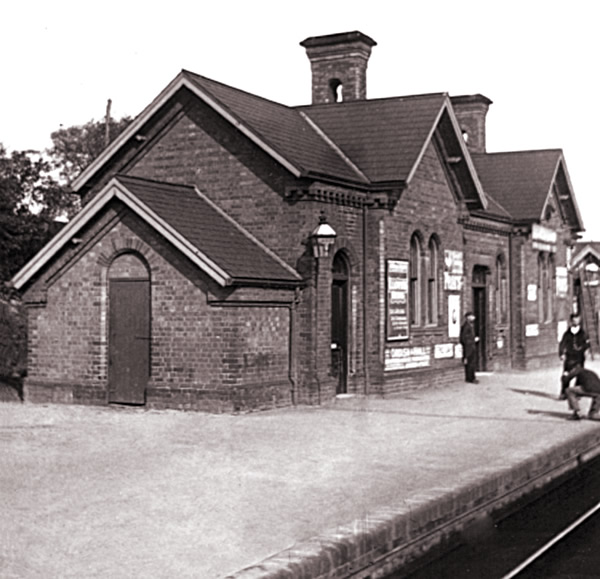
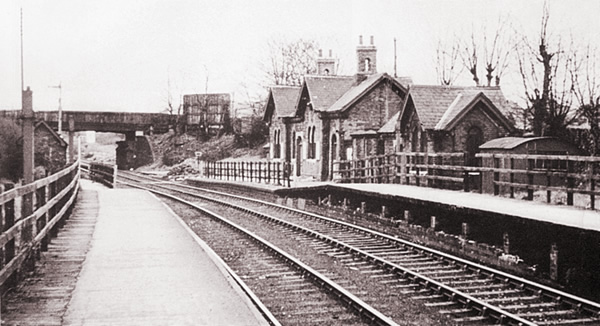
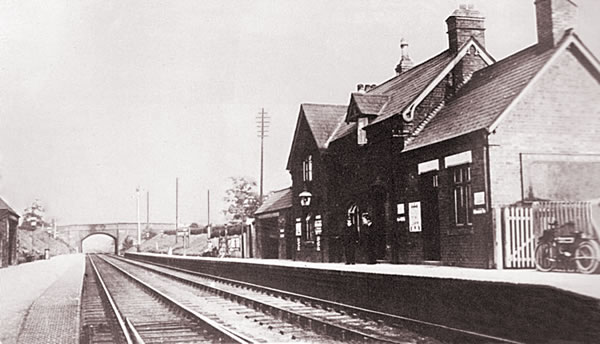
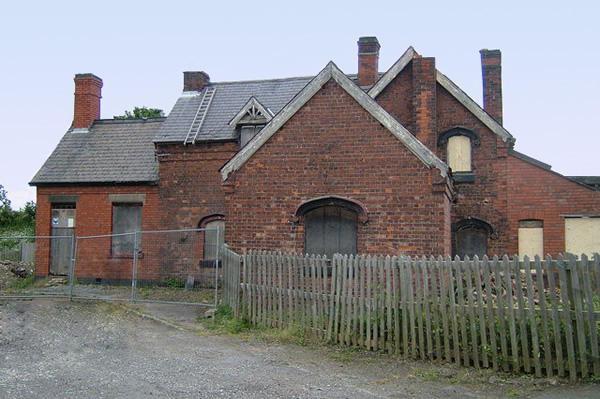
Barton and Walton Station
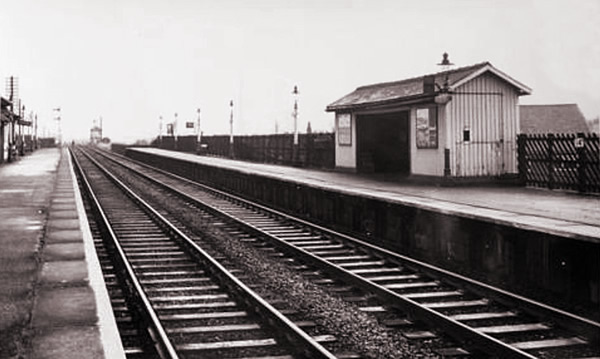
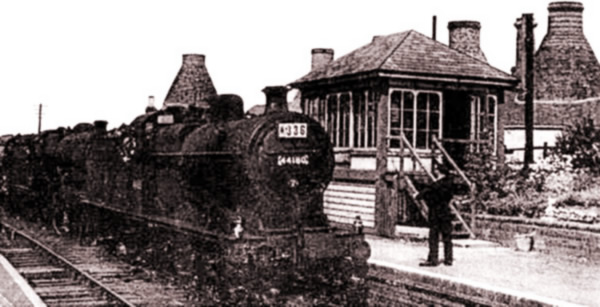
The three following photos show the Barton and Walton Station, opened in 1846 on the Derby to Birmingham line.


It was situated between the villages of Barton under Needwood and Walton-on-Trent. The station was closed in 1958 and is now the site of a railway depot.

Gresley Station
Gresley Station with a name that will always be associated with railways. It was built a Castle Gresely on the Leicester line, which opened in 1849, but there is little evidence left of it today.

The below view towards the end of its life shows its proximity to the bridge that forms part of the A444.

Moira Station
After Gresley on the way to Leicester came Moira (or Overseal and Moira) Station.

The above photo with both platforms empty suggests that a train has recently departed.

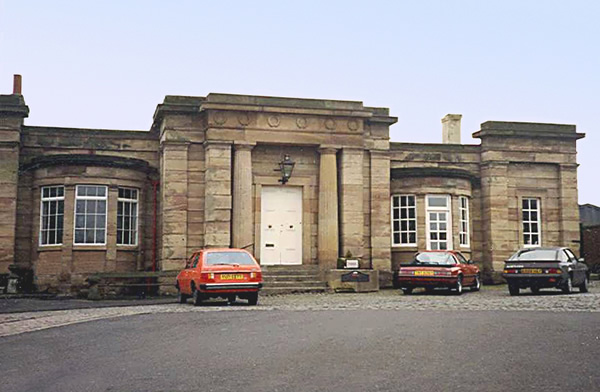
The above photo shows the abandoned station, opened in 1850 – closed in 1964. It was eventually sold for convertion to a private residence.

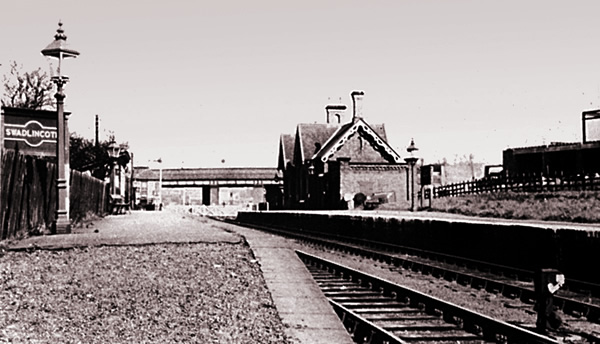
Swadlincote Station
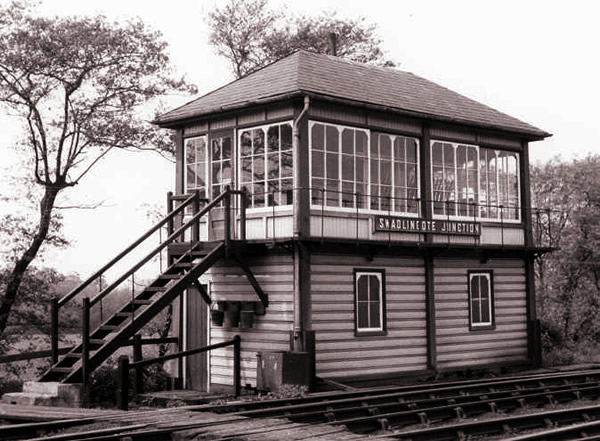
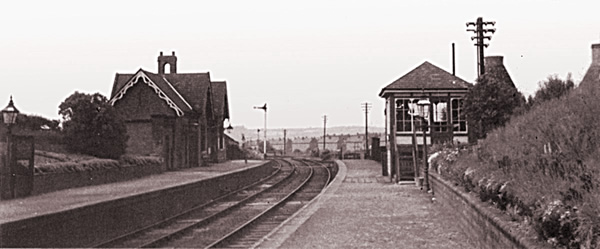
There was a loop off the Burton to Ashby line that some trains used going through both stations as an alternative to going directly to Burton via Gresley. The below photo shows the Swadlincote Junction signal box.

You could be forgiven for thinking that the above and below photos were different angle shots of the same station. In fact, the above photo is Swadlincote Station and below is Woodville Station. Your eyes are not deceiving you however, the two station buildings are identical mirror images of one another. They were both built by the same builder for exactly the same price.

I wonder if anyone ever woke up with a start and jumped off at the wrong station.

Woodville Station
The pottery adds to the confusion because many would deduce that it was Rowley’s Pottery close to Swadlincote Station but in fact, Woodville had its own Mansfield’s pottery.

The road in Woodville is still called Station Road and on Google earth, it is still fairly easy to pick out the loop where the line used to run going back to Swadlincote although it is very difficult to image trains running around there now.

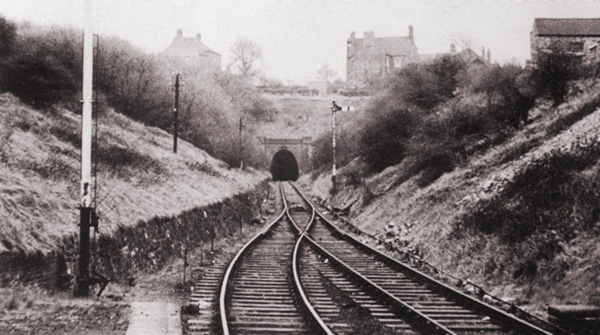
The Woodville Tunnel, seen above, was between Swadlincote and Woodville and went under the main Ashby Road (A511). Although it is easy to pick out the section now, again, it is almost impossible to image steam trains running under the road.

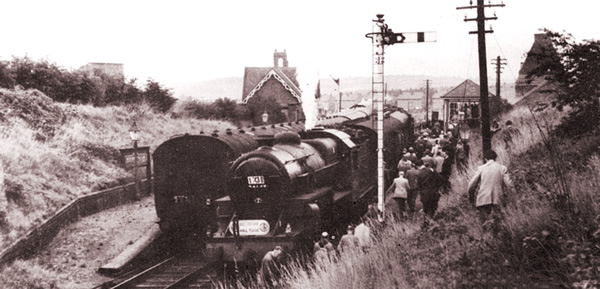
The above shows Woodville station at its busiest. Two trains heading in opposite directions co-incide with both platforms. A regular using his own shortcut has timed his run to perfection to gain one of the few remaining places.

The above wider view gives a better idea of the size and position of the pottery. Because of the gradient between Swadlincote and Woodville, and hence the above shown tunnel, steam engines were often paired together.

Finally, a wide view from the other side taken patiently as a train builds up steam to depart.

The final photo of Woodville Station is very grainy but is, I think, worth showing. Once again, you can just about make out that there are two steam engines.

Ashby Station
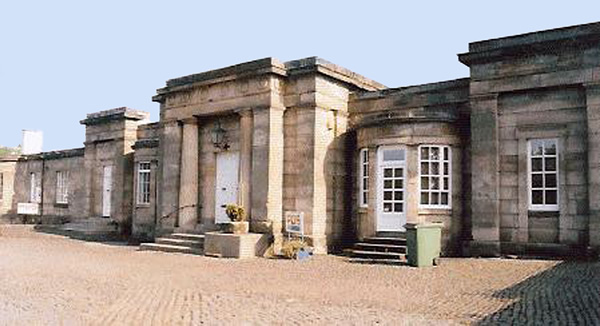
Ashby-de-la-Zouch railway station was too nice a building to fall into disuse. At the time of being built, Ashby was a well-to-do spa town with station to reflect its status.

The Midland Railway opened the station on 1st August 1849 as part of its new line between Swannington and Burton-on-Trent. The station was built partly on the remains of the horse-drawn Ticknall Tramway, which previously connected Ticknall lime quarries with the Ashby Canal.

In 1874 the Midland extended its Derby to Melbourne line to Ashby-de-la-Zouch, partly using the route of the former Ticknall Tramway. The junction with the Leicester to Burton-on-Trent line was just west of Ashby station, so for a time the branch was served by a separate station a short distance from the 1849 building.

Eventually, the station was consolidated with the main platform being the Leicester line. Apologies for the quality of the above image but it does show that it was bustling in its heyday. The stone block above the platform shelter is the rear of the existing building. I am not sure what the tower on top is.

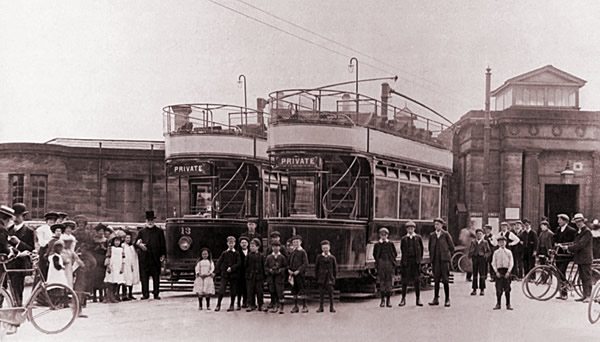
Ashby station forecourt was also a terminus for the 3 ft 6 in gauge Burton and Ashby Light Railway, the tramway between Ashby and Burton upon Trent, built by the MR and closed on 19th February 1927. Tram lines for the Burton and Ashby Light Railway are still visible in the forecourt.

The line became part of the London, Midland and Scottish Railway under the Grouping of 1923. In the nationalisation of transport in Britain in 1948 the line passed to the London Midland Region of British Railways. British Railways withdrew passenger services and closed Ashby station on 7 September 1964.

The building is now Grade II listed.

Drakelow Power Station
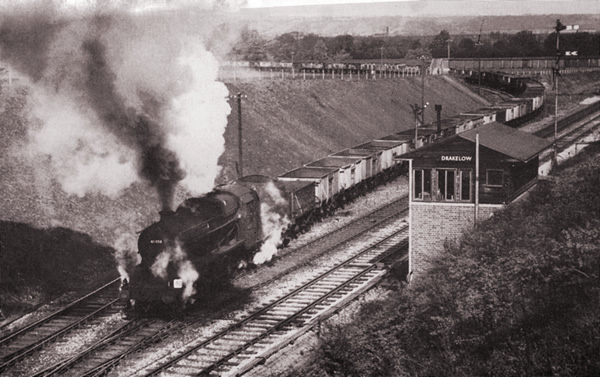
I receive many emails thanking me for memories that were long before my time. But the final photo is for my own sheer indulgence. It shows a coal train joining the Leicester Line at the Drakelow junction.

My Nan and Grandad used to live in an upstairs flat on Rosliston Road close to the Drawelow Bridge. My Grandad worked at the Power Station and he explained to me why they were always going one way full of coal and the other empty. From the window, it was possible to see steam rising in time to race to the bridge and watch the train go under and enjoy being surrounded in steam and taking in the smell.

I could almost have taken this photo myself from the days that waving to the driver might result in a wave back. I had never been on a train and this is my sole recollection of trains from the age of steam.

Map
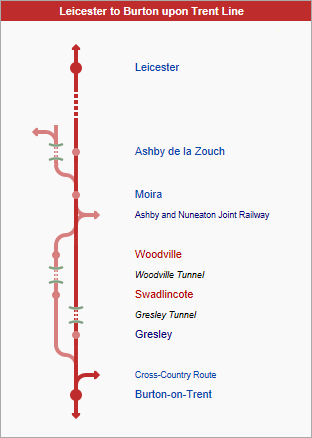
The below map shows the relationship between the local Leicester Line stations. The direct route was through Moira and Gresley to Burton but some trains took a detour between Burton and Moira, missing out Gresley but taking in Swadlincote and Woodville instead,

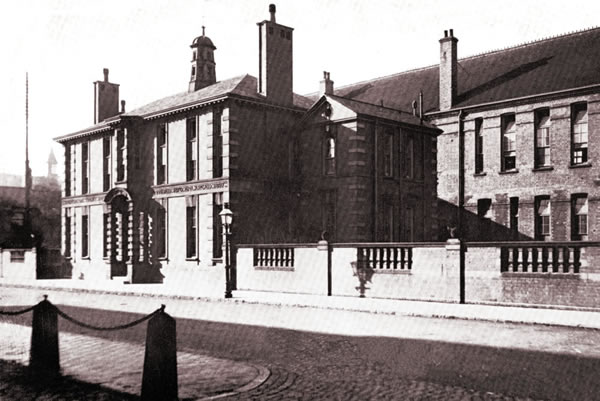
First Burton Hospital – Duke Street

On the 20th March, 1867, a meeting was held in Bank House in the High Street to consider the building of an Infirmary in Burton upon Trent. One curious feature of the occasion was that all seven who came were associated with the brewing trade and no member of the medical profession was in attendance. Possibly the problem was thought at this stage to be a purely business affair, although it is more than likely that at least some discussion with the senior doctors had gone on behind the scenes. Robert Belcher, Fellow of the Royal College of Surgeons, was brother-in-law to W. H. Worthington, one of the founder members of the committee. It may be the idea had been simmering in the minds of a few people for some time, but the precipitating factor was a legacy of some £450 left by a Mr. Brough of Winshill for the specific purpose of founding a hospital in the town. Whatever other local conditions brought the hospital venture to a head at this time it is extremely doubtful if any member of that committee was aware of just how propitious their timing was. During the previous decade two events had occurred which were to revolutionise the whole future character of the voluntary hospitals throughout the country.

Once the decision to build the Infirmary had been taken the first problem was money. The original concept was to build a twelve bedded unit at an estimated cost of some £1,700. At the first meeting in March of 1867 Major Gretton of Bass’s and Captain Townshend of Allsopps promised a sum of £500 from their respective breweries on the understanding that a further £1,000 would be raised from other sources. It was a method the brewers were to repeat on more than one occasion over the years. Their gifts did not become valid until the whole capital sum for any project had been raised. The town and district was divided between members of the committee to canvas their friends and business associates. Subscription lists were published in the local press giving the names of the donors and the amounts subscribed. It was a method which took full advantage of the principle of keeping up with the Joneses. The slightest hint at an afternoon tea party that the hostess’s name had not appeared on the list caused many a husband to subscribe twice as much as he had originally intended to do. Within a few months over £2,000 had been promised; but promises were not cash in the bank and it is surprising how many subscribers had to be nudged and nudged again before their cheques arrived. By March, 1868, the promises amounted to £2,683 of which only £605 had been actually paid into the Infirmary’s account at the Burton, Uttoxeter, and Ashbourne bank. On the whole the promises were eventually kept and by the time the new Infirmary was opened in October, 1869, only a few pounds had to be written off.

The committee’s second problem was to find an appropriate site for the new building and for the first time the ‘medical gentlemen of the town’ were called into consultation and an area in Duke Street approved. Most of the property was on leasehold to several different owners, but the freehold was in the hands of the Marquess of Anglesey and a deputation waited on Mr. Darling, agent to the Marquess. Darling was a man of considerable business ability and had obviously a good deal of freedom in dealing with estate matters, but not unnaturally his only concern was to see that any transaction was carried out in the best interests of the Marquess. At the first meeting he had rather surprisingly agreed that the Marquess would give the freehold of the actual building site to the Infirmary committee and some additional adjoining property which might be needed for future extensions on a ninety-nine year lease at an annual rental of five pounds, provided the Infirmary bought out the sitting leaseholders. On the strength of this agreement the committee went ahead. Leaseholds were bought over and three architects invited to submit plans for the new Infirmary. With the funds promised now well over the £2,000 mark it was felt possible to plan for a twenty-two bedded hospital rather than the twelve of the original scheme. There was to be accommodation for the nurses, domestics and the House Surgeon, a dispensary, an operating room, and in the blunt language of the time a ‘dead house’ or mortuary. The plans were submitted to the Committee and the doctors and Mr. Holmes’ plan accepted on the understanding that the total cost would not exceed £2,300, the building to be completed in seven months, and the architect’s commission agreed at five percent. Tenders for the building were invited and all seemed progressing well when a letter from Darling brought things to an abrupt halt.

Whether Darling had had second thoughts or whether the Anglesey solicitors in London had queried his original agreement is difficult to say. His letter, dated the 2nd April, 1868, makes no reference to the previous agreement and simply states that the Infirmary committee could have all the property they had asked for on a ninety-nine year lease at a rental of twenty-five pounds a year and he would recommend the Marquess to give an annual subscription to the Infirmary of twenty pounds. The committee was furious. The chairman, James Finlay, adjourned the meeting for an hour or two while he and three others went hot-foot to Darling’s office to protest at what they considered a breach of faith. Darling gave way and agreed to instruct the Anglesey solicitors in London to prepare the deeds on the original agreement, but in the circumstances the promised subscription of twenty pounds a year by the Marquess would be withdrawn. It seemed a little mean, but the committee was satisfied and instructed the architect ‘that the contractors might at once take possession of the land and push on with the building as rapidly as possible’.

The committee’s problems with the Marquess, however, were not yet over. Very rightly they had invited him to be the first President of the new Infirmary, an offer which he had accepted, and when it was decided to hold an official ceremony to lay the foundation stone he was invited through Mr Darling to make his first official appearance on a date to suit his convenience. The ceremony was fixed for the Whit Monday of 1868. The enthusiasm of the members of the committee for the new Infirmary was not altogether shared by everyone in the area. There had been a curious apathy in the town right from the start. When two members of the committee had waited on Lord Chesterfield at Bretby Hall and invited his financial and personal help he had turned them away empty handed. As the descendant of Lord Chesterfield whose ‘Letters to his Son’ is now an English classic, the noble Lord may have had too much of the eighteenth-century aristocrat in him to wish to consort with a malting of brewers, but he was by no means alone in his opposition. As Whit Monday approached the committee became more and more concerned and finally at a meeting convened on the 26th May the secretary had to record ‘there seemed to be some little difficulty in obtaining the attendance of a sufficient number of the committee and other influential residents in the town to meet the Marquess if he came to lay the foundation stone, and it would be better under the circumstances to dispense with any public ceremony at the laying of the foundation stone, but to ask Mr. Finlay, the chairman, to arrange, if possible, with the Marquess to defer his promised visit until the building is finished and ready to be opened’.

There was nothing for it but for the unfortunate Mr. Finlay to travel post-haste to wait on the Marquess at his London residence and explain as best he could that no-one in Burton really cared whether he laid the foundation stone or not. Whether Finlay had the temerity to add insult to injury by inviting the Marquess to open the Infirmary when completed as the committee had suggested is not known. What the first Marquess, who had seen the French off at Waterloo and lost his leg in the doing of it, would have said might well be imagined. What the third Marquess replied is not recorded, but when in October, 1869, the Infirmary was duly opened there were no fanfares, no civic receptions, and no Marquess; the Infirmary simply opened its doors.

There was trouble from a new and unexpected quarter. The whole concept of the Infirmary had been triggered off by Brough’s legacy of £450. Brough himself, of course, had died, but his brother, acting as his trustee, was keeping a watchful eye on what was going on and not liking what he saw. He demanded a meeting, it might well have been called a confrontation, with the committee in February, 1869, and made his view abundantly clear. His brother’s idea apparently had not been the acute hospital the committee was in process of building, but an Infirmary rather in the style of the monks of the old Abbey to look after the chronic and elderly sick. In the second place he affirmed the Duke Street site was no place to build a hospital and in any case the hospital planned was too small to be of any use to the community. Finally when the committee had laid down the specific areas of the town and district from which it would accept patients it had completely omitted the mining villages of South Derbyshire.

It was a difficult situation. The committee had no desire to lose the Brough legacy on a technicality but its own financial position was now strong enough both to stand firm and to compromise. Brough’s first suggestion could not possibly be accepted. The committee had just laid down in its rules that the chronic sick and incurable could not be admitted. Nor could there be any reconsideration of the Duke Street site; the contractors were already in possession. Brough’s last two points were reasonable and could be accepted. The committee had already decided almost to double the accommodation from twelve to twenty-two beds, which in turn made it impossible to increase the catchment area to include the South Derbyshire villages. Brough was somewhat mollified but not very trusting. He demanded not only that the new agreement be put in writing but also published in the local press so there could be no question of the committee reneging; and just to make assurance doubly sure he agreed to hand over a cheque for only half the amount ‘less legacy duty, say £225’, the remaining half to be paid when he was satisfied the Infirmary was large enough to provide accommodation for the people of South Derbyshire. Rather regrettably Brough leaves the story at this point. He must have been an interesting character and few trustees would have struggled quite so hard to have his brother’s wishes fulfilled. The Scots would have called him a bonny fighter and the people of South Derbyshire are still somewhat in his debt.

Over the two and half years the Infirmary took to complete the original committee had added to its numbers, elected a President, Vice-Presidents and trustees, but the major preliminary work had been done almost entirely by the original seven who formed a kind of caucus on which the full committee was based, and in the first annual report in 1870 the number of members was fixed at twenty. No voluntary scheme of this kind could possibly have succeeded without the moral and financial support of the brewers and the names are all there: the Allsopps and the Basses, the Worthingtons and the Grettons, the Eversheds, the Salts and the Nunneleys. A more influential body of men could hardly have been gathered together in any provincial town in England to guide the new hospital through its formative years. Of the twenty members of the committee in the early seventies no less than four were sitting members of Parliament at the same time; two of whom, Arthur Michael Bass and Samuel Charles Allsopp, were to be raised to the Peerage within a few years. From the surrounding countryside the Hardys of Dunstall and the Moseleys of Rolleston were raronets; and over all as President ‘the most noble the Marquess of Anglesey’.

The Marquess was appointed the first president.

Domesday Book

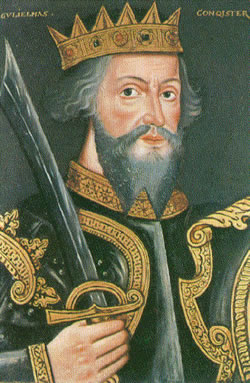
William the Conqueror (William I) is recorded to have come to Staffordshire in person during 1069 and 1070 in campaigns to stamp out rebellion. The force of this and general level of destruction was so great that large crowds of men, women and children wandered as far south as Evesham trying to scavenge food. William I is also known to have visited the shrine of Saint Modwen so certainly visited Burton and its Abbey.

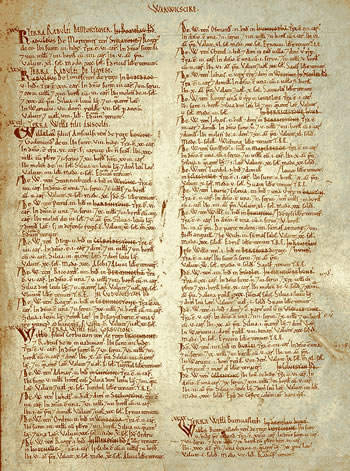
A survey later nicknamed and now commonly known as ‘The Domesday Book’ was compiled on the order of King William in 1086.

In the Burton entry in the ‘Domesday Book’, it is wrongly entered as ‘Stafford’ instead of ‘Burton’ which led to some later confusion. 20 estates were bestowed in Staffordshire by Wulfic but only 9 of these are recorded in the survey. Despite the Abbey, Burton was actually recorded as smaller than Stretton.

The Norman lords who accompanied William on the conquest of England were rewarded with land and title. The most significant beneficiary in the Burton area was Henry de Ferrers, who was given Tutbury castle in 1071. Another was Robert de Toeni whose son Nigel obtained Drakelow and Gresley. Royal commissioners visited each area and the inhabitants gave the information required in Old English although the final record was written in abbreviated Latin. Henry de Ferrers, of Tutbury castle, was one of the commissioners for Staffordshire.

William’s principal aim in making the survey was to provide a complete audit of England for the purposes of tax assessment. It was also used as a land registry to record new rightful ownership which could be used to settle disputes of ownership that had arisen in the twenty years since the battle of Hastings in 1066.

One unit of measure used in the ‘Domesday Book’ a ‘hide’. This was the amount of land that could be ploughed by a team of 8 oxen in a year and was equal to around 120 acres. A quarter of this was the ‘virgate’, and an eighth the ‘bovate’, which therefore, represented the amount of land that one ox could plough in a year and was around 15 acres.

Aside from ‘The Domesday Book’ survey, two later surveys were made in 1114 and 1126 to record the Burton Abbey estates. These show record a class of persons known as ‘censarii’ or rent-payers. An example is William (of) Shobnall. He held two bovates of land for which William (of) Shobnall paid a rent of two shillings a year. Another example was Tintor, the dyer, who also paid a more expensive two shillings and sixpence for his two bovates and also had to adhere to an agreement to work his plough on the Abbey Demesne (home farm) twice a year and had to mow three times in August.

In 1121, Ralph the ox-herd of Winshill had charge of four oxen and had to plough the Abbey Demesne. In return for this, held 8 acres of land.

The later surveys suggest that as many as two thirds of the inhabitants of Burton were omitted from the Domesday survey, most likely due to deliberate evasion to avoid taxes.

Another listed class of person was a ‘villein’. They were a class of medieval land tenants who held the legal status of freemen in their dealings with all people except their lord. A medieval village or manor usually contained several classes of laborers, consisting of in order of hierachy, the villein, the serf and peasant.

There might be a number of freemen, who paid a fixed rent, either in money or produce, for the use of their land. Gradually the distinction between the villein and the serf disappeared. Most of the peasants were serfs or villeins. The serf and the villein laboured in the lord’s household or at work on his domain. Under feudalism the lords and nobles of the land had certain rights over Medieval Villeins which included the right of jurisdiction, which gave judicial power to the nobles and lords and the right of hunting.

Among the local villeins listed in the early 12th century surveys was Alwin. He owed two day’s work on the Abbey Demesne every week. He also had to fetch salt once a year and fish on some occasions. At Christmas he had to bring a cartload of wood to the abbey and provide two hens, and during the year he had to make a ‘sester’ (large measure of malt) used by the monks for brewing, and fulfil various other obligations to pay for the right to graze his pigs.

Other recorded groups of tenants on the Abbey lands were cottagers, working one day a week on the Demesne for their small plot of land, and oxen (usually one or two). In addition the surveys mention a number of skilled craftsman such as goldsmiths, dyers and masons, each of whom paid between sixpence and eighteen pence for a dwelling house with around half an acre of attached land.

The two surveys suggest that in the early 12th century the arable Demesne land, which was scattered about the open fields in pieces called ‘flatts’ totalled about 500 acres within the manor of Burton. On the manor, the Abbey also had four oxen for drawing lime and four for drawing timber, one horse for harrowing, 70 mares and foals in the breeding stud, three Spanish asses, nineteen cows, one bull, eight heifers, two oxen not used for draught and 128 pigs.

The total Burton population is estimated at about 60 households. The ‘Domesday Book’ mentions just nine villeins.

The area of the Burton Demesne was limited by the fact that Burton was a town and Demesnes elsewhere on the Abbey estates, for example in Shobnall, were larger. Crops grown included wheat, barley, oats, rye, peas, beans and vetch. The Abbey was largely self-sufficent in food, the fertile soils of the river plain providing for both arable cultivation and cattle-rearing; the river provided fish and power for the water-mills, also listed, to grind the corn.

Ferry Bridge

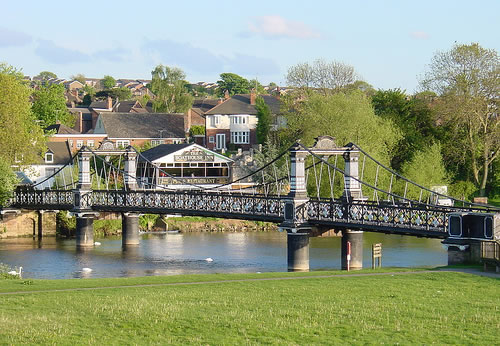
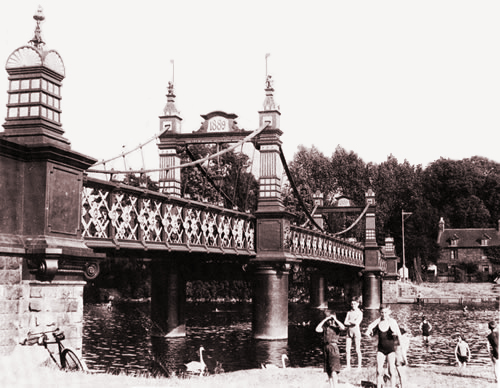
The Ferry Bridge was gifted to the town by Michael Arthur Bass (at the time, Baron, later to become Lord) to replace a simple ferry boat that operated at around the same site.

Built by local engineering company, Thornewill and Warham, it was opened in 1889, the same year as the Eiffel Tower in Paris, but was met with much greater initial enthusiasm! Very shortly afterwards, iron construction was largely replaced with superior steel.

It remains one of Burton’s most distinctive landmarks but now in need of considerable restoration to bring it back to its former glory.

Select page to view:

Ferry Bridge – The Ferry

IN THE BEGINNING
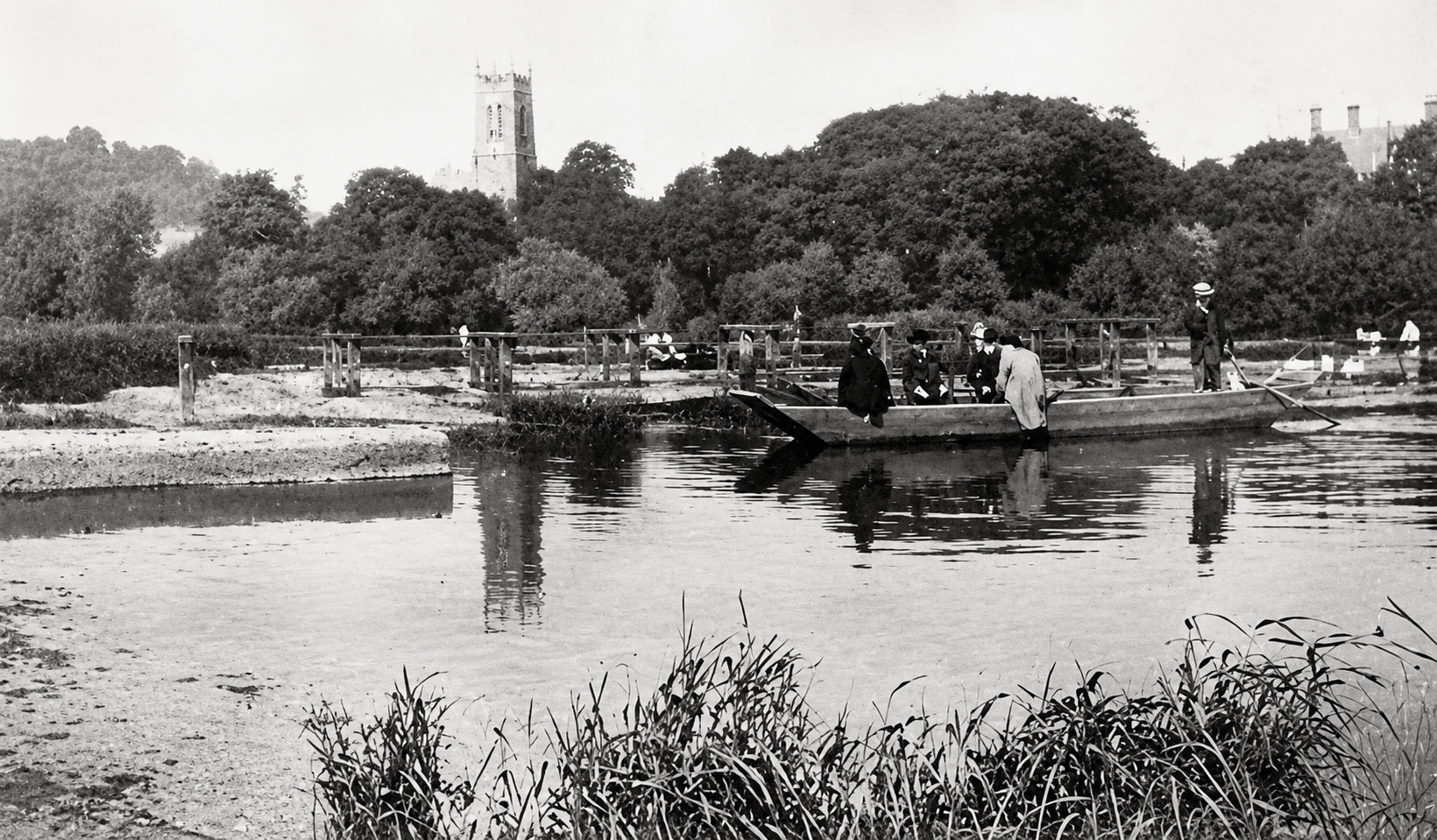
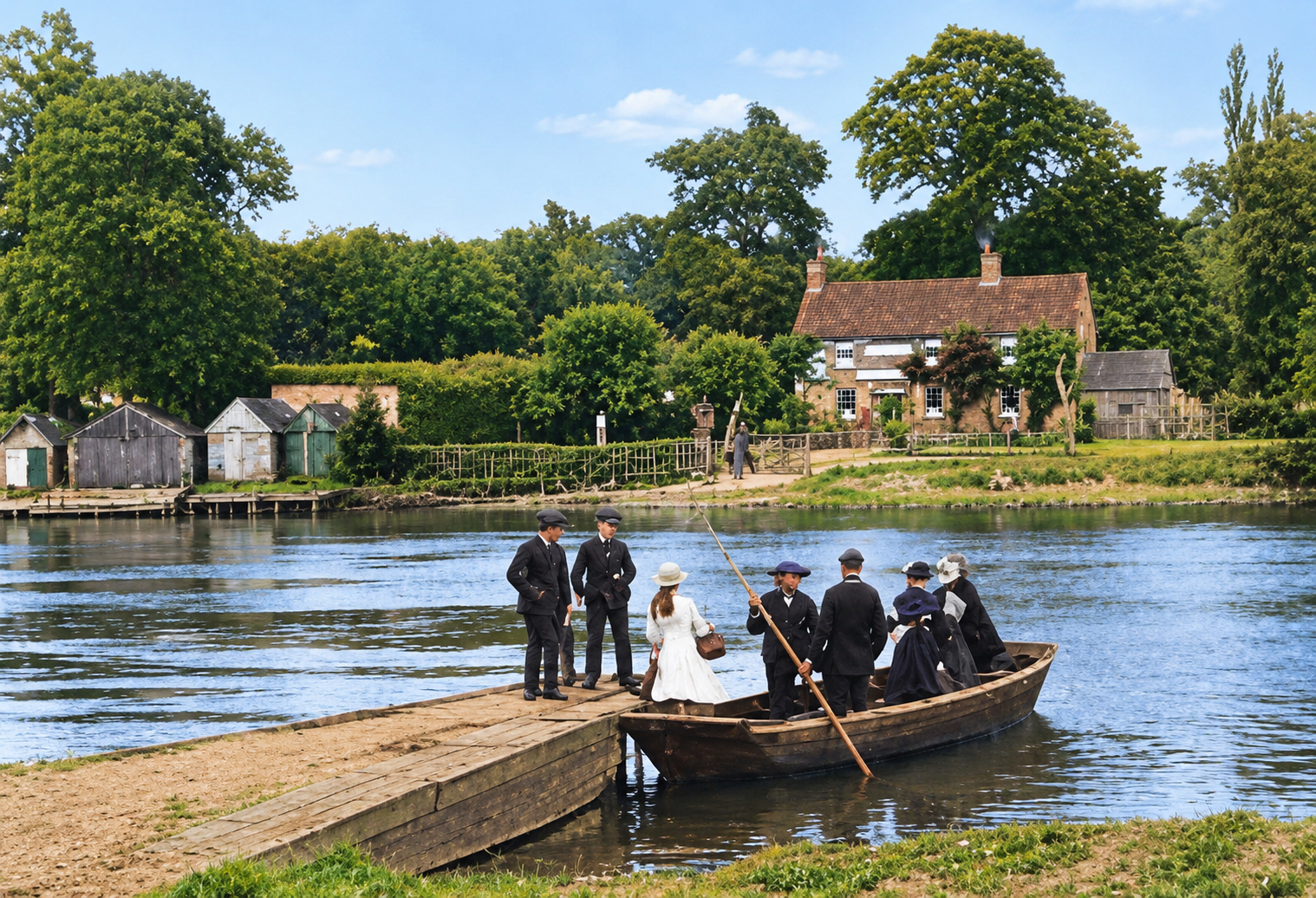
There is evidence to suggest that the early settlement across the river to the East of Burton that was to become Stapenhill arose because there was a convenience crossing point where the river was sufficiently shallow to be waded through. The original site is thought to be a little upstream from the eventual ferry site and this is thought to have some influence on the name of Ford Street still situated perpendicular to the river at the southern end of Ferry Street. Although wading across the river would have been no great obstruction to a strong adult, for the less physically able and for the transportation of loads across the river, or when the river was running high, it is thought that simple ‘boats’ were used to allow goods and people to be ‘Ferried’ across.

The crossing was to have additional significance because the river Trent used to be the defining line between the two counties, Staffordshire and Derbyshire meaning that passengers effectively travelled from one county to the other.

Although no ancient origins have been recorded, there is a record dating back to the reign of Edward I ‘Longshanks’ (1239-1307) of a man named William ‘The Shipman’, who died in 1286. There is the suggestion that he had the official role of Ferryman at this time which makes ferry boat activity around the site at least 700 years old.

The first firm documented evidence of a Ferryman comes much later, in the reign of Richard II (1367-1400). The site is now very close to the current site, most likely due to there being a more natural site from which to launch a more substancial boat. At this time, it was under the control of Burton Abbey.

Later still, there is documentary evidence in the form of a will dated 1496, by an Alice Bolde, who bequeathed two solid silver spoons towards the maintenance of the ferry boat which was still controlled by the still powerful Burton Abbey who were keen to oversee everything that passed between Burton and Stapenhill and Drakelow.

During the reign of Henry VIII (1491-1547), as part of the dissolution of Burton Abbey, all assets and income was seized by the King, which included any sources of income such as ferry rights. Along with everything else, these were gifted, together with almost the entire lands of Burton and surroundings extending as far as Cannock, to William Paget, a close advisor of Henry VIII and who was installed as first Clerk of the Council; a service for which he was knighted in 1543. Sir William was also made Baron of Beaudesert in 1549.

At this time, the Old Burton Bridge existed and had been built to ‘afford free passage for all across the Trent’ and so was free of toll. The first Baron of Beaudesert was compelled to provide a free means of passage further up the river between Burton and Stapenhill. A footbridge could not be funded so this was provided by Ferry boat. Before long, and strictly speaking, illegally, a penny toll was introduced by the Paget family to charge a fee to cross the river. Once established, a fee for crossing was continued when the management was eventually passed back to the Marquis of Anglesey, and continued right up until the ferry’s very last trip on April 3rd 1889.

Despite the toll charged for the ‘upkeep of the service’, in 1585, the wooden ferry was in such poor condition that William Paget was pressured into provided a new one.

A well known old ferry rhyme went as follows:
Across ye Trent to Stapenhill
And hack to Burton town,
A penny fee will carry me,
Tho’ well ’tis worth a crown.

THE FERRY MEN
In 1596, a small ferryman’s cottage was built on the Stapenhill side of the crossing. Operation was passed to an official ferryman in the form of a leasehold and he would reside in the cottage for its term. An annual payment was also payable to the local Lord. Above that, any fees taken by the ferryman were his from which he derived his family income.

Use of this cottage passed as part of the arrangement for each successive ferryman right through to the end of the nineteenth century. Each time the tenure changed hands, the outgoing ferryman had to ensure that the ferryboat was in perfect order or provide a new boat at the end of their lease period.

In 1771, the ferrykeeper’s cottage was replaced by the much more substancial Ferry House on the same site, which still stands today. It was also granted license to double as a public house. The cellar was cut deep into rock which, in the days before refrigeration, allowed ales to be kept in excellent condition for the time so it became a very popular venue and meeting house. A Mr Simmonds resided as both ferryman and publican who enjoyed a prosperous time up until 1825 when it met with a dramatic end. The story goes that a neighbouring baronet was returning home one night and wished to use of the ferry. In what was by then customary, he yelled “Boat, Boat!” which usually summoned the ferryman into service. On this occasion however, the cries went ignored because it was later than the published time for the last crossing. The baronet eventually had to resort to wading across the river fully clothed. When half way across the river, he became so enraged with the revelry and jeers coming from the inn that he fired upom it with a loaded gun he was carrying. His anger grew still further when he saw that some of the emerging patrons were actually amomg those he employed. Some of them were promptly dismissed and he made it his mission to ensure that the premises lost its license to serve alcohol and so its joint role as a public house came to an abrupt end. To add to the misfortune, some time later, a strong gale uprooted a large tree which crashed down onto the ferry house causing significant damage.

Mr Simmonds did not renew the lease which was taken up by Mr Lee with the property still showing signs of damage. In 1831, the post was sub-let to a Mr Preece who operated the ferry for four years until he retired in 1835. On Mr Preece’s retirement, Mr Francis Dalton, a Burton Hatter and his wife, Ann, obtained a lease on the house and ferry, still under management by the Paget family. Thus began the long tenure by the Dalton family which is most associated with the Stapenhill Ferry House which was to last for over fifty years. The building still showed signs of damange for the aforementioned accident when it was eventually sold to Mr Francis Dalton and it was he who finally took it upon himself to effect full repairs and ended up living there for the rest of his life until he died in 1871.

The census of 1841 records a Francis Dalton, Hatter, aged 25 and his wife Ann, aged 23 as the occupants of the Ferry House, with their children James, aged 2 years and Jane aged 5 months.

Despite its very long history, there are no reports of any fatality occurring from people using the ferry boat. There is, however, a record of a young man who drowned at the ferry in, or around 1839, after becoming entangled in some weeds half-way across the river whilst attempting to wade through the water after the ferry had closed for the day. After the Ferry House ceased trading as a public house the Punch Bowl became a favourite drinking place for many Burtonians, and the poor unfortunate had emerged from the hostelry at night and much the worse for drink. The ferryman had long finished his work for the day and so this foolhardy youth, likelyt aided with courage the beer had given him, attempted to cross the river without the safety of a boat and paid for his recklessness with his life.

A number of minor mishaps had occurred over the years with loaded ferryboats being upturned, resulting in the occupants being given a thorough soaking and weekly provisions from the shops and markets ending up on the river bed or being gobbled up by the ever present swans and ducks. On one occasion, the sinking of an overloaded boat resulted in the cancellation of a prize-fight. An argument at one of the Bond End pubs between two ‘bruisers’ resulted in a prize-fight being immediately arranged between the pair, and Drakelow Park was to be the scene of the affair. A great crowd then set off for the ferry and in their haste to arrive at the fight on time, a boatload of would-be spectators found themselves taking an unexpected swim after crowding onto the boat which very soon upturned, pitching everyone into the water. Not surprisingly, the fisticuffs contest was quickly forgotten!.

It was occasionally an eventful trip and not without its thrills and uncertainties. Apart from the craft sometimes overturning in mid-stream, as previously described; when fog descended the boatman might toil for a long time only to find at the end of it all that his boat and its passengers were still near the Burton bank. It was an eerie sound when the voice of a lonely traveller on its western bank echoed across the river for the, “Boat! Boat!” -the boat which sometimes never came.

JAMES DALTON – Last of the Ferrymen
James (Jimmy) Dalton, having been born at the Ferry House in 1839, had grown up and assisted his father there. When his father died in 1871, he was aged 32 and took over the operation of the Ferry.

The 1881 census records that 10 years after the death of Francis Dalton, the Ferry House was still occupied by the Dalton family with Ann, now 63 listed as ‘Proprietor of Ferry House’, and James Dalton (son) aged 42 as ‘Ferryman’ in her employment.

‘Jimmy Dalton’ became a well known local character and the subject of many local stories. Perhaps most famously, he was known for keeping a tame magpie which constantly ‘annoyed’ him by hiding his spoons and clay pipes. Around this time, a notorious criminal, Charles Peace was making national news and was hanged at 8:00am on February 25, 1879. To commemorate the occasion, Jimmy Dalton rigged up a miniature gallows and hung his magpie as the clock struck eight announcing that “Two rogues have gone together!”

Records for 1879 show that the ferry carried no fewer than 17,754 people per month. The journey across the river was sometimes a treacherous one. Periods after heavy rain made for a very fast flowing river with sometimes very muddy, slippy banks and a sometimes swollen brook still had to be negotiated once across the river. James introduced a number of improvements such as chain handrails across the brook and the firming of the boggy banks.

The roads and tracks leading down from Stapenhill to the ferry often caused concern to travellers, especially during wet periods and winter months. They had become little more than churned up muddy cart tracks often difficult to negotiate. With much hard labour, James Dalton strove to make the passage as safe as possible by patching the roadways with whatever suitable materials he could lay his hands on.

The pathway from the Burton side of the meadows led across the Fleet Green and Shipley Meadow (later known as Baldwin’s Meadow). There were a couple of planks were laid across the brook there, with just a post in the centre to assist users in balancing themselves whilst making their way over this crudely constructed bridge. Even so, many unwary travellers emerged cold and soaked to the skin after slipping into the water at this point in adverse conditions. On one occasion, an unfortunate man slipped off the bridge and was drowned.

Following this unfortunate incident, James Dalton was partly responsible for improving the bridge and adding a dis-used colliery chain to act as a handrail. The time was long overdue for the ferry to be replaced by a footbridge.

As demand for the Ferry grew, it became necessary to operate two boats at peak times to cope with the volume of passengers. James employed a number of different additional Ferrymen to assist in this role when required.

Following the eventual and inevitable closure of the Ferry when the bridge finally arrived in 1889, James Dalton gave up life on the river and went to work for his brother-in-law, John Webb, as a Tailor’s Porter in premises on Stapenhill Road with many ‘Tales of the Stapenhill Ferryman’ to share in the local taverns.

THE CASE FOR A FERRY BRIDGE
In 1800, the population of Burton was under 3,700; Burton Extra (Bond End) added just over 700. The population of Stanhill was less than 500. The population on both sides of the river grew steadily and by 1831, it reached over 4,300 for Burton, just over 900 for Burton Extra and Stapenhill had a population just short of 600.

As the breweries in Burton continued to expand and the workforce increased, usage of the ferry also began to increase proportionately. The population of both Burton and Stapenhill grew steadily with new houses springing up on both sides of the river with to accommodate them. By 1851, the population of Stapenhill had increased to 635; by 1861, this was over 1,100 and by 1871, there were almost 2000 inhabitants. With this rate of growth, two boats were now needed at peak times to handle the sheer volume of passengers across the river, although no figures ever seem to have been produced to give an accurate account.

The inconvenience of having to wait for the ferryman, often for lengthy periods, was voiced by an irate gentleman who wrote a letter of complaint to the Burton Weekly News in 1860:

“I should like to call attention to the shameful way people are kept waiting at the Stapenhill ferry. Now it may be very picturesque as represented in paintings, with fair, rustic maidens in bright, coloured petticoats and bare feet on a golden day in August, but when the waiting takes place on a stormy night, it is anything but picturesque, and very unpleasant. I have had to wait, when the attendant has been, I have no doubt, roasting his toes before a bright fire and until he has chosen to stir, I have had to stand catching a cold and losing my temper. Surely in this enlightened 19th century, ferries are behind the age.”

In the same year (1860), a complaint was made by a Mr T. Lowe, one of the Town Commissioners, concerning the bad state of the Fleetstone Bridge which, he observed, “was a complete disgrace to the town and ought to immediately be repaired”. For all the complaints about the Fleetstones bridge and the Ferry little was done towards making any improvements. The only improvement in fact, was the erection of a shelter on the Burton side of the river, due mainly to the efforts of a certain Councillor Redfern. Although always under consideration, it would be almost another 30 years before the building of the Ferry Bridge was to begin.

In October 1864, the council commissioned a census over a typical two week period to get some idea of the number of people using the ferry service. It revealed that 10,592 persons had used the Ferry service in that time. Similar records for 1879 show that no fewer than 17,754 crossings a month, sometimes significantly more, were using the Ferry. Given that service operated on a Sunday, that equates to almost 700 crossings a day making use of the ferry (of course, many of these were the same people making a return journey).

The population continued to increase relentlessly and it was estimated that over 4,700 inhabitants were now within the borough boundaries. This increase in the population naturally led to proportionate demands being made on the use of the ferry boat. Business was booming and the ferrymen were kept very busy. It was almost impossibly hectic on dates such as ‘Stapenhill Wakes Week’ and ‘Burton Statutes Fair’.

A new notice board which was erected at the boarding point advising passengers:

STAPENHILL FERRY
Open Sundays and weekdays for foot passengers.
Lady Day (March 25th) 5:30am till 10:00pm
Michaelmas to Lady Day 5:30am till 9:00pm
Fares l/2d each person.
Hand carriages (prams) l/2d each.
Weekly fares 3d, 4d or 6d. according to requirements.
Persons wishing to use the ferry before or after public hours
must make their own private arrangements with the ferry man.

An 1878 candidate for the Council wards of Stapenhill and Winshill stated in the local press: “James Dalton the ferryman has plied his honourable office long enough and must wish to retire and if James retired the ferry would not be worth preserving. The property on both sides of the river would be greatly enhanced by the addition of a new bridge”. The pledge to push for a bridge was a strong campaigning issue capturing the strong feelings of Burton and Stapenhill residents that the out-dated ferryboat conveyance was long overdue replacement with a suitable bridge.

Still without a bridge, according to a report which appeared in the Burton Observer in April 1889, no less than 185,000 persons were ferried across the river between May 7, 1888 and the beginning of April 1889, an increase of something like three thousand per week more than was the case less than ten years before.

THE RIVER TRENT
The river Trent diverges through Burton making a few islands. It is easy to think of this as being fairly static but it should be considered that the current course of the Trent through Burton, like much of the town, has changed dramatically since the times that the Ferry was in use.

Perhaps most surprisingly, the river downstream of the Ferry Bridge that flows past Stapenhill Gardens and round the bends between the Ox Hay and Stapenhill Hollow was NOT the main course of the river at this time! Rather, the river turned left just down from the present day Ferry Bridge into a mouth that is now only just visible as it forms the end of what is now known as the Silverway. It rejoined the main river some distance down at a point known as Alligator Point, froming an island known as Horse Holme which no longer exists other than the expanse of land that lies the otherside of the eastern woodland on the Ox Hay.

In the early 1800s, the Silverway itself was very wide and, in the summer, patronised by many bathers who swam in the river in the absence of the not yet build public baths. Even after the public baths were donated to the town by Richard and Robert Ratcliff in 1875, the Silverway was widely used and its use continued after the Ferry Bridge causeway was added.

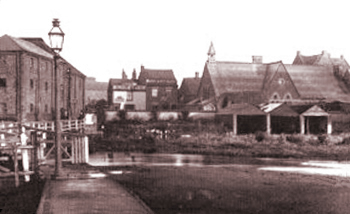
At the Burton end of the causeway, the Fleetstones area contained a good flowing leg of the river with numerous boathouses and a rather precarious footbridge that had to be carefully negotiated. This flowed passed the Abbey and Saint Modwens chrurch but is now almost stagnant.

For old times sake, crossings were available for a while after the Ferry Bridge had been built.

Ferry Bridge – Building and Opening

BRIDGE FINALLY AGREED
Reported on an 1886 meeting: “Alderman Evershed and Councillor Chamberlain convened a meeting at Stapenhill to consider improvements to Stapenhill Ferry. The Major, who presided, said the ferry was 100 years out of date and a footbridge was urgently needed. He said that Lord Angelsey had a life interest in the ferry rights and the whole of the estate was in the hands of the trustees. There was a clear income of £560 from the ‘rights’. His proposition ‘that the delay and inconvenience of the present ferry boat, especially on dark and foggy nights, was intolerable and that the meeting approve the desire of the trustees of Lord Anglesey to erect a footbridge, and earnestly support them in taking prompt action to carry out the work’, was carried”.

Hopes were raised when, in 1865, the Marquis of Angelsey obtained an Act of Parliament authorizing him ‘to build and maintain a bridge over the river Trent, near the town of Burton-upon-Trent, at or near the site of Stapenhill ferry, with approaches thereto’. This bridge was originally intended to be a second river crossing that was on par or better than the existing Burton Bridge. Plans for a traffic carrying bridge were drawn up but, much to the dismay and disappointment of the many ferry users, the work never progressed beyond the planning stage. The ferry users were still hopeful that a river crossing would still be built by some other means and it was generally perceived that the Marquis of Angelsey was responsible for the halting of the proceedings.

Almost a decade later, still frustrated, the inhabitants of Stapenhill began a new determined campaign to push their demands for a second bridge to coincide with the local elections. Any candidate seeking election for that ward on the Town Council would not have stood any chance of winning had they not given their whole-hearted support in favour of these fervent calls to be met.

After still more years of inactivity, in 1885 the Marquis of Anglesey applied for new parliamentary approval, but this time, only to erect a much less ambitious footbridge over the river Trent near the site of the Stapenhill ferry and to sell the rights and the ferry to the Burton Corporation. The application was approved in 1886 but the general sentiments were that the sum being asked by the Marquis were much too high.

After considerable time and frustrating negotiations between the council and the Marquis, Sir Michael Arthur Bass (later to become Lord Burton) came forward with a generous offer to build a footbridge at his own expense, as long as the council bought the rights from the Marquis. After still more delays due to further negotiations between the Marquis and the Council over remuneration, terms were eventually agreed upon with the Marquis agreeing to sell the rights for the Ferry and the Bridge for the then substantial sum of £12,950 from the Corporation.

Having acquired the rights, the Corporation agreed to retain the services of the men who had worked the ferry and to arrange for the purchasing of the boats from Mr Darling, the agent of the Marquis of Anglesey.

A letter was received by the Town Council in January 1888 from Messrs. J & W.J. Drewery, stating that the completion of the purchase of the ferry could now be entered upon. The committee recommended that a cheque for £12,950 be forwarded in favour of the bankers of the Marquis of Anglesey’s Trustees and that one of £32 19s 6d balance on account for outstanding tolls. To put this is perspective, ferry toll receipts for the final month were recorded as £67 10s 5d.

Lord Burton finally selected Messrs. Thornewill and Warham Limited, a highly esteemed local engineering company, to erect the bridge and, after design plans and costs had been agreed, work was at last commenced in 1888.

THE BRIDGE BUILDER
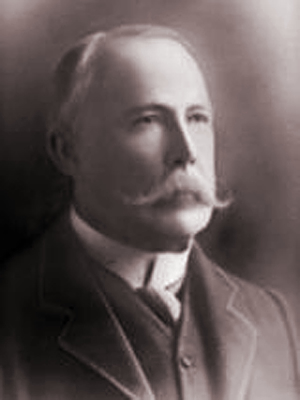
Thornewill & Warham Engineering Limited was established in Burton during the late 1830s with a partnership between local engineer, Robert Thornewill (pictured) and John Robson Warham, an engineer from South Shields. Its main concern was the manufacture of pumping and winding engines, most for Midland’s collieries.

By 1861, the company had 178 employees and had expanded into manufacturing steam locomotives for the local breweries. By 1870, it had a national reputation for producing steam engines and began to export engines all over the world. It gradually acquired more land to build a large site that extended between New Street and Park Street adding a number of iron foundries. During its continued growth, Thornewill & Warham supplied the majority of all iron-work for the rapidly expanding brewery construction projects.

In 1883,the company was approached to supply a substantial iron bridge to replace the wooden footbridge that linked the main town to Andressy island. The following year, in 1884, the new impressive Andressey Bridge was opened to great success. This made them natural candidates for the construction of a new Ferry Bridge. Not wishing to be cynical, it may also have helped slightly that Lord Burton was married to Robert Thornewill’s daughter.

Whilst the company was enthusiastic to supply the proposed bridge, they didn’t have anyone within the company with sufficient bridge building experience to erect a bridge of such span when it was agreed that the bridge would require some sort of suspension design. Mr Edward William Ives played the main role in designing the bridge. He had been involved with a number of construction projects for Thornewill and Warham, including the Andressey Bridge built a few years earlier. However, he had never designed a bridge of such span and so the services of Mr Langley were sought. Mr Langley was an eminent engineer in the Midland Railway Company. With strong bridge building experience for the railway industry, he took great interest in both the design and construction of the bridge and made his full engineering experience available.

The large factory of Thornewill and Warhams was between New Street and Park Street. In its glory days, it was difficult to imagine such an engineering company ever disappearing. Around forty years after the construction of the Ferry Bridge however, the company had disappeared in the decline of heavy engineering. The site was taken over by S. Briggs and Company in the 1929. The remainder of the assets were acquired by the new ‘Burton Copper and Engineering’ which started in an abandoned brewery in Moor Street. The site was finally vacated when S. Briggs was re-located to Derby Street to make way for the new Octagon Shopping Centre leaving no trace.

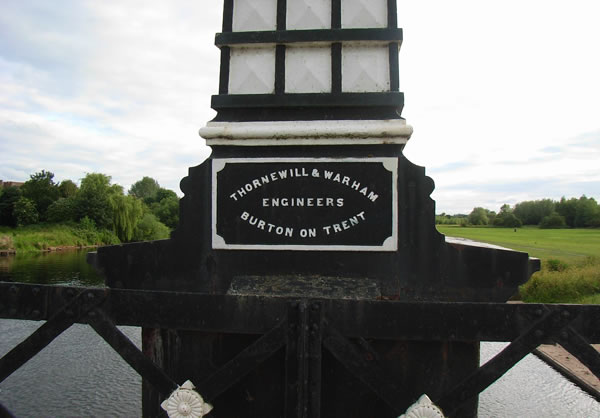
One of a number of plaques to commemorate the builders

THE BRIDGE
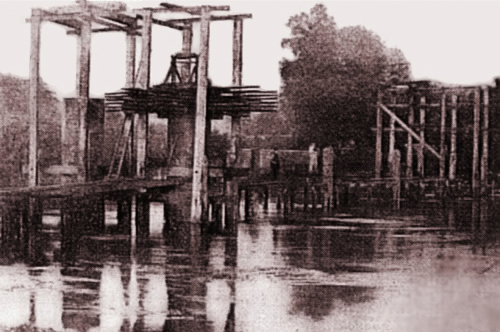
The original work was for the Ferry Bridge itself but did not yet include the causeway. For a few years, there would still be a path across the meadows between the Ferry Bridge and Burton. The Ferry Bridge was 240 feet in length and had a walkway width of ten feet.

The construction of the bridge was on a suspension principle. Its distinctive feature being the chains which are made of flat bar iron, riveted to the ends of the main girders. These chains are continuous from one end to the other and are not anchored at the ends as they would normally would be on a traditional suspension design. This form of construction had not been previously used and was the first bridge in Europe to be constructed in this way.

It spanned the river in three sections, supported by four cast iron piers, five feet in diameter. These were placed in pairs fifteen feet apart from centre to centre. The piers were sunk to a depth from twelve to fifteen feet below the bed of the river to a solid foundation of marl and sandstone. The centre section was 115 feet long with the two symmetric end sections measuring 57 feet. The bridge stood eleven feet above the average water level at the centre and nine feet above the water at each end.

The cylinders were filled with solid concrete and on top of this was built three feet of non-porous engineering blue bricks cemented together. Finally, to complete the foundation, was an ashlar stone bed onto which the towers were erected.

The towers were cased externally with ornamental cast-iron work and stood 23 feet 6 inches high, the bases being panelled and decorated with the arms and supporters of Lord Burton, together with his motto – ‘Basis Virtutum Constantia’ (The basis of virtue is constancy). The towers were surmounted with lions rampant and carried wrought-iron staffs with gilded copper vanes and his monogram. They were indeed a great tribute to the superb Victorian craftsmanship that existed in the Town.

The bridge is 240 feet long and the roadway is 10 feet wide. It crosses the River Trent in three spans, the centre span being 115 feet wide between the piers and the two side spans each being 57 feet wide between the piers and the stone abutments. The height of the underside of the bridge from the average water level is 9 feet at the ends and 11 feet in the middle.

The towers over which the chains pass are carried on four cylindrical piers and are placed in 2 pairs, 15 feet apart from centre to centre, 5 feet in diameter (the diameter of the cylinders was fixed upon as providing the smallest area inside which the men could conveniently work) and are sunk to a depth from 12 to 15 feet below the bed of the river to a solid foundation of marl and sandstone.

The water was pumped out of the cylinders by a pulseometer supplied with steam by a portable boiler and the earth and rock was hoisted to the surface in a bucket. Large piles were driven at the sides of the cylinders to keep them vertical and to strengthen the overall structure. The cylinders were filled with concrete and upon this is laid 3 feet of blue bricks and a stone bed onto which the towers were erected.

The towers are contracted of wrought-iron lattice work 2′ 3-1/2″ (two feet three and a half inches) at the bottom to 1′ 4-1/2″ (one foot four and a half inches) at the top and 20’3″ high. They are braced together at the top by a lattice girder 11-1/4″ (Eleven and a quarter inches) deep. The towers are cased externally with ornamental cast iron work 23’6″ high, the bases being paneled and decorated with the arms and supporters of Lord Burton and his motto: Basis virtutum constantia. The towers are surmounted with lions rampant (his lordships supporters) carrying wrought-iron staffs with gilded copper veins with his monogram.

The girders are continuous from one end of the bridge to the other. They are 6 feet deep, the top and bottom flanges are made of “T” iron 6″ by 6″ by 1/2″ thick. The lattice bars 3″ by 3/8″ of flat iron and stiffened by double angle irons and gusset plates. The longitudinal girders are tied together by lattice cross girders 12″ deep in the middle and 6″ deep at the ends, and wind ties of flat iron are also placed between these girders. The longitudinal girders formed the parapet of the bridge, the top and bottom flanges being cased with ornamental iron work, and the junction of the lattice bars enriched with ornamental castings.

The chains are made of flat bars 3 inches thick, riveted in the middle of the centre span and at the ends of the bridge to the main girders. The piers and towers are placed outside the main girders, which increases the resistance of the bridge to wind pressure, the distance between the chains being wider at the tower than at the middle and ends of the girders. The chains are simply riveted to the ends of the girders and not anchored to the masonry of the abutments, so that the whole bridge is self contained. The main girders are hung from the chains by suspension rods one and a half inches in diameter. The roadway was originally red deal 3 inches higher in the middle than at the sides to allow run off of rain water.

The bridge was tested by loading the middle section of the bridge with several tons of old rails and its rigidity was further tested by 20 men from the Staffordshire regiment marching at double time across the bridge. This was considered the most severe test that a suspension bridge could be exposed too. The lattice girders which tie the towers together are cased with more ornamental iron work bearing the date of the erection of the bridge, 1889 and underneath this the inscription The gift of Michael Arthur First Baron Burton.

The bridge was lit by two lamps hanging from each of the cross braces between the towers and the heavy cast iron lamp pillars in character with the towers at the ends of the bridge, bearing four more lamps. Lord Burton also diverted the pathway so as it was to make it lead directly to the bridge from the fleetstones and replaced the small wooden bridge over the ditch cut to the silver way with a small lattice girder bridge of similar design to the main bridge.

The total weight of the iron work of the bridge is over 200 tons. The stone abutments were built by Messrs Lowe and Sons, and the carving of the patterns being executed by Mr Hilton of Victoria Street Burton. The total cost of the structure including the diversion of the roadway the iron work approach, the small bridge, the earth work embankments, and the purchase of the land for the improvement of the roadway on the Stapenhill side of the river was between £6000-£7000. Once built the bridge was testament to the quality of the local workforce and the expertise of the contractors concerned.

THE OPENING
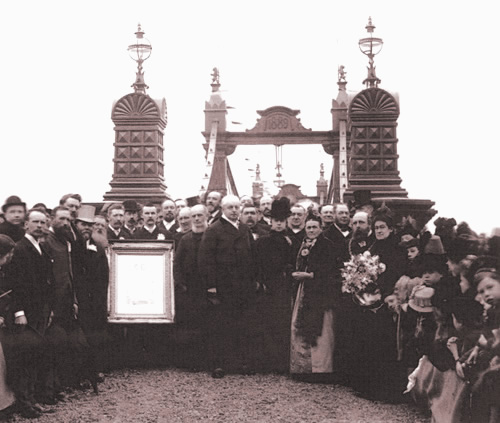
In early 1889, Sir Michael Arthur Bass (still not yet Lord Burton) contacted the Mayor and advised him that the bridge would be completed and an official opening day was set for Wednesday 3 April 1889. The bridge was decorated bridge the day before and crowds began to assemble early. From early morning, many people crowded onto the ferryboat to take the opportunity of a trip on the very last day of operation. The weather was wet and stormy which was a big disappointing. Nonetheless, a crowd estimated at between eight and ten thousand assembled on the Burton side of the river alone. Although heavy grey clouds filled the sky, the rain held off, but it was still uncertain as to whether Sir Michael, who had not been too well, would be able to attend the ceremony. Fortunately, these fears were unfounded.

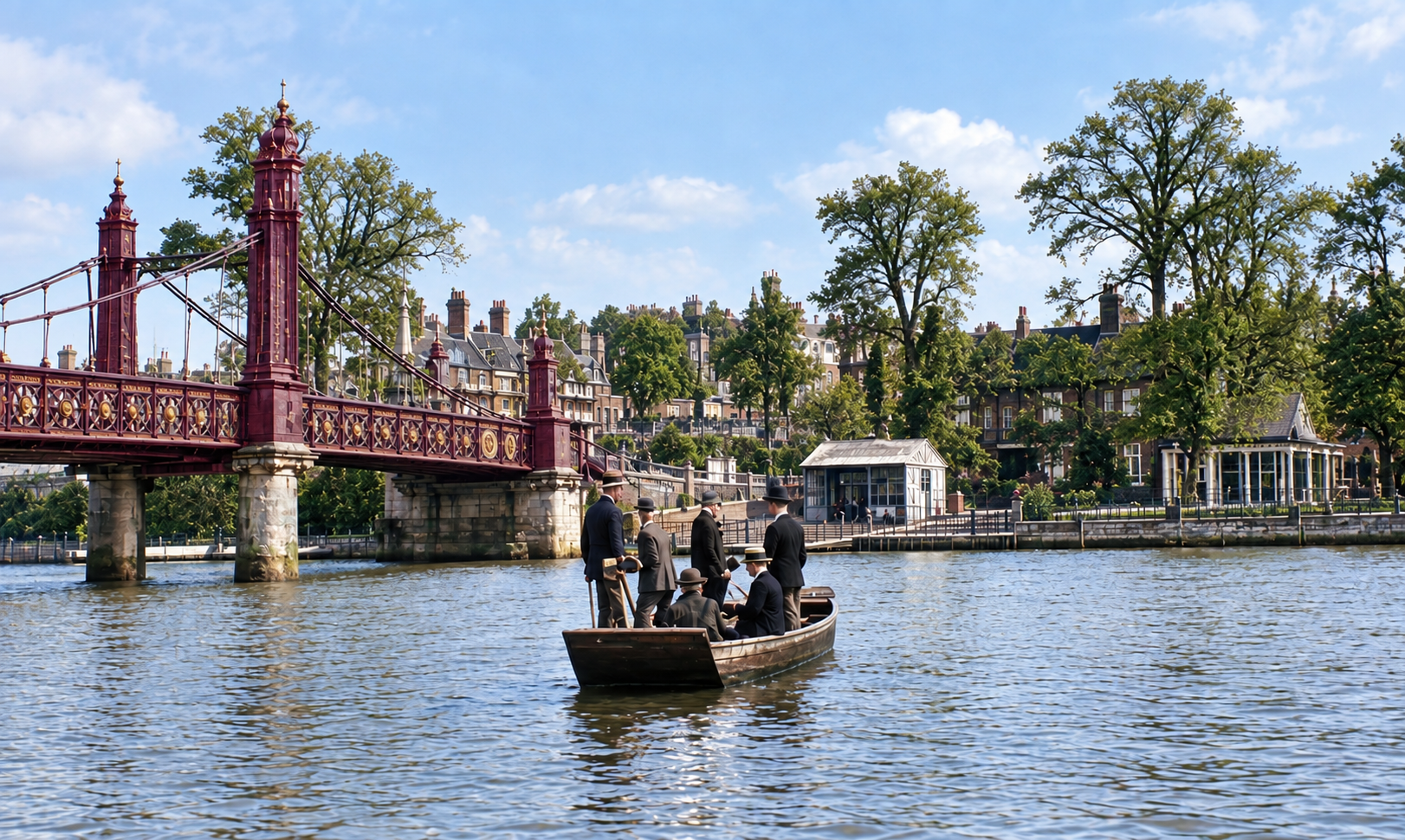
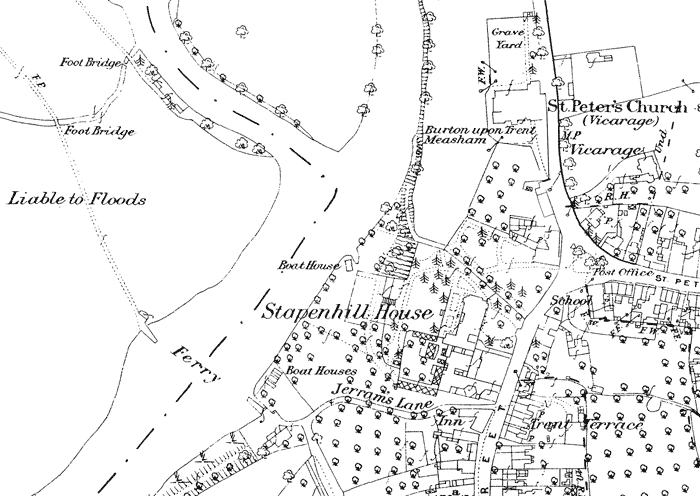
Sir Michael Bass and his party drove from Rangemore Hall to Stapenhill House, residence of C.J. Clay JP. Stapenhill House occupied the upper terrace of what is now Stapenhill Pleasure Gardens and the whole of what is now Stapenhill gardens belonged to the house with a tennis court occupying the place now taken by Burton’s iconic white swan. The party walked down Jerram’s Lane to the Ferry Bridge and word was given to stop the ferry boat at ten minutes to ten in readiness for its one final historic trip which would carry the opening party.

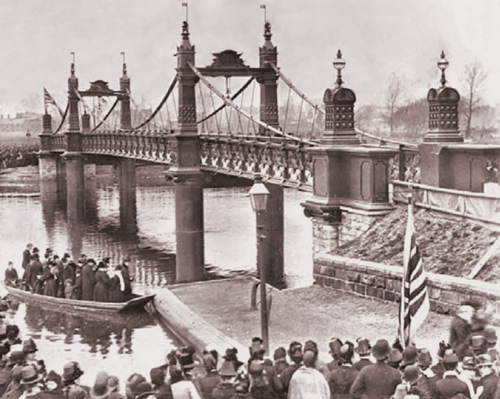
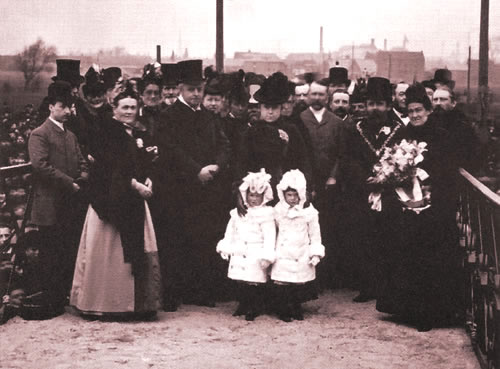
Cheers from the crowd which had reached an estimated 8,000-10,000, rang out as the party crossed the bridge and boarded the ferry boat on the Burton side. Mrs Burton entered first, followed in order by Sir Michael Arthur Bass, Sir W. and Mrs Plowden, Sir Michael’s brother-in-law, the Hon. Miss Bass, the Mayor and Mrs Harrison, Misses Kathleen and Violet Thornewill, the daughters of Mr and Mrs. Thornewill, Mr and Mrs C.J. Clay and Mr G. Burton.


On the front row above are Mrs Harrison, Sir M.A. Bass (later Lord Burton), Nellie Bass (with Misses Kathleen and Violet Thornewill), Mr C. Harrison (Mayor), Mrs Bass.

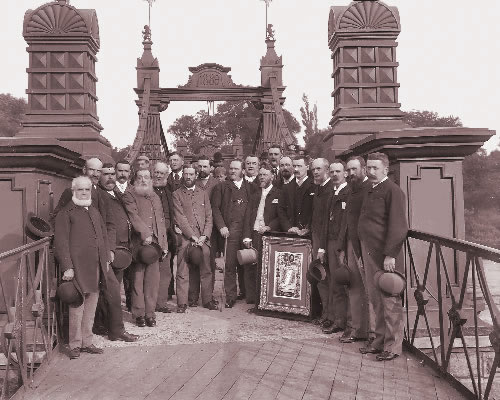
Safely across, they went up on to the bridge for the formalities. The Mayor presented Mrs Burton with a boatshaped fruit dish in solid silver, its engravings including a representation of the bridge and an appropriate inscription. The work had been carried out by Mr A.J. Wright, jeweller of 170 High Street. Sir Bass was then given an elaborate illuminated address subscribed for by over 5,000 people. Sir W. Plowden MP replied on behalf of Sir Michael who had a throat infection and proceedings were handed over to the Mayor.

Title deeds in connection with the bridge were officially handed over to pass responsibility of the structure to the Corporation. Following an introductory speech of thanks by Mayor Harrison, Mrs Burton was invited to declare the bridge open. Stepping to one side of the bridge, Mrs Burton, speaking in a clear voice said, “I declare this bridge open, and I hope it will be of great benefit to the public”. The declaration was greeted with much loud cheering and flag and handkerchief waving and in the distance, the bells of both St. Paul’s Church and those of St. Modwen’s rang out.

The official party then adjourned to St Paul’s Institute a substancial banquet with many courses, toasts and long speeches. It was here that Sir Michael Bass announced to the guests his proposal to erect a raised causeway across the meadows to provide a safe crossing from the Ferry Bridge to Burton, avoiding the muddy trek from the Fleetstones bridge across the meadows to the new Ferry Bridge. This generous proposal was welcomed with enthusiasm from those present.

The public cheerfully crossed and re-crossed the bridge free of charge for the day and no doubt drank in local hostelries to the words on a banner draped across The Dingle – ‘Three Cheers For Bass’.

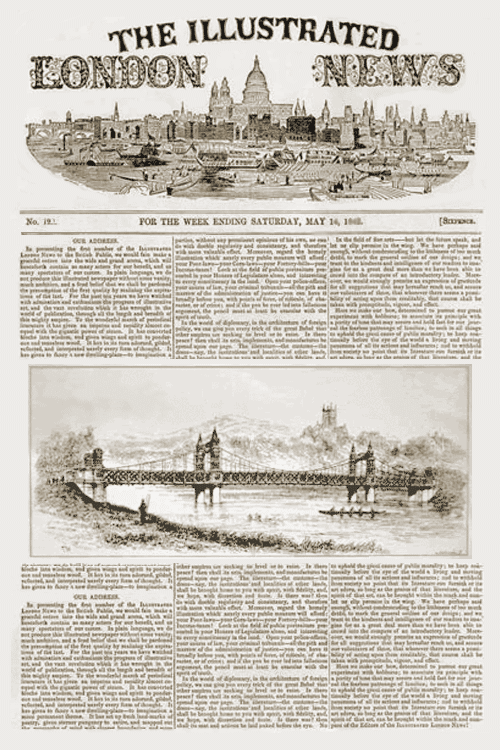
Once the bridge had been opened, it was featured in the ‘Illustrated London News’ – the World’s first illustrated newspaper founded in 1842 by Herbert Ingram who went on to become editor of Punch magazine.

The Illustrated London News enjoyed a country-wide weekly distribution of around 25,000 making it a major publication at the time and helped to put the Ferry Bridge on the map.

Ferry Bridge – The Bridge

NEW FERRY BRIDGE
After purchase of the rights, there was further delay due to the fact that Sir Michael Bass wished for the bridge to be free of toll. A compromise was eventually reached and it was agreed to charge a toll of one half-penny per person until the Corporation had recovered the money for the purchase of the ferry rights. The Town Council decided to spend £50 on the erection of two turnstiles on the Stapenhill side of the bridge in order to enable them to accomplish this aim.

A Mr and Mrs Whitney were appointed by the Town Corporation as toll-keepers and notice boards were erected providing the opening and closing times of the bridge and the toll fees for using it. Although there was no cause for the Ferry to still operate, the new bridge still had a toll to recover the cost of construction. The Ferry House was therefore occupied by Ferry Bridge Toll Collectors who were now employed by the Town Corporation though the much lighter job probably didn’t warrant having a house supplied with it!

However, Thomas Whitney and his wife Anne moved in as Toll-Keepers and they were, not altogether surprisingly, still occupants of the Ferry house ten years later, in 1901. By now, Thomas Whitney’s occupation was recorded as ‘Corporation Labourer’ since the Ferry Bridge was freed of toll three years earlier in 1898.

At the banquet at St Paul’s Institute following the official opening, Sir Bass had announced that he was to erect a raised causeway across the meadows join the Ferry Bridge to Burton. A few days after the ceremony, the Town Council received a letter from Sir Michael dated 9th April 1889, confirming his proposal. The erection of an iron viaduct was begun and this was presented to the town in 1890. This elevated the total cost of the bridge from around £7,000 to £10,000.
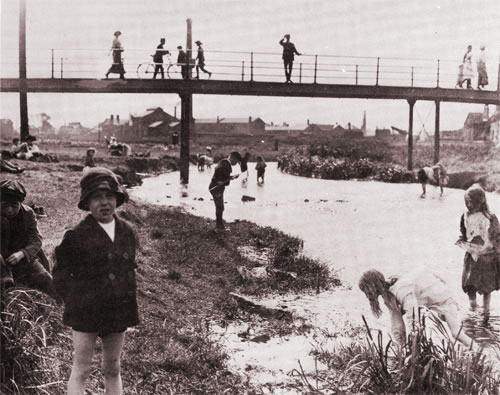
At the time the causeway was built, it had to cross another branch of the river which was a common play area in the summer. The slightly raised section can still be seen but the river has long gone.
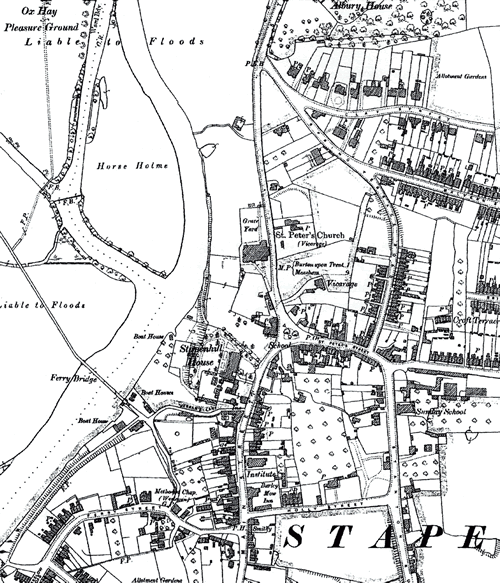
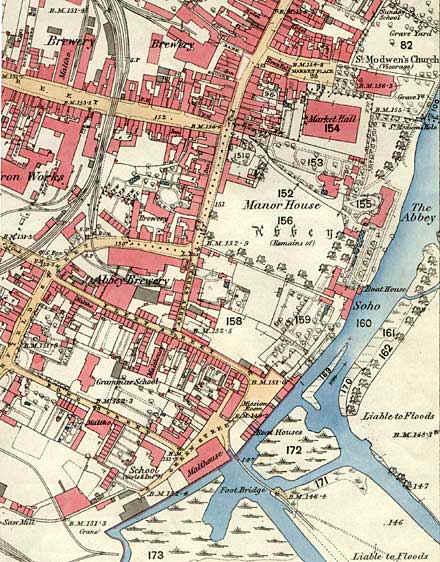
A new Ordanance Survey map was prepared in 1900 which showed the Ferry Bridge and Causeway officially ‘on the map’!
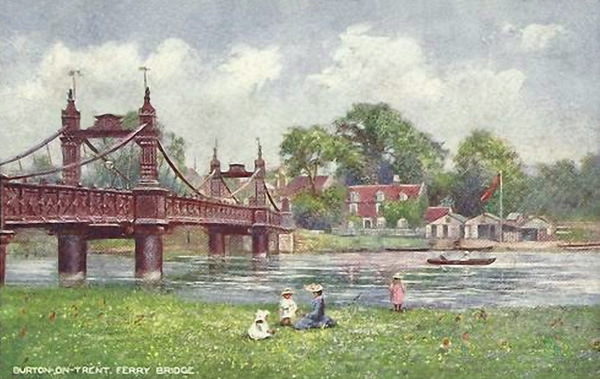
The bridge soon became the subject of a number of Burton postcards.

TOLL FREE
On April 21st 1898, the ‘Burton Chronicle’ reported:

“Lord Burton’s latest donation to the town is a cheque for £230 to clear the Ferry Bridge of its debts. Ever since the structure was built, he has received a yearly statement of accounts, showing the progress of the tolls which it was necessary to create to pay off the loan of nearly £13,000, the price paid to the Marquis of Anglesey for his ferry rights. On the receipt a short time ago of the last balance sheet, he decided to wipe off the incubus, so the people have witnessed the freeing of the bridge two months earlier than anticipated”.

The early freeing of the toll on April 13th 1898 came as a complete surprise. A Stapenhill resident at the time, Mr Harold Lewis, who used the Ferry Bridge on a regular basis recalled walking across on his journey to work in Burton, where he was employed by Messrs. Worthington’s in their brewery offices. He and other travellers, not to mention the Town Council, all expected the enforcement of the toll to continue for several more months.

The Council had no opportunity to give notice of Lord Burton’s generous offer to wipe out the remaining debts on the ferry rights so on the way home from his work at the brewery, Mr Lewis stopped as usual, to purchase a weekly ticket from the toll collectors, Mr and Mrs Whitney, at a cost of 4d. The next morning, on his way to work, he went to present his ticket to a non-existent collector, for unknown to Mr Lewis, the bridge had been declared free of toll the previous night.

Many users of the Ferry Bridge retained their toll tickets dated April 13th 1898, as a souvenir as a momento of the last day of a toll being charged.

On the shelter positioned on the causeway, it is still possible to read the declaration:

THIS BRIDGE AND VIADUCT
WERE PRESENTED TO THE BOROUGH OF BURTON UPON TRENT
BY THE RIGHT HONOURABLE MICHAEL ARTHUR BARON BURTON
AND THE BRIDGE WAS DECLARED FREE OF TOLL BY THE CORPORATION
ON THE THIRTEENTH DAY OF APRIL 1898
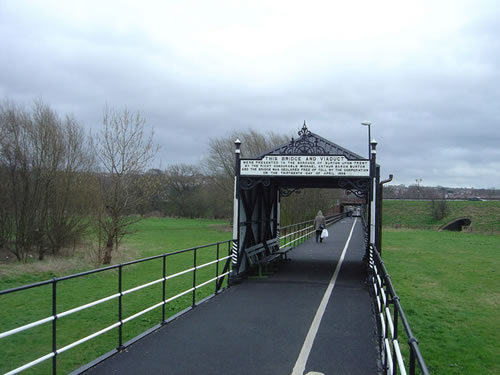
The following Sunday, April 24th 1898, was the first free Sunday on the bridge. A kind of ‘Children’s Carnival’ took place on that warm Spring day, when lots of children attended the bridge to celebrate the freeing of the toll. The only person who failed to appreciate the occasion, apparently, was an old blind beggar who regularly stood at the Stapenhill end of the bridge, hoping to receive a few coppers from the public using the crossing. The youngsters had great fun, tormenting the poor chap mercilessly, whilst being watchful of his stout cudgel which kept them at bay. Happily, no one came to any harm on this day of light-hearted fun and celebration, when people could look forward to taking the walk to town free and forever more.
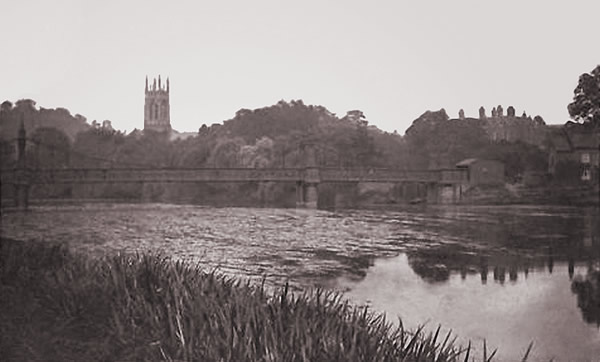
Taken in 1915 from across the river, the above photo gives a marvellous view of Stapenhill House, whose grounds eventually became Stapenhill Gardens, with the Ferry Bridge in the foreground providing a very good feel of how imposing the house would have been to people walking across the bridge.

As cycling gained ever increasing popularity with the public, both for pleasure and as an easy and convenient way of getting to work, people were tempted into cycling across the bridge and viaduct This was strictly prohibited and notices made of cast-iron were erected at both the Stapenhill and Burton approaches to the crossing, warning the public that they risked a fine of forty shillings (£2.00) if they were caught breaking the law in this regard.

Despite this, a great number of the public chose to ignore these warnings and over the long period that these restrictions remained in force, many of them found themselves in court after being confronted by a waiting member of the police force, who were occasionally instructed to stand at one end or other of the bridge to catch perpatrators. They would also quite often have to suffer the indignity of reading their name in the Burton Mail in the list of court cases

As time went by, the fine for cycling across the bridge rose considerably, eventually rising to as much as £10.00. It became common practice to traverse the bridge by standing on a pedal with one foot and scooting along with the other and quickly stepping off to resume walking at the first sight of a police uniform.

In recent years, restrictions on cycling were finally lifted and a special, narrow cycling lane was marked out across the whole length of the bridge and viaduct. The bridge and viaduct remain in good use and a new tunnel was added when the new Saint Peters Bridge was built so that the causeway could be retained.
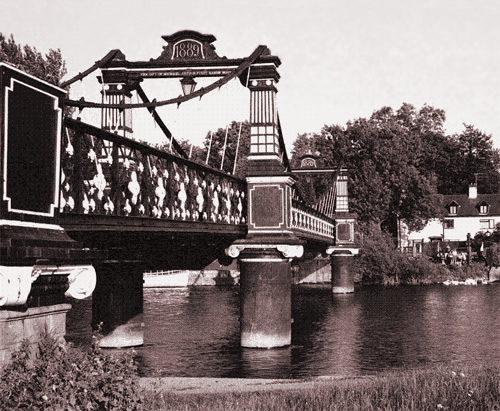
For a brief period, there was another ‘ferry’, The ‘Dingle Belle’, this time for pleasure and operating from the Stapenhill Gardens side of the Ferry Bridge. This was a private enterprise intended to commemorate the days of the ferry with pleasure trips up and down the river, beginning and ending at the Ferry Bridge. It can be seen in the above picture, fittingly taken through the Ferry Bridge, at its small loading jetty.
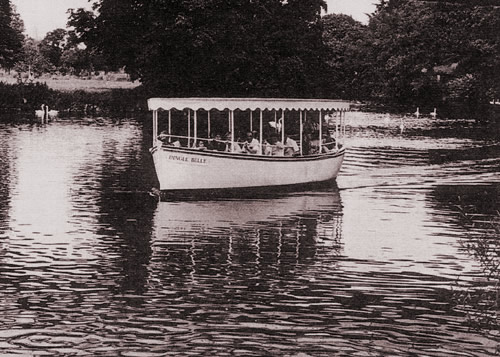
Unfortunately, after the initial novelty, it failed to attract enough ongoing business to make it viable.

COUNCILLOR C.H.DOBSON
After James Dalton, the person probably most associated with the Stapenhill Ferry House is Councillor C.H.Dobson.

Mr Dobson brought the Ferry House in 1911 for him to set up a business on the ferry site as a Boat Builder, where he later became a well-known and respected figure in the community. The business thrived and during the summer months, the hiring of boats at the ferry in order to take a pleasant trip up or down the river, proved to be very popular with people.

The river, however was not without its dangers, and Mr Dobson, who had served throughout the 1914-18 War, was called upon at least three times during his time at the ferry, to launch himself into the river to save someone from drowning. In 1943, he was honoured with the Parchment of the Royal Humane Society for Gallantry for saving a woman from drowning in the River Trent. Mr Dobson was also a member of Burton Town Council, to which he was first elected in 1937, as a representative of the Uxbridge Ward.

The Burton Observer reported on 22nd July 1943:

BURTON COUNCILLOR’S RIVER RESCUE
Mr C.H. Dobson Receives Parchment from Mayor.
Before the start of the ordinary business of the monthly
meeting of Burton Town Council last week, the Mayor,
Councillor F.G.Thompson, presented to Councillor C.H.Dobson
the parchment of the Royal Humane Society, for gallantry in
saving a woman from drowning in the river Trent last
February.

The Mayor read a letter from a witness of the “timely and
plucky rescue” by Councillor Dobson who jumped fully clothed
into about six feet ot flowing water.

The Mayor said that he believed this was the third occasion
on which Councillor Dobson had saved people from drowning in
the river Trent but as he was a very modest man, no formal
recognition had hitherto been shown towards him.

Making the presentation of the parchment to Councillor
Dobson, the Mayor said: “We know full well that Councillors
are brave men; they have to be to stand up and air their
convictions, but Councillor Dobson has gone a little bit
further by showing that apart from being a man of words, he
is also a man of deeds”.

“You have done great credit to us as a body and we are
grateful to you for your example”, the Mayor told Councillor
Dobson.

The Council endorsed these remarks by acclamation.

Mr Dobson continued to run his business at the ferry site successfully for many years although, on occasions, he was presented with a few headaches when the Trent was in flood. On November 27th 1954, the water rose dramatically, flooding his main workshop to a depth of several feet. The flood water receded later the following week, when Mr Dobson was photographed by a cameraman from the Burton Observer, busy at work in his flooded boathouse wearing Wellington’s, the water still a few inches deep, lapping around his ankles.

In or around 1959, he and his son, John, moved to Shardlow where they carried on the business of Boat Building, after selling the premises at Stapenhill. In January 1969, Mr Dobson died at the age of 78 years, at his home at Shardlow.
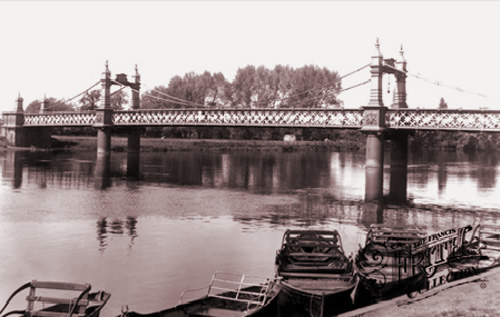
The ferry site business was purchased from Mr Dobson by two brothers, Ronald and John Sheffield, whose intentions were to continue the business of hiring boats out to the public and run the enterprise much the same as their predecessors. Sadly, this was not to be, for after only three years or so they were forced to give up the business because of continued acts of vandalism by selfish, mindless individuals, who were responsible for damaging the boats, throwing oars into the river and causing many other problems for the owners. The business was sold and the brothers moved to premises in Burton-on-Trent, where they began another enterprise which they ran successfully and trouble free, under the name of ‘Ideal Insulations’.
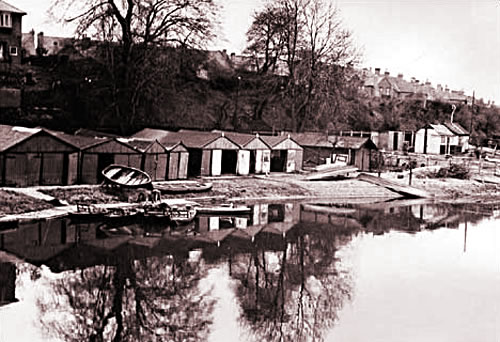
The Ferry House and boat-yard changed hands perhaps two or three times following the departure of the Sheffields’ but boats continued being available for hire at the ferry site, but a few were sold off, some of which were in use some years later on the boating lake at Drayton Manor Theme Park, still clearly displaying in white lettering, ‘Stapenhill Ferry’.

Around 1974 the premises were acquired by Mr and Mrs R. Collins, who bought the site and replaced old and rotting boats with new ones. They then had a mobile home moved on to the site where they started the planning and building of a riverside restaurant, after tearing down the old and dilapidated boathouses. The new restaurant, which took a year to build, was called, ‘The Boathouse Restaurant’, and was officially opened on Saturday, 26th. April 1975, by actor Stephen Hancock, otherwise known as ‘Ernie Bishop’, a star in the television soap, ‘Coronation Street’.

1969 ‘RESTORATION’ (Rape)
In 1969, some eighty years after the bridge had been erected the elements had taken their toll on the structure. The outer metal casing on the huge piers that supported the bridge had started to rust and, in places, had cracked, allowing water to seep inside the casing. Specialists were called in to examine the whole structure.

BEFORE
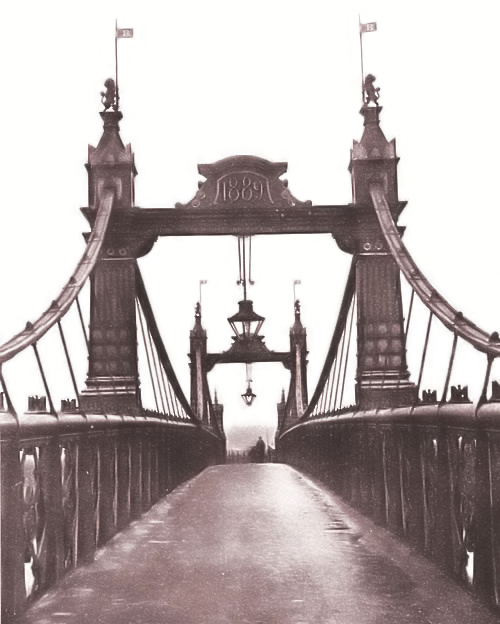
After close and careful examination, they came to the conclusion that the heavy, ornamental cladding had put too much weight on the structure and should be immediately removed, along with much of the decorative ironwork, including the four very attractive Victorian gas lamps, which had been mounted high on the structure at each end of the approaches to the bridge.

AFTER
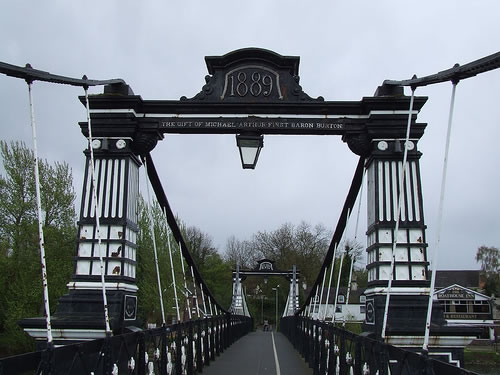
Rust had eaten into the metal work which supported the lamps and they were in danger of collapsing, as were other decorative embellishments which had adorned the bridge. The Burton Borough Engineer and Surveyor, Mr J.P. Wain, in his report to the Burton Town Council, advised the sealing of the cracks in the piers with concrete in order to prevent the same thing happening again and he recommended the stripping off altogether of the ornamental ironwork, which was in urgent need of attention. Mr Wain suggested that the iron-work should be treated with metal preserver, re-painted and then restored to their original fixtures on the bridge.

Early in February 1969, the headlines in an edition of the Burton Mail reported the serious condition of the bridge to its readers, who were deeply concerned to learn that the Ferry Bridge was actually in danger of being demolished. This concern was also voiced in a national daily newspaper which stated in its report that ‘Burton was in danger of losing its famous Ferry Bridge’. A suggestion had been put forward that the bridge should be dismantled altogether, and a new one built. It was estimated that a new bridge would cost the ratepayers in the region of £60,000. To everyone’s relief, the recommendations of the borough surveyor were accepted and the job of renovating the bridge began.

The bridge was first enveloped by a network of metal scaffolding to enable workmen to carry out the necessary renovations and the long and arduous task at last got underway, a task which carried on throughout most of the year. Eventually, with the all the necessary work completed and the scaffolding finally removed and taken away, it was found that the bridge had taken on a rather different appearance. Stripped of much of its decorative iron-work, the bridge appeared almost naked, and a stark contrast from its original state, much to the dismay and disappointment of many local people who had speculated that the bridge was to be restored to its former glory.

To add to the disappointment, the attractive burgundy and cream coat of the original had been replaced with a stark black and white which contributed to its much worse appearance.

THE FUTURE
The bridge continues to decay with no since attempts by anyone to have the bridge restored. The original lanterns and much of the ornamental iron-work and cladding remained locked away in storage. The skill and meticulous care and attention to detail that the Victorian craftsmen had taken in order to create such an impressive structure for the use and enjoyment of future generations would turn in their graves.
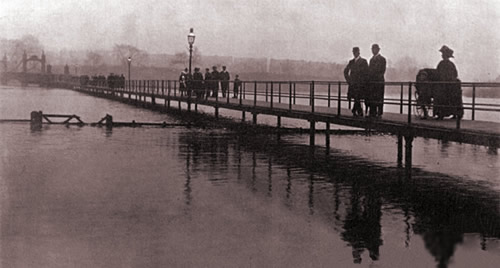
The causeway has also proved to be every bit as good an investment in the town as the Ferry Bridge itself. The washlands are prone to being extremely water-logged when the river is high and a simple footpath across the meadows would on many occasions have made the walk between Stapenhill and Burton impassable. The above picture shows the viaduct saving the day in 1910.
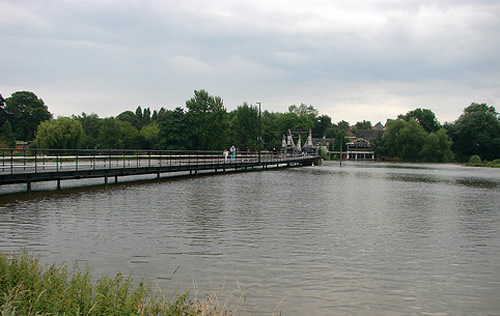
Even in modern times, the river has swelled to within a few inches of the raised walkway. The above picture was taken in 2007. A few years earlier, the lowest section had a small section with water lapping over the edge demonstrating that the necessary height was judged to perfection. At no point in well over a hundred years has the route been unavailable to the many walkers that have come to rely on it.
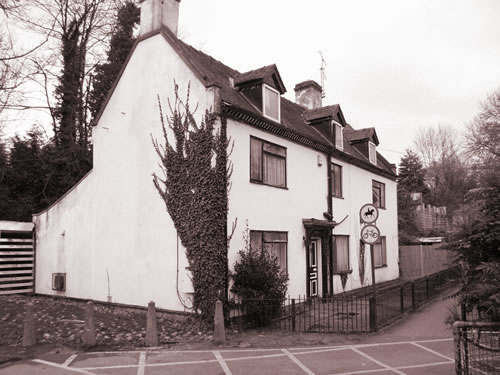
The Burton Civic Society, presented a Design Award for the renovation of the Ferry House and a commemorative plaque dated 1978 can be seen on the front of the building. Some initial work has been done in making a case for the restoration of the Ferry Bridge and, for the sake of Burton’s heritage, it is hoped that this if effective before it has to be demolished and replaced by a featureless concrete section.
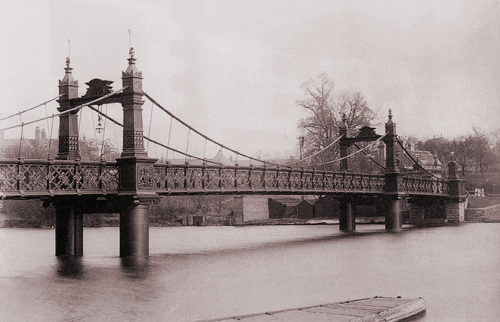
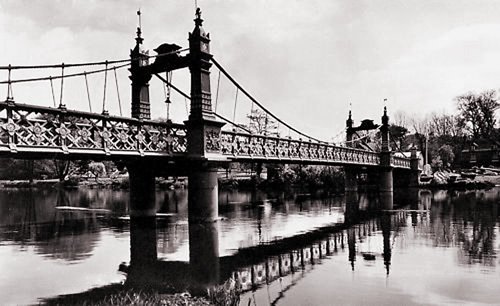
One thing is unfortunately for sure; it will never again see its original splendour.
Saint Peter’s Church – General History

EARLY HISTORY
The fact that Stapenhill church is dedicated to Saint Peter suggests that it may have foundation that preceeded the conquest since this dedication was most common in the Anglo-Saxon period. The church could well have had minister status in the late 11th century when it is known that there were chapels at Stanton (then Heathcote), Newhall and Drakelow as well as one in Caldwell, recorded in 1280. It is recorded that a plot of land once belonging to a chaplain in Brizlincote was assigned to the chamberlain of Burton abbey in 1326 which suggests a chapel there too. All came under the Stapenhill parish and were to be served by Saint Peter’s.

According to an early 16th-century history of the abbots of Burton, Stapenhill church was given to the abbey by Abbot Beohtric. After the dissolution of the abbey by Henry VIII, the patronage, like most of Burton, was passed to William Paget, his close advisor.

Not all holdings of Burton abbey in Stapenhill were not fully integrated into Stapenhill parish. Some houses near Stapenhill church and the hall at Brizlincote Farm were in Burton parish for ecclesiastical purposes, although residents there were often buried at Stapenhill.

In 1650 parliament advocated that these outlying parishes should also come under the Stapenhill parish. The transer did eventually happen, but not until 1864 – 214 years after the suggestion was made!

In 1884, the river Trent was the dividing line between Staffordshire and Derbyshire so Stapenhill was in Derbyshire; it was therefore transferred from the Lichfield diocese, which was in Staffordshire, to the newly-established diocese of Southwell, where it remained until 1927 when it was taken into the Derby diocese.

In 1925, Saint Peter’s was transferred to the Church Association Trust which later became the Church Society Trust.

INCOME AND PROPERTY
In the 1150s the priest at Stapenhill was assigned some tithes by the abbey. When Bishop William Cornhill (1214-23) confirmed the abbey’s ownership of the church there, he stipulated the institution of a vicar. The order was repeated by Bishop Alexander Stavensby in 1230, and following the resignation of the church by John de Caen, presumably the rector, in the same year a vicarage was ordained; the abbey was inducted as rector in 1231.

There appear to have been later disputes about the endowment of the vicarage, and in 1268 the bishop confirmed that the abbey as rector was entitled to the tithe of corn throughout the parish, including its chapelries of Caldwell, Drakelowe, and Newhall, and also the tithe of hay and the small tithes from its demesne land. The vicar was to have the tithe of hay and the small tithes from other land, together with a house in Stapenhill and parcels of glebe land in various parts of the parish.

The church income was valued at £15 13s 4d a year in 1291.

In 1535 the abbey received £10 a year, probably representing the great tithes, and the vicar received only £2 10s (13 shillings from glebe, 16 shillings from small tithes, and 21 shillings from offerings), the vicar however, also received an annual payment of £3 6s 8d from the lords of Newhall (presumably in lieu of tithes).

By 1650 the church income had grown to £43 6s 8d a year, together with £5 for Caldwell. In 1665 the vicar still claimed all the small tithes, but by 1668 Caldwell paid a modus of £6, as did Stanton and Newhall by 1693. The Caldwell modus was evidently disputed, but was confirmed in 1676 by an agreement which required the vicar to preach once a month at Caldwell.

In 1707 the vicar received £31 from glebe and tithes and £12 3s from moduses, together with Easter offerings, fees, and small rents. Owen Lloyd, vicar from 1768 to 1813, disputed the Caldwell modus in 1773, and by decision of the House of Lords in 1777 he was restored the small tithes there, worth c. £40 a year. The Stanton and Newhall payment was disputed by his successor in 1815, but the defendants argued that it was not in fact a modus but rather a pension derived from there once having been a chapel at Newhall. The vicar’s claim was evidently dismissed, and he still received the payment in 1841.

At inclosure in 1773 the vicar was assigned 24 acres on Stapenhill heath in lieu of small tithes from ancient inclosures, and in 1841 the total glebe was 86 acres. It was probably as a result of the renting of glebe to brickmakers that the vicar’s net income had risen by 1831 to £373, out of which he paid £93 to the curate of Caldwell.

There was a vicarage house of two bays in 1665, enlarged to four bays by 1698. Owen Lloyd left it in a ruinous condition, and it was still uninhabitable in 1831. A new house, east of the church on what was probably the same site, was built in the late 1830s by John Clay who was vicar from 1837 to 1877, even though Clay lived in a family house near the church. The 19th century vicarage house was sold in the late 1960s and the present vicarage built to the west on the main road.

CHURCH LIFE
William Bradshaw, a noted puritan divine, was suspended from his lectureship at Chatham, Kent, in 1602. Following this, he was supported by Alexander Redich of Newhall and began to preach in a private chapel in Redich’s grounds. As the congregation grew larger, Bradshaw moved into Stapenhill church, and he continued to preach there, as well helping to conduct a ‘common exercise’ in the Burton area. He died on a visit to London in 1618. Another puritan, John Lucas, was appointed as vicar in 1647, and in 1650 he was described as being ‘of good conversation’.

The registers, now held at Matlock, date back to 1679.

Soon after Owen Lloyd became vicar in 1768, he began to celebrate holy communion at Michaelmas, in addition to Christmas, Easter, and Whitsun, and in the earlier 1770s there were between 30 and 40 communicants. A sermon was preached every Sunday morning. A stipendiary curate, Hugh Jones, served Stapenhill for the absentee vicar Henry Des Voeux in 1824; Jones was also the curate at St. Modwen’s in Burton, where he lived. In 1829 the curate was Joseph Clay, the son of the Burton banker Joseph Clay (d. 1824). The younger Joseph retired because of ill health, and his brother John was curate in 1834, becoming vicar in 1837. He died in office in 1877. In 1851 there were two Sunday services, with average attendances of 140 in the morning and 180 in the evening; there was also a Sunday school.

The growing number of brickyard workers caused the vicar to engage a scripture reader in the early 1850s, and in 1869 a mission room was opened in Short Street, doubling up as a board school from 1874. Another mission room opened at the southeast end of Stanton Road in 1884 was served from Christ Church, in Burton. The parish church itself was completely rebuilt on a much larger scale in 1881 to accommodate the increased population.

The services were formerly mainstream Church of England, but the church now has an evangelical ethos and there is a strong supporting lay ministry.

In 1874 the vicar proposed to convert the boys’ day school at the north end of Stanton Road into a parish reading room and library. The present building there was erected by subscription in 1891 and was vested in diocesan trustees in 1900. Later known as the Glebe School, the building was restored in 1988 and was used in 1999 mainly as a church hall.

CHURCH BUILDING
Nothing survives of the medieval church of St. Peter, but an 18th-century drawing shows a building whose exterior was mainly of 13th-century date with a chancel, nave, and two-stage west tower with crenellated parapet.

The nave and possibly the chancel were probably aisled on the north side. Internally, however, that building included earlier features such as a roundheaded chancel arch, possibly of pre-Conquest date, and the nave was probably of a length found in many Anglo-Saxon churches. The nave and tower were demolished in or shortly after 1780 and were replaced with an aisleless nave with a bell-turret at the west end. The cost was probably met by local subscription, the chancel being left untouched presumably because Lord Paget as the rector was not prepared to pay for its rebuilding. A north gallery was erected in the nave in 1821. It was retained when the nave was rebuilt in the late 1830s under the direction of Henry Stevens of Derby and entirely at the expense of the new vicar, John Clay. The pulpit and reading desk were sited on the south side of the chancel arch, and the new work included the addition of a south porch and a west tower with tall lancet windows and pinnacles. The chancel was demolished in 1860 or 1861, again with Stevens as architect, and the nave was extended eastwards to form a new chancel with only a shallow projection. The pulpit and reading desk were separated, the former (or possibly a new one) being moved to the north side of the chancel arch.

The increase in population in the 1860s and 1870s necessitated a larger building, and money was raised to rebuild the church in its present form in 1881. The main benefactors were members of the Clay family and Burton brewing firms.

Above is the original Architects drawing by Evans and Jolly of Nottingham. The indicated date of 1880 AD was the original anticipated date and should not be taken as an historic record because it was not actually completed until some years later.

The church comprises a short chancel, short north and south transepts with north vestry, an aisled nave of four bays lit by clerestory windows, a small south porch, and an engaged south-west tower with pinnacles; there is also a door and internal porch under the tower. Derbyshire stone was used for the walls, with dressings of Bath and Ancaster stone. Internally, the organ was resited in a gallery at the west end of the nave and the pulpit placed in the centre of the chancel, flanked by prayer and lesson desks.

The upper stages of the present tower with its pinnacles were not yet completed in 1881 but were added soon afterwards in limestone. The west gallery was removed and the organ placed on the north side of the chancel in the early 20th century, when the chancel and south Lady chapel were refitted in an Art Nouveau style: a memorial east window in the Lady chapel is dated 1908.

A map prepared in the year that the new church was built shows that things were quite different at the time. There was not yet a Ferry Bridge and persons with business on the other side of the river had the options of paying the penny toll for the ferry and walking across the meadow, catching the house-drawn omibus from Stapenhill Green, close to Saint Peter’s for fourpence, or walking to the old trent bridge.

Stapenhill House dominates the area adjacent to the church with what was to become Stapenhill Gardens forming part of their private garden with a boathouse near the present day white swan monument.

Burial Graveyard
The burial graveyard around the church was no longer in use in the late nineteenth century. It was closed when Burton municipal cemetery was opened nearby in 1866. To compensate the church for the loss of income due to burials, the council maintain the grounds of what used to be the graveyard.

Stained Windows

A photograph taken in 1900 shows a plain east window behind the alter. When an elderly Miss Eleanor Meynell attended the church, she is reputed to have remarked as much to her father, Canon Francis Meynell. Francis as a result became involved in the installation of the existing, much more impressive, stained glass window within the next few years, before the First World War.

It has many layers of symbolism. The main theme is a great early hymn sometimes called ‘A Creed in the form of the Adoration’ – Te Deum Laudamas.

It was very nicely deciphered in an article in the Saint Peter’s Parish Magazine in 1992 by Ray Earp.

At the top is the blue of the firmament with its heavenly bodies. The cinquefoil (five leaved plant) element in the centre depicts the Spirit in the form of the Heavenly Dove bringing down the Host and guarded by five angels. On either side are representations of the Archangels supported by Cherubim and Seraphim with musical instruments.

In the position of ascendancy, in the main body of the window, is the figure of Christ as Priest and King – Christus Pantocrator – Christ all powerful. He wears priestly robes of crimson and gives the blessing with two fingers folded, as was the custom in the early church. In his left hand he holds the whole world surmounted by the Cross as his orb. Round his head there are three shafts of light representing the Trinity, together with the crown of the Godhead. Notice that, unlike an earthly King, he has no sword of state or sceptre.

Below Him stands a guardian angel wearing the ‘whole armour’ with the ‘Sword of the Spirit’. His shield bears the emblem of St. George.

The remaining eight figures are paired.

Top left are the Apostles; St. Paul with his book and St. Peter with his key, a reminder that when Modwen returned from Rome to found her church at the foot of Mount Calvus (later to become Scalpcliffe Hill), she dedicated it to the glory of God and in honour of St. Peter & St. Paul – and part of this dedication we retain today.

Top right are the Prophets, Isaiah from the Old Testament and John the Baptist from the New Testament.

Below the Apostles comes the martyrs. Lower left are Saint Stephen, the first Christian martyr and Saint Alban, the first British martyr.

Lower right represents the ‘Holy Catholic’ church throughout all the world’, in the form of Saint Modwen, holding a model of the church she founded here, together with Saint Chad, the first Saxon Bishop of Mercia who established himself at Lichfield, even before the kings of the day had settled residences.

At the foot of the window are three bishops mitres and arms which trace the history of our parish. In the centre we see Canterbury, in which province we are flanked, by Lichfield to the right and Southwell to the left since the window was completed before Derby Diocese was separated from Southwell.

To complete the window are two roundels with Christian symbolism. These are the triumphant Pascal Lamb and the Pelican in her Piety who plucked her breast to draw blood on which to feed her young, and so represents the demands made upon the church.

Other Stained Windows that can be enjoyed within Saint Peter’s Church…