DRAKELOW IN THE 17th & 18th CENTURIES
Sir Thomas was succeeded by his son, George, who continued in high favour with James I and was included in the first list of baronets created by that monarch in 1611. Each applicant for this hereditary title had to provide thirty foot soldiers at 8ds. per day for three years for the settling of Ulster, or compound for this by a single payment of £1,095. The original number of baronets was 200, and they ranked above all knights except Knights of the Garter.
Sir George spent most of his time at Drakelow but was a member of the short-lived Parliament of 1628-9. Possibly this brief session shook his confidence in Charles I, for when the struggle between King and Parliament began in 1642, he took up arms on the latter side. This was a brave thing to do for Sir George was the only ‘gentleman of quality’ in South Derbyshire to join the Parliamentary forces at Derby where he commanded a troop of horse under Colonel Gell.
There were Royalist strongholds at Tutbury, Lichfield and Ashby de la Zouch which plundered and laid waste his estates including Drakelow, so that in 1644 Sir George had to apply to Parliament for financial assistance and was voted £4 per week. Although the Parliamentary forces were eventually victorious, Sir George suffered heavy losses and was the first of his line to sell some of his estates including the manors of Colton, Rosliston and Seale.
The following extract is from a MSS of Sir George Gresley formerly preserved at Drakelow. It is entitled “A true account of the raising and employing one foot regiment under Sir John Gell”.
“Now let any indifferent and impartial man judge whether our single regiment of foot hath been idle…..Prince Rupert with his army came once against us, the Earl of Newcastle in person twice, and the Queen when she lay as Ashby earnestly pressed the plunder of this town (Derby) as a reward to her soldiers, and yet we are safe.
Let wise men consider if this town had been lost and malignant lords and gentlemen in possession of this place what would have become of our neighbour Counties?
That the world may know we neither undertook this business with other men’s money nor have since employed any man’s estate to our profit. We had no advance money either from Parliament or our Country, or from any other man or woman, but went upon our own charges. Our Colonel hath since sold his stock, spent his revenue, and put himself into debt in maintenance of this cause. We are out of pocket many hundreds of pounds spent only on this business, not that we are weary of the cause but are absolutely resolved to continue and persevere so long as God shall give us lives to venture and estates to spend“.
One effect of the dissolution of the monasteries was to throw the burden of poor relief upon churchwardens and overseers of the poor and it was ordered that a general assessment for the relief of the poor should be made in every township.
In 1682 an appeal to the Quarter Sessions was made by the inhabitants of Church Gresley, Castle Gresley, Swadlincote, Oakthorpe and Donisthorpe, and parts of the parish of Gresley, that they were not able to raise enough money for the relief of the poor in their hamlets, but Sir Thomas Gresley and the inhabitants of the hamlet of Drakelow, having no poor, had claimed exemption from the rate and had paid nothing toward it. The Court ordered that Sir Thomas and the inhabitants of Drakelow should show cause why they should not be assessed to tax.
At the following Sessions it was ordered that as the manor of Drakelow of the yearly value of £400 is not charged with any poor, Sir Thomas Gresley will pay a third part of the levy, in other words, if the levy be fixed for £24, Sir Thomas shall pay £8, and the same rate for a greater or lesser amount to be paid to the overseers and churchwardens for the relief of the lame, impotent, old, blind, and such others being poor and unable to work.
Sir Thomas Gresley, the second baronet, had 14 children, two of whom made unusual marriages. Dorothy, the fourth daughter eloped with one of her father’s servants at 1 a.m. on June 18th, 1681, and was married by licence at Tutbury Church eight hours later. She was never forgiven by her mother.
The eldest son, William, at the age of 35, decided it was time he took a wife. So he journeyed into Shropshire and proposed to an heiress who refused him. Having made up his mind not to return without a wife he proposed to her eldest sister who accepted him. But the news did not please his parents when they learned that she was a widow with seven children.
However, ‘Squire Bill’, as he was known, declared he would have her “and that quickly too, for hunting is coming and then no time!” He also threatened to shoot his mother if she did not agree and she fled to Burton. But a reconciliation took place when his family learned that the widow had an income of £250 p.a. and invested funds worth £2,000, the children of her first marriage being otherwise provided for. Squire Bill, a man of few words, afterwards declared her “best wife in world”, and she presented him with three more children.
Sir Nigel, sixth baronet, grandson of Squire Bill, succeeded unexpectedly to the title and family estates when his elder brother died from smallpox at the age of 30. Nigel was a Captain in the Royal Navy and it was in his ship that Flora Macdonald, who aided the escape of “Bonnie Prince Charlie”, was conveyed to London after the abortive rebellion of 1745. As a reward for his kindness and courtesy, she presented him with her portrait which was hung in Drakelow Hall. An inscription on the back stated:
“This portrait of Flora Macdonald was given by herself to Sir Nigel Gresley, Captain in the Royal Navy, who captured her in flight from Scotland to France and from whom she experienced every courtesy and as a mark of her gratitude presented him with this picture in 1747”.
Sir Nigel inherited extensive property in Staffordshire from his mother, a daughter of Sir William Bowyer, and became a patron of James Brindley, the engineer. With his aid the “Gresley Canal” was built, nine miles in length, to convey coal and ironstone from mines at Apedale to the Grand Trunk Canal at Newcastle-under-Lyme, on condition that coal should be supplied to the inhabitants of the latter place at 5 shillings per ton.
Sir Nigel was a good-natured man of great size and an old inhabitant of Netherseale described him as the biggest man he ever saw in his life “except for a giant in a show”. When he worshipped in Netherseale Church it is said he had to wriggle sideways into the Hall pew!
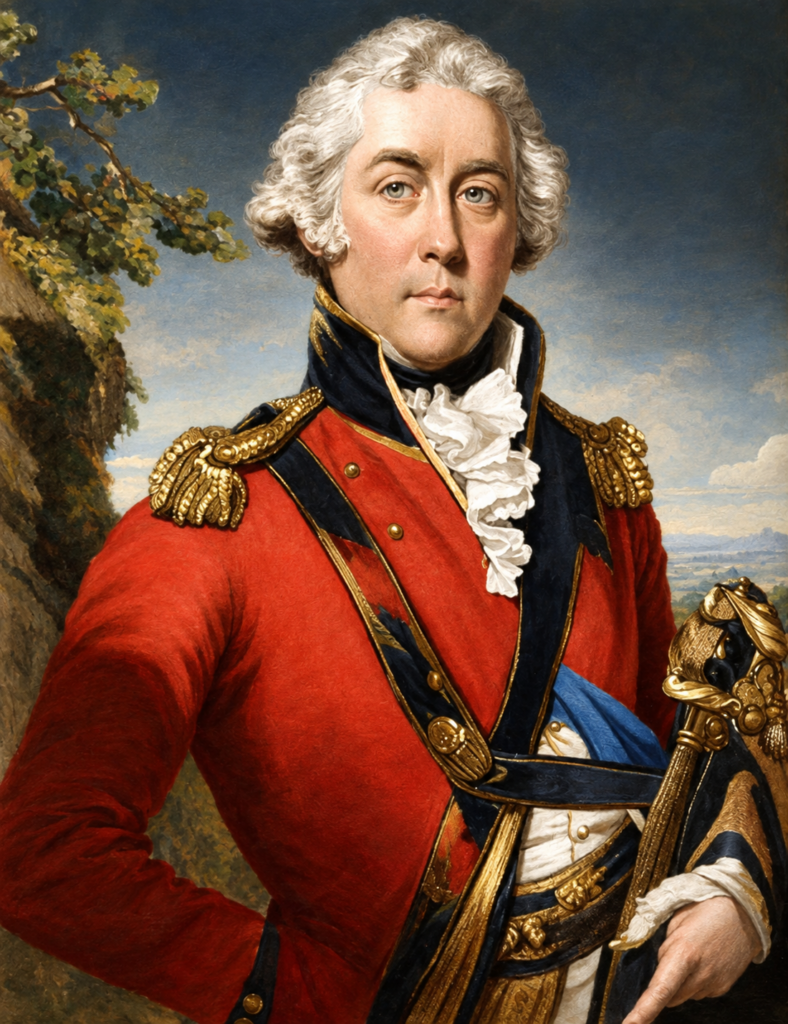
Like his father, Sir Nigel Bowyer Gresley (1755-1808), the 7th baronet was interested in the improvement of his estates, and he endeavoured to improve the quality of local pottery.
At that time the pottery produced in Gresley and Swadlincote was a coarse brown earthenware made from a bluish-white superfine clay. In 1795, Sir Nigel, in collaboration with a relative. Mr. C.B. Adderley of Hams Hall, established a porcelain factory in buildings erected about fifty yards from Gresley Hall. The services of William Coffee, a modeller from the Derby China factory, were secured, and Sir Nigel’s daughters are said to have painted some of the patterns. But most of the pottery cracked in firing and the experiment proved a failure.
An order for a magnificent dinner service was obtained from Queen Charlotte through her Chamberlain, Col. Disbrowe, of Walton Hall, but it was never completed as the china came out of the ovens cracked and crazed. So far as the writer is aware Gresley china bore no distinctive markings. Specimens were preserved at Drakelow Hall and others can be seen in Museums at Derby and Birmingham. In the possession of Lord Gretton at Staple ford Hall, is a dessert service comprising 34 pieces with flower springs in colour on a yellow and gold background.