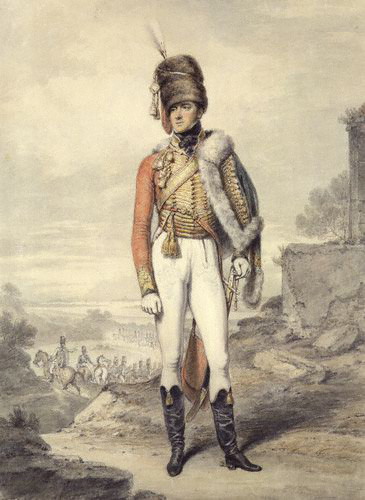
 Field Marshal Henry William Paget, 1st Marquess of Anglesey KG, GCB, GCH, PC (17 May 1768 – 29 April 1854), known as Lord Paget from 1784 to 1812 and as the Earl of Uxbridge from 1812 to 1815, was a British military leader and politician, now chiefly remembered for leading the charge of the heavy cavalry against d’Erlon’s column during the Battle of Waterloo. He also served twice as Master-General of the Ordnance and twice as Lord Lieutenant of Ireland.
Born in London, as Henry Bayly (his father assumed the name Paget in 1770), he was the eldest son of Henry Paget, 1st Earl of Uxbridge, by his wife Jane, daughter of the Very Reverend Arthur Champagné, Dean of Clonmacnoisie, Ireland. The Hon. Sir Arthur Paget, General the Hon. Sir Edward Paget and Vice-Admiral the Hon. Sir Charles Paget were his younger brothers. He was educated at Westminster School and Christ Church, Oxford.
Paget entered parliament in 1790 as member for Carnarvon, a seat he held until 1796, and then represented Milborne Port between 1796 and 1804 and again between 1806 and 1810.
At the outbreak of the French Revolutionary Wars, Paget raised the regiment of Staffordshire volunteers and was given the temporary rank of lieutenant-colonel in 1793. As the 80th Foot, the corps took part in the Flanders campaign of 1794 under Paget’s command. In 1795 he was made a lieutenant-colonel of the 16th Light Dragoons; in that same year, he married the daughter of the Earl of Jersey. In 1796 he was made a colonel, and by 1801 he had become colonel of the 7th Light Dragoons. In 1802 he was promoted major-general, and six years later lieutenant-general. He commanded the cavalry for Sir John Moore’s army during the Corunna campaign, wherein his troopers provided excellent rear-guard defence during the long retreat. The British cavalry showed a distinct superiority over their French counterparts at the action of Sahagun and routed the Chasseurs a Cheval of the Imperial Guard at Benevente.
This was his last service in the Peninsular War, because his liaison with Lady Charlotte, the wife of Henry Wellesley, afterwards Lord Cowley, made it impossible subsequently for him to serve with Wellington, Wellesley’s brother. His only war service from 1809 to 1815 was in the disastrous Walcheren expedition (1809), in which he commanded a division. In 1810 he was divorced and then married Lady Charlotte Wellesley, who had about the same time been divorced from her husband.
In 1815, he was appointed cavalry commander in Belgium, under the still resentful eye of Wellington. On the eve of Waterloo, Paget had his command extended by Wellington so as to include the whole of the allied cavalry and horse artillery. He handily covered the retirement of the Anglo-Allies from Quatre Bras to Waterloo on 17 June, and on 18 June led the spectacular cavalry charge of the British centre, which checked and in part routed D’Erlon’s corps d’armée (see Waterloo campaign).
One of the last cannon shots fired that day hit Paget in the right leg, necessitating its amputation. According to anecdote, he was close to Wellington when his leg was hit, and exclaimed, “By God, sir, I’ve lost my leg!” — to which Wellington replied, “By God, sir, so you have!” According to his aide-de-camp, Thomas Wildman, during the amputation Paget smiled and said, “I have had a pretty long run. I have been a beau these 47 years and it would not be fair to cut the young men out any longer.”
He was to have an articulated artificial limb fitted by James Potts. Lord Uxbridge’s amputated leg had a somewhat macabre after-life.
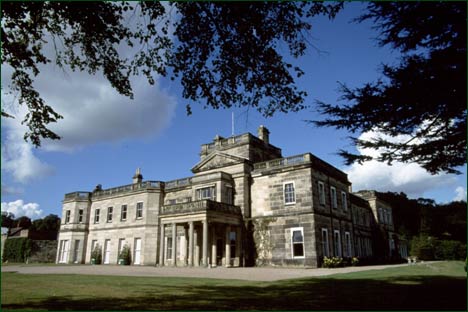
Paget was appointed a Knight Grand Cross of the Order of the Bath in January 1815, and on 4 July 1815, just over two weeks after Waterloo, the Prince Regent created him Marquess of Anglesey. He was also made a Knight of the Order of St George of Russia and a Knight of the Order of Maria Theresa of Austria the same year. In 1816 he was also apppointed a Knight Grand Cross of the Royal Guelphic Order and in 1818 he was made a Knight of the Garter. A 27m high monument to his heroism (designed by Thomas Harrison) was erected at Llanfair PG on Anglesey, close to his country retreat at Plas Newydd, in 1816. A separate monument to his leg was erected at Waterloo but the bones were later disinterred and put on display.
In 1819 Anglesey became full general, and at the coronation of George IV, he acted as Lord High Steward of England. His support of the proceedings against Queen Caroline made him for a time unpopular, and when he was on one occasion beset by a crowd, who compelled him to shout “The Queen!”, he added the wish, “May all your wives be like her.” In April 1827, he became a member of the Canning administration, taking the post of Master-General of the Ordnance and becoming a member of the Privy Council. Under the Wellington administration, he accepted the appointment of Lord Lieutenant of Ireland (March 1828).
In December 1828, he addressed a letter to the Roman Catholic primate of Ireland stating his belief in the need for Catholic emancipation, which led to his recall by the government; on the formation of Earl Grey’s administration in November 1830, he again became lord-lieutenant of Ireland. In July 1833, the ministry resigned over the Irish question, he spent thirteen years out of office, then joined Lord John Russell’s administration in July 1846 as master-general of the ordnance, finally retiring in March 1852 with the rank of field-marshal and colonel of the Royal Horse Guards. He also held the honorary posts of Lord Lieutenant of Anglesey between 1812 and 1854 and Lord Lieutenant of Staffordshire between 1849 and 1854.
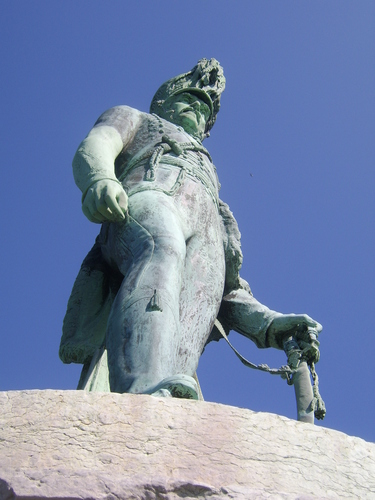
As well as the long name, the village of Llanfairpwll on the island of Anglesey is also locally famous for the Marquess of Anglesey Column. It is 90 feet high and was erected as a tribute in 1817.
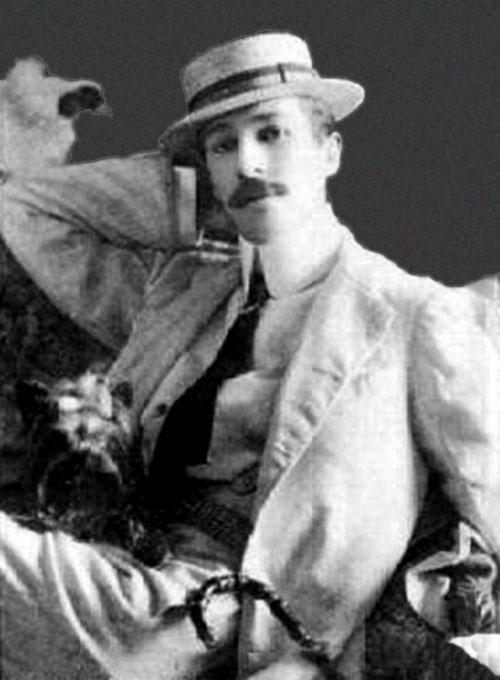 (known until 1880 by the courtesy title of Lord Paget de Beaudesert and from 1880 until 1898 as Earl of Uxbridge)
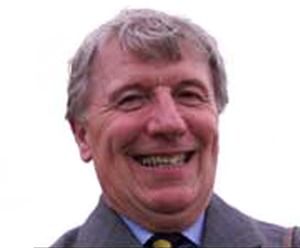 In brief, Stanley William Clarke was businessman and racecourse owner. Born in Burton upon Trent from a fairly humble background, he rose to become chairman and president of St Modwen Properties plc and was a founder and chairman of Northern Racing. He was appointed CBE in 1990 and knighted in 2001.
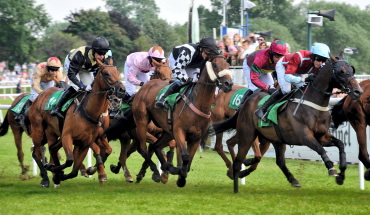
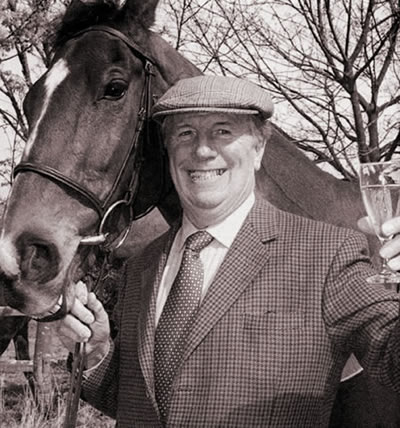 His success allowed him indulge his life long love of horse racing but, unlike most who have to content themselves with buying a racehorse, in 1988 at age 55, he bought Uttoxeter Racecourse! Though the course was struggling at the time, it was quickly transformed under Clarke’s ownership. He gave each of his courses a distinctive green and white livery as part of a re-branding that concentrated on quality.