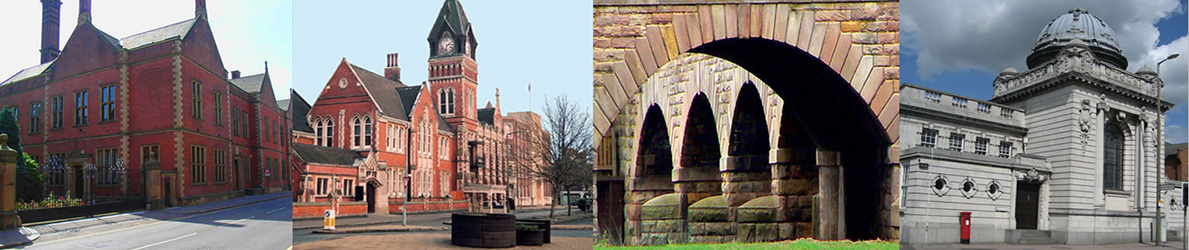
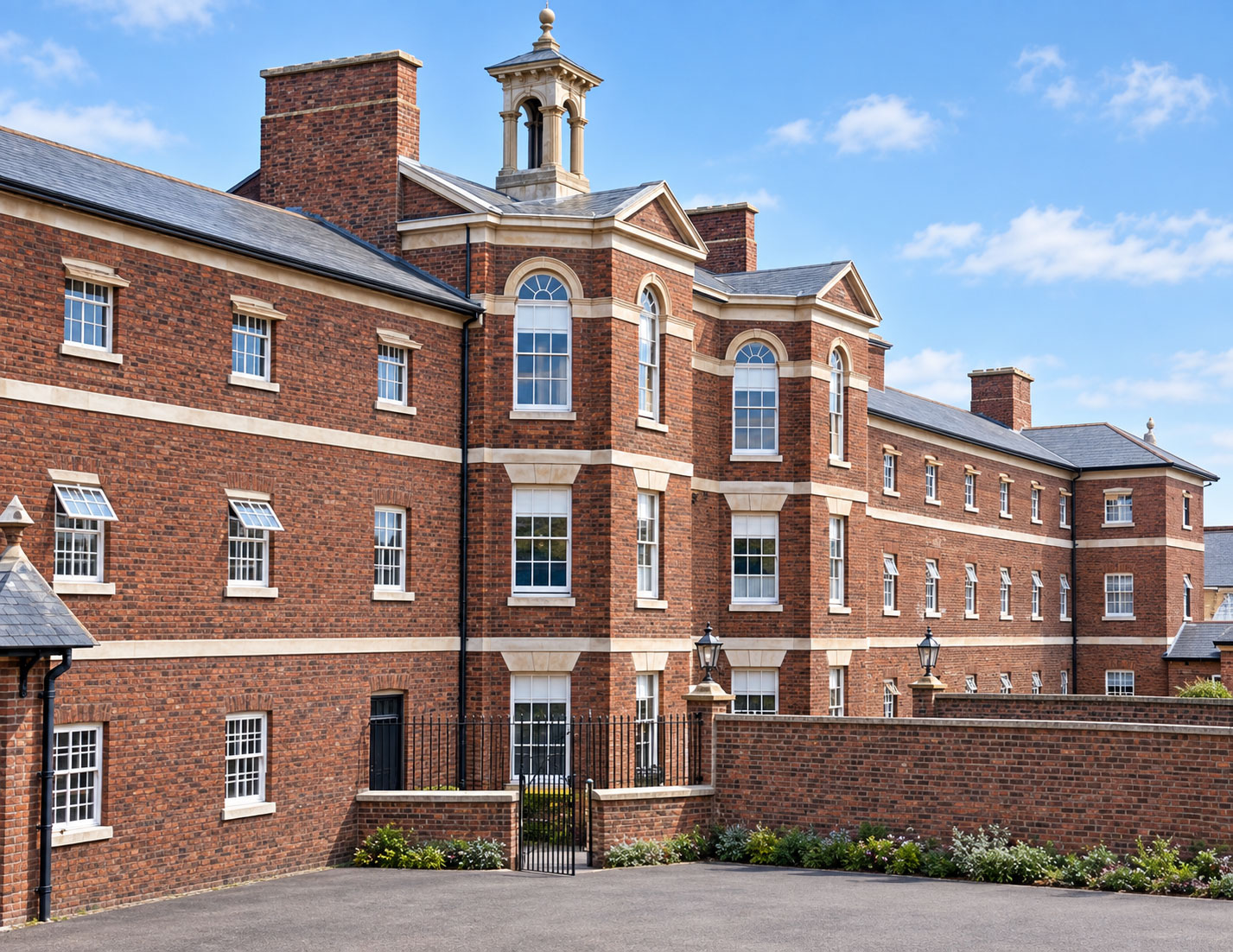
The first Burton-upon-Trent Union workhouse was built in 1838 between Horninglow Street and Hawkins Lane in Burton. It was designed by George Gilbert Scott and William Bonython Moffatt. The Poor Law Commissioners authorised an expenditure of £5,400 on construction of the building which was intended to accommodate up to 300 inmates.
The building had a single-storey entrance block at the west. This had a central archway and would have contained a porter’s lodge, board-room, offices and a chapel. To the rear, the main accommodation block was three storeys high, with the Master and Matron’s accommodation at the centre, with males housed to one side and females to the other. An H-shaped infirmary block was build at the rear. The site also included various workshops, utility rooms and a laundry.
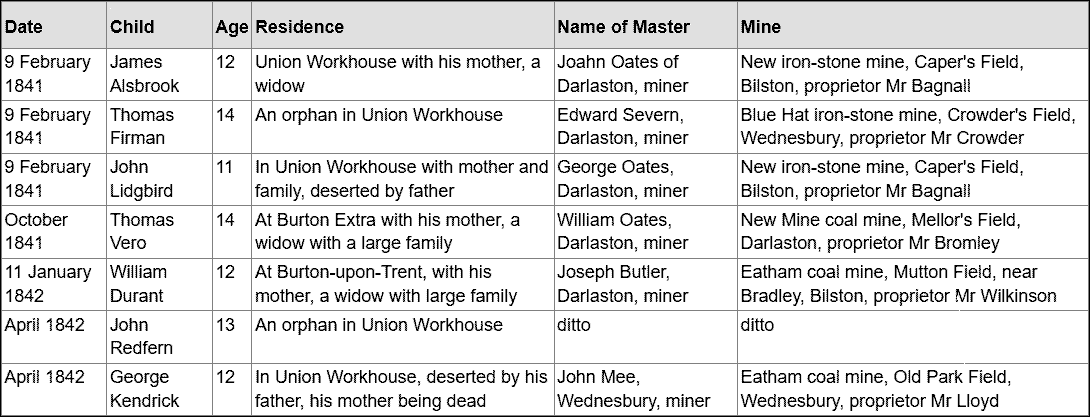
In 1842, the Commissioners investigating the employment and conditions of children in mines and factory and discovered that workhouse boys, some as young as eight, were being sent on ‘apprenticeships’ of up to twelve years working in coal mines. As a result the Union Workhouse was requested to provide detailed information on the children who had been apprenticed in the mining industry in recent years. The return for the Burton-upon-Trent covering the years 1841-42 is included below.
The Burton Guardians were at pains to point out the care they employed when placing children for apprenticeship: premiums in money were not allowed and the boys were instead provided with two full suits of clothes; any master applying for a boy was required to produce a certificate of character from the minister and officers of the parish in which he resides; a trial period of at least six weeks was required, at the end of which the boy was brought before the magistrates and strictly questioned as to his food, lodging, moral and religious instruction, and especially whether he had any objection to the apprenticeship being formalised.
By 1880, this had become inadequate and plans were produced for a larger workhouse to be constructed on the Belvedere site. Following the opening of a new workhouse on Belevedere Road in 1884, the Union Workhouse infirmary was used as an infectious diseases hospital.
The building eventually fell into dis-use in 1891 and the site was sold to Messrs. Bass, Ratcliff and Gretton, June 1891 for the princely sum of £3000