ANGLO-SAXON CHURCH
The Life of St. Modwen references an Anglo-Saxon chapel dedicated to St. Andrew on Andresey, it is possible that it was associated with one of the foundations of the Northumbrian Bishop Wilfrid when he was exercising episcopal functions in Mercia between 666 and 669. Wilfrid founded a number of unidentified ‘monasteries’ in Mercia, and his devotion to St. Andrew is indicated by his churches at Hexham, Northumberland, and Oundle, Northants. The church on Andresey is thought to have been destroyed in a 9th century Danish invasion.
There is also evidence for a pre 11th century minster church serving an extensive parochia in Burton. In the 1120s the abbey was recorded as having the typical exemptions of an earlier minster church: it did not have to pay for ‘chrism or holy oil or any other parochial matter’, nor send a representative to chapter or synod. The extent of the parochia may be suggested by the abbot’s spiritual jurisdiction over Abbots Bromley and Mickleover (Derby) in the 13th century.
The endowment of a monastery on the west bank of the Trent by Wulfric Spot, an Anglo-Saxon nobleman, by a will dated between 1002 and 1004 presumably followed the conversion of the minster church to a Benedictine abbey in the late 10th century. That abbey is treated in an earlier volume of the History.
PAROCHIAL ORGANIZATION TO 1545
In the early 12th century the parish was served by a chaplain, presumably the man named Recelbert who received half the income of the parish altar, a corn render (or thrave), and the provisions of one monk, and who had a lodging house. The abbey supplied him with candles for the parish altar, presumably in the abbey church. He was probably assisted by a man known variously as Alwine the deacon, Alwine the priest, and, evidently in jest, Alwine ‘the bishop’. The abbey endowed Alwine with an annual payment of 2s., 4 bovates of land in Stapenhill worth 6s. a year, the provisions of one monk, fodder for one horse, and a house outside the abbey gate, probably the lodging house which Recelbert had previously held. Alwine’s son, also Alwine, later became chaplain for life with the same endowment as his father. Some time between 1160 and 1175 the younger Alwine was in turn succeeded by his son, a third Alwine, who held the post on similar terms. Vincent, son of the third Alwine, evidently followed in the office c1190.
The abbot and convent were said to be the rector of the parish in 1319, when the clergy included two parochial chaplains and four priests. There were two parochial chaplains in 1324, but probably only one in 1342 and 1383 (styled a perpetual vicar in 1391 but a parish priest in 1421), and still probably only one in 1434. Guild priests may have had some parochial responsibilities from the 15th century, although it is not known precisely how the parish was served when the abbey was dissolved in 1539.
The laity used the west end of the nave of the abbey church for their services probably from the rebuilding of the church in the early 12th century. The division between the upper church for the monks and the lower one for the laity was probably at the first nave pier west of the crossing, and services for the laity were probably taken at the Holy Cross altar, recorded in the early 13th century. In 1459 the pope granted permission for the celebration of a mass before dawn for laity who came to the abbey. A divinity lecture ordered by the abbot in 1537 to be read three times a week in the church by the schoolmaster of Burton may have been intended partly for the benefit of the laity.
Burton college, founded in 1541 after the abbey had been dissolved in 1539, maintained a single parish priest in 1544, whose stipend was £6 13s 4d a year. He was styled a curate in 1545, when the college was itself dissolved.
There was a graveyard for the laity separate from that for the monks by 1402.
GUILD
There is thought to have been a guild in Burton by the mid 13th century, when William ‘de Gildhus’ was recorded as holding land in Branston. He is probably the William ‘atte Gyldehus’ mentioned in 1270. The four priests who celebrated at Burton in 1319 may have been guild priests.
The first definite evidence for a guild is a bequest of 1465, when the guild evidently had more than one priest. By 1466 there were four priests, the normal complement, and the guild was often known as ‘the four guilds’. Each priest, who had his own clerk maintained by the guild, was assigned a part of the parish: Branston, Shobnall, and Sinai; Horninglow and Wetmore; Winshill and Stapenhill; and Stretton. In the 1540s there was lay master of the guild and a steward, who was also styled ‘the warden of the pyx’ of the borough of Burton. The guild presumably ceased to function on the dissolution of the chantries in 1547.
The Guild maintained a chapel dedicated to St. Luke, presumably in its hall; the chapel was probably founded in 1468 when the Crown granted a fair on St. Luke’s day. Each priest had a chest with a chalice, four suits of vestments, altar cloths, and hangings. In addition to its liturgical plate the guild had plate for guild dinners including a great standing cup of silver gilt, 25 silver spoons, 8 brass candlesticks, napkins, towels, and tablecloths. The guild priests also celebrated by turns in the chapel on the bridge over the river Trent, which had its own chalice and three suits of vestments.
Membership of the guild was presumably open to all parishioners, and several testators in the 1530s and 1540s left 3s. 4d. to be included in the guild book and for prayers to be said for their souls. Each guild priest had £4 13s. 4d. a year intended to be raised by the profit of four ‘ales’ (or dinners), to which parishioners brought ‘a dish of meat… to make merry’; any deficit was made up from income from the guild land. Each priest also had a chamber (cubiculum or camera) in what was evidently a row between the church and guild hall, which in 1550 stood on the south side of the market place.
In 1547 the guild held lands in Burton worth no more than £3 a year. In 1564, however, it was claimed that the guild had also held lands at Morrey, in Yoxall, and elsewhere, and in the late 16th century the total value of its lands was said to have been more than £14 a year. After 1547 some of the lands became part of the town lands.
PECULIAR JURISDICTION
Bishop Robert Peche (1121-6) confirmed to Burton abbey as ‘the mother church of Burton’ various rights then said to date from the church’s foundation. The church was free of payments for chrism, holy oil, and ‘any other parochial matter’, and it was not required to send a man or a woman to chapter or synod; moreover, it could hold its own court. The grant was confirmed by archbishops of Canterbury and diocesan bishops in the 12th and 13th centuries, and was acknowledged by archdeacons of Stafford in the 12th, 13th, and 14th centuries. In the 1140s the diocesan confirmed that the chaplain of Burton was exempt from paying any custom or exaction to the archdeacon of Stafford, and in 1280 the archbishop determined that the chaplain should pay nothing to the diocesan or archdeacon except 3 shillings for Peter’s pence.
The powers of the abbot’s court were confirmed in the 1120s by Bishop Peche ‘so long as justice is not wanting’, perhaps implying a right of appeal to the bishop. In a later confirmation by Archbishop Theobald (1150-61), however, the abbot’s court was said to be for ‘all causes’. In the mid 13th century the abbot claimed matrimonial jurisdiction, but the right appears to have been stopped by the pope.
In the 13th and 14th centuries the bishop’s right to visit Burton parish was contested by the abbot. The bishop, however, held a visitation of the parish in 1390, and by 1535 the abbey had acknowledged his visitation rights and paid procurations. Bishops and archdeacons continued to visit the parish church after the Reformation.
In the 18th century the peculiar jurisdiction was again contested. The Earl of Uxbridge resisted the bishop’s claim to exercise faculty jurisdiction in Burton when the parish church was pulled down in 1718, although in 1723 the churchwardens by-passed Uxbridge and appealed to the bishop to allot the pews in the new church. In 1751 there was a dispute over the bishop’s attempt to exercise the right of excommunication within Burton.
In the early 19th century it was stated that while the lord of the manor had the uncontested right to prove all wills in Burton, other matters such as licensing the perpetual curate, granting marriage licences, swearing in the churchwardens, and ‘all contentious jurisdiction whatsoever’ belonged to the bishop.
Probate of Wills
There was an official of the abbey’s spiritual jurisdiction in 1344. His functions are unknown, but the survival among the abbey’s muniments of a Burton will made in 1402 suggests that the abbey exercised probate jurisdiction by that date, and an official of the abbey’s jurisdiction was certainly granting probate of wills by 1465. After the dissolution of the abbey, probate jurisdiction passed first to Burton college and then to the Pagets as lords of the manor, and they continued to employ an official of the peculiar jurisdiction, also styled a commissary. Some wills, however, were in the mid 16th century proved in the bishop’s consistory court at Lichfield.
In 1728 the post of official of the peculiar was described as ‘an office of some dignity and trust, but of very little profit and advantage’. Wills were kept ‘in a loose promiscuous manner’ at Sinai Park House, the home of the Earl of Uxbridge’s bailiff; because many had been lost, the Earl appointed Richard Rider, then an officer of the episcopal registry at Lichfield and later chancellor of the diocese, as registrar or assistant to the Burton official, and he kept Burton wills with those proved at Lichfield. In 1729 Rider was succeeded by John Fletcher, who acted as registrar of several peculiar jurisdictions. In the late 18th century two probate courts were held each year in Burton by the official, although in the 19th century at least one will was proved at Lichfield by an attorney acting for the peculiar court of Burton. There may have been some confusion between the jurisdictions of the Burton peculiar court and the Lichfield consistory court: in 1820 a will was proved first at Burton and subsequently at Lichfield. Nevertheless, the lord of the manor still exercised probate jurisdiction in Burton in 1856. Under the Court of Probate Act of 1857 the Pagets’ probate jurisdiction was extinguished in 1858.
PAROCHIAL ORGANIZATION FROM 1545
After the dissolution of Burton college in 1545, the parishioners used the transepts and crossing of the church, in addition to the western arm, as their parish church. By 1687, and possibly from the 1650s, the parish was divided between the ‘town’ (Burton and Burton Extra) and the ‘country’ (Branston, Horninglow, Stapenhill, Stretton, and Winshill), an arrangement reflected in the appointment of two churchwardens for each division.
ST. MODWEN’S PARISH CHURCH FROM 1545
Benefice and Advowson
After the dissolution of Burton college in 1545, Sir William Paget as the lord of the manor was charged with maintaining a curate and a preacher to serve the parish; the two offices were combined from the mid 17th century. Described as a perpetual curacy in 1768, the living became a vicarage under the Incumbents Act, 1868. From 1957 it was held in plurality with Holy Trinity until 1969, when the two benefices were united as the benefice of Burton-on-Trent, and in 1982 St. Paul’s was included in the benefice.
On the dissolution of the college, the Crown appointed a ‘chief curate’, but shortly afterwards it granted the advowson to Sir William Paget and the advowson thereafter descended with the manor. The patron was occasionally susceptible to popular pressure: in the 1690s Lord Paget replaced the curate on the petition of the parishioners
Income and Property
The clergy originally received only what the lord of the manor allowed them. By the terms of the 1546 grant of Burton manor Sir William Paget received all the tithes and in return was charged with annual payments of £7 to the curate for administering the sacraments and £10 to another priest for preaching; there was no other endowment of the living. Paget initially raised the curate’s stipend to £10 and lowered the preacher’s to £7, and from 1558 he dispensed with the preacher and paid the curate £13 6s. 8d. a year. By 1585 there was once more both a curate, paid £14 10s,. and a preacher, paid £14. The salaries were confirmed when the Crown restored the Paget estates in 1597, the preacher then described as being for the borough of Burton. By 1639 the two offices had been combined and the minister was paid £28 10s. By 1689 the minister received £35 from the manor, and that remained the stipend until it was raised to £50 in 1777. Secured by the patron’s endowment of a £30 rent charge in 1826, that stipend was still received from the marquess of Anglesey in 1953 and probably continued until around 1972.
The lord of the manor also received the Easter dues, worth between £7 13s. 4d. and £11 2s. 8d. in the later 16th century, but by 1693 they had been granted to the minister.
The first endowment assigned to the curacy was a grant of £50 a year made by parliament in 1652 out of Hanbury rectory; it evidently ceased to be paid after the Restoration. In 1820 a benefaction of £200 was made by the executors of the Burton lawyer Isaac Hawkins. To meet that benefaction and the securing of the curate’s stipend in 1826, Queen Anne’s Bounty in 1827 made two grants of £300 each; it had already given £800 on account of population in 1825. In 1838 the living was worth only £217 18s. 5d.; by 1855 it had risen to £255. In 1897 the endowment was described as ‘miserable’. In 1902 parishioners devised a plan to guarantee a stipend of £350 a year, and in 1924 Fred Young gave £100 to endow an Easter offering for the vicar.
Incumbent’s House The ‘chamber of the parish priest’ which adjoined the graveyard in 1550 was probably one of the former guild priests’ houses. In 1585 the curate had a tenement (possibly the Earlier chamber) in High Street, provided by the lord of the manor, who was also paying to clothe him. By 1612 the curate occupied a room provided by Paget within the former monastic precinct, and by 1666 he had a house probably still within the precinct.
Lecture
By will proved in 1649 Thomas Boylston, a London clothier who was probably the son of John Boylston of Anslow, bequeathed to the London Company of Clothworkers £800 to establish a lecture in Burton every Thursday morning. The lecturer was to be appointed by the bailiff of Burton and between four and six of the chief inhabitants, on the advice of three local ministers, and he was to be paid £31 4s. a year. For tolling the sermon bell the parish clerk was to have 16s. By the 18th century it was customary for the incumbent of St. Modwen’s to be the lecturer, as a means of augmenting his stipend.
Clerical Provision
The curate appointed by the Crown after the dissolution of the college was Robert Baslowe, formerly a petty canon of the college; he was succeeded in turn by Bartholomew Francis (d. 1557) and Thomas Smith, a former guild priest. Another former guild priest, William Smith, officiated as ‘under curate’ in the 1550s. Anthony Gefscocke, who succeeded on Thomas Smith’s retirement in 1578, had been a scribe of wills in Burton since 1570.
William Browne, minister from the 1690s, was a pluralist with independent means; although he chiefly resided at Burton, he regularly employed an assistant curate from the 1720s. Thereafter there was usually an assistant curate.
Church Life after the Reformation
Under the terms of the 1546 grant of Burton manor, Sir William Paget as lord of the manor was expected to pay £1 a year for bread, wine, and other necessaries; in fact, he usually spent considerably more. Paget also paid for copies of the new Book of Common Prayer in 1549 and 1552. His son Thomas, Lord Paget, was an ardent recusant, and although John Tailor of Burton Extra had an English Bible in 1568 and the will of James Sutton, a Burton carpenter, made about the same time, suggests zealous godliness, committed protestantism failed to get a hold in Burton until after Paget’s flight in 1583. The subsequent influence in Burton of the godly Hastings family of Ashby-de-la-Zouch (Leics.), Earls of Huntingdon, allowed evangelical protestantism to grow.
Peter Eccleshall, the preacher at Burton by 1585 and the curate from 1587, was indicted in 1588, probably for not using the Book of Common Prayer, and it may have been the growth of puritanism in Burton which attracted Philip Stubbes, a godly pamphleteer, to settle briefly in the town in the early 1590s. Eccleshall and Arthur Hildersham, a celebrated godly minister of Ashby-de-laZouch, were conducting a ‘common exercise’ in Burton by 1596. After 1603 the exercise included William Bradshaw, another noted puritan and preacher at Stapenhill, and it rotated between Burton, Stapenhill, Repton, and Ashby until its suppression in 1611.
Eccleshall was one of those who supported the claim made in 1596 by a 13-year-old boy, Thomas Darling of Burton, that he had been bewitched by Alice Gooderidge of Stapenhill and diabolically possessed. Known as ‘the boy of Burton’, he had visions of green angels and a green cat, with convulsions and temporary paralysis. Darling continued a zealous puritan after being exorcized, and when a student at Oxford in 1602 he was sentenced to be whipped and to have his ears cropped for attacking the vice-chancellor’s campaign against puritans.
In 1609 Edward Wightman, a Burton draper and alehouse keeper who had helped record Darling’s fits and who had signed a testimonial of the boy’s character, attended the Burton exercise and began voicing heterodox views about the soul. After presenting James I with an heretical tract concerning the Trinity he was arrested in 1611, whereupon he claimed to be the Holy Spirit. He was executed at Lichfield in 1612, the last heretic to be burnt in England. It was because of its association with Wightman that the exercise was suppressed.
Music
The deacon assigned £4 a year for playing the organ under the terms of the 1546 grant of Burton manor may be identifiable as John Bradshaw, a singing man of Burton college, who was recorded as the organ player in 1557. The organ had probably been removed from the church by the 1580s when Bradshaw was paid the same salary but described as a sexton.
The purchase of a singing book in 1697 possibly indicates the existence of a society of psalm singers, but it is not known how they were organized nor for how long they existed.
Church Buildings
St. Modwen’s Old Church, predecessor of the current church, was part of the former abbey church which was reserved to the parish when the Crown granted the possessions of the dissolved Burton college to Sir William Paget in 1546. It comprised the aisled nave of seven bays, west tower, west porch, crossing with tower and spire, and trans epts. By 1603 the eastern arm, which had been granted to Paget, was in ruins and the arch separating it from the crossing was walled up. In the early 18th century the pulpit and font stood on the south side of the nave, and a ‘spread eagle in brass’ which then stood in front of the pulpit may have been the brass lectern bought by the parishioners from Burton college in 1545. There were three galleries, one each for the ‘town’ and the ‘country’ parts of the parish and a private one for the Every family of Burton and Egginton besides seats for the poor in the south aisle.
The parish registers date from 1538.
In 1545 the commissioners for dissolving Burton college gave one pair of organs and sold another to the parish church.
There were six bells ‘in the college steeple’ in 1545 but only two bells and a sanctus bell in the church in 1553. A ‘great bell’ and a hand bell were mentioned in 1570.
There was a clock in the early 1550s. A later mechanism with chimes was added which needed repairing in 1707.
Maintenance of the fabric was a problem, especially after 1643 when an explosion of gunpowder in the church destroyed the roof and blew out the windows. The church was again in disrepair in 1697 when props had to be inserted in the chancel. Further buttressing was needed in 1707 and in 1710, when all the doors on the south side had to be nailed shut ‘to prevent all danger’ and the dismantling of the spire was considered. It was then claimed that the minister and parishioners could not meet in the church for services ‘without hazard of their lives’, and a brief was obtained to raise money for repairs. In fact, without the consent of minister or churchwardens, and contrary to a resolution of a parishioners’ meeting, the church was dismantled in 1718.
The Earl of Uxbridge was said to have approved the demolition, which was supervised by two close associates, William Woodcock, rector of Egginton, and his relative George Hayne, lessee of the Trent navigation and a resident of the abbey precinct. The costs of demolishing the old church and building the new one, however, were met by levies on the parish.
A combined pulpit and reading desk was provided in 1722. It may also have included a clerk’s seat: in the mid 19th century a three-decker pulpit stood at the east end of the nave. Also in the mid 19th century the font was at the west end of the nave, and the centre aisle was filled with wooden benches; behind the altar were text panels and the royal arms, and the side windows of the chancel were filled with clear and coloured glass.
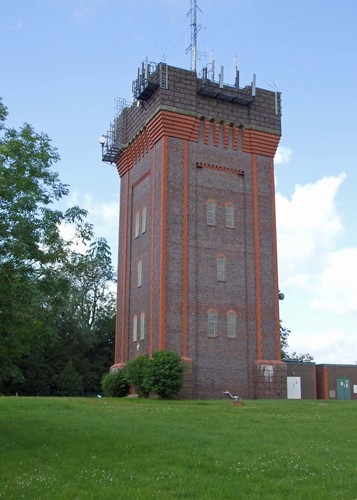 The Waterloo Tower, standing in what is known as Waterloo Clump, is without doubt Burton’s most prominent landmark and can be seen from many miles aways from Northerly, Southerly and Westerly directions. My own house stands at the foot of it and it can be seen from some windows so it is a particularly welcome marker on the skyline on homeward journeys.