Menu Close

1612 Last Heretic – Edward Wightman

Edward Wightman of Burton-on-Trent was the last person to be executed by burning at the stake for heresy in England in 1612.

Early Life
Edward was born at Burbage, Leicestershire in 1566. He was the son of a schoolteacher and draper (cloth trader) but during his childhood he moved to Burton-on-Trent where he was educated at Burton Grammar School. After initially working in his mother’s drapery business, Edward was apprenticed by a wool cloth trader in Shrewsbury. Edward’s parents were members of the traditional Church of England with no known separatist or puritan leanings but, whilst in Shrewsbury, he became involved with, and strongly influenced by, a group of puritans headed by John Tomkys. The radical brand of Protestantism included the rejection of the trinity and the divinity of Jesus Christ as well as a complete rejection of the institutionalized Church of England. This would have been extremely dangerous in Tudor times, but still pretty thin ice in the times of James I.

In 1590, he was admitted as a master into the Shrewsbury Drapers’ Company, but within a few years, he returned to Burton-on-Trent to start a clothing business. He married Frances Darbye in 1593. They produced 2 sons and 5 daughters.

When Edward returned to Burton, the religious mood had changed quite dramatically from his childhood days there when religion in the town was dominated by the local noble, Lord Paget who still promoted Roman Catholicism.

In 1583, during the interim period, Lord Paget had fled England after ending up on the losing side of some political plotting involving Mary, Queen of Scots. Henry Hastings emerged as the new local noble and political leader, and he was a committed Protestant. Under his leadership, a new evangelical puritanism emerged in Burton. Peter Eccleshall, the Burton curate, was indicted in 1588 for not using the Book of Common Prayer. A puritan evangelist, Philip Stubbes, lived in Burton for a time during the early 1590’s, thus a modest form of puritanism quickly became well-established in Burton.

The clothiers and various influential business people in Burton were very much involved in the religious transformation so Edward’s turn to puritanism was part of a town-wide trend. In 1595, Lord Hastings died, and William Paget, son of the previous noble, was reinstated in the lands of Burton. Despite Paget’s establishment as Baron in 1604, he spent little time in the Burton area so there was no reverse of evangelical puritanism in the town. This paved the way for Edward eventually becoming a radical ‘lay leader’ in the religious community.

Stapenhill Witch
In February 1596, at a time when the country was obsessed with witchcraft, thirteen year old Thomas Darling accused Alice Goodridge of Stapenhill of being a witch and possessed him with a devil. Young Thomas exhibited the classic ‘Exorcist’ symptoms such as vomiting, paralysis, and hallucinations. During his fits of spiritual possession, he would apparently be possessed by the devil one moment and the Holy Spirit the next.

The new puritan minister in Burton, Rev. Arthur Hildersham, became interested in the case, and prayed with Darling, but was unable to exorcise the boy’s demons. Another puritan minister, Rev. John Darrell, who came from nearby Ashby-de-la-Zouch was finally able to exorcise Darling and drive off his possessor.

Alice Goodridge was jailed in Derby and interrogated at Burton town hall in May 1596. Under pressure, she confessed. Many who knew of the Darling case were not convinced of the truth of the boy’s possession. It soon became a symbol in the growing political struggle between the puritan and Anglican communities. The Burton puritans sought to document and prosecute the case aggressively.

Edward Wightman took a strong interest in the Darling case and when Alice Goodridge was interrogated in Burton, Edward was one of five men who ‘examined’ her showing that he was an important and well-respected public figure and religious authority. He was actively involved in documenting the boy’s possession and involved in the ecstatic prayers associated with the boy’s exorcism. The testimonials on the truth of the boy’s claim included the signatures of Edward, Rev. Eccleshall, most of the Burton clothier community, and many established and well-connected local individuals.

The case demonstrates Edward’s highly emotional and spiritual brand of puritanism and his position of authority and leadership despite his relative youth. His involvement in the Darling case proved a turning point in his life, making him entirely amenable to the possibility of unmediated spiritual intervention. Darling claimed not just to be possessed by the devil, but engaged in a series of ‘spiritual wars’ in which both demonic and angelic voices were said to emanate from him.

In the wake of the Darling case, there was a significant backlash against the puritans. Rev. Darrell, the minister who had finally succeeded in exorcising the boy, was convicted of fraud and went into hiding. The practice of group exorcisms was suppressed and soon afterwards died out.

Edward the Radical
Partly through circumstance, Edward was driven to an even more radical separatism. In the late 1590s, England suffered a severe economic downturn after a series of very bad harvests, and several bad aspects of the economy. The cloth trade was particularly badly hit and Edward’s business pursuits failed. By 1603, Edward had purchased an alehouse in Burton and was now a simple tavern keeper, impoverished and deeply in debt. His financial standing had taken a disastrous turn, close to ruin. His swift rise to prominence in Burton society during the 1590s followed by almost as fast a fall fuelled his religious extremism.

Edward was also involved in a court case over a dispute between him and his former apprentice, Samuel Royle, from November 1600 through January 1601. For whatever reason, Edward apparently failed to appear before the court in January 1601, which may have cost him a 40 pound bond. The loss of that sizeable sum might have finished Edward off in the clothing business. The justice who handled the Royle v Wightman dispute was Sir Humphrey Ferrers, and later events suggest that Edward harbored ill feelings toward the noble.

Despite Edward’s legal and financial woes, it is apparent that he retained some degree of significant stature among the new leading puritans in Burton and still closely associated with key figures in Burton’s religious society. They apparently thought well of him and perhaps still looked to him for religious leadership.

The first documented evidence of Edward’s descent into extremism came in early January 1608. Sir Humphrey Ferrers had recently died and Edward was entertaining company in his own home. The conversation turned to Ferrers’ death and Edward’s grudge against him from the 1601 case that may have helped precipitate Edward’s ruin. Edward stated to the assembled company that he believed that the soul does not leave the body upon death, but rather stays with the body until Judgment Day, at which point it either ascends to heaven or descends to hell. Though not too shocking now, this would have been shockingly heretical at the time.

Edward became more vocal about his view of the nature of the soul and death. He continued to argue the point with local clergy. Curate Henry Aberley of Burton opted to use his own pulpit to argue against such heretical ideas, but this apparently led to bitter, and sometimes public, arguments with Edward. As a result, Edward stopped attended the Burton parish church and began worshipping elsewhere.

Despite Edward’s theological split with the established religious community, he was not abandoned by religious leaders. This is consistent with the behavior of other puritanical communities in response to other heresies. Instead of prosecuting or excommunicating the errant individual they would try to reform his views. Chief among those who engaged Edward was Burton puritan minister Rev. Arthur Hildersham, who had probably played a major role in Edward’s ascendance in the religious community a decade earlier.

Hildersham, and Rev. Simon Presse of Egginton, Derbyshire, met with Edward privately and attempted to convince him to change or moderate his view. The obstinate Edward refused and Hildersham ultimately responded by preaching against Edward’s heretical views from his Burton pulpit on March 15, 1609. Hildersham continued to correspond with Edward for a time, but eventually tired of Edward’s stubbornness and cut off the debate. Edward apparently interpreted this as a victory and became all the more convinced of the righteousness of his heterodoxy.

From 1609 to 1611, the process of engaging and attempting to ‘correct’ Edward’s view continued, but Edward became increasingly radicalized and spent his energies writing manuscripts outlining his views. He was a prolific writer, although none of his writings have survived. He was known to never leave home without a number of his books which he read and preached to anyone who would listen. Edward was only ever a ‘lay leader’ in the religious community and never held an official ministerial position. Although enjoying a number of followers for a time, by 1611 he was increasingly avoided and eventually became something of a loner.
King James I Condemnation
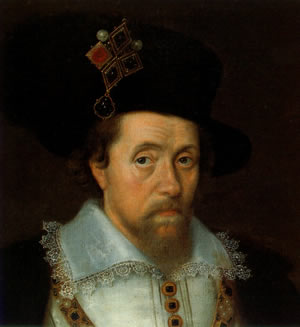
England had become a relatively tolerant nation under Elizabeth I but the religious and political situation changed when James I took the throne in 1603. Although King James was tolerant toward Catholics and helped liberalize the Church of England, with the famous English translation of the bible bearing his name, he saw Protestant dissenters, such as Puritans, Baptists, and Quakers, as a major problem and challenge. Among James’ great religious interests was support of catholic orthodoxy, which includes adherence to the major creeds. He took his title of ‘Defender of the Faith’ seriously and since 1607 he had been engaged with Roman Catholics over the ‘Oath of Allegiance’. Edward’s views were therefore, very much opposed to the King’s view.

Wightman set about putting together a compendium of his theology for his upcoming hearing and defense. Perhaps thinking that he would at least be allowed time to plead his case, he delivered copies of it to members of the clergy in an effort to gain support.

Now completely deluded, believing in his own righteousness and persuasiveness, he delivered a manuscript detailing his radical theology (thought to have originally been intended for Anthony Wotton) to King James I despite being fully aware of the King’s religious stance. This was a dubious move to say the least, particularly since the King had recently ordered the execution of Bartholomew Legate for heresy.

The manuscript consisted of eighteen leaves (pages). To give a flavour, it began, “A letter written to a learned man to discover and confute the doctrine of the Nicolaitanes very mightily defended with all the learned of all sorts, and most of all hated and abhorred of God himself, because the whole world is drowned therein: And seeing he hath promised to answer he knew not to what, and least he should also deal with me as the men of that faction have done already…”. The document concluded, “… and say glory be to God alone which dwelleth in the high heavens, whose good will is such towards men that he will now at the last, plant peace on the earth, and let all people say, Amen”. You may be relieved to know that almost the remainder of the document has not survived.

In February 1611, Edward interrupted Lent worship services in Burton with loud outbursts. It took significant effort to get him to quiet down. Finally, the Burton religious community had had enough. The Burton minister involved and others from Burton presented the case against Edward at the ecclesiastical visitation of Bishop Richard Neile of Westminster within a few weeks of Edward’s February 1611 disruptions. In early March 1611, Edward was summoned by Neile to Curborough, near Lichfield. Neile promptly returned to London and reported his findings to King James. The King was set on dealing with this troublesome heretic.

In April 1611, by order of the King, local church authorities issued a warrant for his arrest. The order instructed the church constables of Burton to immediately take him before Bishop Richard Neil at the Consistory Court at Lichfield Cathedral for interrogation of his religious views and for conformation to the established Anglican order. Neile’s Chaplain, who assisted in prosecuting Wightman, was William Laud, the future Archbishop of the Church of England, who was later executed himself!

The Trial
The first day of the trial was held on November 19, 1611. On the second day of the trial on November 26, the crowd was so large that the trial had to be moved to the larger space of the Chapel of the Blessed Virgin. On December 5, Edward was brought before the court for his final appearance. Throughout the trial, Edward did not attempt to defend himself. Instead, he attempted to educate them on the righteousness and intellectual rigor of his arguments, ‘clarifying’ the court’s conception of his heresies.

Sentence was pronounced on December 14, 1611. The charges brought against him included eleven distinct heresies. Part of the charge was that he believed “that the baptizing of infants was an abominable custom; that the doctrine was a total fabrication and that Christ was only a mere man and not the son of God; that the Lord’s Supper and baptism were not to be celebrated; and that Christianity was not wholly professed and preached in the Church of England, but only in part.” Other charges included several equally radical opinions.

After months of being subjected to a series of conferences with ‘learned divines’, Wightman was finally brought before Bishop Neil for the last time. Having refused to change any of his views, he was sentenced to be excommunicated and condemned to be burned at the stake following approval by King James I. Prior to his execution, he was to be placed in a public open place as an example to others who might harbour similar beliefs.
The Execution
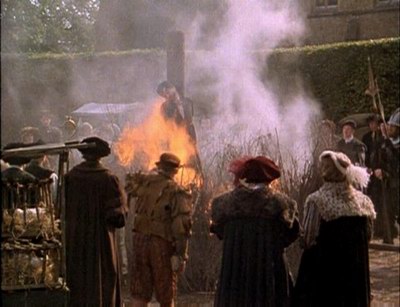
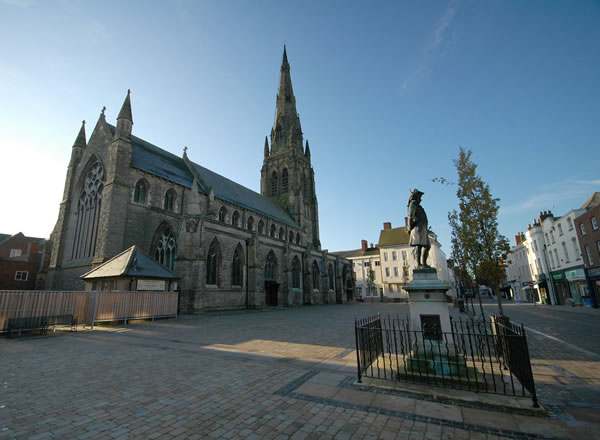
When the execution day arrived on March 20, 1612, Edward was tied to a post on the square in Lichfield next to Saint Mary’s church and the fire was lit under him. On feeling the heat, Edward screaming out in recantation and he was pulled down, already badly burned. A written retraction was hurriedly prepared and Edward, in pain and weakness, orally agreement as it was read to him. Later, however, no longer fearing the flames, he refused to sign the retraction and blasphemed louder than before.

King James re-approved his execution and a few weeks later on April 11th, he was once more led to the stake. Once again, on feeling the intense heat of the fire, Wightman cried out in recantation again but this time, the sheriff told him he would cost him no more and commanded more faggots (bundles of thin sticks) to be thrown on to make the flames roar. Edward was burned to ashes.

Conclusion
Seeing that heresy still survived with a number of religious radicals still emerging, King James I lost faith in burning heretics. After the case of Edward Wightman, it was decided that those found guilty of heresy should instead silently and privately waste away in prison rather than excite others with a public execution.

It was not until 1677 that an act of Parliament expressly forbade the burning of heretics, securing once and for all, Wightman’s dubious position in history as ‘The last person in England to be burned at the stake for heresy’.
Ryknield Motor Company

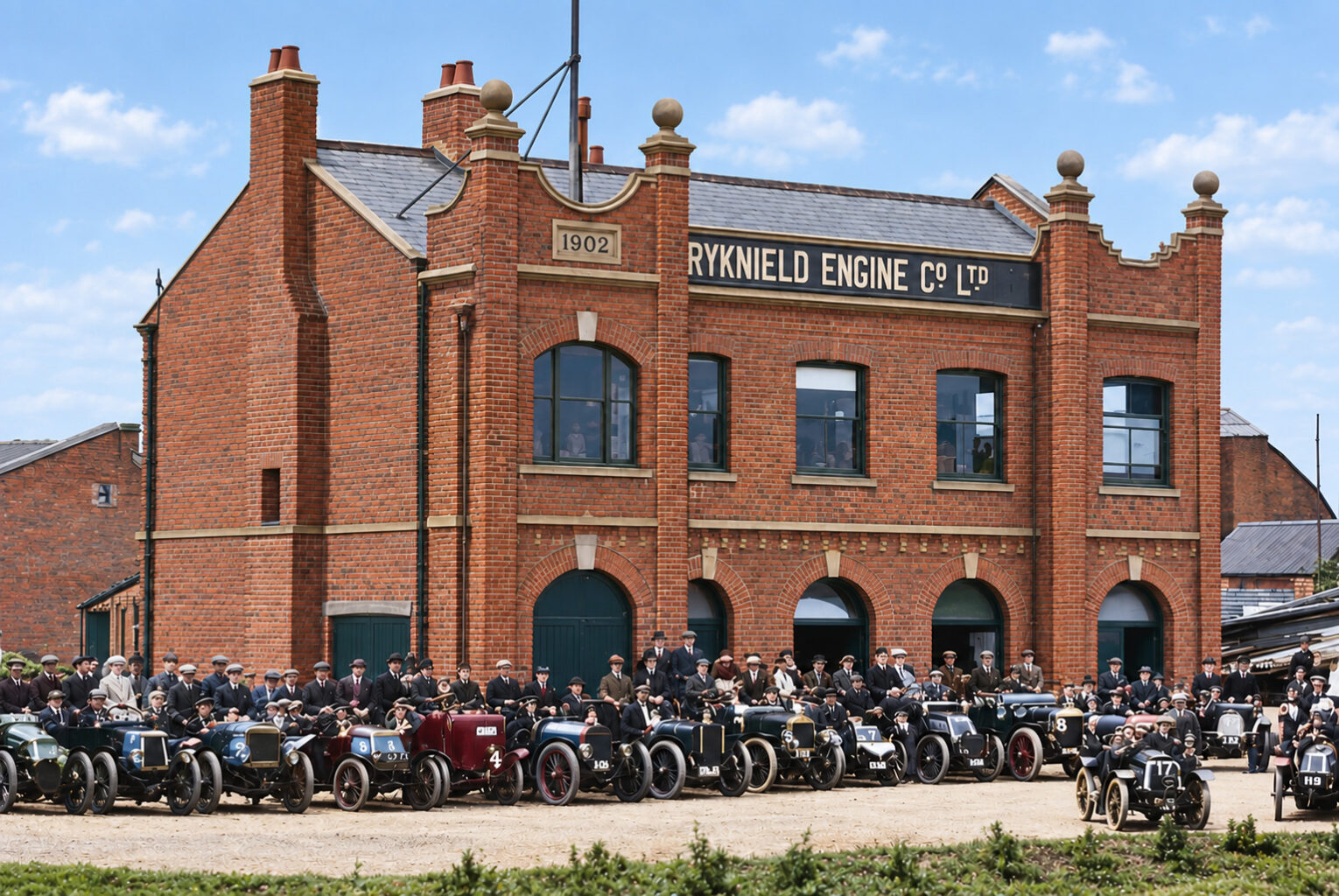
The Ryknield Engine Company was established in 1902 with purpose built factory and offices on Shobnall Road with prominent date-stone on the face of the building. The original intention was simply to build both steam and petrol engines for road vehicles.

The Shobnall Road factory during a vehicle exhibition c1905

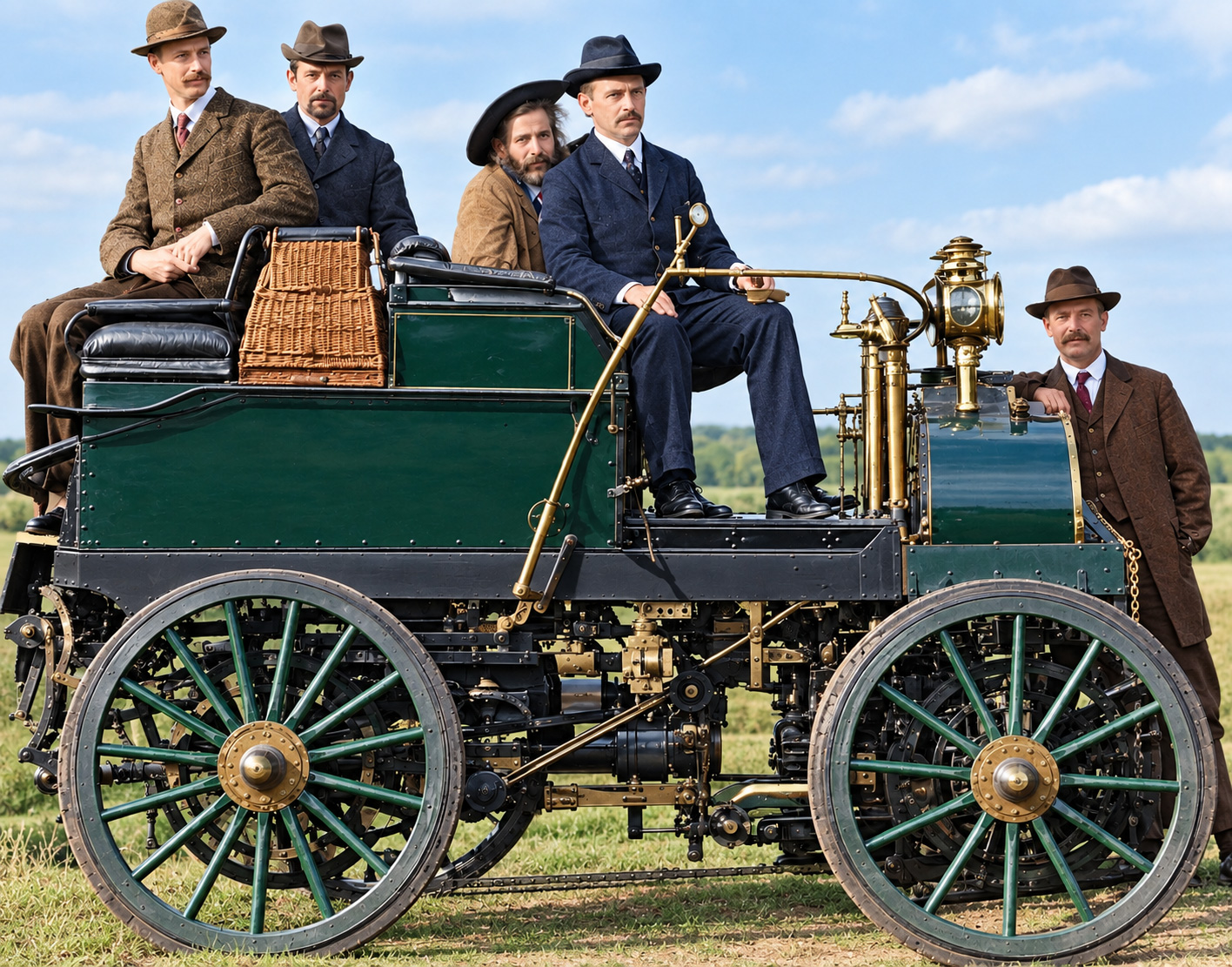
Ernest E. Baguley, who had been an apprentice in the rail industry, saw the potential of the motor car and in 1901 he designed a steam-engine for a motor car whilst employed as an engineer with W.G. Bagnall Ltd. They did not share his enthusiasm so he left to join the newly formed Ryknield Engine Company as manager in November 1902.

The first ever Ryknield steam powered car. 1902

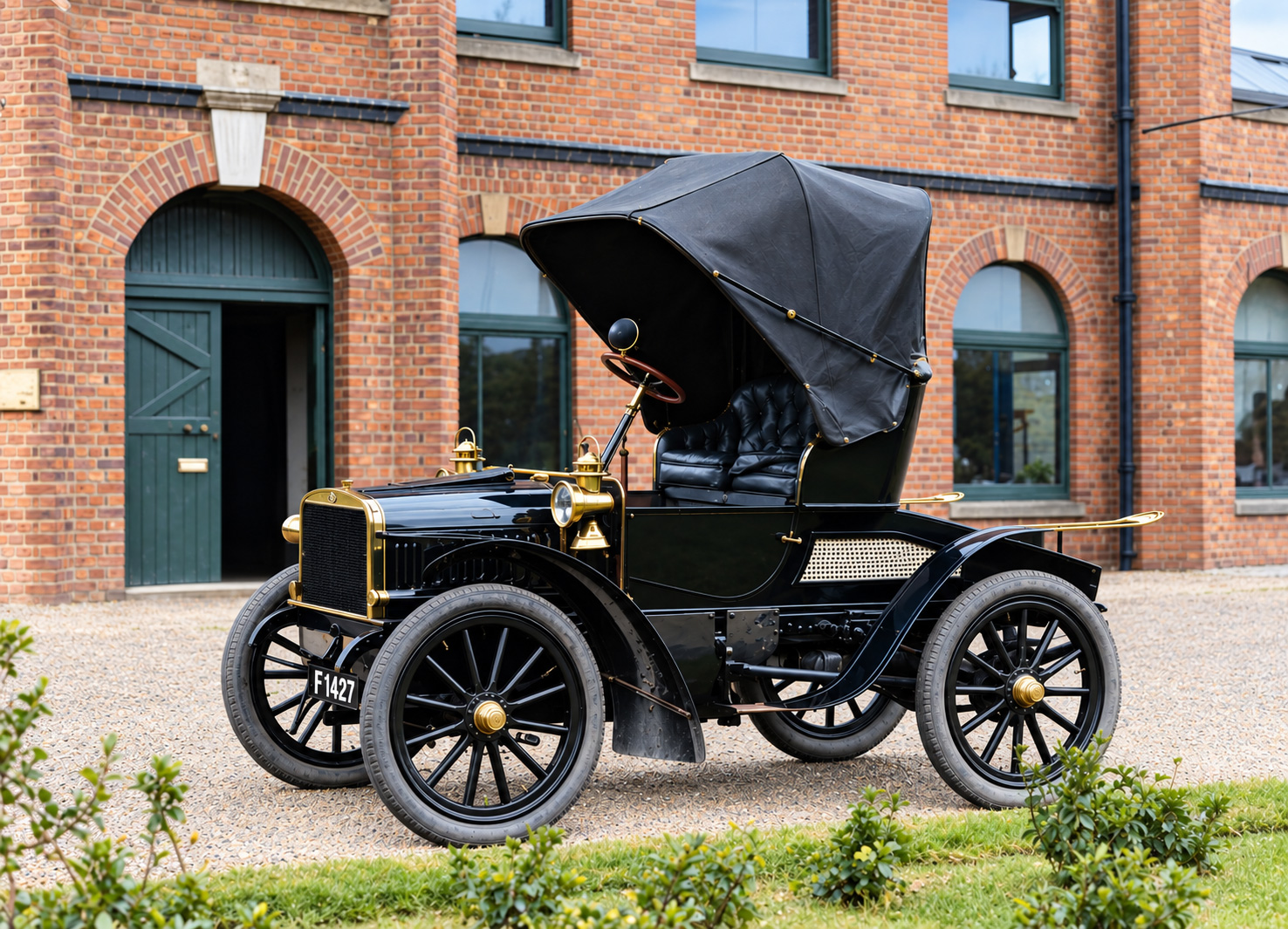
However, the company quickly realised that for road vehicles, petrol internal combustion engines was the future and by the end of 1903, they were producing cars like this fine example with the all essential horn mounted on the steering wheel, despite being under 9 horsepower.

Rynield petrol car 1903

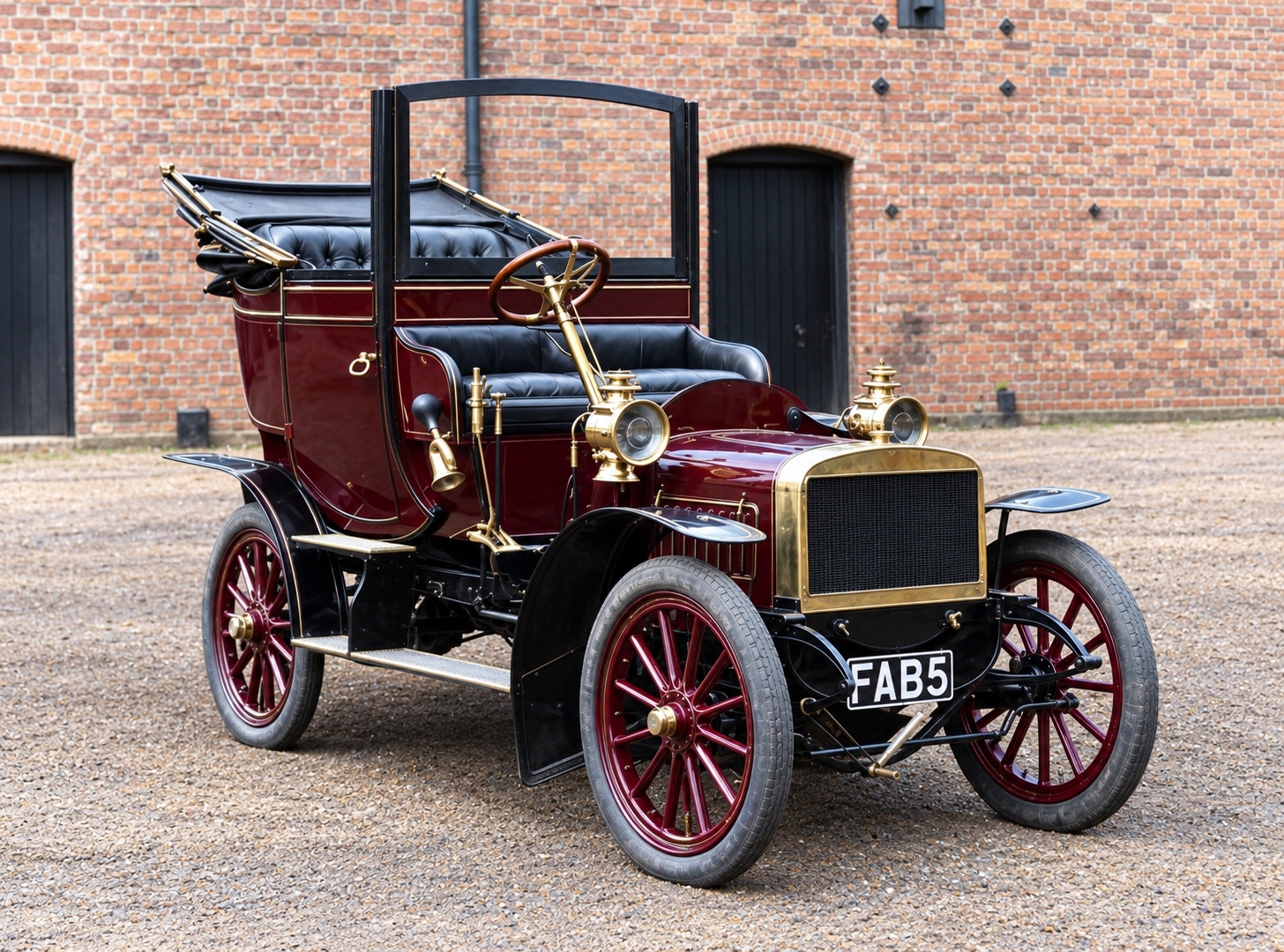
Things developed at breakneck speed. No waiting years for the new model, pretty much every car was a further development of the last. There was now room for more than one passenger and the horn was mounted in a much more sensible place.

Rykield car 1904

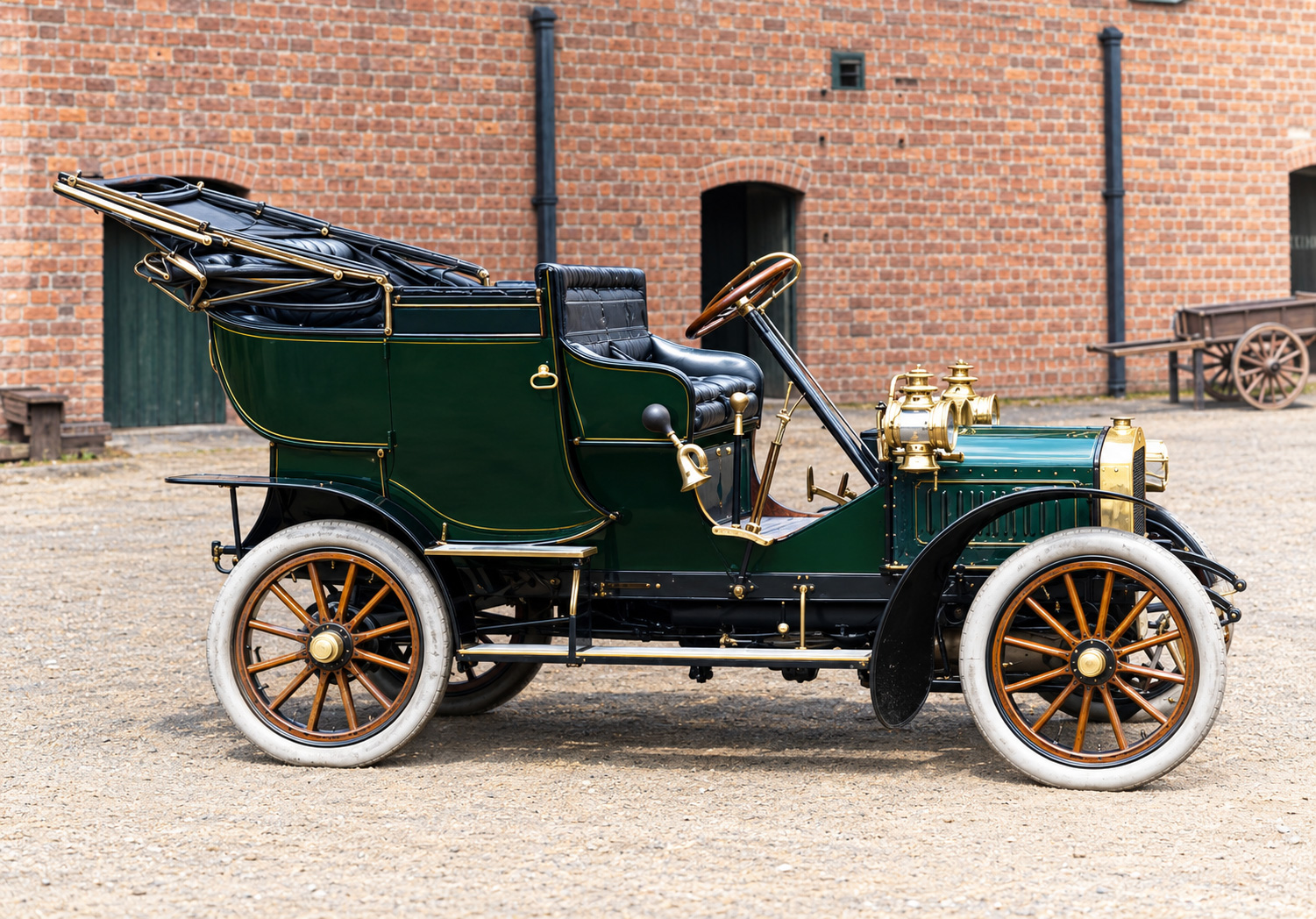
A year later, the engine power had increased and the driver back support had improved after complaints of discomfort. This example was particularly fetching after the owner had requested sporty (well, different coloured) wheels.

Rynield car 1905

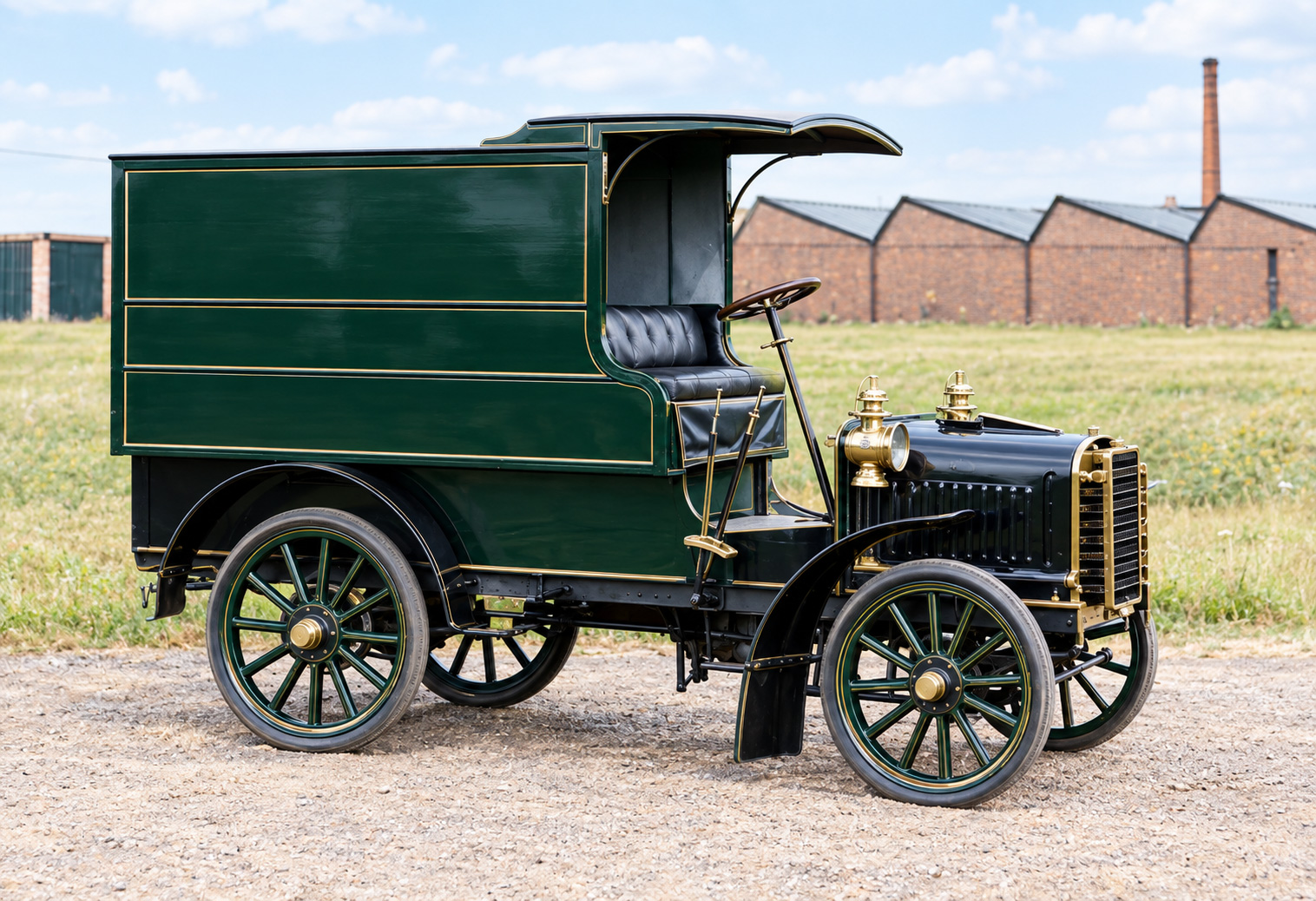
Relatively popular Ryknield light van. This is one of the first to be build and still awaiting its custom livery for its proud business owner.

Ryknield light van

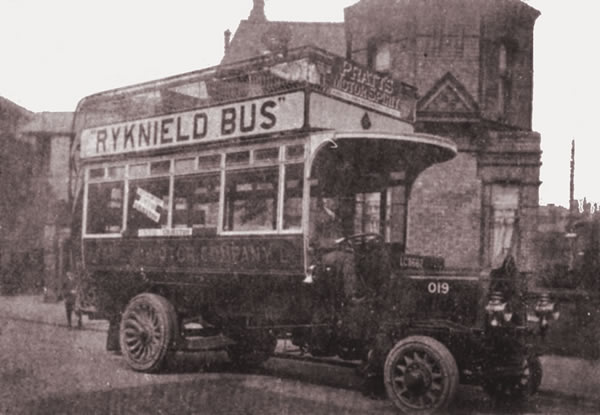
Ryknield Motor Company built the first passenger carrying bus to run in Burton in November 1907. Interestingly, it did not belong to Burton Corporation. It was built and operated by the company itself as an experiment to see if transport available to the fare paying general public could prove to be financially successful.

Ryknield petrol bus. 1907

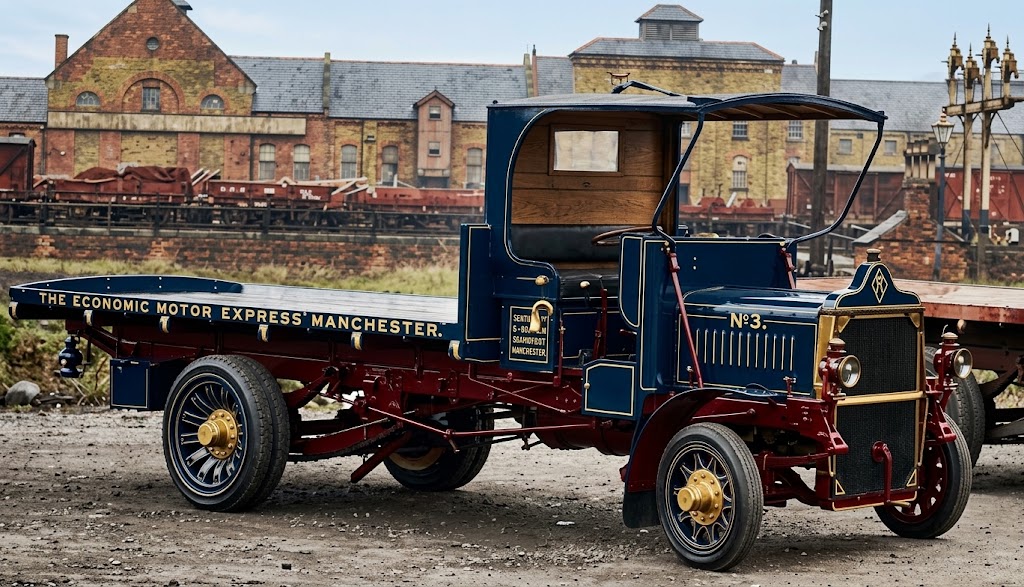
Ryknield did have a go at building larger commercial vehicles like this one for a Manchester company but without great success because this sector was by now covered by far superior offerings despite this producing a whopping 45 horsepower.

Ryknield commercial vehicle was not a great success. c1910

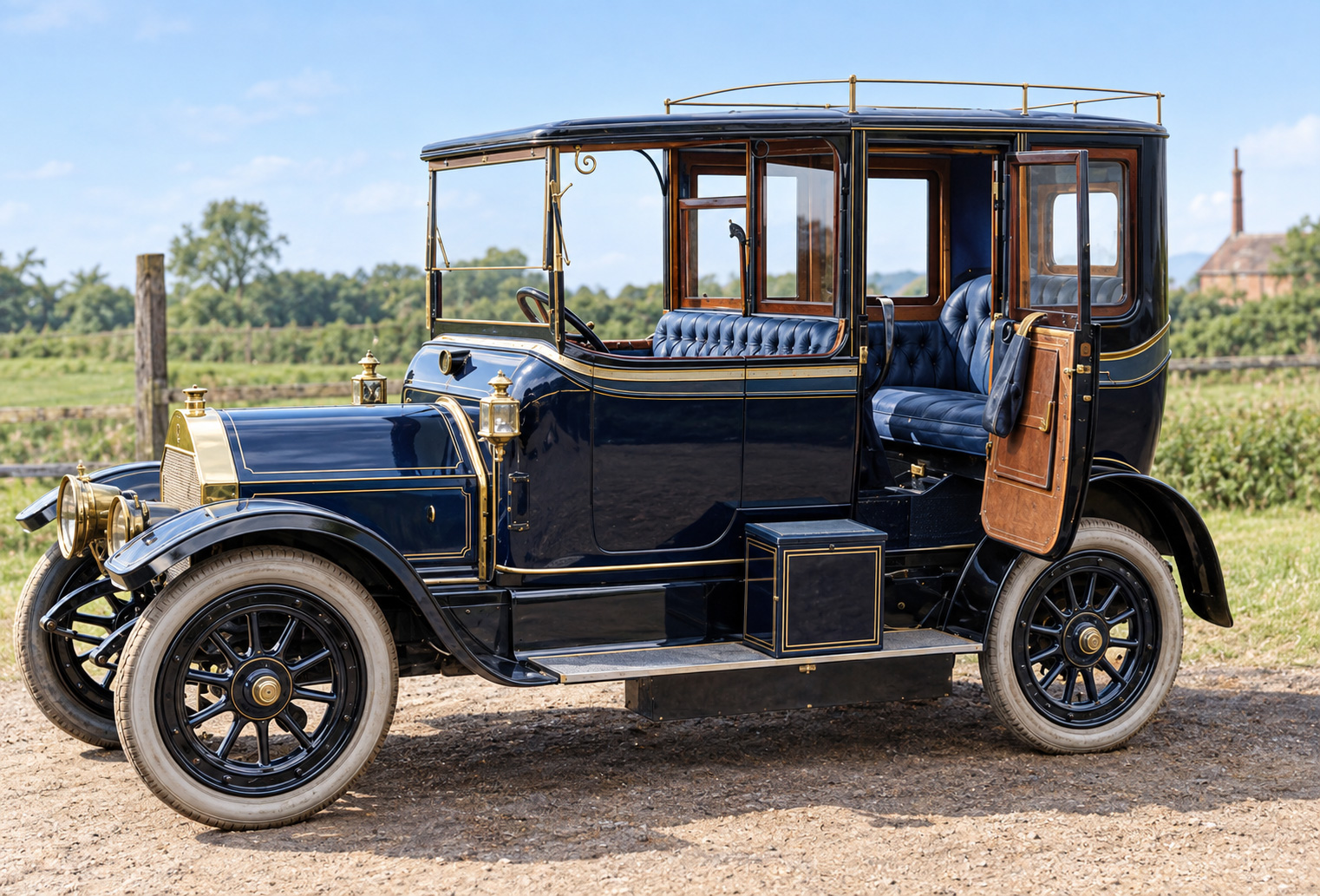
Ryknield motor company ran into financial difficulties and was taken over by the larger Baguley company whose main operation until then had been steam locomotives but they had an interest in producing motor cars and road vehicles. By the time the business had ceased, it had progressed to making cars such as this beauty made for Messrs. Bass & Co.

Ryknield car built for Mssrs. Bass & Co. 1911

L.S. Lowry

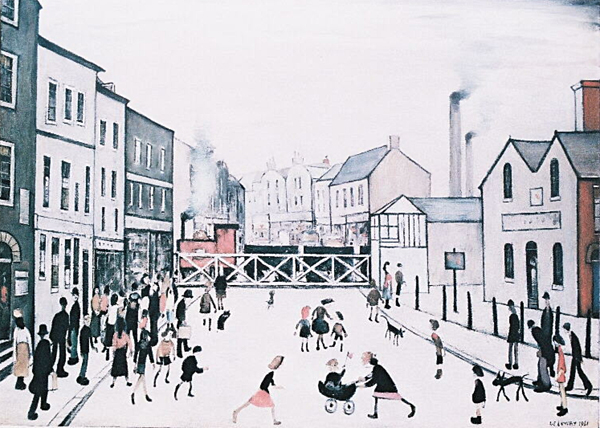
Though I can’t confess to being much of a fan myself, Laurence Stephen Lowry is one of Britain’s best loved and most famous painters, best known for his scenes of life in the industrial districts of Northern England during the early 20th century. He had a distinctive style of painting with human figures often referred to as his “matchstick men”.

The above painting is one of his best known works. The original was painted in 1961 as an oil on canvas measures approximately 21″ x 29″. It is one of a number of pictures that Lowry painted in Burton. The picture shows a brewery engine pulling a beer wagon across a the crossing in High Street, Burton, running past the Blue Posts public house and through the gap which now leads to Burton library.

Lowry often visited Burton while staying with friends. He liked the town and was partial to a pint of Bass which he maintained didn’t taste the same anywhere else. He produced numerous other sketches of Burton which were eventually published as paintings but not quite as famous as this example simply known as ‘The Crossing’.

Thornewill Family

Thomas Thornewill (senior) was baptised in Burton Parish Church on 4th October 1719, the son of Thomas and Elizabeth Thornewill.
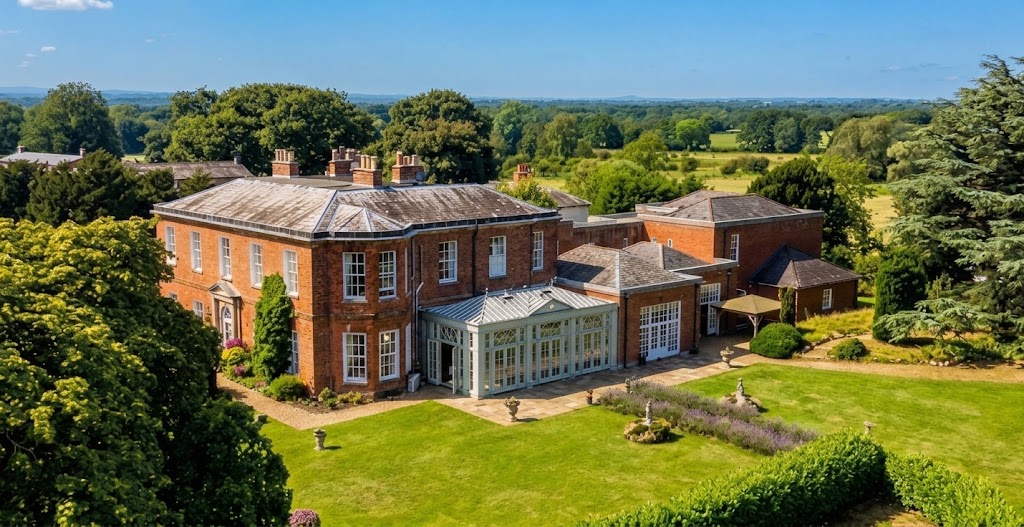
The Thornewill firm dates back to at least 1732 making iron goods. Thomas Thornewill (junior) was apprenticed in that year, at the age of thirteen.

Thomas Thornewill (senior) married Elizabeth Astle on 20th October 1746. She was the widow of Francis Astle, a noted local feltmaker and hatter who had died in 1735. He had left most of his properties to his wife Elizabeth (by a will of 20th May 1735), including a freehold house, on the south side of New Street. She was to have the use of this house for the remainder of her life, and it was then to be sold by Astle’s executors, Thomas Towndrow (gentleman) and John Downes (feltmaker), and the proceeds invested in land worth £5 a year to provide clothing for four poor boys of Richard Allsop’s Charity School in Burton.

Thomas Thornewill of Burton, now listed as ‘Edge Tool maker’ settled the property and its contents to Elizabeth, so that if he died they would pass to her. In 1751, Thomas leased a garden adjoining his freehold property on its eastern side, from William Jordon (cooper) for an annual rent of six shillings. This is significant in that it was the first move towards an expansion of the Thornewill property between New Street and Park Street (which was then known as Pinfold Lane).

Elizabeth, Thomas Thornewill’s wife, died in 1755 and it became the duty of Francis Astle’s executors to dispose of the freehold property in accordance with his will. The freehold property was advertised for sale in the “Derby Mercury”. Thomas Thornewill of Burton and his brother Francis of Clay Mills, both now listed as ‘Edge Tool Makers’ purchased the freehold property in New Street from Thomas Towndrow, the surviving executor or trustee of Francis Astle, for the sum of £140.

By 1760 the Thornewill brothers had established a small business there still making edge tools such as axes, knives and spades. From this time on they began to systematically expand their property in New Street whenever the chance arose. It was not however, their only business interest. A reference to Clay Mills in a 1760 indenture shows that the Thornewills were already in possession of the Forge Mill there. This was sited on the Mill Fleam, a watercourse branching from the River Dove, on or near the site of an old water corn mill. The exact dates when the Thornewills leased the mill and opened the forge are not known, but were probably around the year 1740.

Water power was needed for working the bellows and hammers in the forge and also to operate rolling and slitting mill. The forge usually consisted of a “finery” in which the iron was hammered into blooms and a “chafery” in which the blooms were reheated and beaten into bars. In the rolling and slitting mills the iron was rolled into sheets and then cut into rods ready for the nailers. The Thornewill’s forge may not have had rolling and slitting mills attached in 1760, but it certainly had in 1807 when they purchased the premises outright.

In 1760 about 25,000 tons of iron were imported annually into England (approximately 50% of the requirements) mainly from Russia and Sweden. The Thornewills used this imported iron, which they purchased from the Burton brewers of the time, such as Benjamin Wilson, John Walker Wilson and Samuel Sketchley. The brewers normally accepted some iron, flan or timber as part payment for the beer that they exported along the Trent to the Baltic countries.

Thomas Thornewill (ironmonger and spademaker) leased the White Hart Inn in High Street from the Earl of Uxbridge on 23rd September 1769. Later in the year, he sub-let a house and garden on the north side of New Street (which he previously leased from the Earl of Uxbridge) to John Shorthose (turner). In a property lease of 1770 John Shorthose is described as a spademaker and was an employee at the Thornewill works in New Street.

In March 1772, Thomas and Francis Thornewill leased from the Earl of Uxbridge, two further tenements and a garden to the east of their freehold property, and also a property to the west. Ever expanding, Thomas also leased land at Stretton, including some waste land near the forge.

By 1778 the Thornewill’s business had grown considerably. They were in possession of extensive properties in Burton, particularly in New Street, and at Clay Mills, Stretton. They were purchasing large quantities of imported iron, (for example, in August, 1778 Thomas Thornewill bought 658 iron bars imported by John Walker Wilson from St. Petersburg, Russia, for £273 7 6) and were manufacturing considerable quantities of spades, iron hoops, iron plate and other forms of hardware. They were probably the main suppliers of iron hoops to the Burton brewers of the time, and this was no doubt the way in which the firm developed as brewery engineers.

At the beginning of 1784, Thomas Thornewill made his will, and in this he left his leasehold properties to his daughter Sarah Spiers. After Thomas’s death Sarah sold the property lying to the east of the freehold property, to George Wood for £125, and it was not until 1834 that the Thornewills were able to buy it back from George’s son William. The Wood family, together with William Shorthose, Philip Port and William Smith were also, at this time, eager to acquire land on the south side of New Street, where they operated (approximately 1775 1835) a large screw making works. No doubt the Thornewills supplied this firm with iron.

Thomas Thornewill (senior) died in 1786 and the firm came under the management of Thomas, his son, and Francis, his brother.

In the same vein as his father, in 1801, Thomas Thornewill leased two more properties on the South side of New Street.

Francis Thornewill made his will in 1805 which showed that he was a man of considerable wealth. He left the bulk of his estate to his sons, John and Francis, but he was still able to leave £500 to his daughter Anne; and £200 to his grand daughter Anne Neal. He died just 2 years later in 1807 having done much to build up the business. He had also been one of the Townmasters in 1792 and was a Feoffee in 1794.

In March 1807, Thomas Thornewill (junior) purchased outright for £3,220, extensive properties and rights at Clay Mills from the Earl of Uxbridge. These included:
(a) “Cliffcroft” 7 acres of land containing Dove Cliff House, that was built for him about 1700, gardens, plantations, pleasure grounds, etc.
(b) Clay Mill forge with “all those iron works and all the slitting mills, forges, warehouses, buildings and works belonging thereto”.
(c) A warehouse and tenement near the Grand Trunk Canal in Stretton.

The Grand Trunk Canal had been opened in 1770 and was a considerable improvement on the Trent navigation.

By 1811, Thornewill’s were operating a forge at Wichnor as well as at Clay Mills. At the latter there was also a foundry and an iron casting house.

In the 1818 edition of the Bradshaw & Parsons Directory of Staffordshire, there are two Thornewill listings, the new one being in New Street. These appeared as:

  • J. & F. Thornewill spade manufactures.
  • John Thornewill & Co. merchants.

Although not listed in the Directory, Thornewill & Co. also held the forge at Stretton (Clay Mills) and William Gretton was the iron master there. At the time, there were also recorded living in the area around the works an iron founder, a foundry man, three spade makers, end three nailers, in addition to six patten ring makers and fourteen screw forgers who worked at the nearby screw mill.

By 1834, the Bradshaw & Parsons Directory had pretty much been replaced by The White’s Directory of Staffordshire. The listed had changed slightly to:

  • John & Francis Thornewill Iron and brass founders and spade manufacturers.
  • John Thornewill & Son Iron Merchants.

In 1835/36 the leases for the New Street properties were successfully renewed. By 1837, most of these premises together with the freehold property were in the possession of Robert, John and Francis who were now running the business.

By 1837, Thomas Thornewill made his will. By this time, he was 77 years of age and had taken little part in the running of the business for some time. A few of the main clauses of his will illustrate the considerable wealth that the Thornewill family had acquired since 1760 when Thomas (senior) and Francis (senior) had raised the £140 to buy the freehold premises in New Street. It listed:

  • To Mary, his daughter £3,600.
  • To Ann Fenwick (daughter) £3,700.
  • To Jane (daughter) £3,100.
  •  To Frances Hewitt (daughter) £1,000 q + £2,700 in trust.
  • Residue from the sale of two farms at Yoxall and Hadley End, and other estates; personal effects; and Dove Cliff House, together with the nearby forges, workmen’s houses furnaces rolling and slitting mills, watercourses, weirs, fisheries, and adjoining lands, all to pass to Edward, his son.

During 1839, the New Street premises were further extended and the firm constructed a number of new buildings on its existing land. A large area of land extending to Pinfold Lane was also purchased by Robert Thornewill from Thomas Lambert and in 1840, the date above a new archway marked the alterations.

A large two storied building was built in 1845. Mr. William Jones, the tenant of the neighbouring property, wrote a letter to Robert Thornewill complaining about the number of windows in the upper storey of the new building.

On 1st Feb 1847, Robert Thornewill purchased the leasehold premises, to the west of the freehold property, from Thomas Cooper. These very old premises had, for the previous one hundred and fifty years been used by Francis Astle, Thomas Cooper and others, as a hat factory. At a later date the houses were demolished or extensively modified to form the present offices.

An Indenture of partnership between Robert Thornewill and J.R. Warham (engineer), now described as engineers, ironfounders and iron merchants was signed on 2nd July 1849

Robert Thornewill purchased a piece of land adjoining the west side of the works in Park Street from William Wood in 1852. This meant that the site now occupied a complete 2 acre plot of land between New Street and Park Street.

It was probably about this time also that the business changed considerably in the types of goods that it produced. From its beginning to about 1845 it was little more than a hardware firm making iron, copper, and brass goods for use locally, particularly in the Burton breweries. From 1845 onwards it became an engineering firm in the true sense, and it is significant that Bagshaw, in his Directory of Derbyshire of 1846, lists the firm of Robert Thornewill of New Street iron and brass founders and steam engine makers. These early engines were probably sold mainly to local collieries and breweries.

The 1851 White Directory of Staffordshire, stated that Thornewill and Warham Iron foundry and Engine and Machine Works in New street “employs 75 men and 25 boys”. He also mentioned that Thornewill & Co. had an ironworks at Clay Mills, and that Edward Thornewill lived at Dovecliff House, Rolleston.

Dovecliff House, Rolleston

Robert Thornewill (senior) died in 1858 and his share of the business passed to his wife Martha Hammond Thornewill (neé Wright), in accordance with his Will of 20th Feb 1856.

An article in The Burton Weekly News of 30th March 1860 stated “apart from brewing, the only considerable manufactory now is Messrs Thornewill and Warham’s iron foundry and Engine and Machine Works.”

By this time the firm was producing approximately fifteen to twenty steam engines annually. These consisted of pumping, haulage and winding engines and tank locomotives which were sold mainly to collieries in Derbyshire, Leicestershire, Staffordshire and Warwickshire. A few were sold to Burton breweries and to ironworks and lead mining companies in the Midlands.

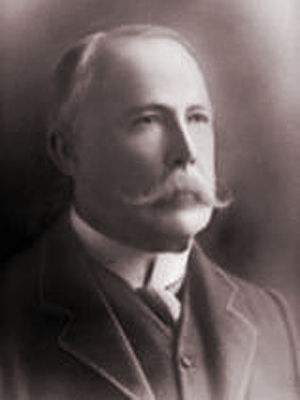
On 25th November 1868, the partnership of M. H. Thornewill and J. R. Warham was dissolved to allow Robert Thornewill (pictured above), son of Robert Thornewill (senior) who had died in 1858, to enter. At this time the property, stock and other assets of the firm were valued at £43,048 1 6 of which M. H. Thornewill held £27,720 15 7 and John Robson Warham £15,327 5 11.

Under the new partnership agreement J. R. Warham was to control 6/12ths, M. H. Thornewill 5/12ths, and R. Thornewill 1/12th of a total capital of £44,000.

At the end of 1878, Thornewill and Warham purchased a piece of land with a number of properties, on the corner of Lichfield Street and Park Street, from Frederick Gretton, a brewer of Burton, for £2,500. It adjoined John Bell’s brewery on its north east side. In 1879 some of this land was sold to the Midland Railway Co., who built a line through Thornewill and Warham’s premises from the south side of Station Street to the Bond End Railway.

Two years later, in 1880, Thornewill and Warham purchased property on the south side of New Street, to the west of their own premises, from the Trustees of G. R. Bircher. This consisted of premises fronting New Street, originally an inn known as the Old Queen’s Head, and 423 sq. yds. of ground to the rear.

In approximately 1885 Thornewill and Warham exported three engines to Japan to be used for winding and hauling at Taskanna Colliery. After 1885 the number of engines made for export increased considerably the following extracts from the firm’s order book illustrates this:

  • 1886 Two pumping engine for a sewage works at Buenos Aires, Argentina.
  • 1889 Two engines for pumping and winding to the Taeping Colliery Co. in China.
  • 1892 Winding engine for the Dundee Coal Co. in Natal, South Africa
  • 1897 Pumping engine for a Gold Mining Syndicate in British Guiana.
  • 1902 Winding engine sent to the Rajah of Sarawak in Borneo.

Not only did Thornewill and Warham considerably expand the extent of their market, they also greatly extended the range of their manufactures. By 1880 they were producing a full range of brewery equipment, including various types of refrigerators, and indeed were capable of producing all types of machinery and metal goods.

On 26th March 1886, J.R. Warham died, leaving his share of the business to his wife, Anne Jane Warham of Birmingham, and to his son, William Warham (gentleman) of Seaham Harbour, Co. Durham. M.H. and Robert Thornewill purchased these shares and thus the business became an entirely family concern again after a break of 37 years.

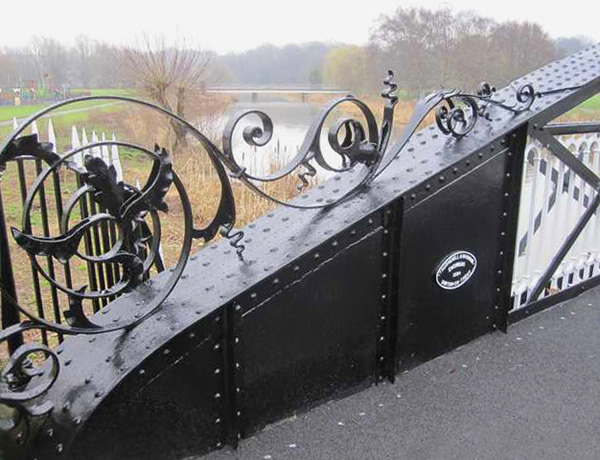
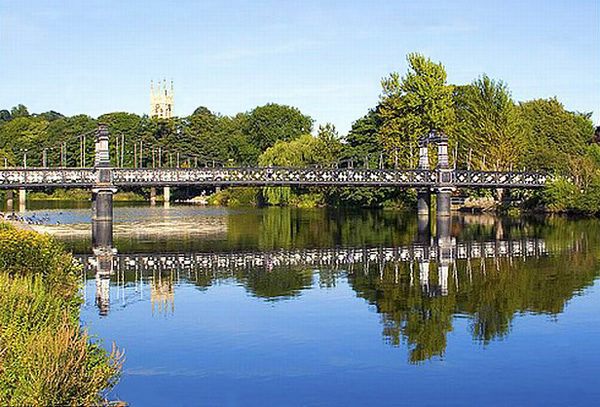
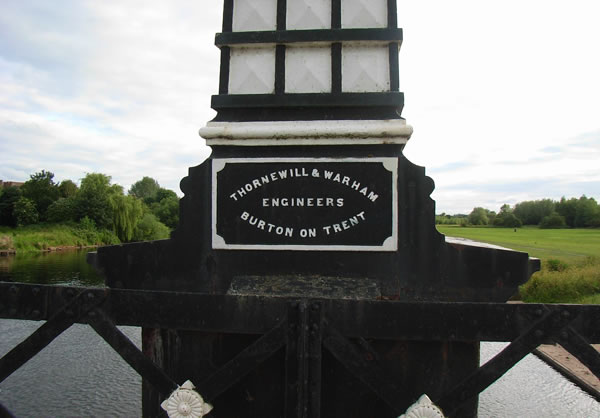
In 1889, Thornewill and Warham made the contribution to Burton for which they are best known… having built the Andresey Bridge by special commission, they were commissioned by Michael Arthur Bass (later to become Lord Burton) to build the Ferry Bridge. The Ferry Bridge was opened on 3rd April 1889, and the viaduct linking it to Bond End added a little later at the total cost of just over £10,000. A few weeks later on 24th April 1889 Martha Hammond Thornewill died, and her share of the business passed equally to her three sons, Rev. Charles Francis, Robert and Arthur, in accordance with her will of 1st Feb 1889. Charles Francis sold his share in 1890 and Arthur his in 1893, leaving Robert in control of the business.

Andresey Bridge

Ferry Bridge
By 1895 Thornewill and Warham were manufacturing approximately twenty steam engines a year. Between 1870 and 1895 they made 500 (including locomotives). Of the 329 that can be traced in the engine order book they were installed in the following types of works:

  • Collieries 202
  • Breweries 50 + 16 locomotives in Burton breweries
  • Waterworks 12
  • Ironworks 10
  • Potteries 10
  • Engineering 6
  • Sewage Works 5
  • Railways 4
  • Gasworks 3
  • Quarries 3
  • Lead mines 2
  • Building works, brickworks, canal company, flour mill. dock company and woodworks 1 each.

In 1907, assignment of the business changed from Robert Thornewill Esq. to Thornewill and Warham Ltd. Robert Thornewill died in 1914, leaving two daughters, Ella Violet and Kathleen Hamilton

1919 marked the end of an era when Thornewill and Warham Ltd. went into liquidation and a new company of the same name was formed. This was purchased by S. Briggs & Co. Limited which remains successful today but was moved from the New Street premises to new premises in Derby Street to make way for the Octagon Shopping Centre.

Pre-1920 Adverts

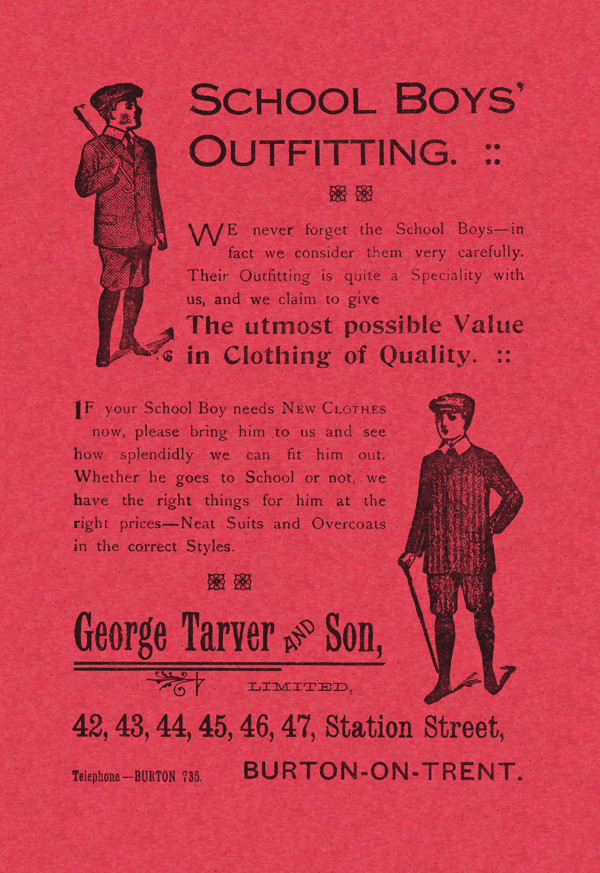
1919 – George Tarver and Son, Gents Outfitters

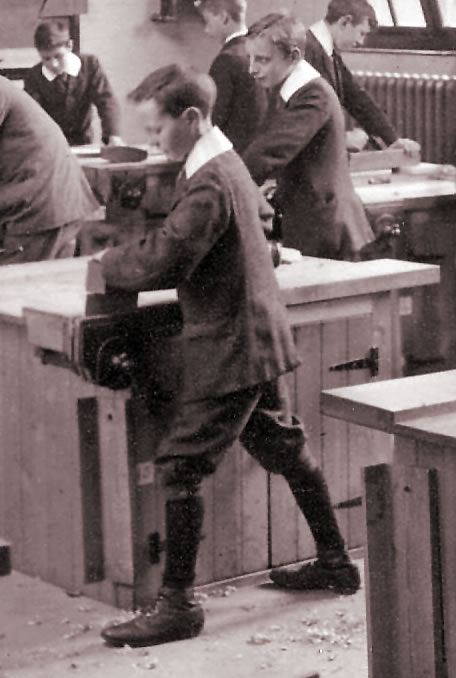
Just in case you have any doubts over whether pupils actually dressed this way… the above picture was taken at Burton Grammar School at around the same time.

1920s Adverts

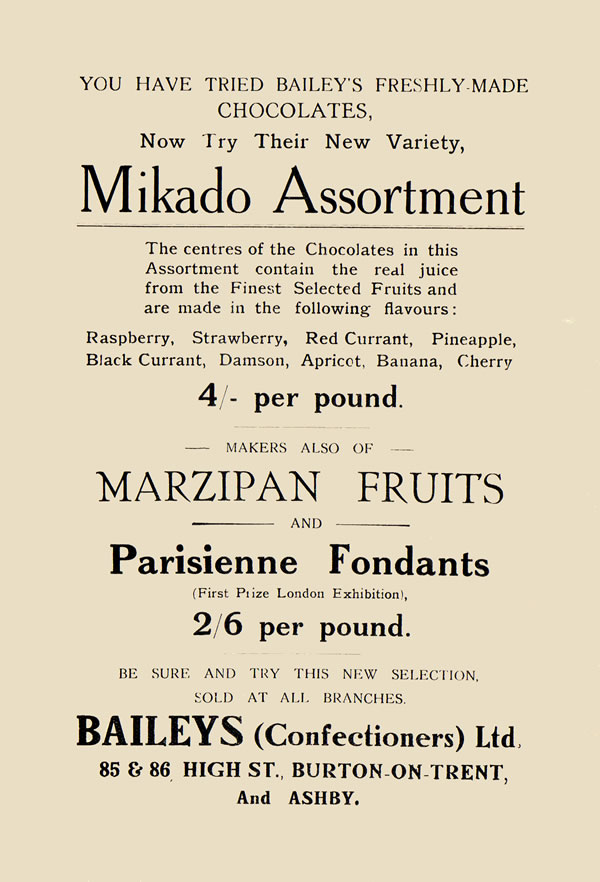
1922 – Baileys Ltd, Confectioner

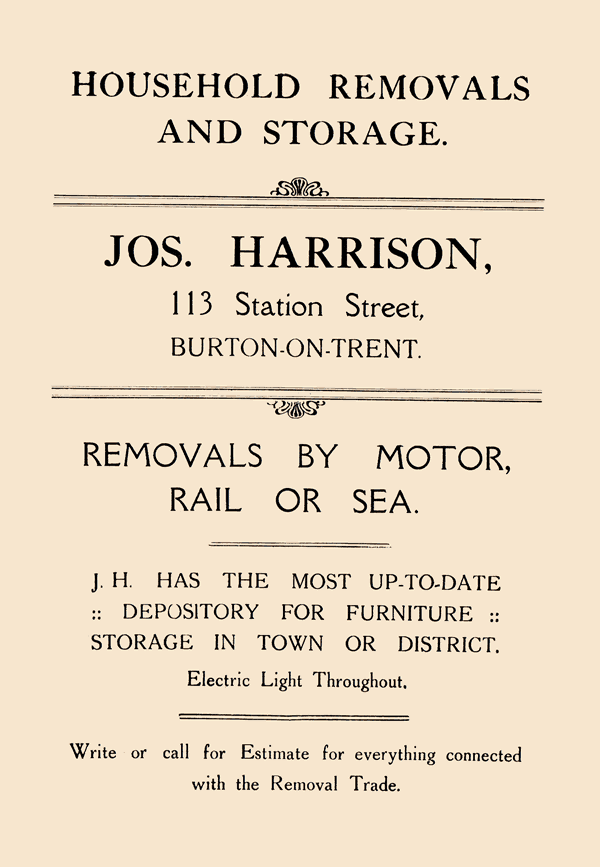
1922 – Joseph Harrison, Household Removals and Storage

1922 – Heape and Company, House Furnishers

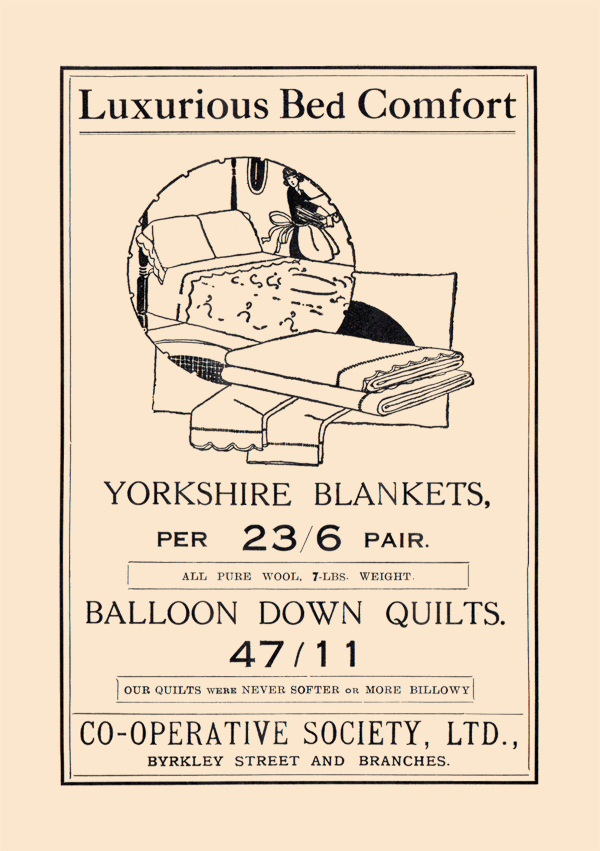
1922 – Co-operative Society Ltd, General Supplies

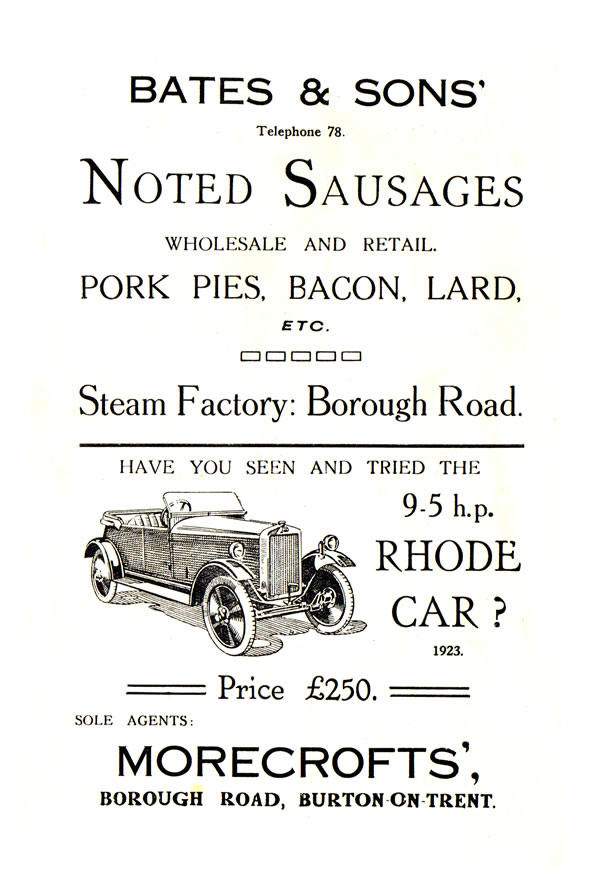
1922- Bates and Sons, Wholesale and Retail
1922 – Morecrofts, Auto sales

1930s Adverts

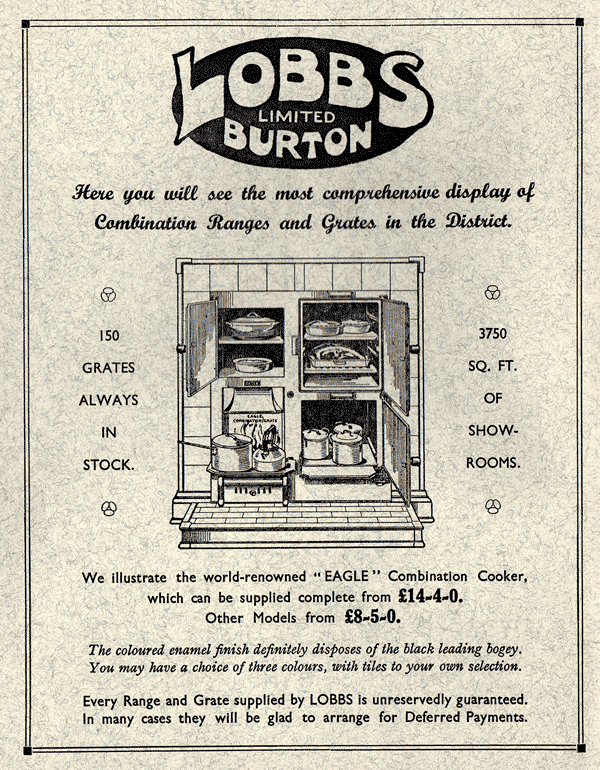
1934 – Lobbs Limited, Ranges and Grates

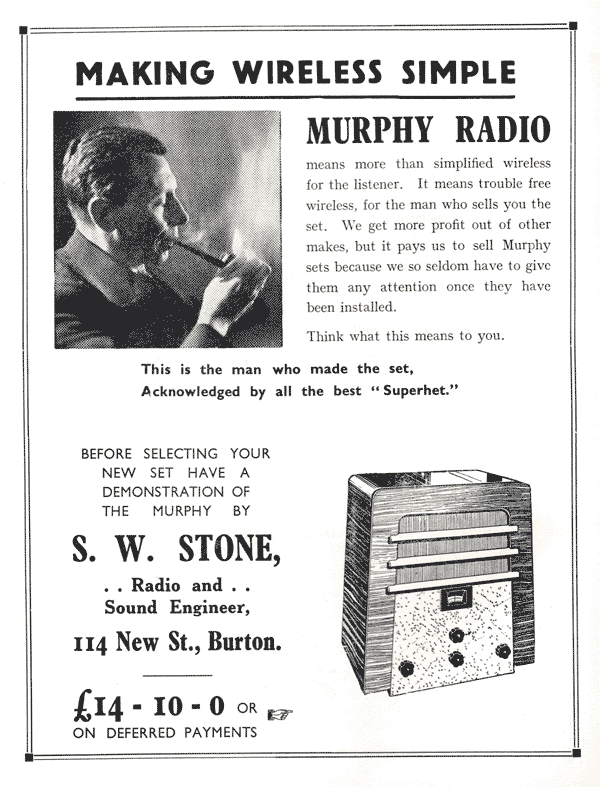
1934 – S.W. Stone, Radio and Sound Engineer

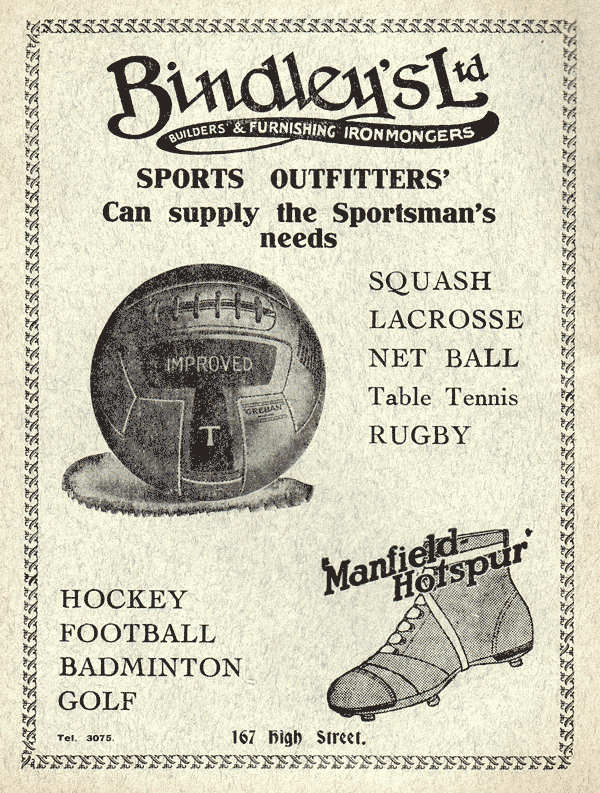
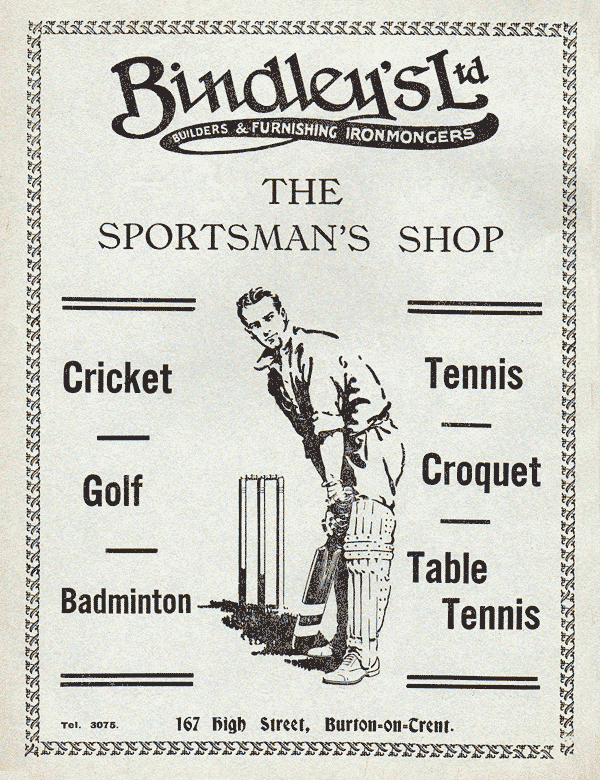
1935 – Bindleys Ltd, Builders and Furnishings Ironmonger / Sports Shop

1936 – Bindleys Ltd, Builders and Furnishings Ironmonger / Sports Shop

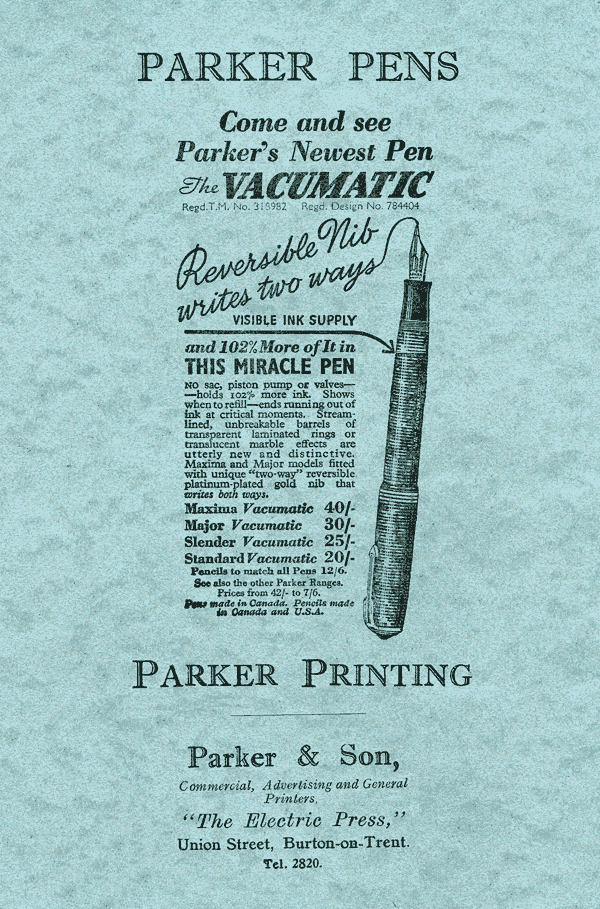
1937 – Parker and Son, Printers and writing supplies

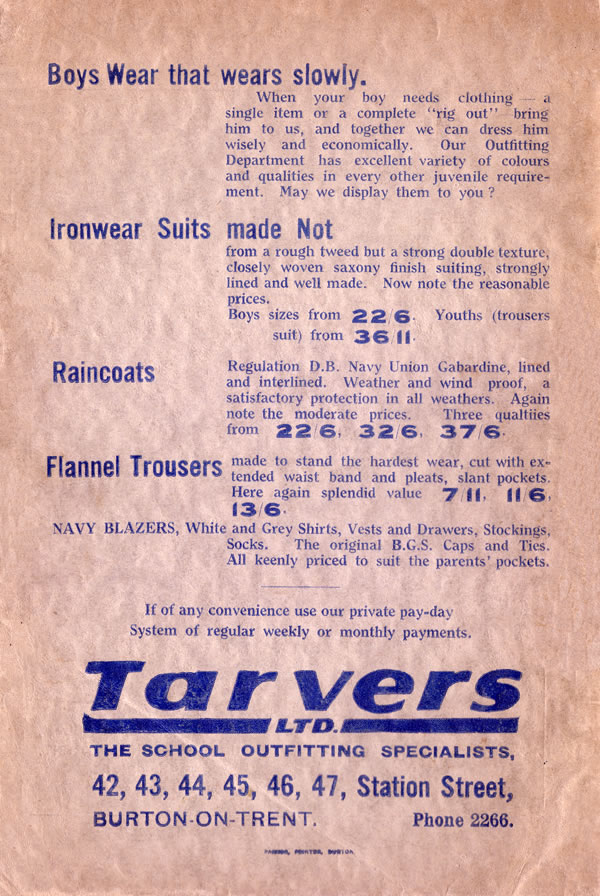
1939 – Tarvers Limited, School Outfitting Specialists

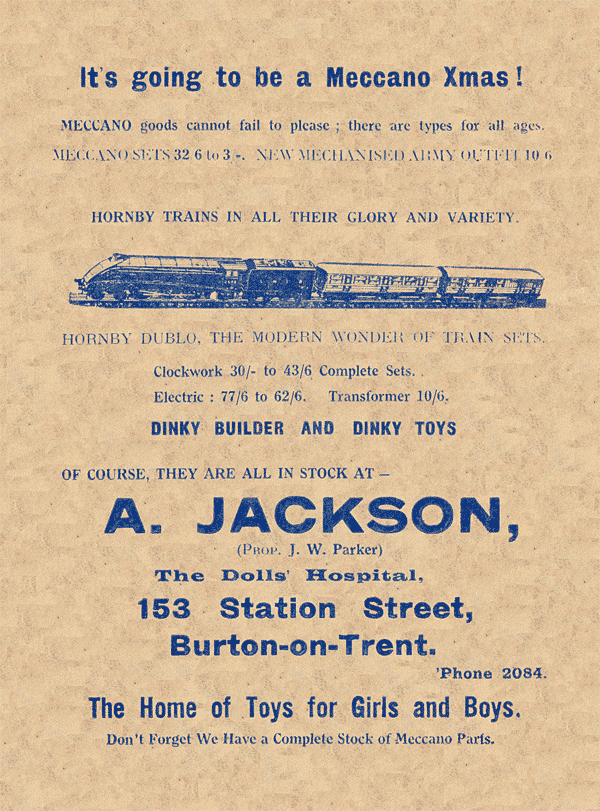
1939 – A. Jackson, Toy Shop

1940s Adverts

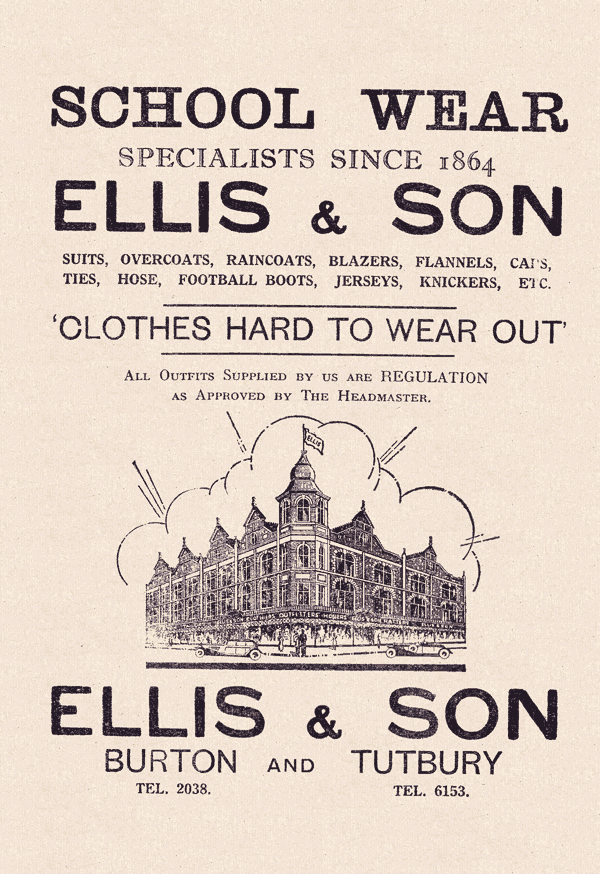
1945 – Ellis and Son, School Wear

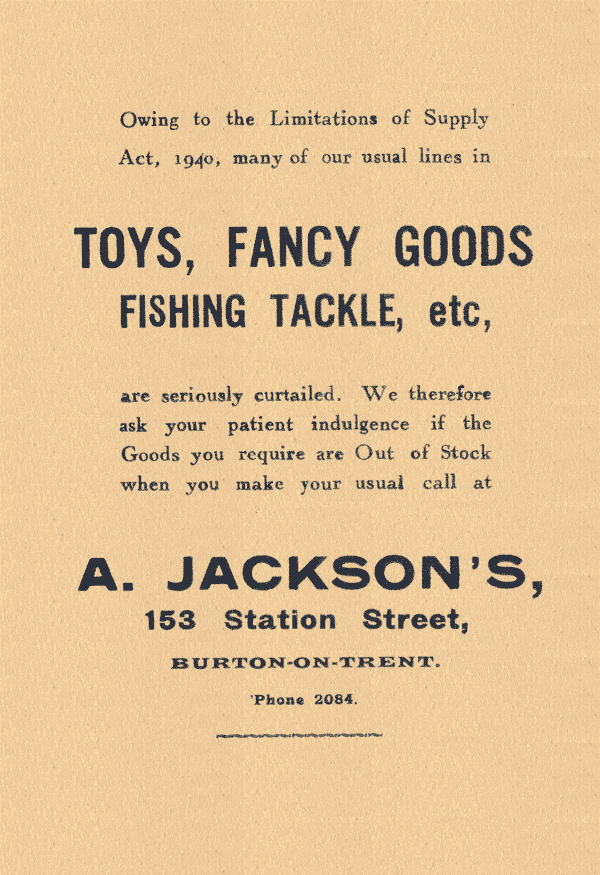
1945 – A. Jackson’s, Toys, Fancy Goods, Fishing Tackle

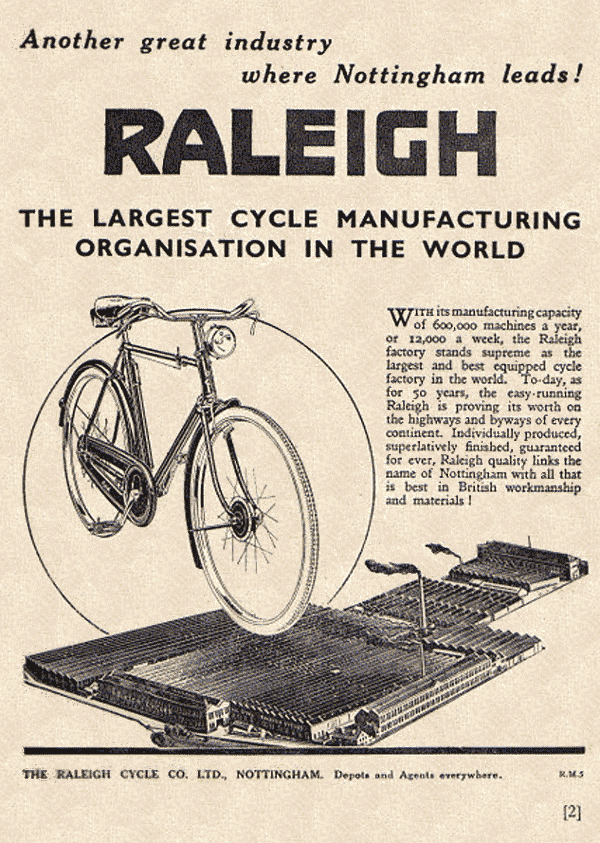
1945 – Raleigh Bicycles, Cycles

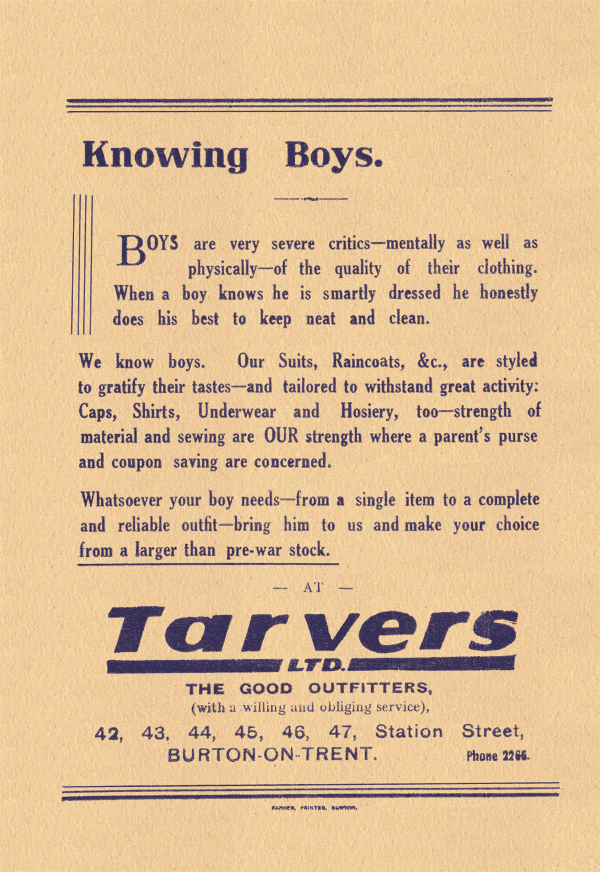
1945 – Tarvers Limited, Gents Outfitters

1950s Adverts

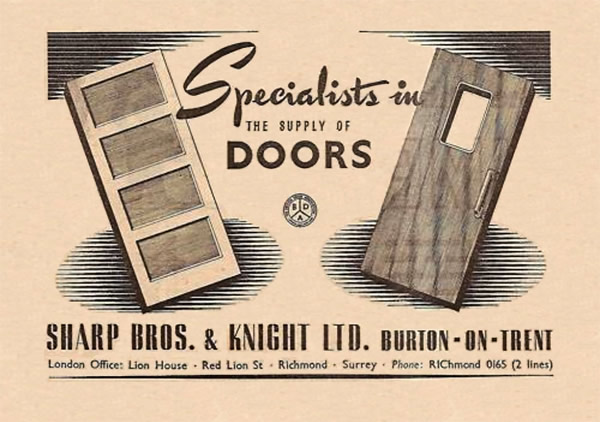
1950 – Sharp Bros. and Knight Ltd, Joinery

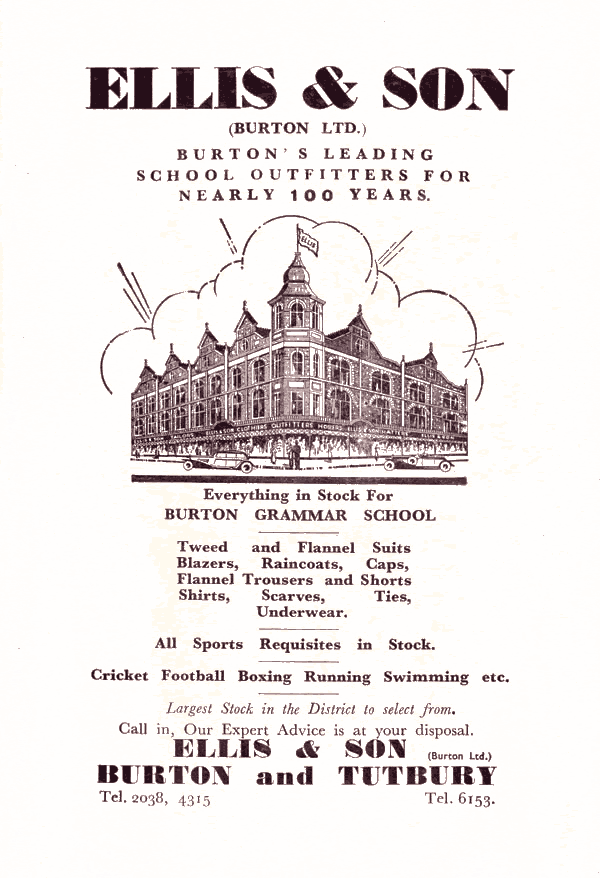
1954 – Ellis and Son, Gents Outfitters

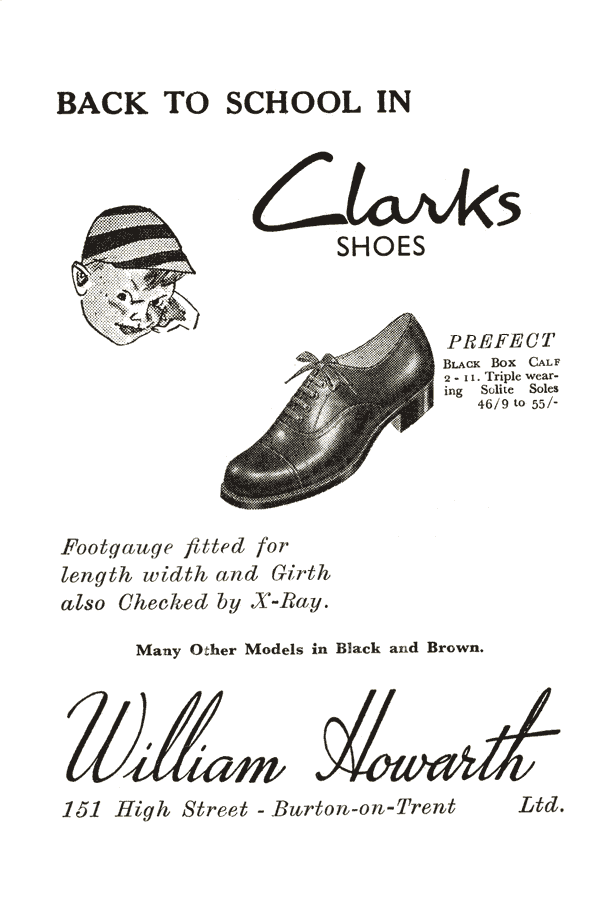
1954 – William Howarth, Shoes