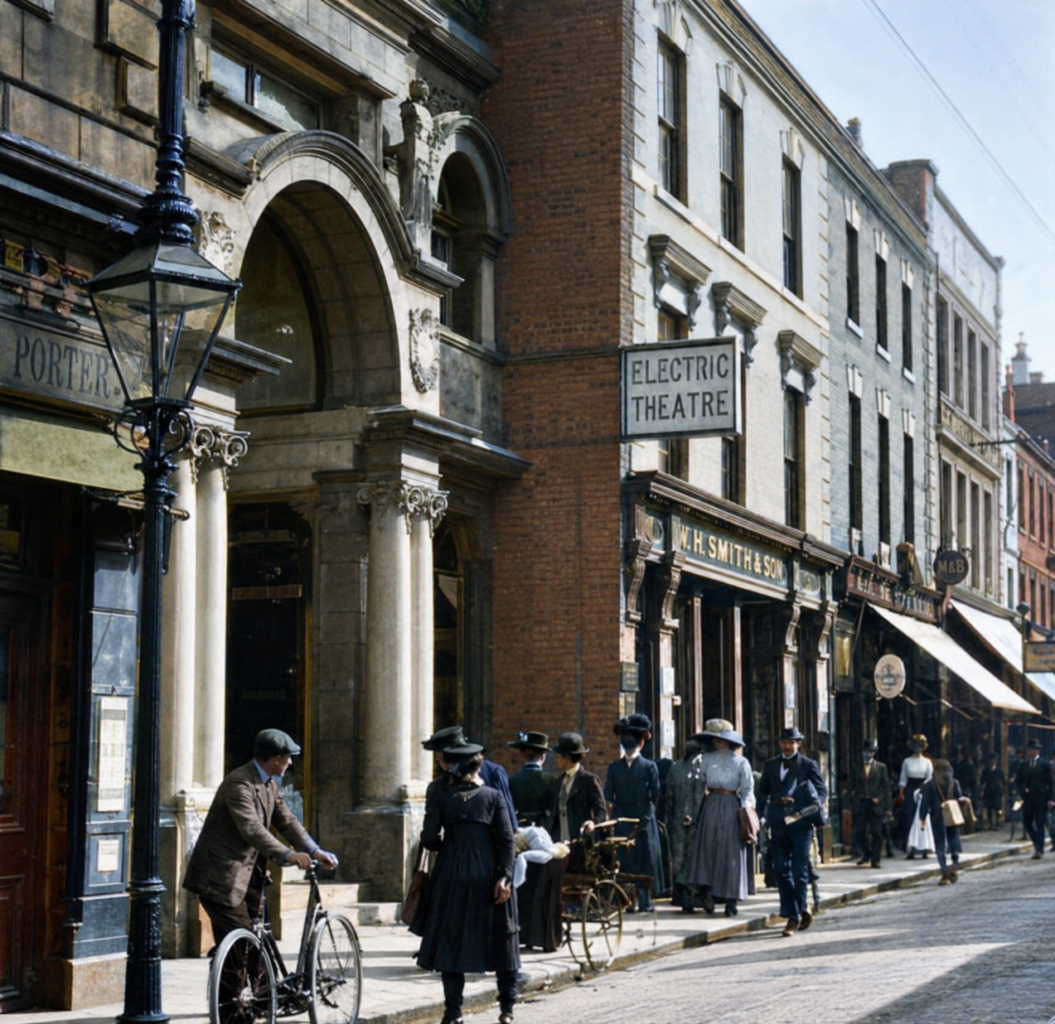
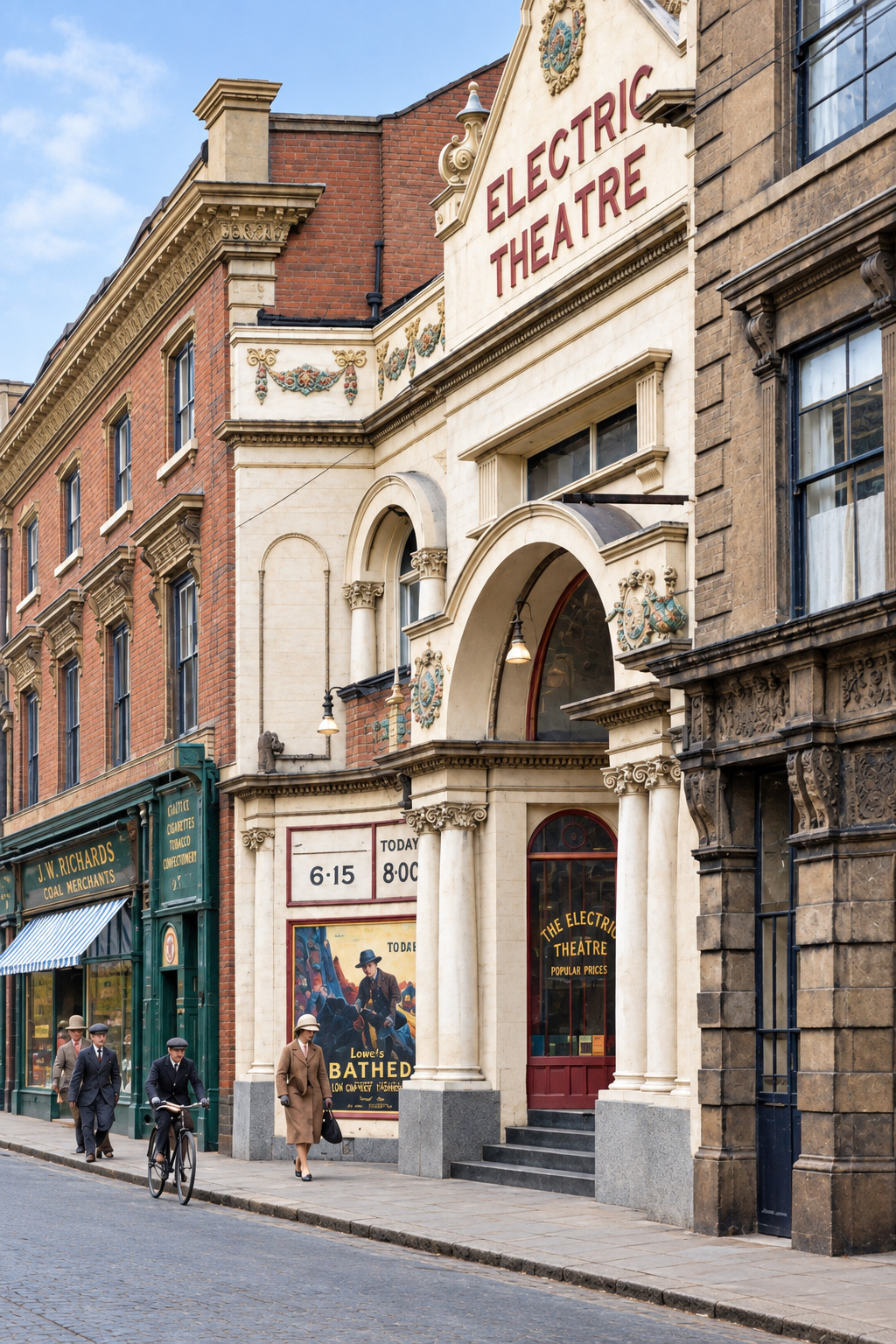
The Electric Theatre, generally known as simply ‘The Electric’, in High Street, was purpose-built on the site of the Empire Tea Store with its 750 velvet tip-up seats and tea lounge. It was opened on October 25, 1910, with the enticing ‘The Indiscretions of Betty’.
In 1928, it was taken over by Gaumont British Theatres chain and was closed for the auditorium to be reconstructed and reopened the same year with an increased seating capacity for 1,025. attached café was retained. The interior was remodelled in 1941 to make utilize unused space and increase the capacity to 1,050.
The first talkie (non-silent) picture, ‘King of the Khyber Rifles’, was shown to much excitement in 1929 which spelled the beginning of the end for the piano player.
The cinema closed for a few days, as did all cinemas, on the outbreak of the Second World War in 1939 but was soon reopened with a special showing of Sherlock Holmes starring Basil Rathbone.
It was acquired by Gaumont on November 28, 1949, and was closed on May 29, 1956.
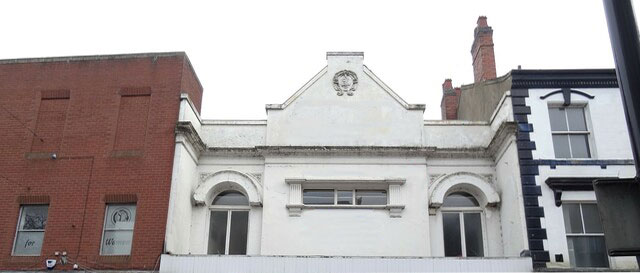
If you glance up at the upper half of the buildings in High Street opposite the banks, you can still see this unassuming piece of history that has seen so much change.
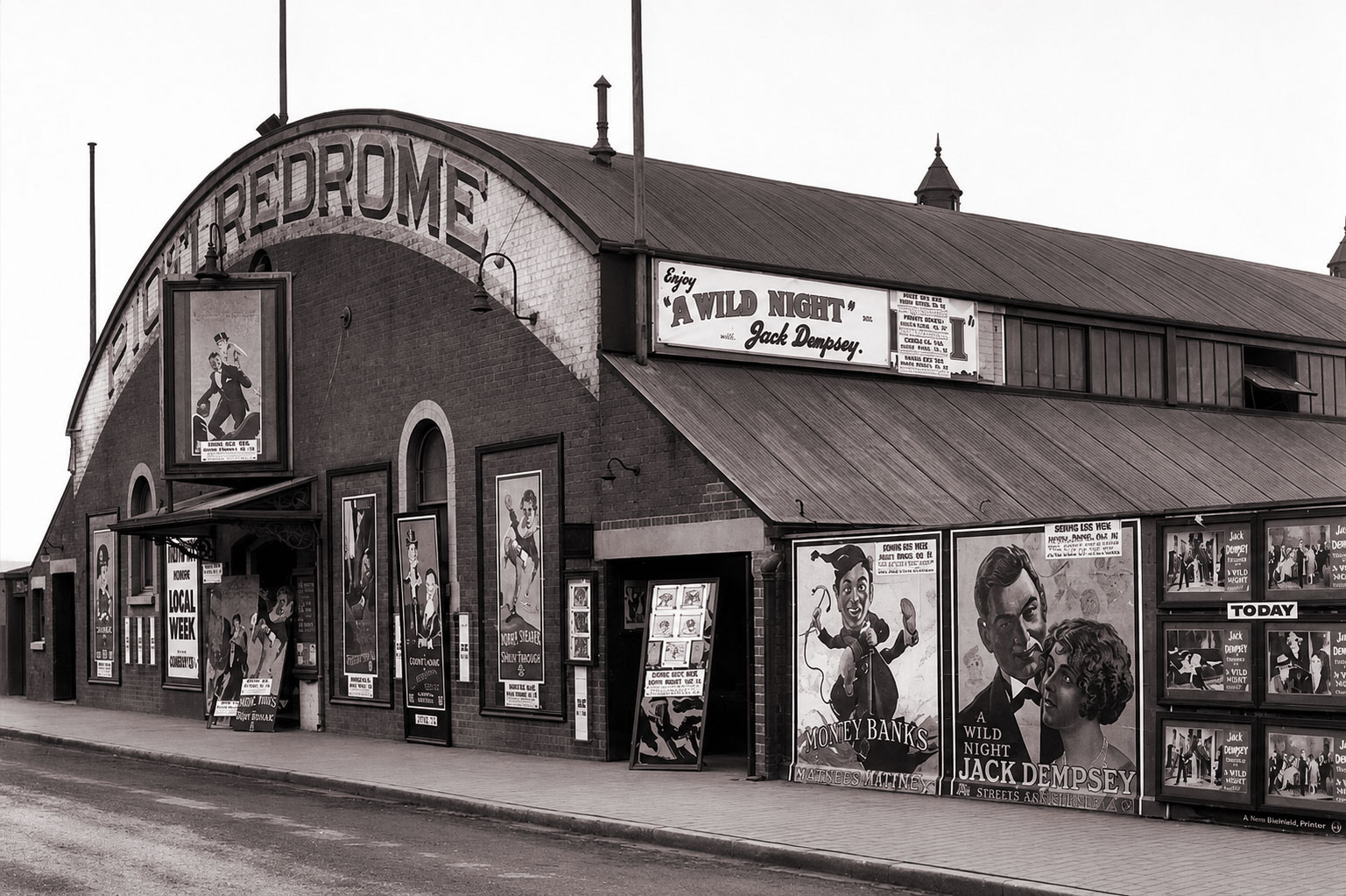
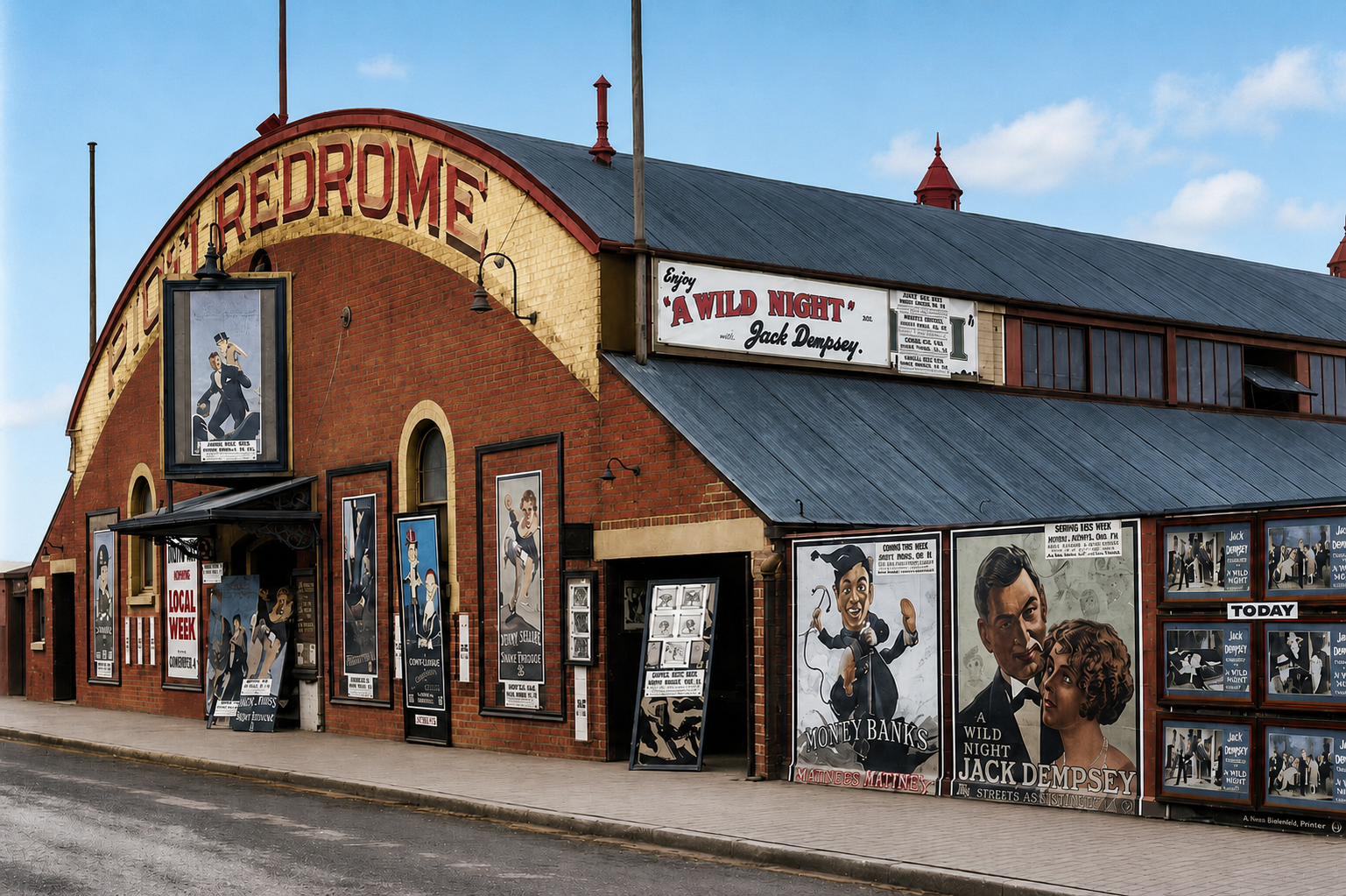
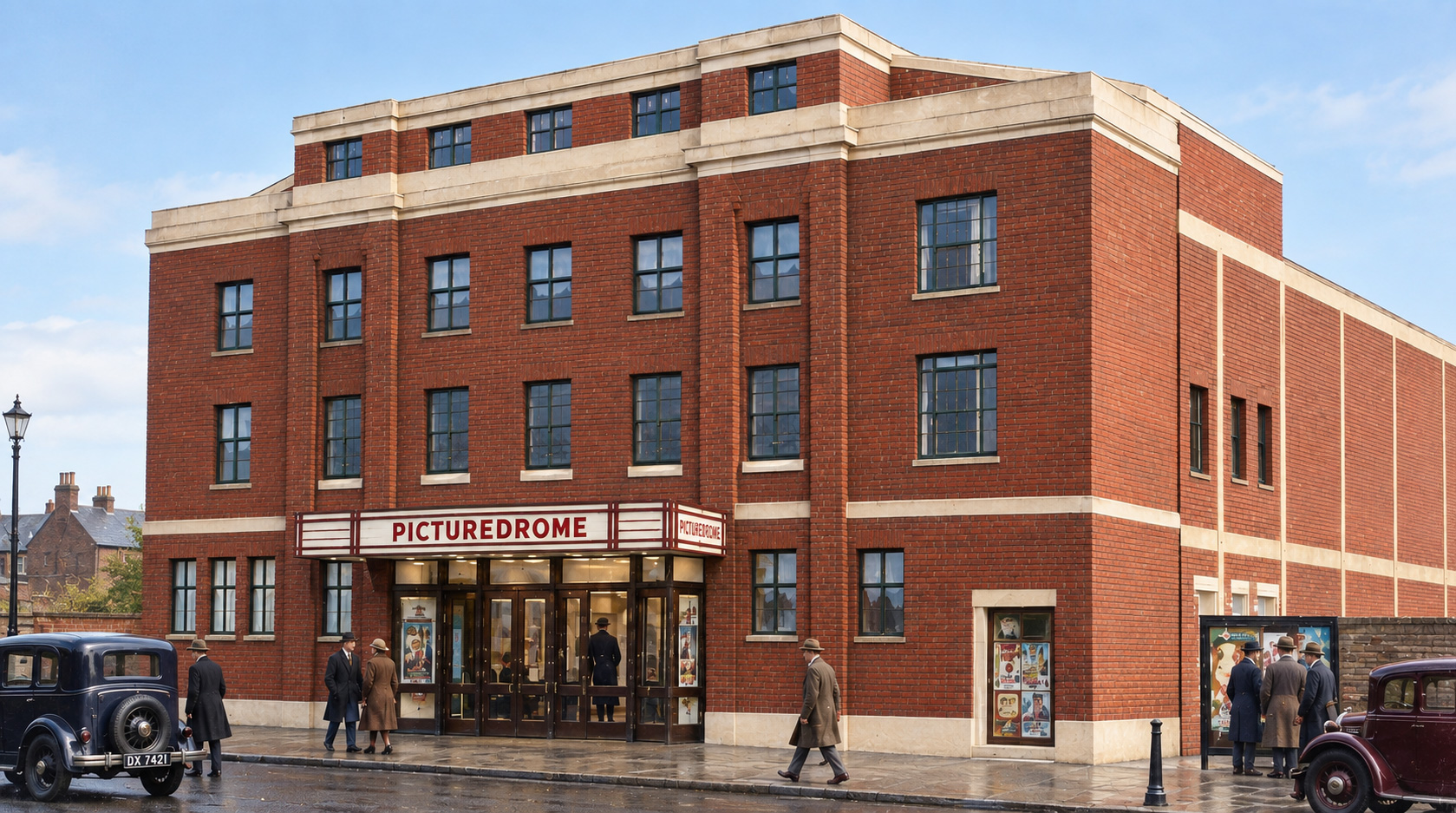
The Picturedrome opened in 1913. It was situated in Curzon Street, adjacent to the Railway Station. Like other cinemas to follow, the cinema was established by local fairground entrepreneurs George Orton, Charles Spooner, and Orton’s sons. It was adapted from what was previously a roller skating rink before being used by the Territorial Army. The building was acquired when it had fallen into disuse after the territorials moved to a superior home at the rear of the police station.
It housed a church organ brought and transported from a London church which was played enthusiastically during the film, which itself of course was silent. In the late 1920s, the Picturedrome had the distinction of showing Burton’s first ever talking picture which was hugely attended. The cinema was serviced by a poster man whose task it was to regularly paste up new posters as the films changed.
The original structure was demolished in August 1931, and a lavish, modern new building holding around 2,000 seats was constructed in just four months. It was designed by architect Alderman Thomas Jenkins and local builders. In 1955, it was acquired by Odeon Theatres Ltd in 1955 and was officially renamed the following year.
It closed as a cinema on June 5, 1965 and the building was transitioned into a Top Rank bingo club, later operating as Mecca Bingo until it closed in December 2003. The structure was subsequently demolished, and a block of flats now stands on the site.
The Ritz Cinema was built in 1935. It was, commissioned by Orton & Spooner, a company based in Burton which earlier in the century had made fairground rides and shows, and later owned the Burton Picturedrome Company. Also so[[prting and involved was Thomas Jenkins, a local architect who had designed the Electric Theatre, of 1910, and conveniently, Mayor of Burton at the time.
It was built on the site of the New Theatre and Opera House, of 1902, which showed films from 1930 which was demolished in 1934. This was a rebuilding of St George’s Hall, a concert hall of 1868. Interestingly, the front of this building was in George Street and the back in Guils Street: the reverse of the buildiding that replaced it.
The cinema is a steel-framed brick building in Modernist style; the façade on Guild Street has above the ground floor entrance a central section projecting forwards, which features five square Crittall Windows, and a row of smaller windows above.
The interior was designed in Art Deco style by Annie Orton, a relation of the owner and after buying a ticket, you entered the door to the left to the stalls and up the stairs through the door to the right for the balcony.
The first film shown at the Ritz Cinema was ‘Blossom Time’. A staple was the ‘Saturday Morning Club’ with a variety of films including the likes of ‘Old Mother Riley’.
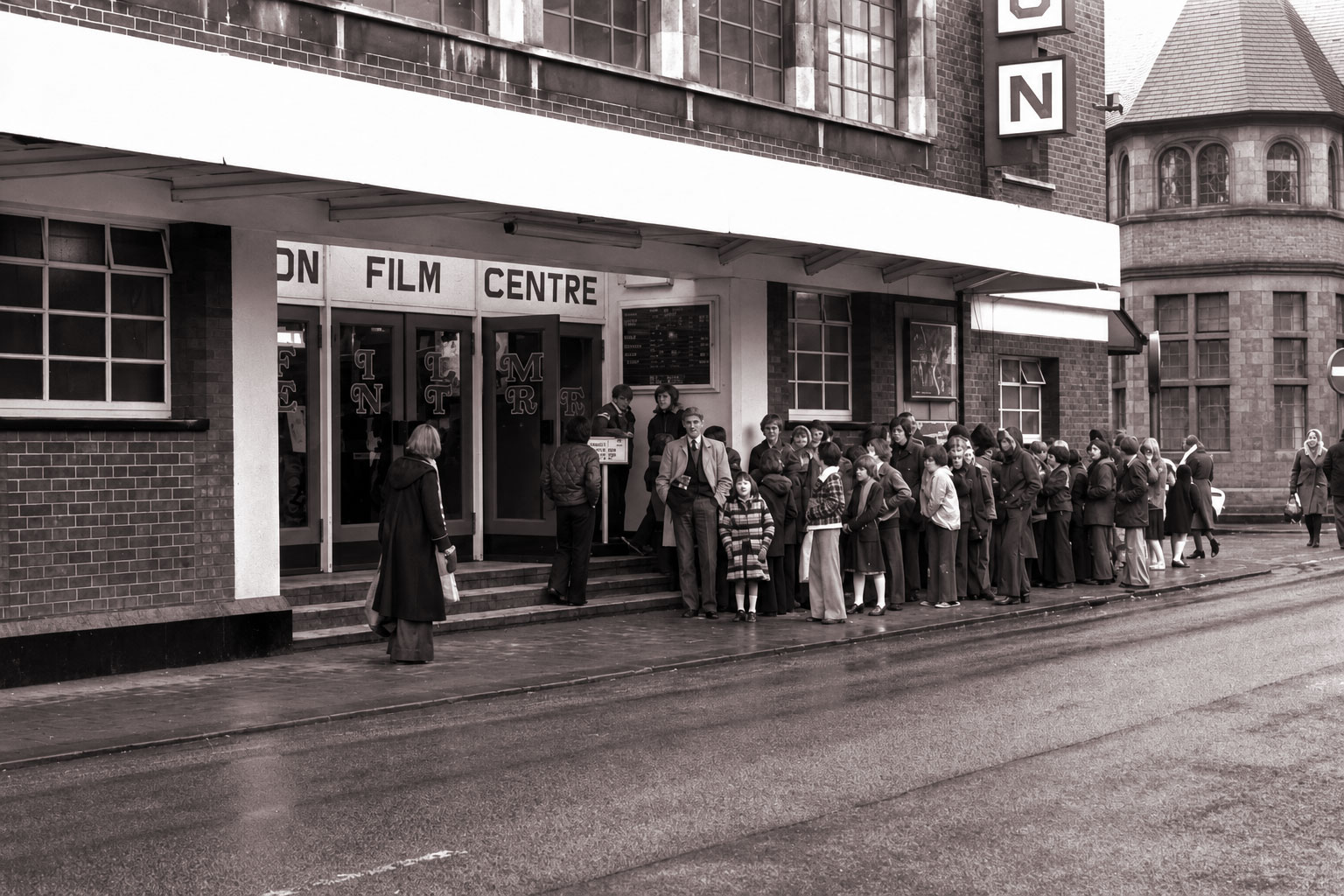
In 1957, it changed ownership and became known as ‘The Gaumont’. It changed again in 1957 to become a member of the ‘Odeon’. Finally, in 1966, it changed to become the ‘Robins Cinema’ although, as can be seen in the above 1870s photo, the Odeon signage remained. It was re-designed in 1974 to have three separate screens.
It was the most successfull and longest lasting cinema in the town, largely due to its central location, but closed as a cinema in 1999.
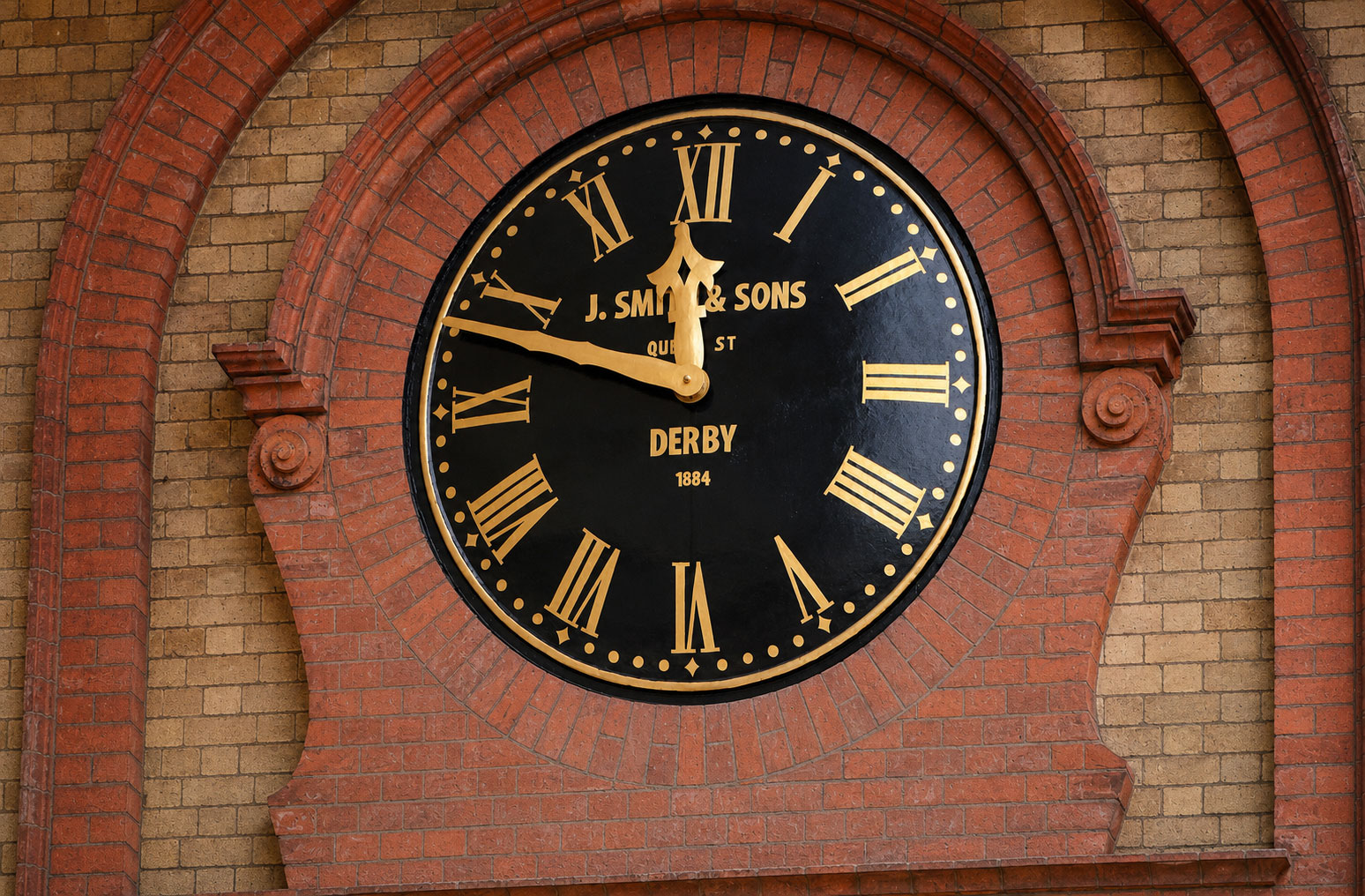
It is easy to overlook the clock in the Market Hall other than to check the time to see if it is correct. The clock was custom commissioned by Derby based J. Smith & Son in 1884, the clock tells its own story so far!
The clock company was though, one of the most renown in the country so was very prestigious at the time of install with no expense spared.
To name but a few of a long list. During the war, the company was commandeered to manufacture dashboard clocks and precision instruments for military vehicles and aircraft including spitfires. After the war, it returned to become a staple manufacturer of large clocks for major buildings, churches, railway stations, schools and colleges etc.
It is comforting that the company still exists and that the Market Hall clock still keeps perfect time but needs regular winding.
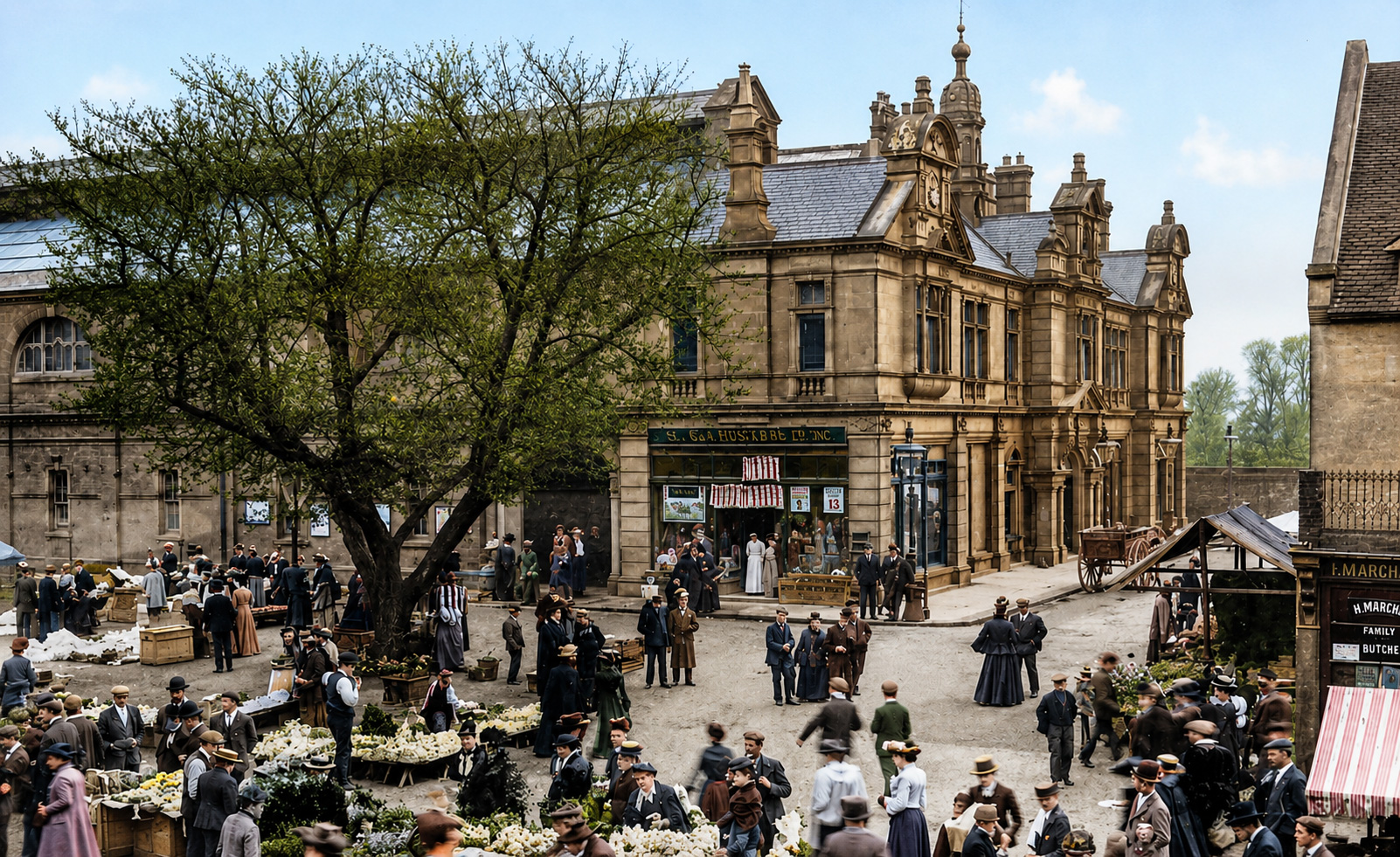
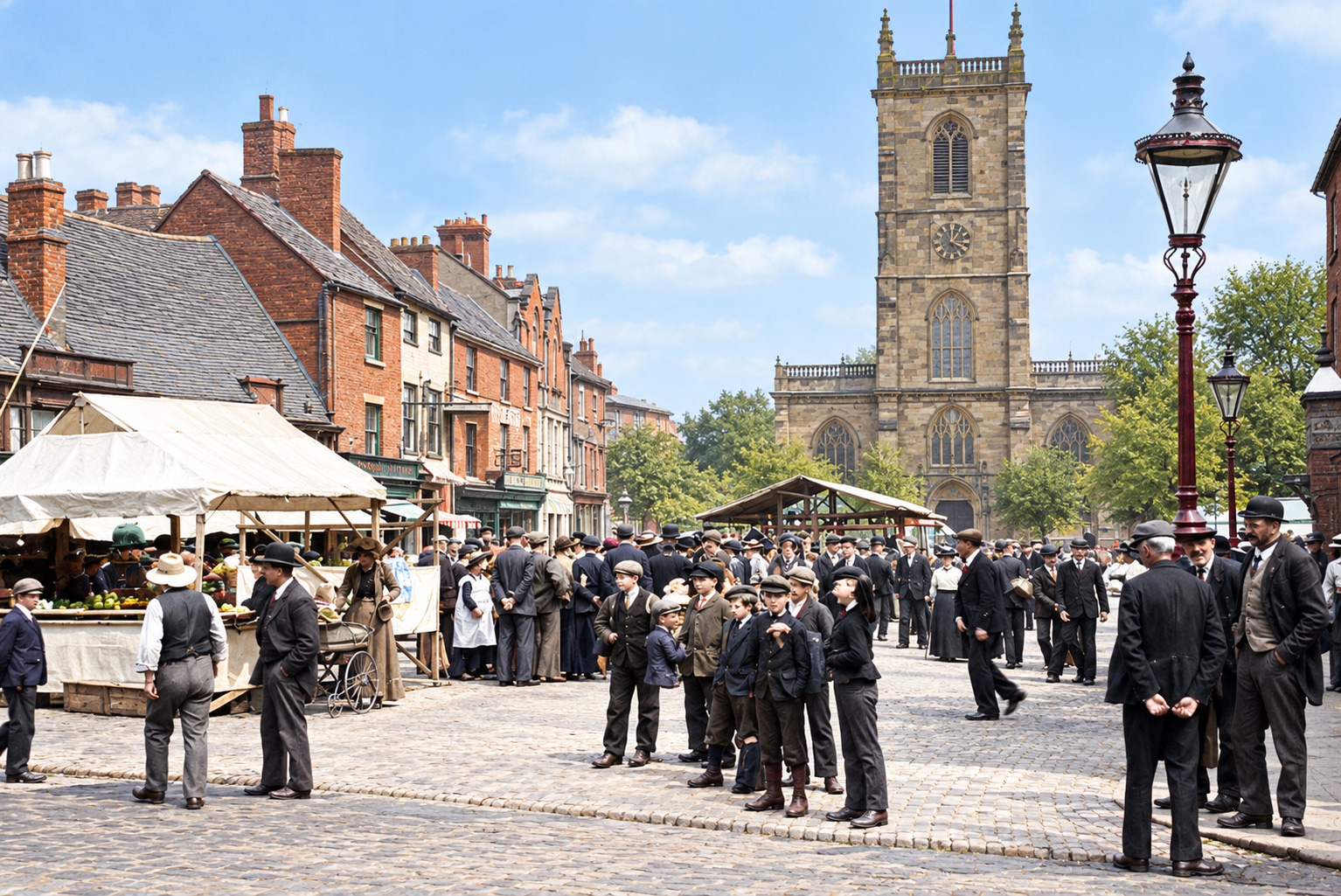
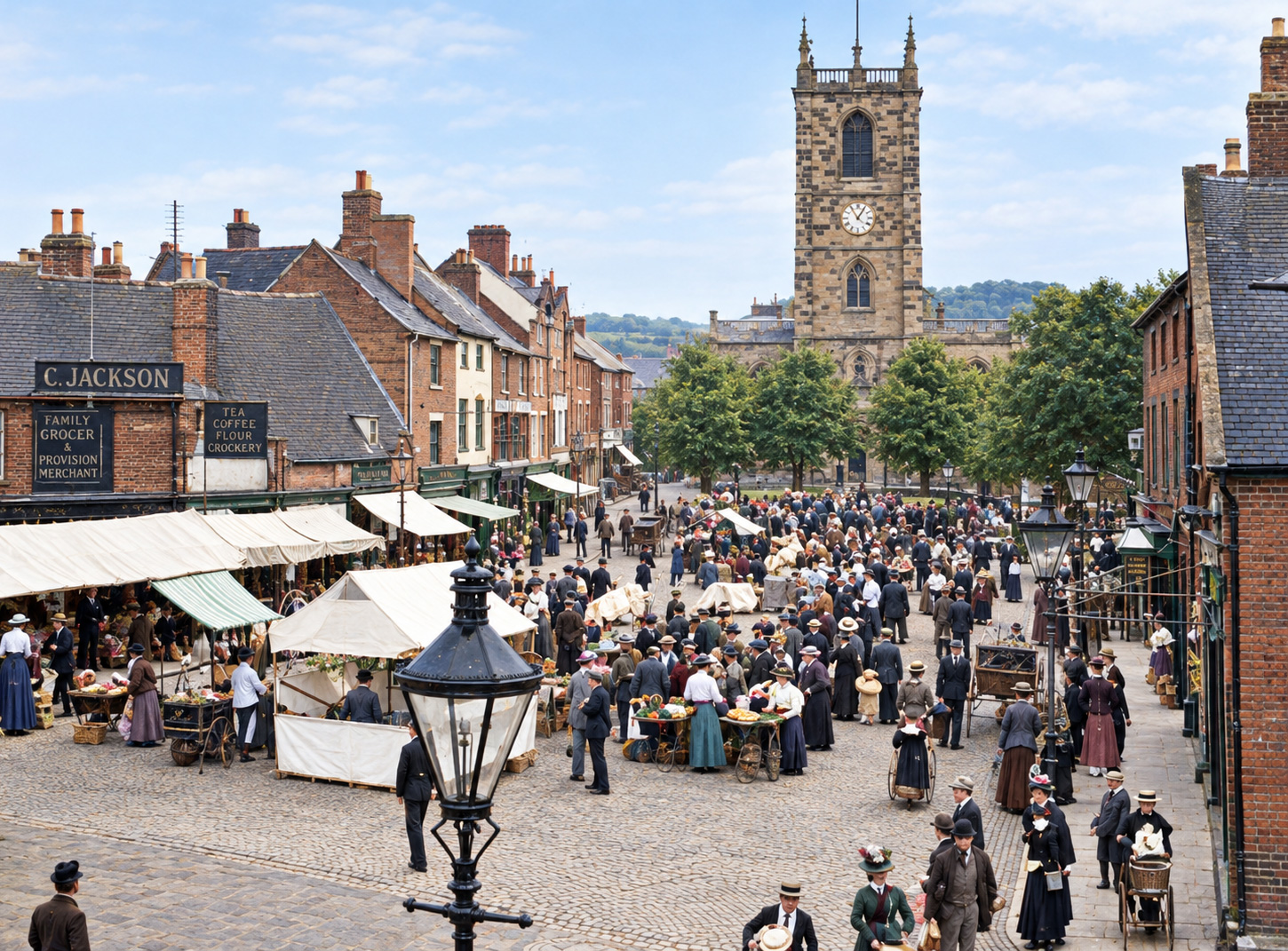
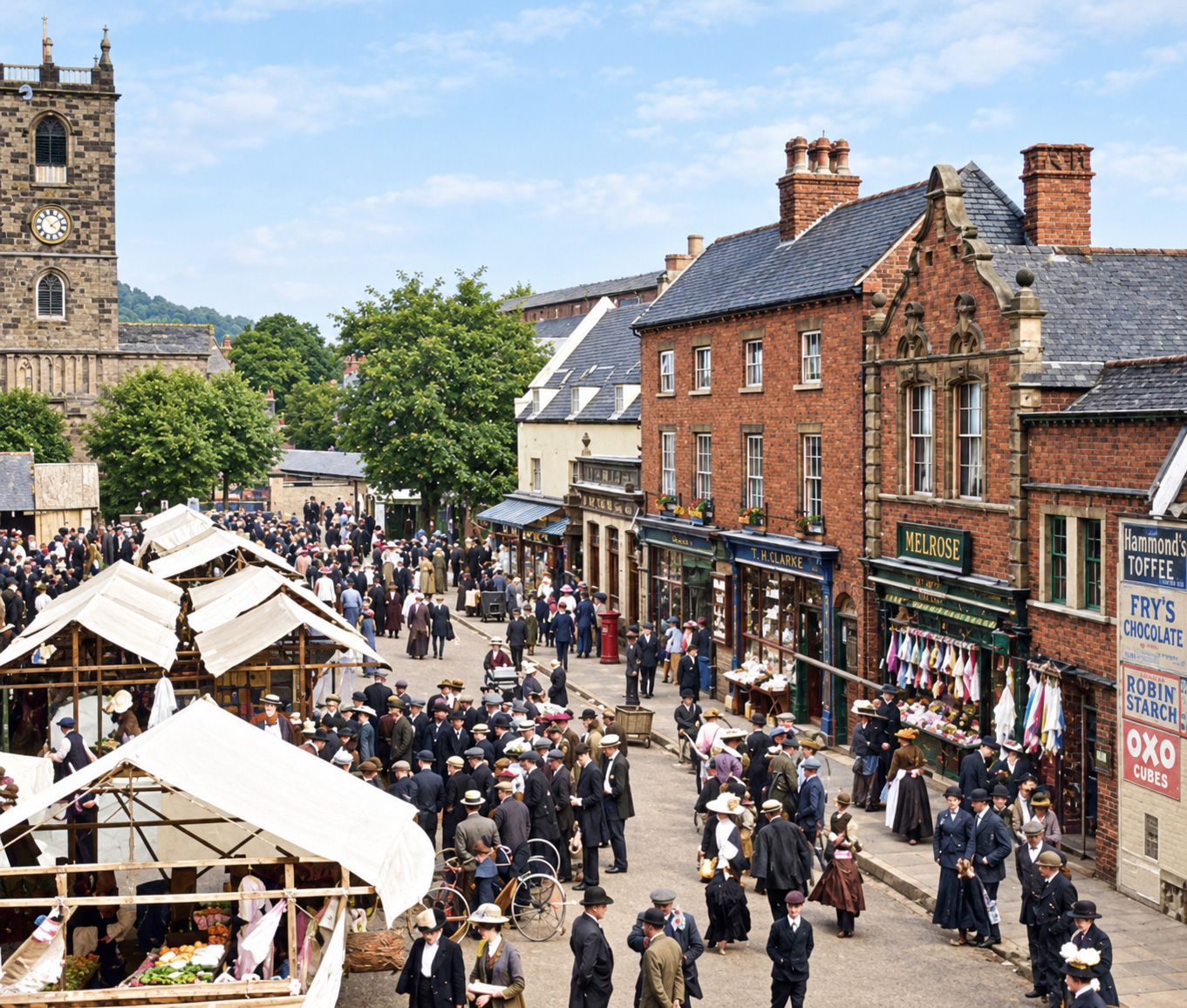
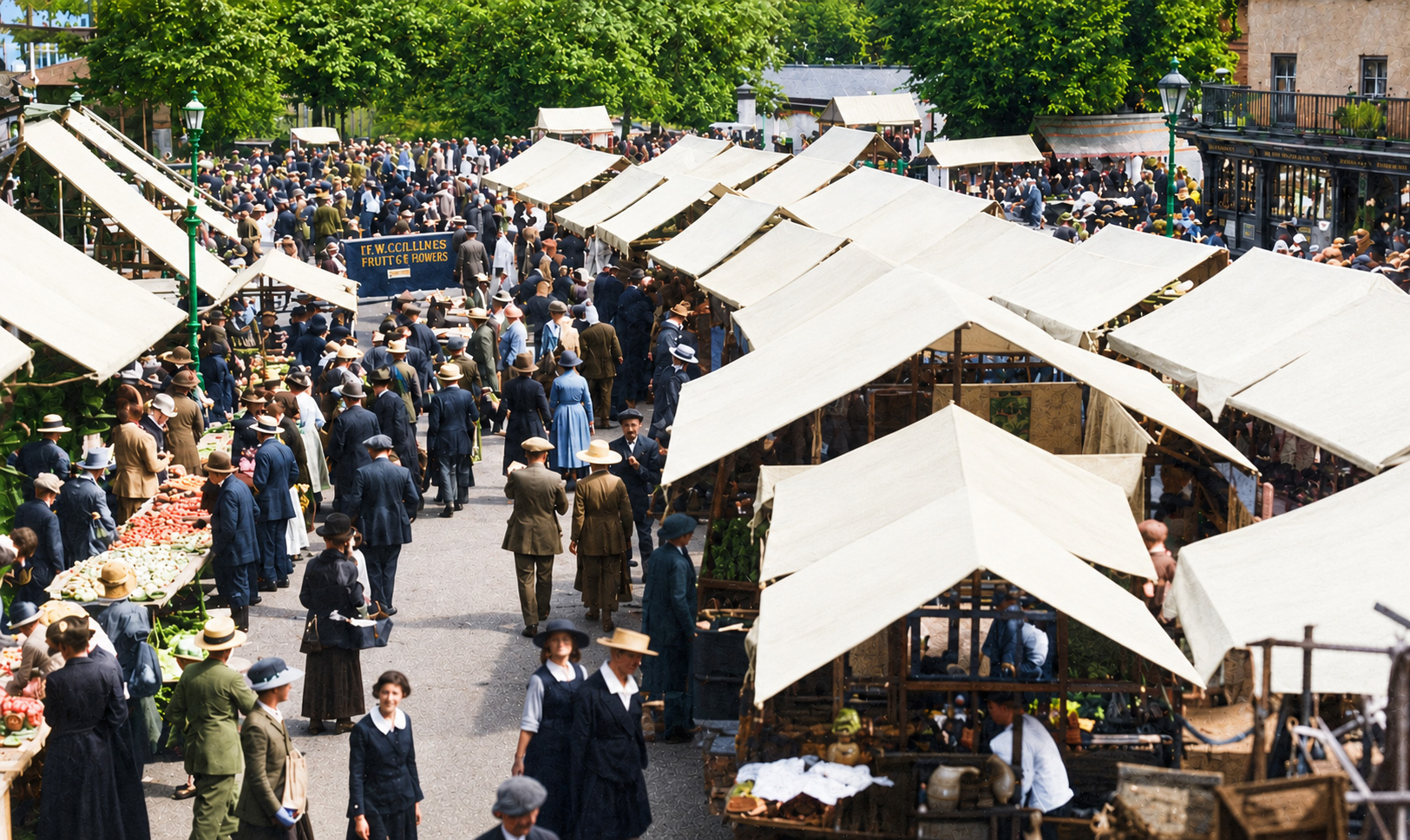
Some wonderful (if you will allow me to say so) restorations of early photographs of Burton Market from 1890 to 1920
The outdoor market adjacent to the recently completed Market Hall, the new pride of the town.
The Statutes fair held on the first Monday following Michaelmas, was originally a hiring fair to match employers looking for workers with those seeking employment.
Bustling market but not yet many formal stalls.
The market busier than ever now with formal lines of permanent stalls which traders were allowed to rent.
The market in its heyday in the 1920s after the recovery from World War I
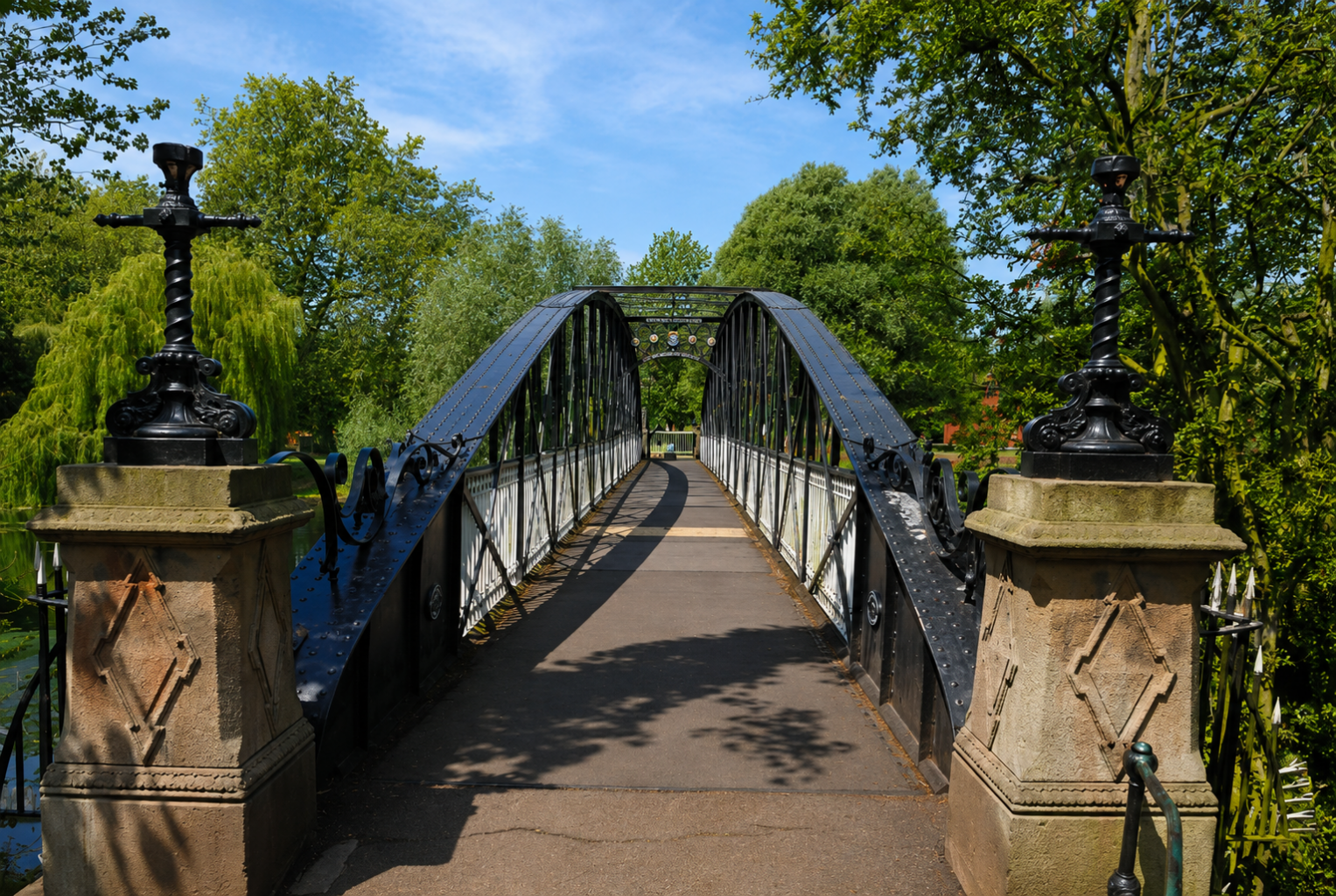
The Andresey Bridge was built in 1884 by Thornewill & Warham Engineering Limited, the same company that was to build the Ferry Bridge five years later.
It was built as a single-span wrought-iron bridge to replace a primitive wooden footbridge that connected what was to become the Garden of Remembrance, adjacent to St Modwens Church, and Andressey Island, which it definitely was at the time being completely surrounded by branches of the river Trent.
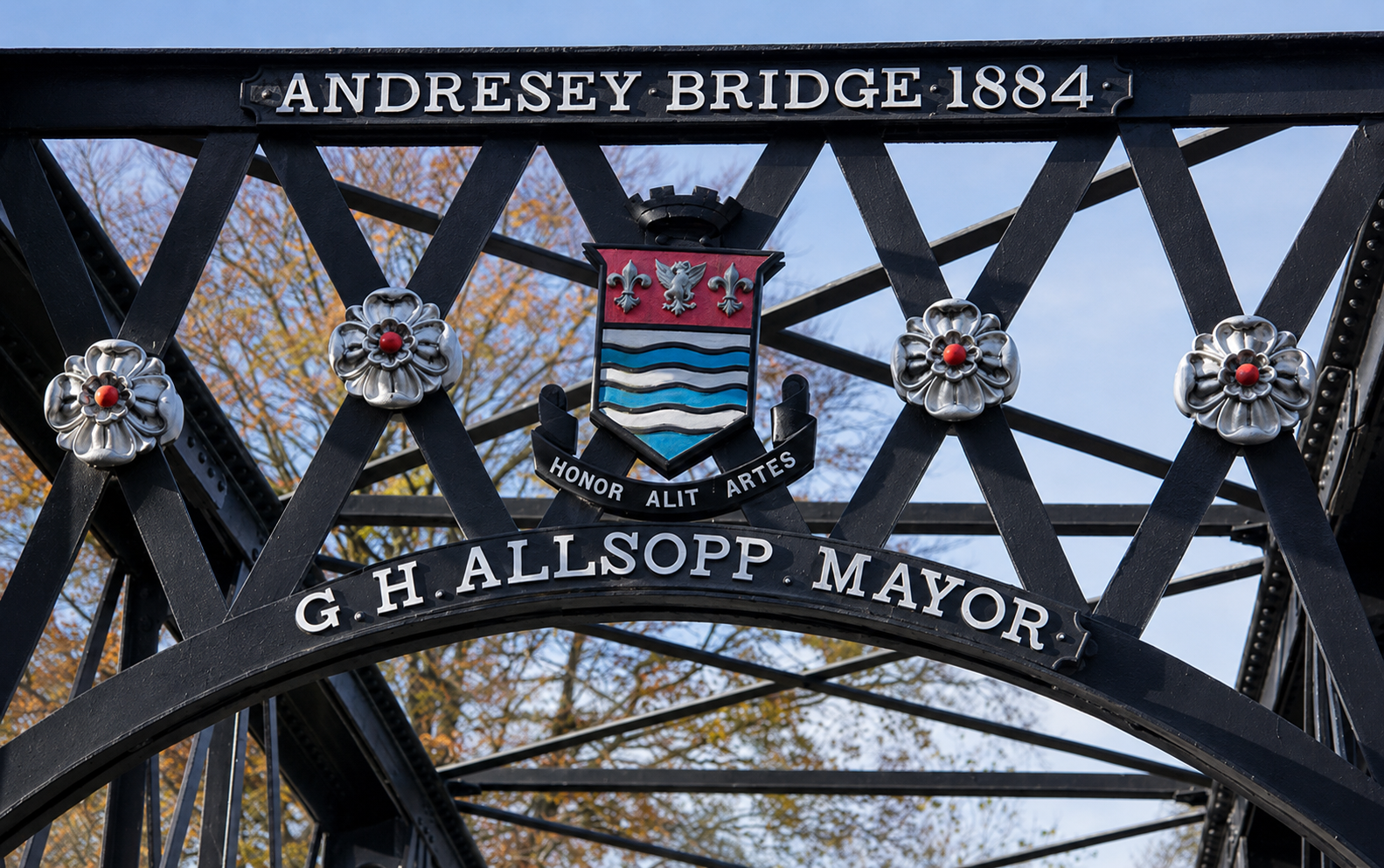
The sign on the bridge confirms the ‘single S’ spelling of the bridge which is often disputed because The origin comes from ‘Andressey ‘ means ‘Andrew’s Isle’ and the island is where Saint Modwen built a church dedicated to St. Andrew in the 7th century. All other instances in the town such as ‘Andressey Passage’ are spelled with a ‘double S’. Personally, I would be happy to accept that the bridge sign is a spelling mistake!
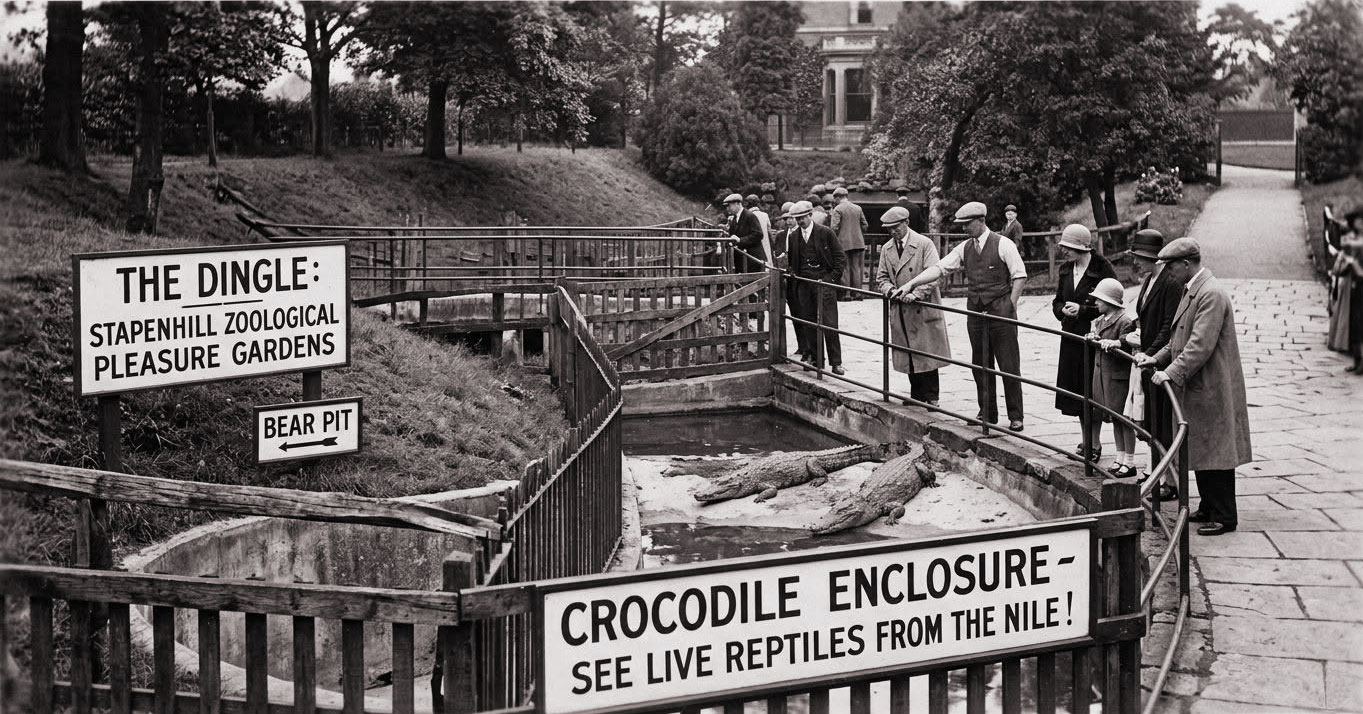
In the 1920s and early 1930s, Stapenhill House opened the ‘Stapenhill Zoological Pleasure Garden’ within its grounds, a section that is now a small car park and children’s playground off the Dingle that runs down from Ferry Street to the Ferry Bridge.
It had a traditional Bear Pit; when the bear eventually died, it went to a taxidermist and can still be seen in Derby museum. The greatest attraction was three crocodiles, two large ones and a smaller one. The picture shows that Health and Safety regulations were slightly more relaxed than they are today!
The zoo also hosted a monkey enclosure and a number of aviaries.
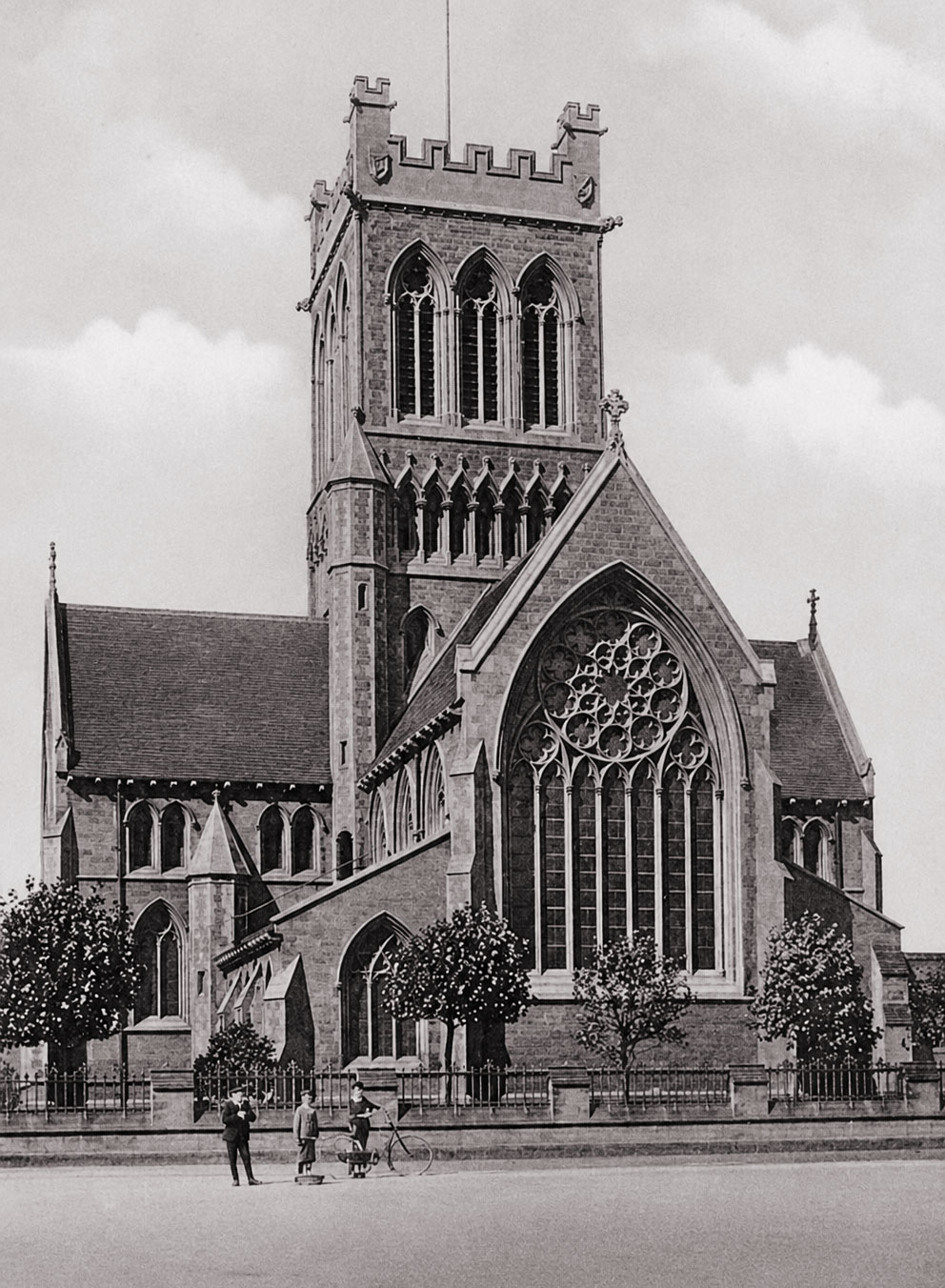
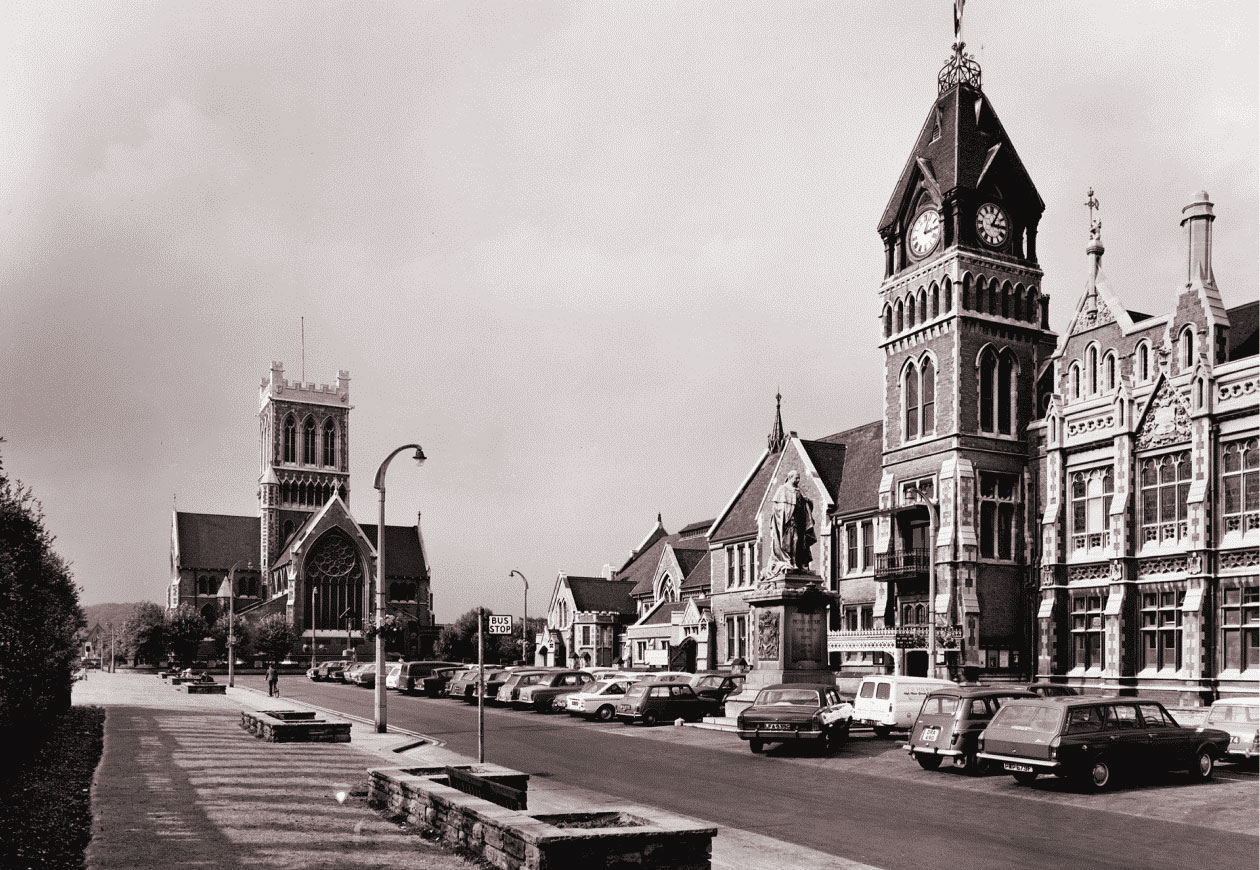
Saint Paul’s Church was opened in 1874 next to the Town Hall and the rectangular space that had the two buildings on two of its sides was named St Paul’s Square.
Michael Thomas Bass paid for the complete erection of the church and vicarage at a cost of £50,000 (equivalent to £7,300,000 in 2026). The church was consecrated on 7th April 1874 by the Bishop of Lichfield, George Augustus Selwyn. It is reputed that Michael Bass had in mind that the church might become Burton Cathedral because at the time, due to the enormous growth and success of the town, it was seeking to gain city status; it was after all, much larger than the nearby City of Lichfield.
The church was designed by the architects James M. Teale of Doncaster with assistance from Sir Edmund Beckett Denison (later Edmund Beckett, 1st Baron Grimthorpe). It uses Coxbench and Ancaster stone. The overall shape forms a cross to depict a cruciform with a square central tower which rises to 123 feet. The tower housed eight bells. The bells were recast in 1912 and two further bells were added in 1922.
The column capitals and label stops throughout the church were designed by a S. Tinkler of Derby and show naturalistic foliage, fruit, and animals with those in the nave representing the twelve months of the year. All the windows have early decorated style tracery, with ballflower ornamentation in the chancel. The nave and transept clerestories have triple lancets, while the clerestories in the chancel have carved spherical triangles. The nave roof has traceried spandrels and principals supported on clustered wall shafts. There are six windows (one in the south aisle and five in the narthex) designed in an Arts and Crafts style by Archibald John Davies of the Bromsgrove Guild of Applied Arts. They date from 1919 to 1934.
Between 1889 and 1901 the eastern arm and south transept were considerably altered to the design of George Frederick Bodley, at the expense of Michael Bass, 1st Baron Burton. In 1889, the south chancel aisle was converted into a chapel for daily services and two years later an external sacristy was added on the north side of the chancel with an internal porch added to the south transept door.
The chancel and sanctuary roof were painted and a canopy was added to the original large circular stone pulpit. The organ cases, one in the chancel and one high in the south transept are both by Bodley. The chancel floor was also relaid with red and white marble. The reredos was replaced by one designed by ecclesiastical and architectural sculptor Robert Bridgeman that depicted the Crucifixion in a central panel of red shawk stone surrounded by the saints.
A number of other changes were made in the 20th century, paid for primarily by parishioners. A western narthex was added in 1910 as a memorial to Baron Burton, who had died the previous year. A calvary war memorial was erected in the churchyard in 1920 and a bishop’s chair of stone was built into the sanctuary wall in 1931. The two west bays of the nave and the narthex were converted into a church hall in 1979 and at the same time several items were added from the former chapel of ease of St Margaret, including a wooden lectern by Morris and Co., a painting of the Crucifixion by Charles Edgar Buckeridge which was placed by the south door, statues of Alpha and Omega which were added to the south chancel aisle chapel. Also added, a banner of the Queen of Heaven and statues of St Margaret of Antioch and St Michael slaying a Dragon.
In 1950 the church became a Grade II listed building.
THE GRESLEYS OF NETHERSEALE The Manor of Seale was purchased from Sir George Gresley by Gilbert Morewood, a London merchant and friend of Sir John Moore, who built a school at Appleby in Leicestershire. Seale derives its name from ‘Scegel’ which meant ‘a small wood’. This wood divided the manor into two parts – upper and lower, now known as Overseal and Netherseal.
This manor was soon restored to the family by the marriage of Gilbert Morewood’s daughter to Sir Thomas Gresley, the second baronet, and in due course it was settled upon the second son of the marriage. By this means a branch of the Gresley family became established at Netherseale and when the main line of the family died out in 1837 with the death of the 8th baronet, a descendant of this branch succeeded to the title and the family estates.
Frances Morewood, Lady Gresley, appears to have been a forceful character. In a letter to Sir John Moore concerning Mr. Waite, a schoolmaster who lived within a mile of Drakelow and had been recommended for the head mastership of Appleby School, she remarked that Sir John was right not to appoint any one to that position for life but only while of good behaviour, adding that Repton School had been ruined by the opposite principle. In their old age Frances and her husband acquired the reputation of being miserly and a tradition arose that large sums of gold and silver were hidden in Drakelowe Hall – but none was discovered when the mansion was demolished in 1926.
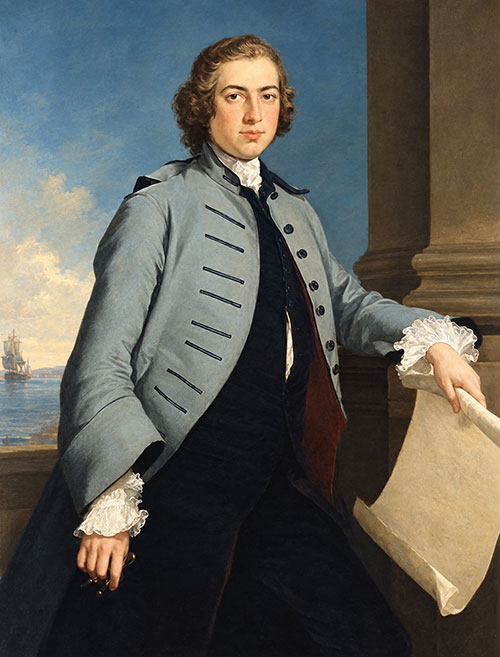
SIR NIGEL GRESLEY, 6th BARONET Sir Nigel Gresley, 6th Baronet (1726-1787) was born at Drakelowe Hall.
In 1753, Nigel Gresley succeeded his elder brother Sir Thomas Gresley, 5th Baronet who died of smallpox without issue. As well as Drakelowe, Gresley inherited from his mother’s family their home of Knypersley Hall at Biddulph, Staffordshire. Drakelowe Hall was still inhabited by Dame Wilmot Gresley, and so Nigel lived at Knypersley. As part of these he owned several coal and iron ore mines. James Brindley built a water engine for draining the mines there in 1752.
He enrolled in the Royal Naval Academy and, by the end of 1746, Gresley was serving in the 24-gun frigate HMS Bridgewater, a prison ship stationed in the Firth of Forth, as a volunteer. Bridgewater transported the Jacobite rising rebel Flora MacDonald to London, leaving on 7 November and arriving in the River Thames on 29 November. Gresley, who was suggested to be a quiet supporter of the Jacobites, was gifted a Richard Wilson portrait of her in thanks for the kindness shown to her in captivity. He was then promoted to lieutenant on 22 April 1748 and was appointed to serve on the 22-gun frigate HMS Inverness, which he did until she was paid off on 14 November of the same year, having served only in home waters. He did not serve again in the Royal Navy due to increasing rheumatic issues, and declined a posting to the 24-gun frigate HMS Mercury in March of 1749 or 1750.
Retired from the Navy, he became High Sheriff of Staffordshire in 1759, serving out his year-long term of office.
In 1765 he and his family moved from Knypersley to Worcester both to allow his children better access to education and to help Gresley lessen the weight of some debts, accrued from unsuccessful business ventures. He subsequently sold Knypersley via the Gresley’s Estate Act 1767 in a further effort to pay off his debts.
Sir Nigel Gresley’s Canal Act 1775 was passed allowing Gresley and his son to build a private canal from Apedale to Newcastle-under-Lyme so that he could more easily transport the mine’s products of coal and iron ore. The canal opened in 1776 and was named Sir Nigel Gresley’s Canal; the act provided Gresley with a monopoly over coal in Newcastle, with all coal apart from that used for pottery coming from his mines and canal for a period of forty-two years. Mostly built on land already owned by Gresley, the project resulted in the price of coal being set at the same rate until the expiration of the act, greatly to the benefit of the local public.
After moving to Bath for health reasons, Gresley died there in 1787 from what was then known as dropsy; he was buried in Bath Abbey where he is remembered by a plaque within the Abbey.
SIR ROGER GRESLEY, 8th BARONET Sir Roger Gresley, 8th Baronet, succeeded to the title when eight years old. He grew up to be a man of many parts, a politician, a dandy, an author, a virtuoso, a sportsman, a country gentleman, and an antiquary. He became High Sheriff of Derbyshire and a Captain in the Staffordshire Yeomanry. Sir Roger fought several Parliamentary elections and incurred considerable debts thereby. In 1828 he sold the site of the Priory at Gresley, as well as the Castle Knob and Gresley Hall. In 1836 he sustained severe injuries by a fall from his horse and died from the effects a year later.
Sir Roger, against his mother’s wishes, married Sophia, youngest daughter of the Earl of Coventry, and their only child leved only a few weeks. So, on Roger’s death, the title and family estates passed to his cousin, the Rev. William Nigel Gresley, Reactor of Seale, with the exception of a life interest in Drakelow which passed to Roger’s widow.
Lady Sophia married as her second husband Sir Hentry des Voeux Bt., who lived with her at Drakelow Hall, and as she did not die until 1875, the ninth and tenth baronets never resided there.
Concerning Sir Henry des Voeux while living at Drakelow, there are two good stories told. When Swadlincote market hall was built by public subscription in 1861, the money was insufficient to install a clock and the Vicar, the Rev. J.R. Stevens, undertook to ask Sir Henry for a donation. Unfortunately, Sir Henry, suffering from gout, had just received news of the loss of a lawsuit, so the Vicar’s request met with a curt refusal. On second thoughts however, Sir Henry added: “You can have your clock if these words are placed beneath it, ‘TIME THE AVENGER’. I’ll beat these lawyers yet”.
The other story was related to me by the late Charles Hanson, a noted local sportsman (1836-1931). Sir Henry gave him permission to shoot wildfowl on the Trent at Drakelow provided certain ducks were left alone. But when one of these birds suddenly rose before him he brought it down with a quick shot. Unluckily Sir Hentry saw this happen and summoned him to the Hall. On arrival the butler warned him Sir Henry was very angry. As he entered the room he was greeted by the words “What the devil do you mean by shooting that duck, you will not shoot here again”. After this wigging he was dismissed and met the butler on his way out. “What did the old man say?” he queried. “Oh it’s all right”, was the reply “he told me to ask you for a drink!”
Some time late Sir Henry said to the butler “Has that young devil gone?” “Yes, Sir Henry”, was the reply, “and I gave him a drink as instructed”. This amused Sir Henry so much that he sat down and penned a letter restoring permission to shoot on the estate again.
The Rev. Sir William Nigel Gresley, who succeeded his cousin Roger as ninth baronet, had followed his father as Rector of Netherseal in 1830 and spent the remainder of his life there. To pay Sir Roger’s debts the manor of Lullington was sold to C.R. Colville for £98,000.
Devoted to hunting, Sir William was forced to give this up owing to ill health and on his death in 1847 he was succeeded by his son Thomas as tenth baronet, who was at that time a Captain in the 1st Dragoon Guards and an aide-de-camp to the Lord Lieutenant of Ireland.
More of the Gresley inheritance was sold by him, including Coton Park and land at Church Gresley and Linton. He was elected to represent South Derbyshire in Parliament in November, 1868, but died a month later. As Drakelow was still occupied by Lady Sophia, he resided at Caldwell Hall, lent to him by Sir Henry des Voeux Sir Thomas was succeeded as eleventh baronet by his son, Robert, who was then only two years old.
On the death of Lady Sophia des Voeux in 1885 the Drakelow estate came into the possession the new baronet. As he was still a minor, Drake-low Hall was let for a time to John Gretton, the brewer, who came there with his family from Bladen House, near Burton-on-Trent. The family included John Gretton junior (afterwards the 1st Baron Gretton of Stapleford Park) and his brothers Frederick and Rupert and his sister Katherin.
On attaining his majority Sir Robert Gresley took up residence at Drakelow and in 1893 he married the eldest daughter of the eight Duke of Marlborough. A Deputy Lieutenant for Derbyshire and later High Sheriff, he took an active part in county affairs.
Sir Robert made many improvements in the mansion and gardens at Drakelow and was. responsible for the construction of the terraced river frontage of the hall. He was one of the best shots in England and reared game on a large scale, but increasing taxation and dwindling resources finally compelled him to sell the estate of his ancestors of which he was so proud.
He died in 1936 and was succeeded by his eldest son Nigel (born 1894) as the twelfth baronet. The heir to the baronetcy is Sir Nigel’s brother Laurence(born 1896).
A notable member of the family was the Rev. John Morewood Gresley, the son of the Rev. William Gresley and half brother of the ninth baronet. Educated at Appleby Grammar School and Harrow, he graduated M.A. at Oxford and took Holy Orders, becoming Reactor of Seale and subsequently Master of Etwall Hospital. A Fellow of the Society of Antiquaries and an archeologist of some renown, he married a great granddaughter of Dr. William Stukeley, the celebrated antiquary.
The Rev. J.M. Gresley was a founder of the Leicester Archaeological Society and of the Anastatic Drawing Society. In 1861 he carried out an extensive and systematic excavation of the foundations of Gresley Priory. He also compiled “Stemmata Gresleyana” and gathered together a large number of family papers which were extensively used in the compilation of ‘The Gresleys of Drakelowe’ by F.C. Madan in 1899.
During the course of a Parliamentary election at Ashby de la Zouch in 1865 he imprudently drove into the town with his horses and carriage decorated with blue ribbons. These Conservative colours infuriated some people so much they surrounded his carriage and followed him into a house in Wood Street where he was handled so roughly that he died a few months later.
SIR NIGEL GRESLEY
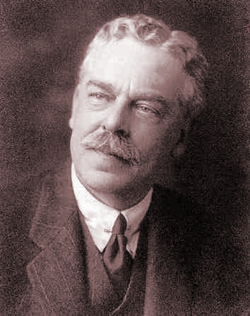
Probably the most notable member of the family from today’s perspective was Sir Herbert Nigel Gresley, C.B.E., D.SC, M.I.C.E., M.I.MECH.E., M.I.E.E. shown here. He was born in 1876 he was the fourth son of the Rev. Nigel Gresley (9th baronet) and nephew of Sir Thomas Gresley (10th baronet) and cousin of Sir Robert Gresley (11th baronet).
Sir Nigel, as he preferred to be called, was educated at Marlborough and early evinced an interest in railway locomotives, sketching them at the age of 13. After serving as an apprentice in the railway works at Crewe, he entered the service of the L. & Y. Railway at Horwick, and in 1905, at the age of 31, was appointed carriage and wagon superintendent of the G.N. Railway at Doncaster.
Sir Herbert Nigel Gresley first worked on the railways as an apprentice at Crewe eventually working for the Lancashire and Yorkshire Railway. Appointed carriage and wagon superintendent of the Great Northern Railway in 1905. In 1911 he was appointed locomotive engineer, being then in his thirty-sixth year and in the same year, he succeeded H.A. Ivatt as Chief Mechanical Engineer. In 1923 he was appointed Chief Mechanical Engineer of the London & North Eastern Railway, being knighted in 1936. He was also president of the Institute of Mechanical Engineers in 1936.
During the First World War of 1914-18 war, he was responsible for the design of armoured trains and held the rank of Lt. Colonel in the Royal Engineers. On the grouping of the railways he became chief mechanical engineer of the L.N.E. Railway and had the task of integrating the technical staffs of the constituent companies into one team. For over 30 years he exercised an influence over the design of British locomotives in a career which has no parallel.
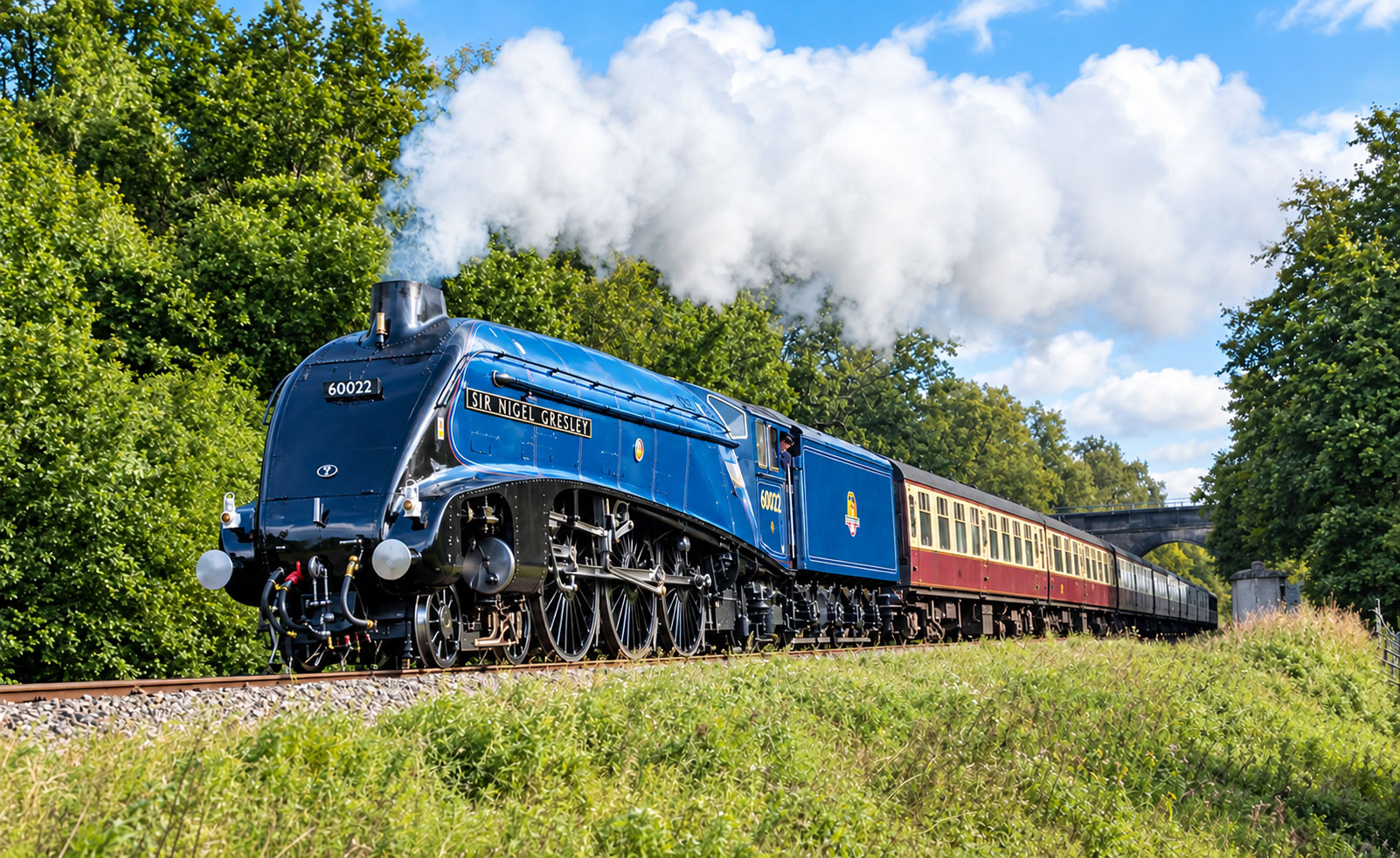
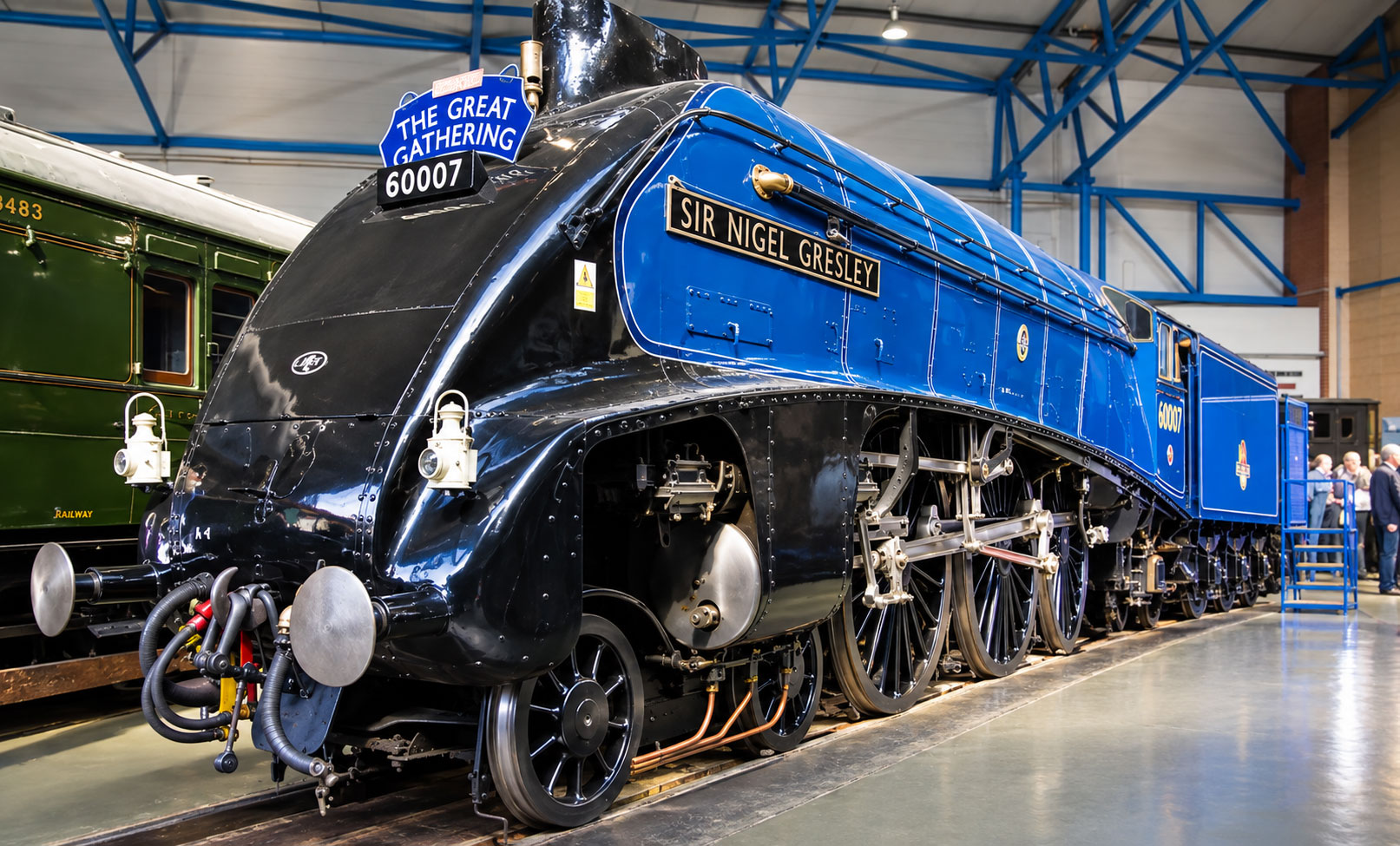
He designed the silver jubilee trains of 1935 and on November 26th, 1937, the name-plate “Sir Nigel Gresley”, affixed to his 100th “Pacific” locomotive, was unveiled by the chairman of the L.N.E. Railway – a tribute never before paid to any living locomotive engineer. This picture shows the 100th Pacific locomotive, which was named after him.
Sir Nigel Gresley in service 1938
Sir Nigel Gresley in retirement
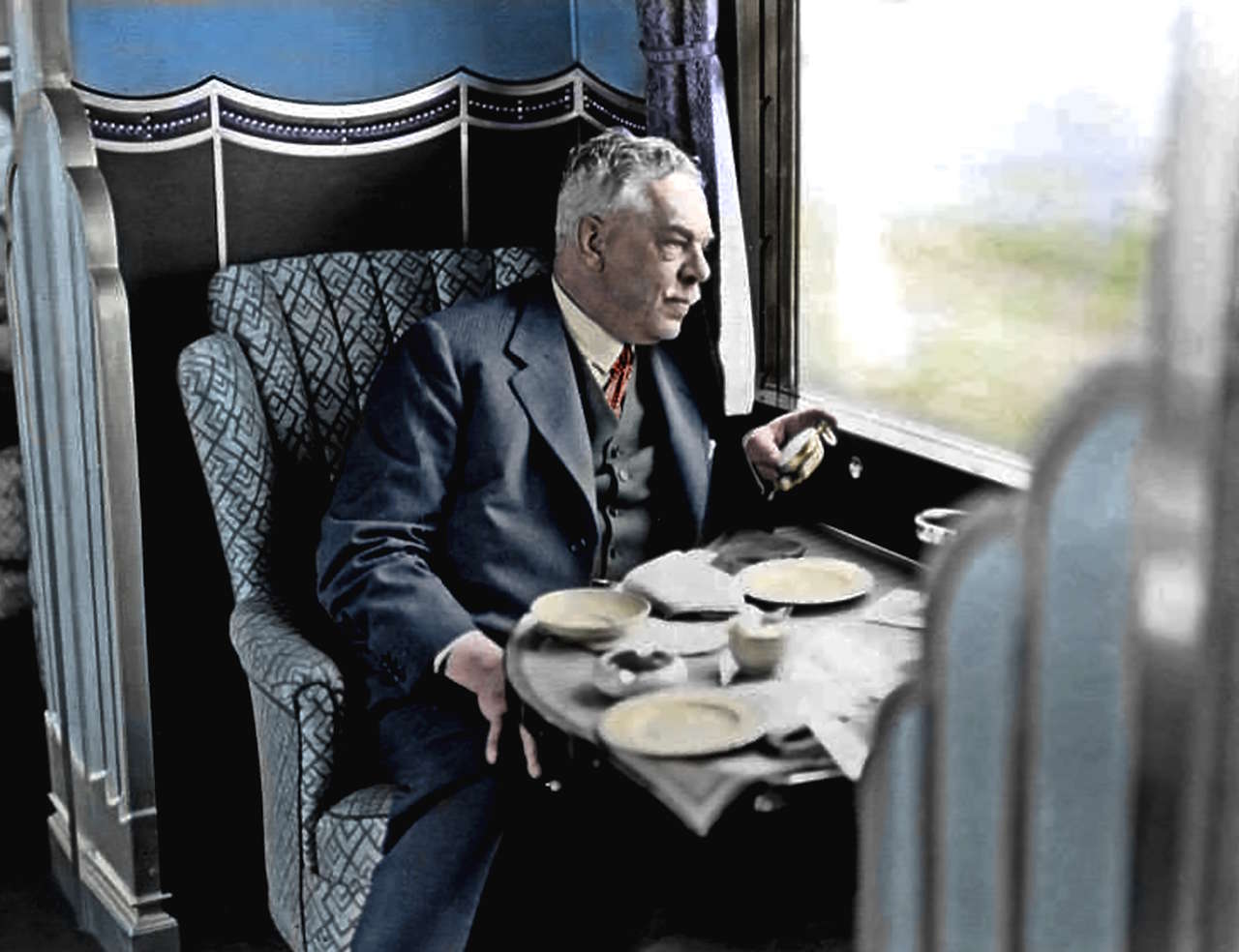
The interior also enjoyed the grandeur of the day with salubrious ‘Art Deco’ styling. Sir Nigel can be seen below enjoying the results of his labour.
Sir Nigel was created C.B.E. in 1920 and knighted in 1936. He died in 1941, three months before he was due to retire, and is buried in Netherseal church near the home of his ancestors.
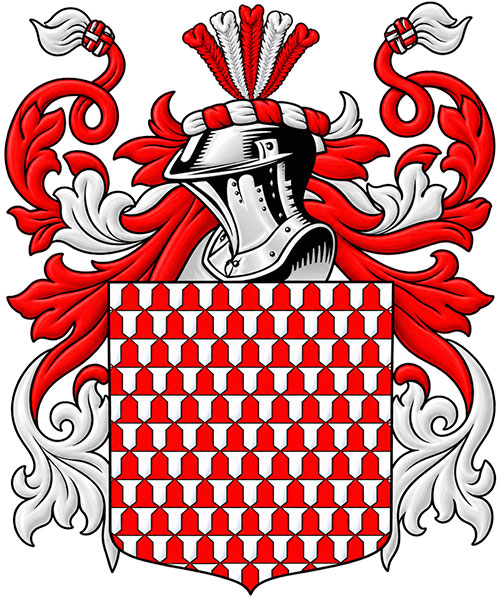
THE GRESLEY COAT OF ARMS
The Gresley Arms are “Vaire, ermine and gules” (i.e. silver and red). Armorial bearings came into use during the last quarter of the 12th century and it was not unusual for a tenant at that time to adopt the arms of his feudal lord.
It is therefore probable that William de Gresley, who was exempted from all but nominal service to his feudal overlord, William Ferrers, 4th Earl of Derby, in 1200, assumed the Ferrers Coat of Arms “Vaire or and gules” (i.e. gold and red) with a change of tincture.
These arms appear for the first time on the family seal of Geoffrey de Gresley circa 1240. With the creation of the baronetcy in 1611, the badge of Ulster was added to the cost of arms borne by the head of the family.
The family crest is a “lion passant, ermine, armed, langed and collared gules” the first occurs in 1513.
The family motto was meliore guam fortuna – “More faithful than fortunate”
DRAKELOWE HALL, GRESLEY HALL AND GRESLEY CHURCH The site of the earliest mansion or castle at Drakelow is unknown, but there is evidence of an early structure at the junction of the Walton and Rosliston roads. The site of the moat is clearly visible and it enclosed an area measuring 75 yards by 75 yards. This site was outside Drakelow Park, which was enclosed at a much later date. Excavation would probably reveal traces of foundations of a structure which may have been built by William de Gresley on his return from Castle Gresley in 1201.
It was notable that this piece of land was excluded from the sale of the Barn Farm, of which it forms part, in 1933. At the final sale of the remainder of the Drakelow Estate it was purchased by Mr. J. Hulse, of the Barn Farm, who felled the trees growing on it and eventually sold the land to Sir Clifford Gothard the present owner of the farm.
At present the land is covered with a thick growth of scrub but it is hoped that at some future date a systematic excavation of the site may yet take place to throw some light upon its past history.
It would appear that between 1086 and 1090 a motte and bailey castle of the usual Norman type had been built in a clearing in the large wood mentioned in the Domesday Survey, and that Nigel de Stafford was in residence there. Of 51 of these Norman structures, 36 were built in places insignificant before the Norman Conquest. These strongholds were erected to overawe the Anglo-Saxons, and to serve as a place of refuge in case of any uprisings.
A wide ditch of considerable depth was dug in a circle, the earth being thrown inwards to form a lofty mound, advantage being taken of a natural mound if this was available. On the flattened top of the mound, or ‘motte’, a wooden tower was erected to serve as a residence for the lord and his family.
In addition to the ditch, which was crossed by a drawbridge, the mound was protected by a wooden stockade. Outside the ditch a “baily” or courtyard, of varying extent but usually of half-moon shape, was surrounded by a further ditch and also protected by a stockade. Within this space, huts, barns and cattle shelters were erected for labourers attached to the manor. As the structure and palisades were of wood there are no visible remains except the mound which is now known as ‘Castle Knob’. It is from this ‘motte and bailey’ castle erected in a ‘Grassy Lea’ in the large wood that the place-name of GRESLEY is derived.
Concerning the late hall in Drakelow Park, Sir Robert Gresley (eleventh baronet) stated that the date of foundation of this structure was not known, nor was it easy to determine from the available evidence. Described in the sale catalogue as ‘Elizabethan’, it may have contained some earlier work, but during successive centuries considerable alterations and improvements had been effected.
The greater part of the mansion was apparently rebuilt by Sir William Gresley (fourth baronet) in 1723 for this date appeared on several leaden waste-pipe heads.
Sir Roger Gresley (eighth baronet) altered the west front considerably and built a billiard room and the bedrooms above it c1830. Sir Robert (eleventh baronet) also effected some alterations and improvements both in the mansion and the gardens, the most notable being the construction of terraces leading down to the river front which were completed in 1902 in memory of his mother.
On the dissolution of Gresley Priory in 1543 the buildings were sold to Henry Criche, a speculator in monastic properties. Thirteen years later they were purchased by Sir Christopher Alleyne, son of Sir John Alleyne, twice Lord Mayor of London. Sir Christopher, who had property in Kent, married a daughter of Sir William Paget, who had acquired the monastic properties of Burton Abbey, and possibly this influenced his purchase of Gresley Priory.
He pulled down the Priory buildings, except for the church, and used the material to build a residence known as Gresley Hall. There is no foundation for the belief that the Hall was connected to the Priory by an underground passage.
It would appear the Hall was rebuilt in the Flemish style in the early 18th century and it has some interesting architectural features which have been carefully preserved.
On the death of Samuel Alleyne in 1734 the property passed into the possession of the Meynell family. It was purchased by Sir Nigel Gresley in 1775 and the outbuildings were converted into a pottery in 1794. Gresley Hall was sold by Sir Roger Gresley in 1828 and was converted into a farmhouse and subsequently became a tenement building.
After changing hands several times it was purchased by the National Coal Board in 1953 and converted into a Miners’ Welfare Club. In 1957 the premises were extended to cater for five collieries in the district.
That there was a chapel at Drakelow in the 12th century is proved by a grant to Burton Abbey of the ‘vil’ and church at Stapenhill together with the chapels and tithes of Drakelow, Heathcote and Newhall. This grant was confirmed by Pope Lucius III in 1185. The sites of these three chapels are not known for none was in existence in the 16th century.
In 1650 a Parliamentary Commission stated that: “Drakelow supposed to be a member of Stapenhill is lately united to Gresley and fit so it continue”. The Gresley family always maintained a close connection with Gresley priory from the date of its foundation and the nomination of the Prior was in their hands.
After the Dissolution the Priory buildings were demolished and the nave of the monastic church became the parish church of Gresley and the family association was continued. Although Gresley Church has undergone considerable alterations at different times, it still contains many memorials of the Gresley family, the most notable being an ornate alabaster tomb erected to the memory of Sir Thomas (second baronet) who died in 1699. Under an arch in the centre kneels a life-sized figure of the baronet and round the tomb are impaled the arms of every marriage of his ancestors.
Following the establishment of the Netherseale branch at the beginning of the 18th century, several members have been Rectors of Seale and there are various family memorials in that church. Sir Robert (11th baronet) worshipped at Caldwell Church and is buried there while Sir Nigel, the L.N.E.R. engineer, is buried at Netherseale.
In 1540 Leland wrote: “Sir George Gresley hath upon Trent, a mile lower than Burton, a very large manor place and park at DRAEKELO”. Concerning the park, Sir Robert Gresley (eleventh baronet) wrote: “This park, including the pleasure grounds and that part called the Warren (in older times known as the Hare Park) is 580 acres in extent of which the deer park comprises 297 acres”, It may be of interest to note that the coneygreave or rabbit warren is mentioned in a deed dated 1328.
The deer park was well wooded and contained some fine old trees, a notable feature being the “one mile avenue”, a double row of trees leading to the Hall from a thatched entrance lodge on the Walton Road. There was a large pond in the park and a curious castellated cottage occupied by a gamekeeper.
In addition to a number of Galloway cattle there was a herd of 160 fallow deer, the average weight of a buck being 84 lbs. When the timber was felled in 1934 the remaining deer escaped to the woods where they were eventually killed off.
Burtonians of an older generation will remember with delight the pleasant walk by the riverside from Stapenhill which crossed the Burton-Leicester railway and continued through a meadow into a spinney over a brook crossed by a narrow wooden bridge. Thence a path through the park led to the lodge on the Walton Road.
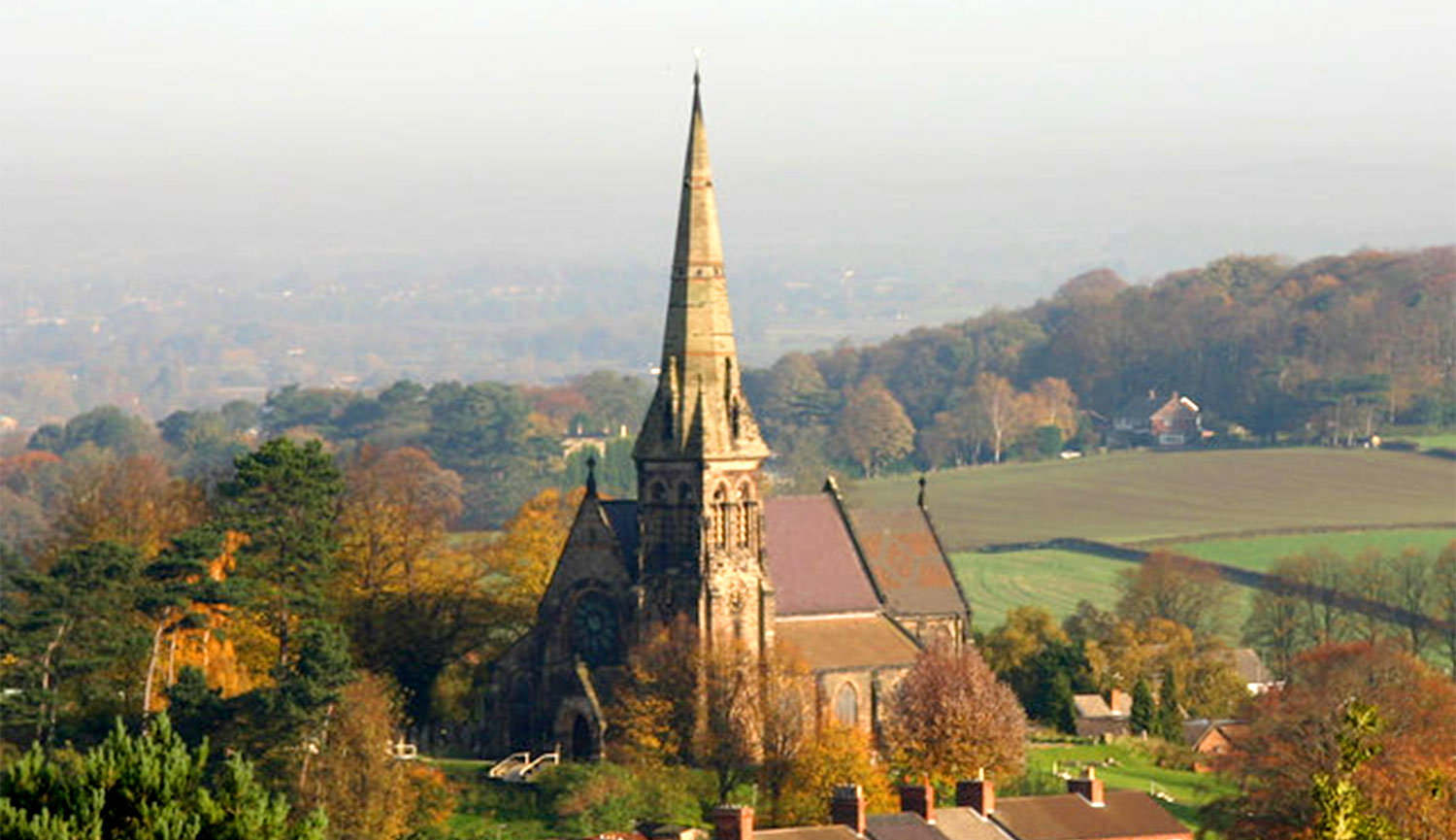
The Parish Church of Saint Mark is a Grade two listed building in Winshill, a suburb of Burton on Trent which lies on the South Derbyshire side of the River Trent. The church was financed by and built at the request of its patron, John Gretton, Esq., (of brewers Bass, Ratcliffe and Gretton) on land supplied by the Marquis of Anglesey. The church is sited on a prominent hill named “Wheadley Nob”, this exposed position within the area of Winshill makes the church clearly visible to many of the population.
The church was completed in 1869 and its consecration took place on 13th September, 1869. Although it now lies within the boundaries of the diocese of Derby, it was part of the diocese of Lichfield when built, and between 1884 and 1927 it was part of Southwell diocese. The service of consecration was performed on behalf of the Bishop of Lichfield by William Garden, the Lord Bishop of Auckland, New Zealand. The present patron is Lady Gretton who still takes an interest in St. Mark’s.
St Mark’s church was designed by Edwin Holmes of Birmingham and is in the early decorated Gothic style with geometric tracery, nave and aisles, chancel and south west tower with broach spire.
There is little point in my expanding further because it has its own excellent website: Click to Open

 Sir Nigel Gresley in service 1938
 Sir Nigel Gresley in retirement