Sharps and Knight
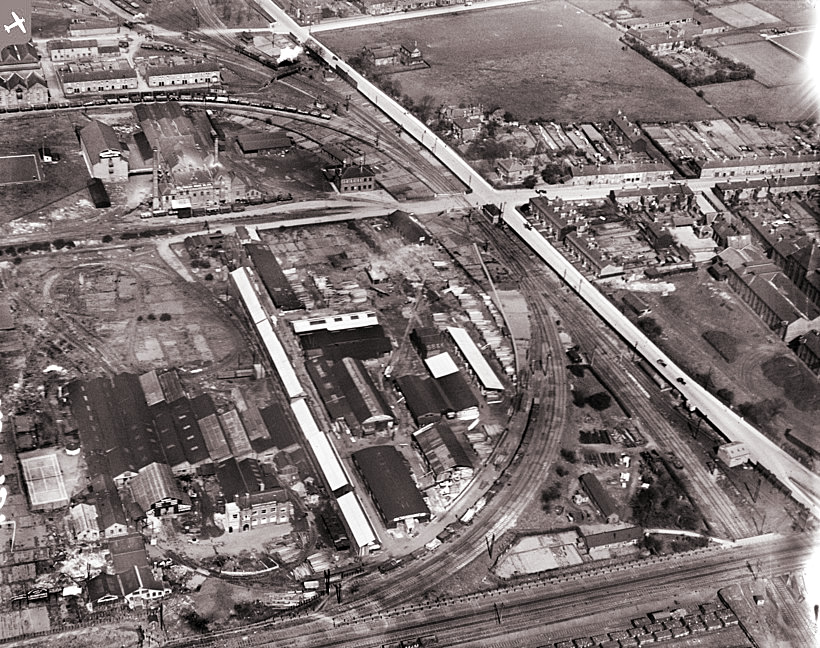
1926 Sharps and Knight #1
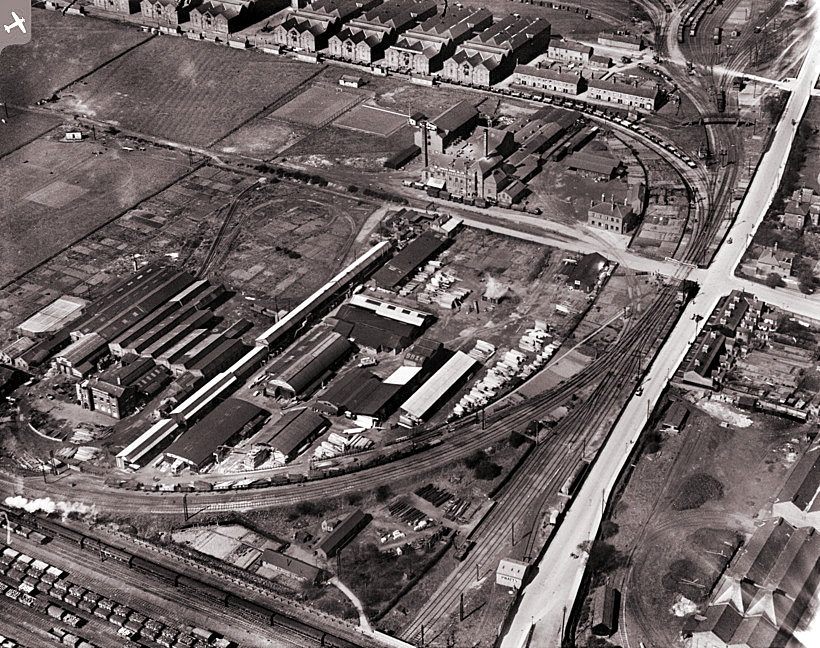
1926 Sharps and Knight #2
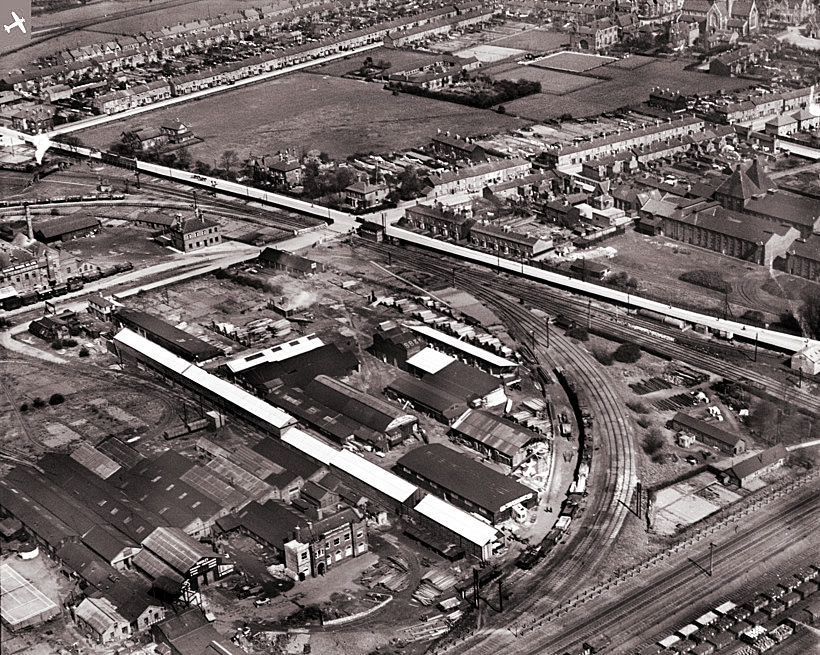
1926 Sharps and Knight #3
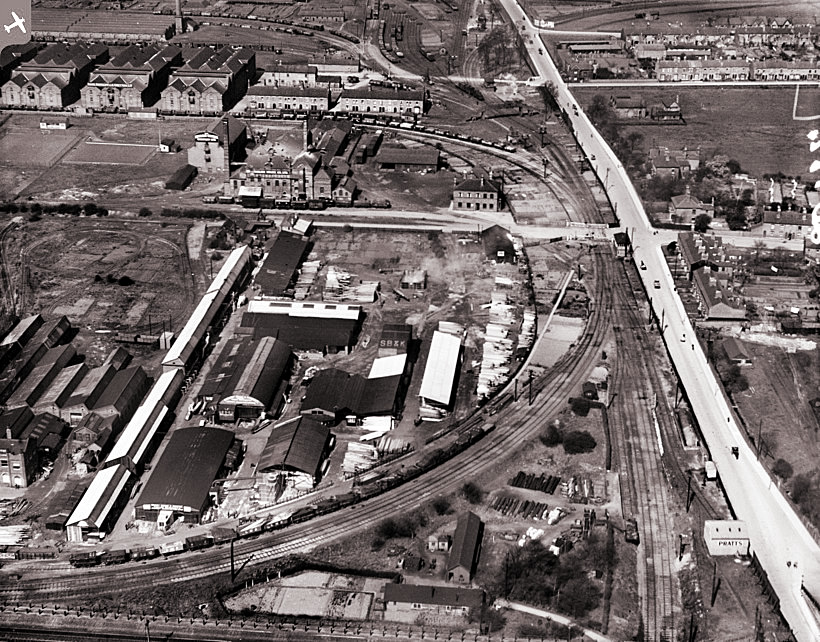
1926 Sharps and Knight #4
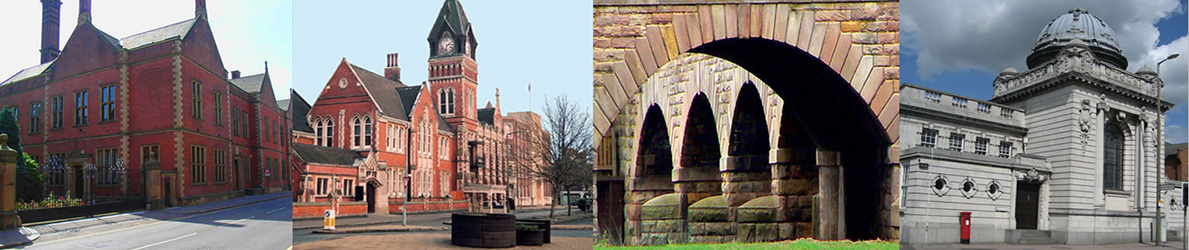
Sharps and Knight
1926 Sharps and Knight #1
1926 Sharps and Knight #2
1926 Sharps and Knight #3
1926 Sharps and Knight #4
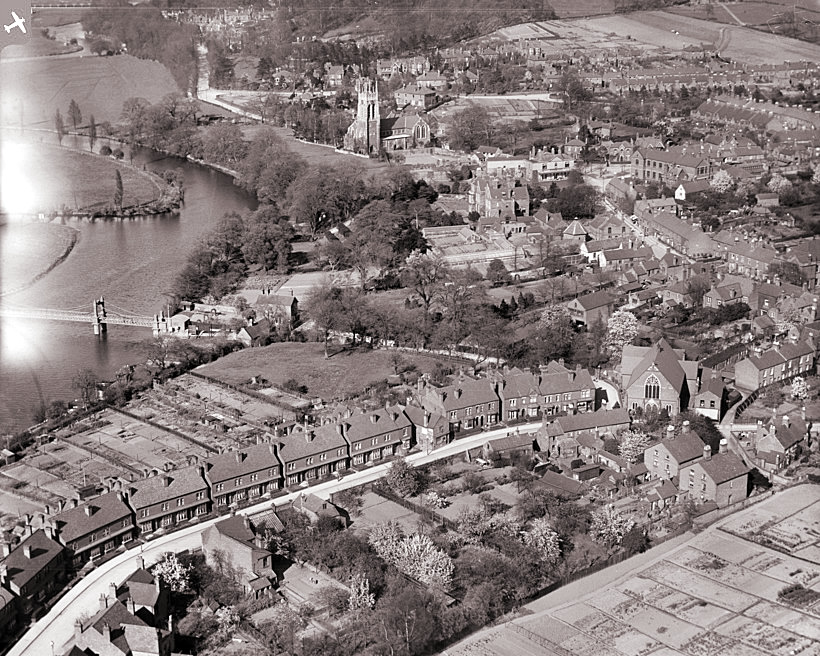 1921 Ferry Street
Beautiful photo showing a newly constructed Ferry Street. Of particular interest is Stapenhill House still in place which was later demolished and the extensive grounds donated by the Goodger family to become Stapenhill Pleasure Gardens.
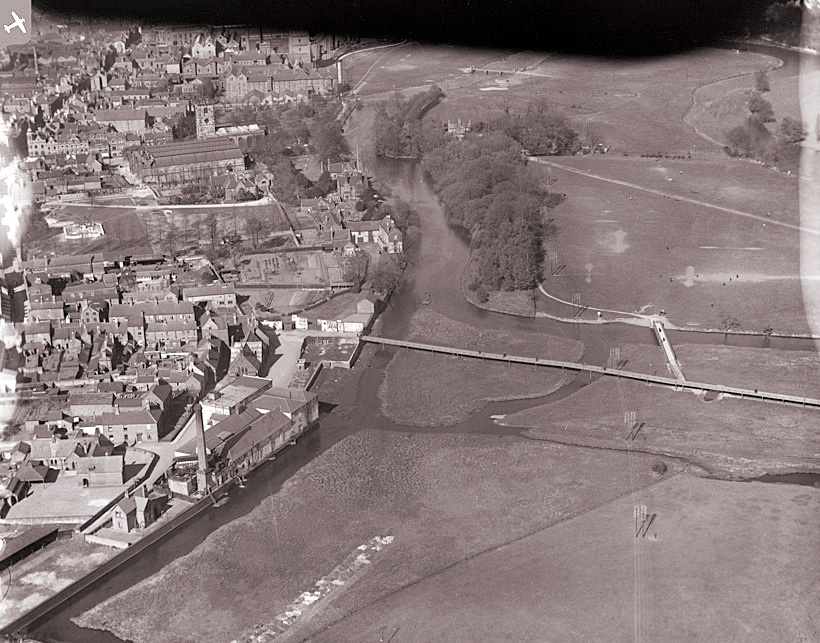 1921 Ferry Bridge Causeway
The Ferry Bridge Causeway is still pretty much the same today but the course of the river has changed significantly. If you take a look from Saint Peter’s Bridge, the large bump which negotiated the river can still be seen but looks rather odd with dry land underneath.
The most glaring omission from this photo is the Burton Technical College (now ‘University’) which was built on land originally belonging to Burton Abbey – a site that extended to 14 acres. The other significant development not yet constructed is the Abbey Arcade.
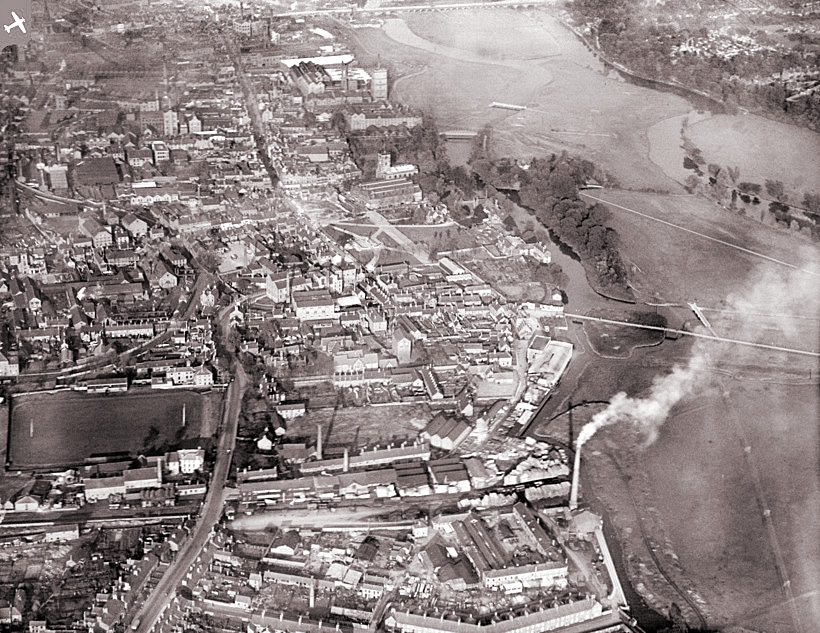 1927 Causeway Bond End
A wider picture of the Bond End end of the causeway provides a great illustration of how things have changed. In the centre of the photo is the Burton Grammar School, later to be replaced with the new school in Winshill.
Of great interest is the course of the river. The wide branch across the middle of the Hay used to be the main flow, rather than the existing branch which travels along the edge of Stapenhill Gardens. At one time, this also used to be the county line dividing Staffordhire and Derbyshire.
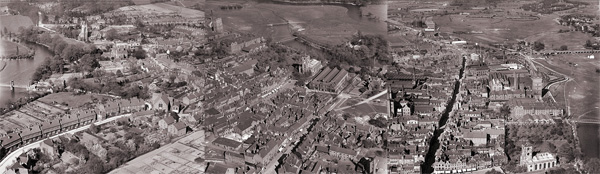
1920s Burton from Above
Select page to view:
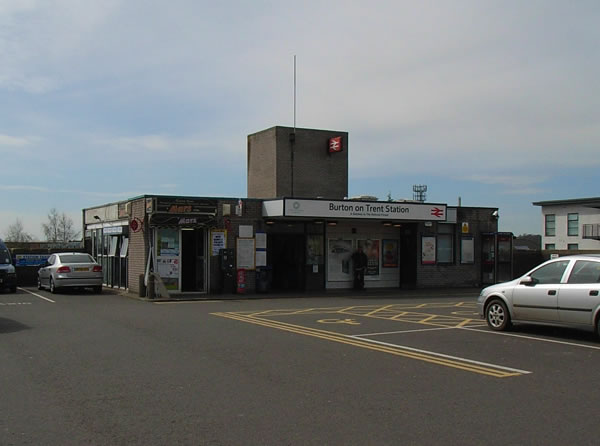
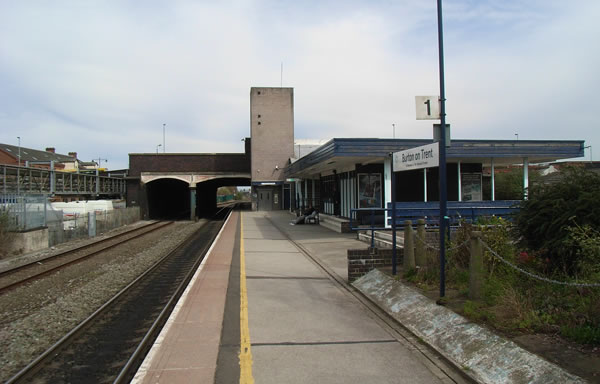
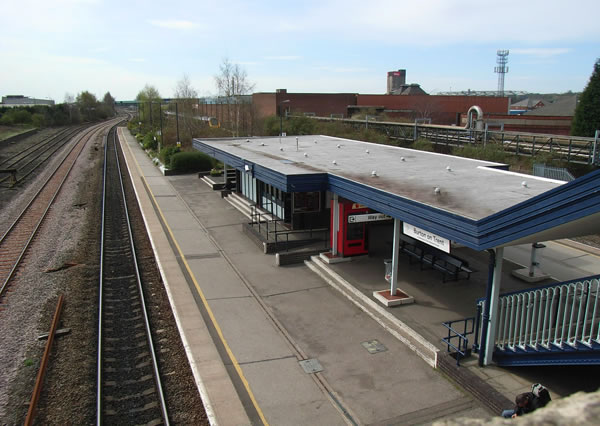
The station was demolished and rebuilt in 1971.
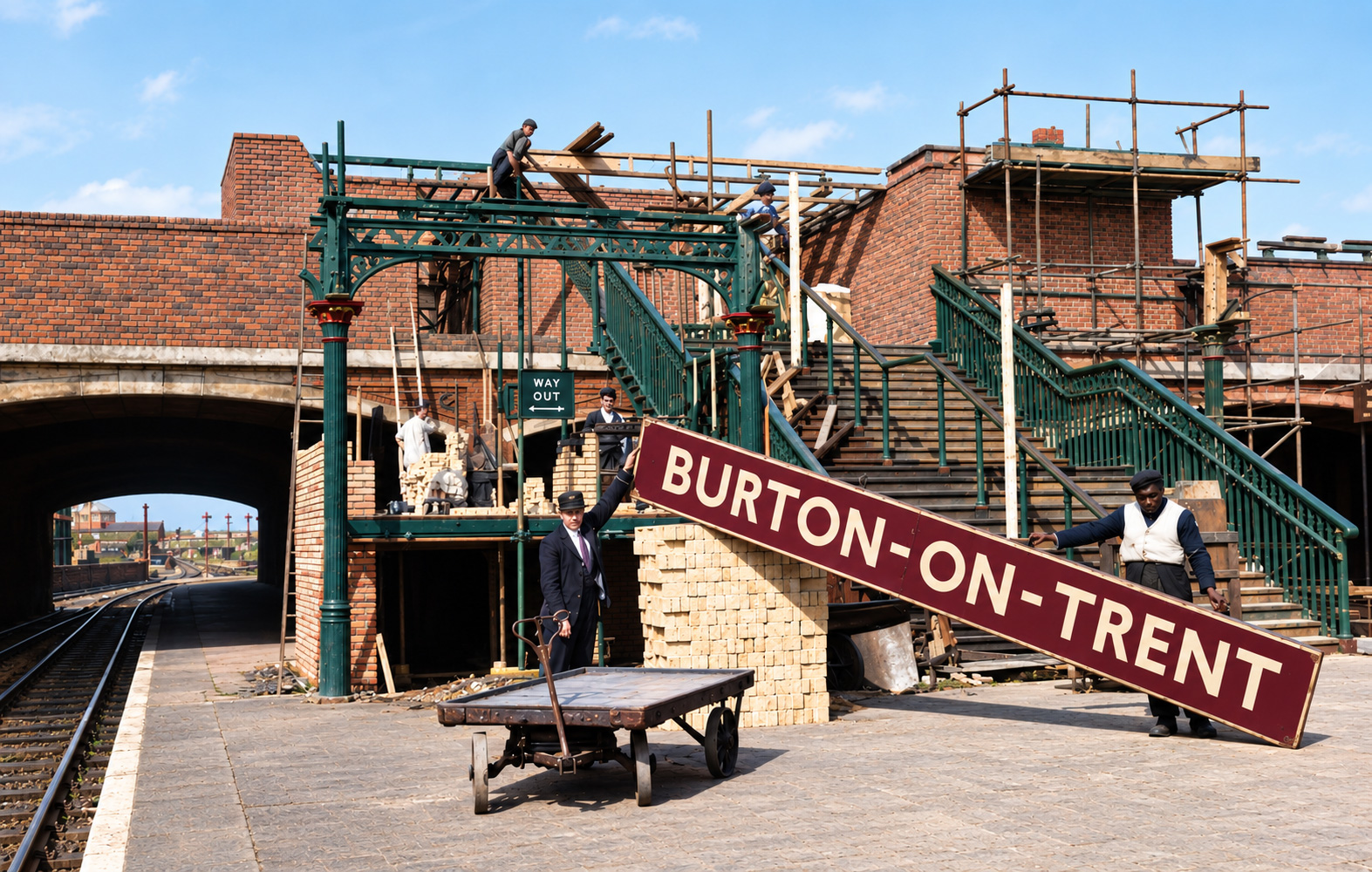
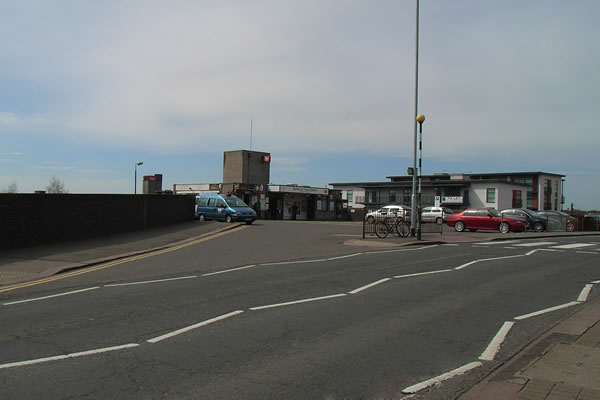
The booking office remains in around the same place and the platform stairs are largely original to the previous station. The final photos show the present station with its magnificent architecture for comparison.
General Town
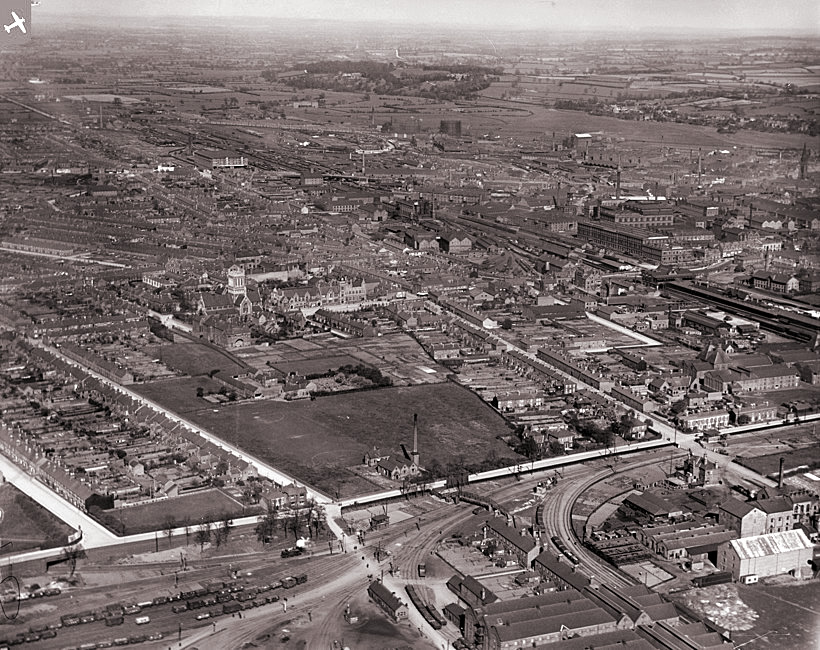
1921 View From South West #1
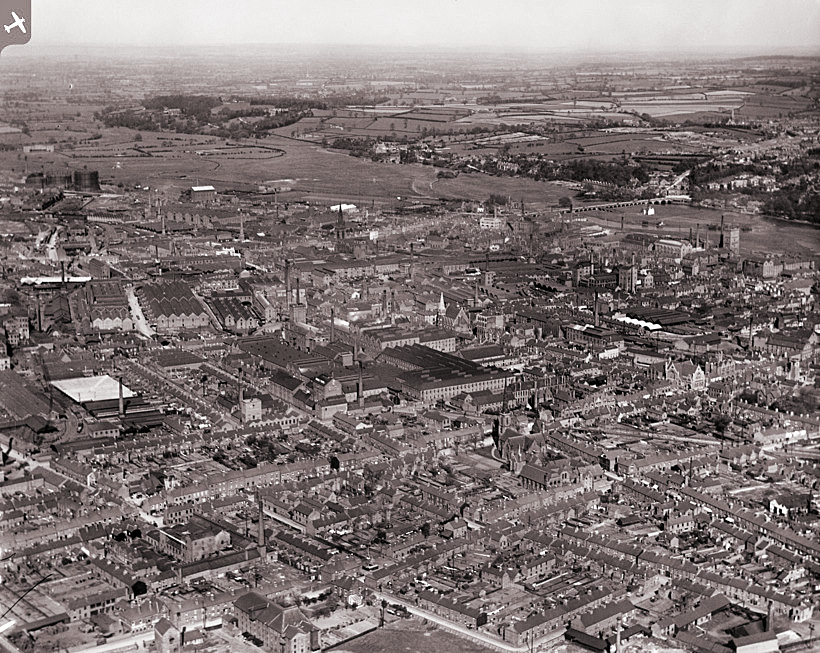
1921 View From South West #2
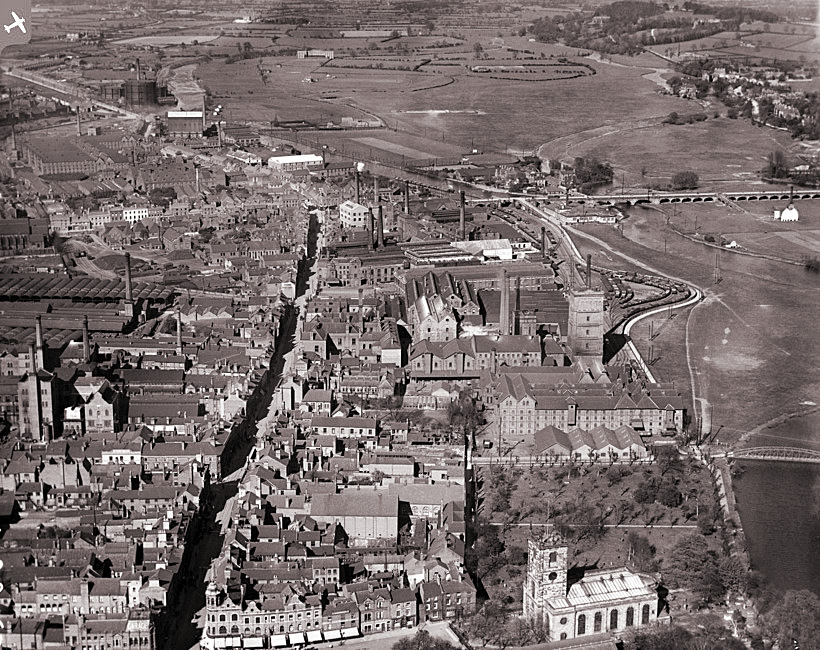
1921 High Street and Malthouses
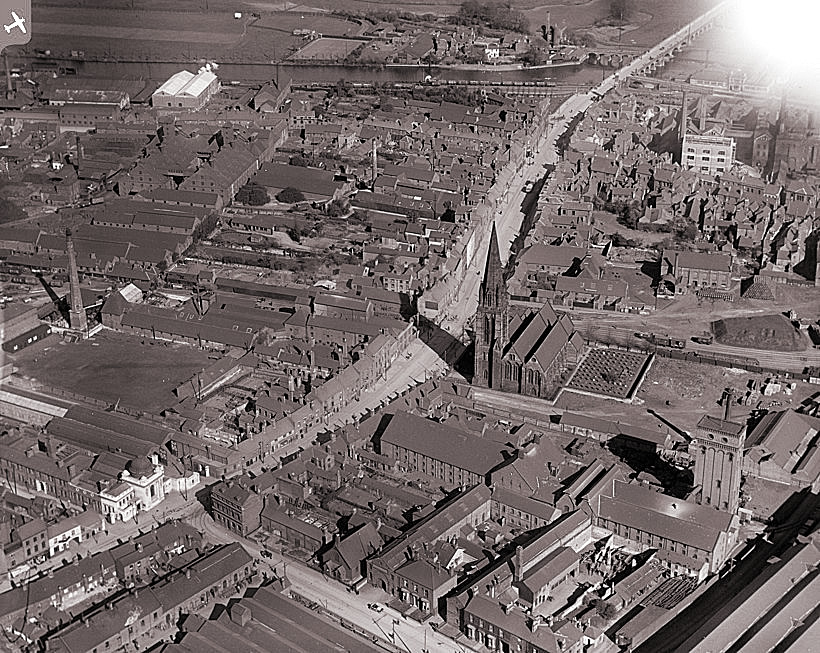
1921 Horninglow Street #1

1921 Horninglow Street #2
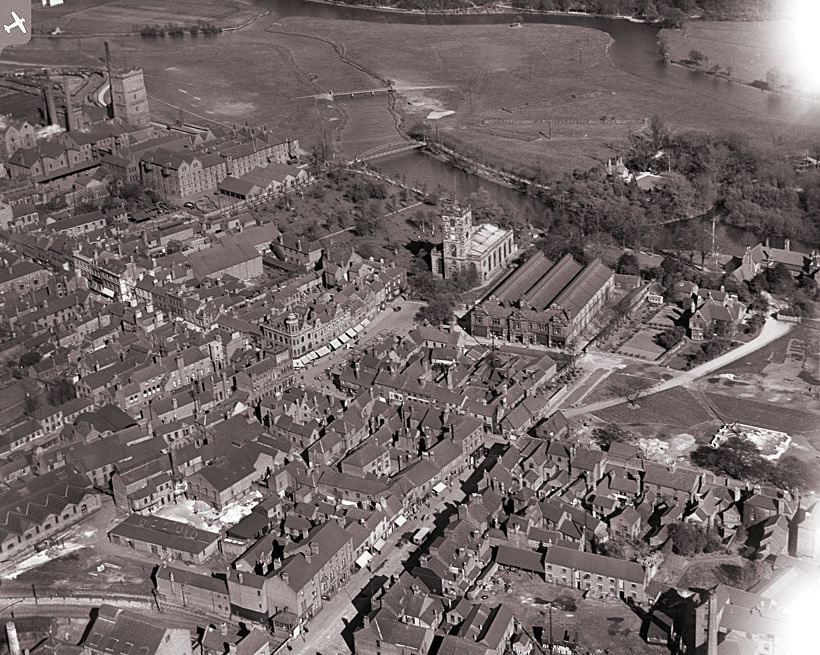
1921 Market Place
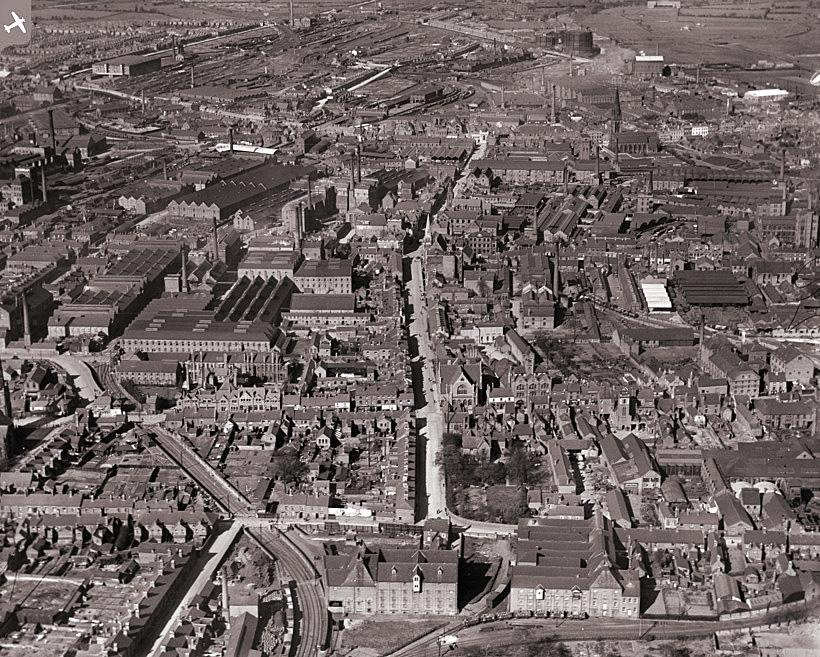
1921 Union Street
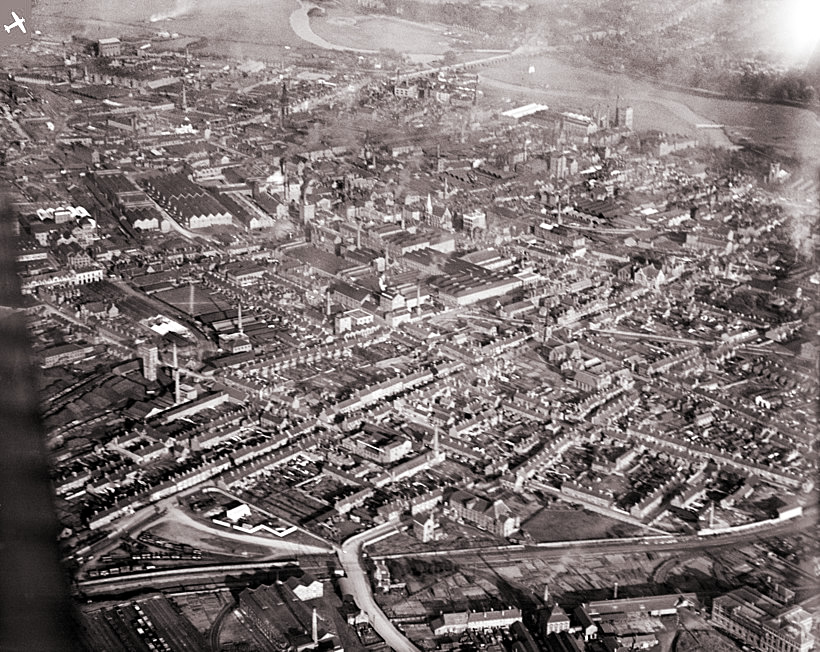
1927 Moor Street
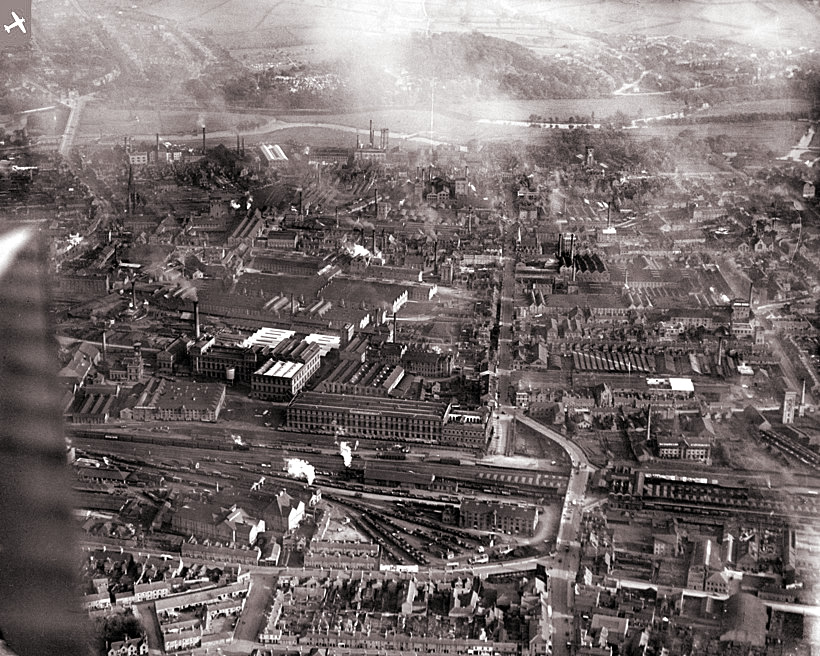
1927 Railway Station
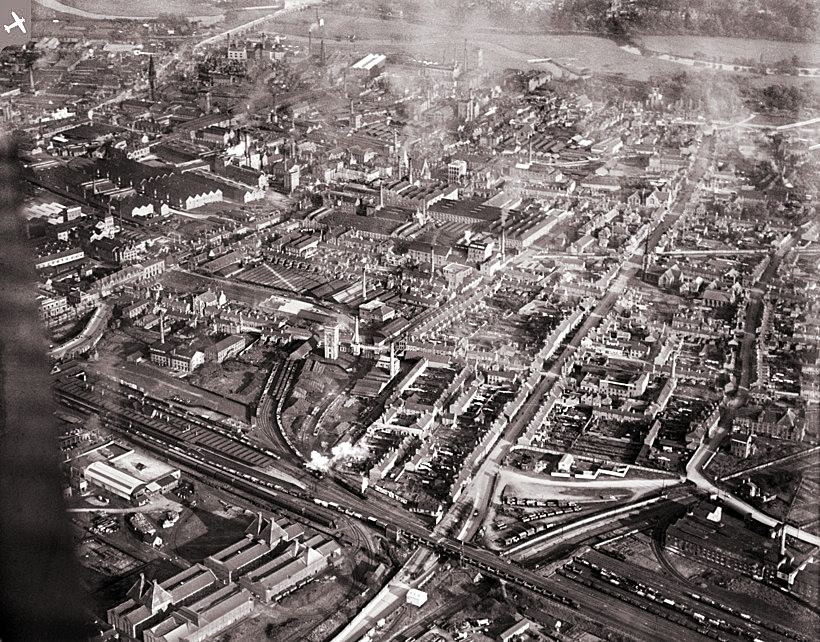
1927 Town
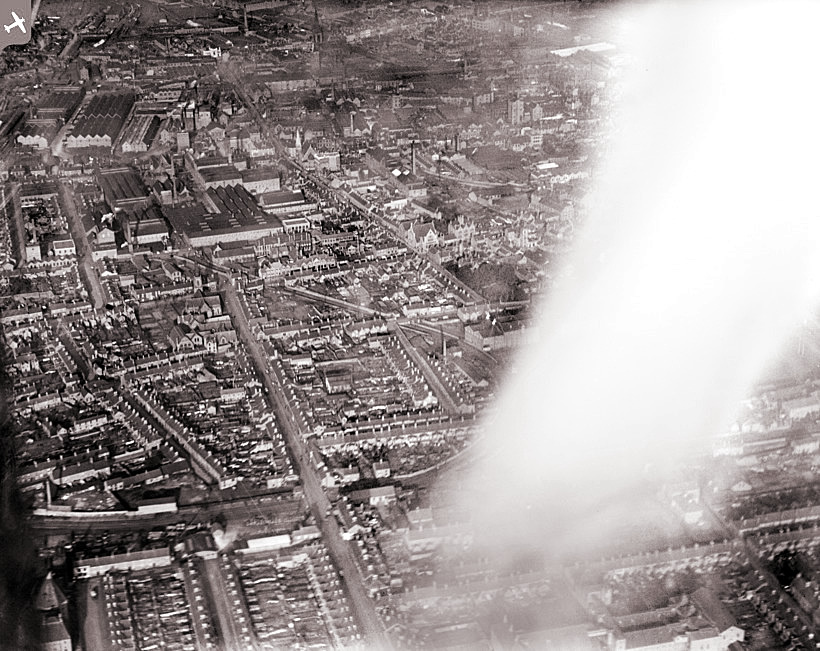
1927 Uxbridge Street
1927 Washlands
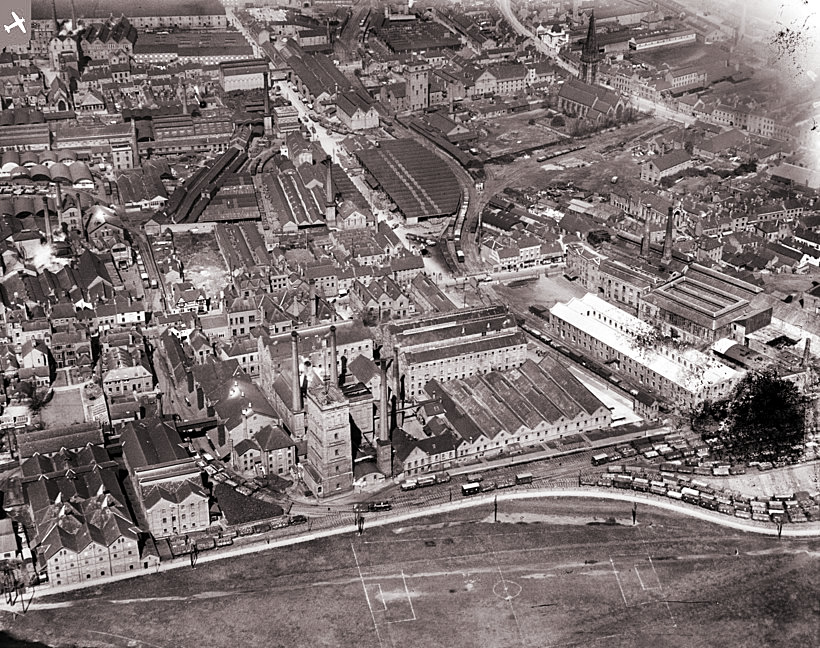
1928 Middle New Breweries #1
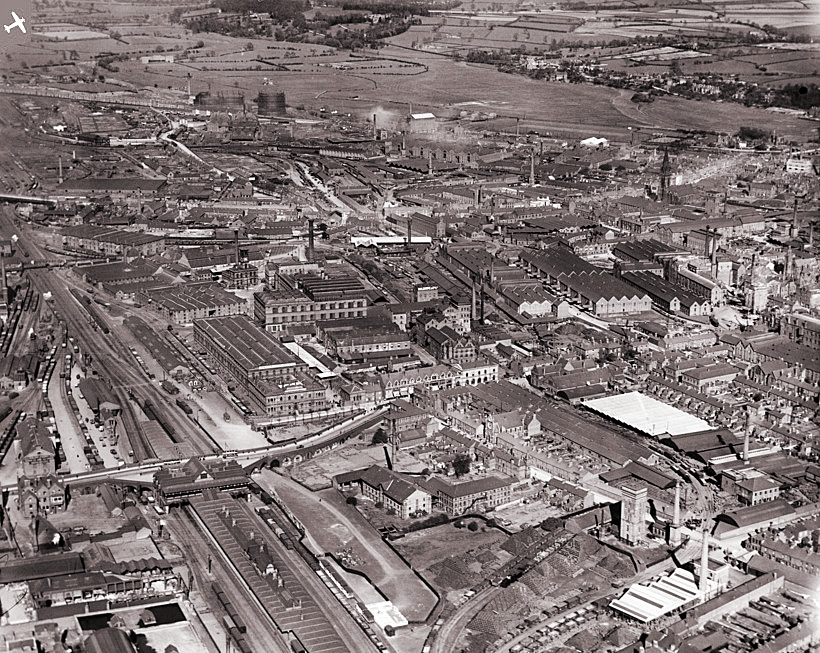
1928 Middle New Breweries #2
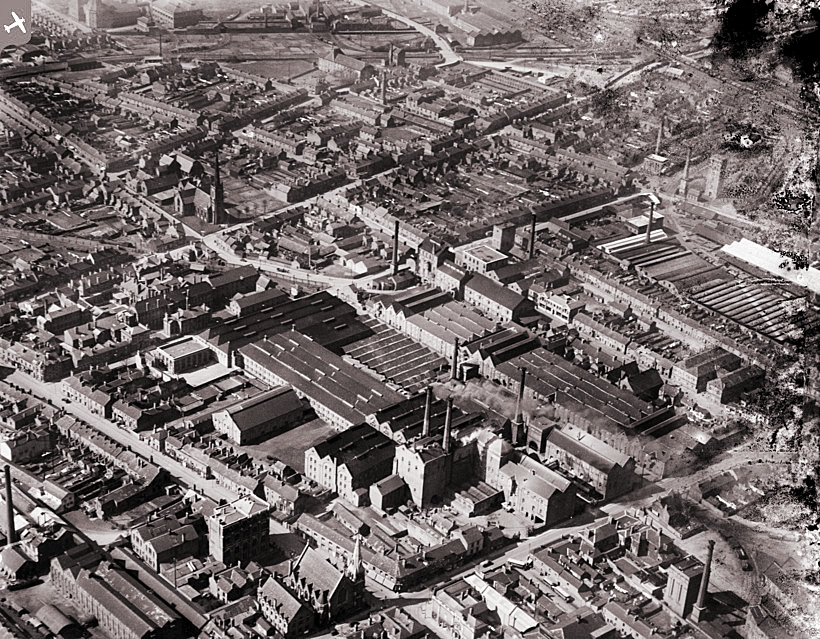
1928 New Brewery
Burton upon Trent when renown as one of the most significant brewing towns in the country, was famous for having its own internal railway system solely to serve the breweries.
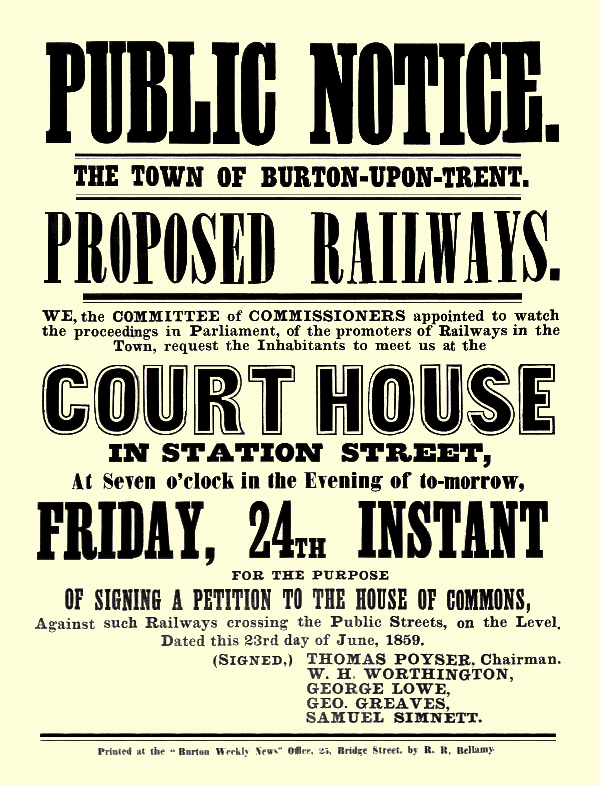
Brewers aside however, the plans were not met with enthusiasm, largely because of the many proposed railway crossing that would disrupt the traffic. In 1859, notices were posted all over the town prompting readers to meet at the Court House in Station Street to sign a petition to the House of Commons “Against such railways crossing the Public Streets”. Slightly surprisingly, one of the signatories was W.H.Worthington (who would eventually go on to become Burton’s first Mayor). This might suggest that the Worthington Brewery could manage without them more than some of its competitors!
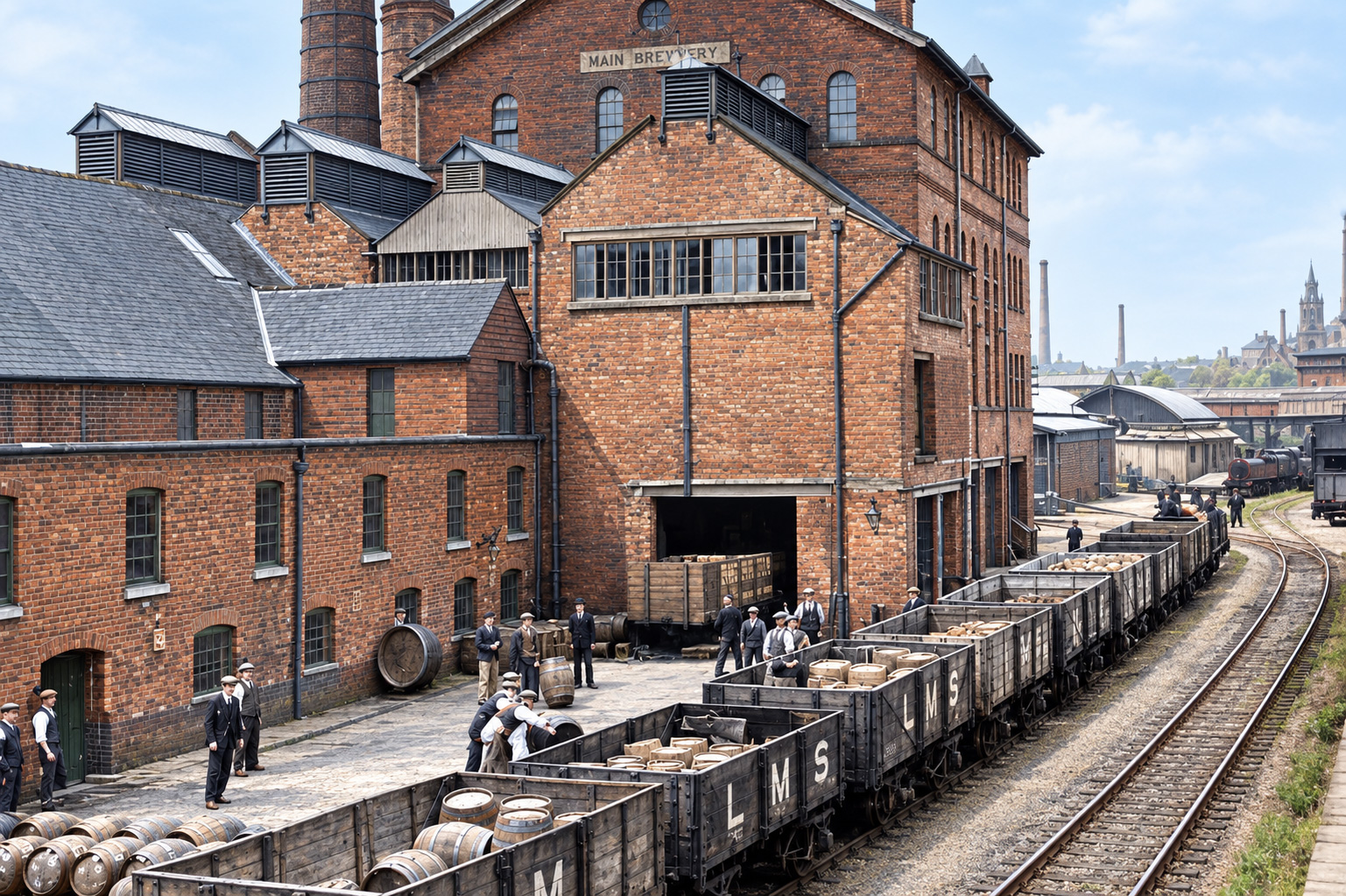
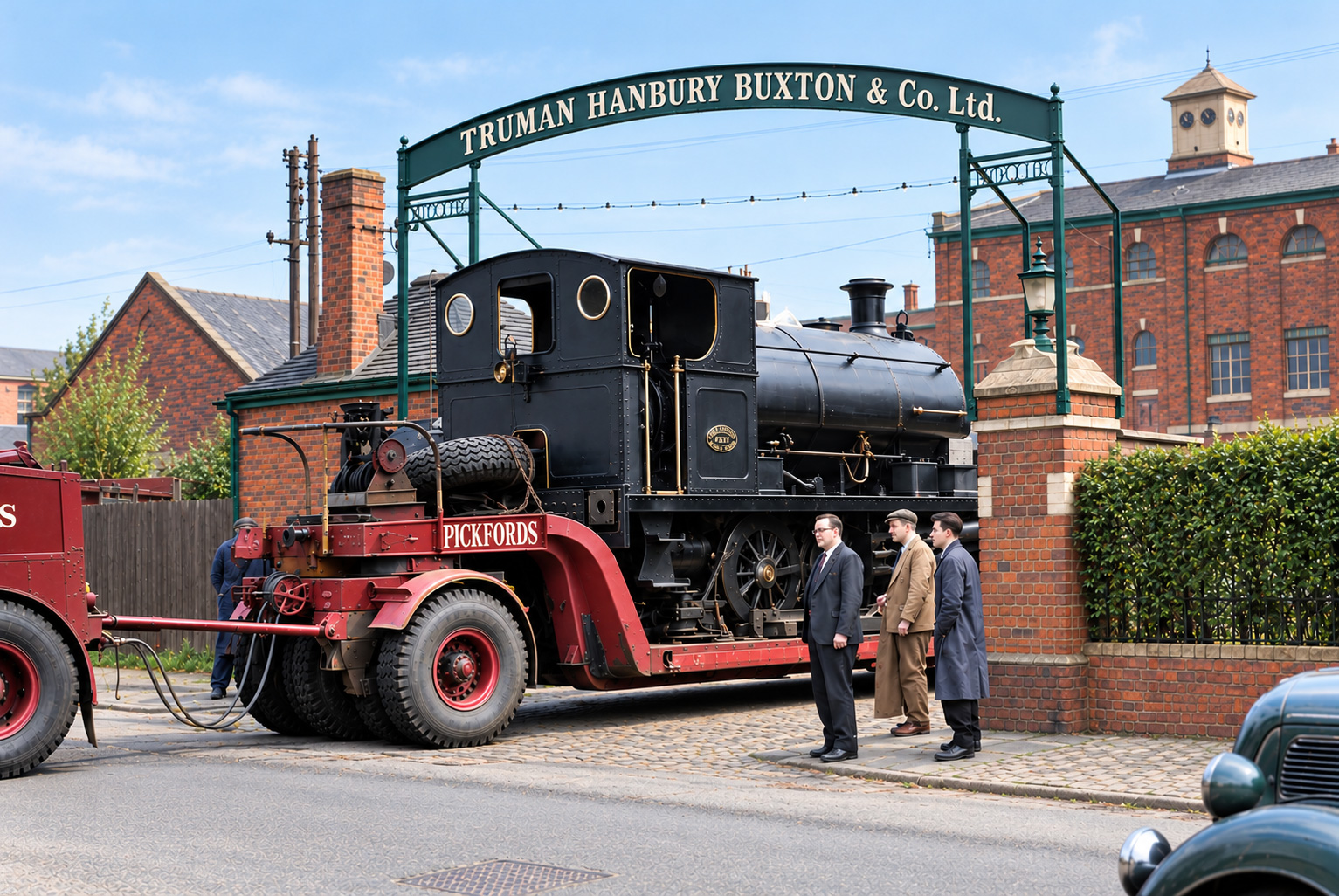
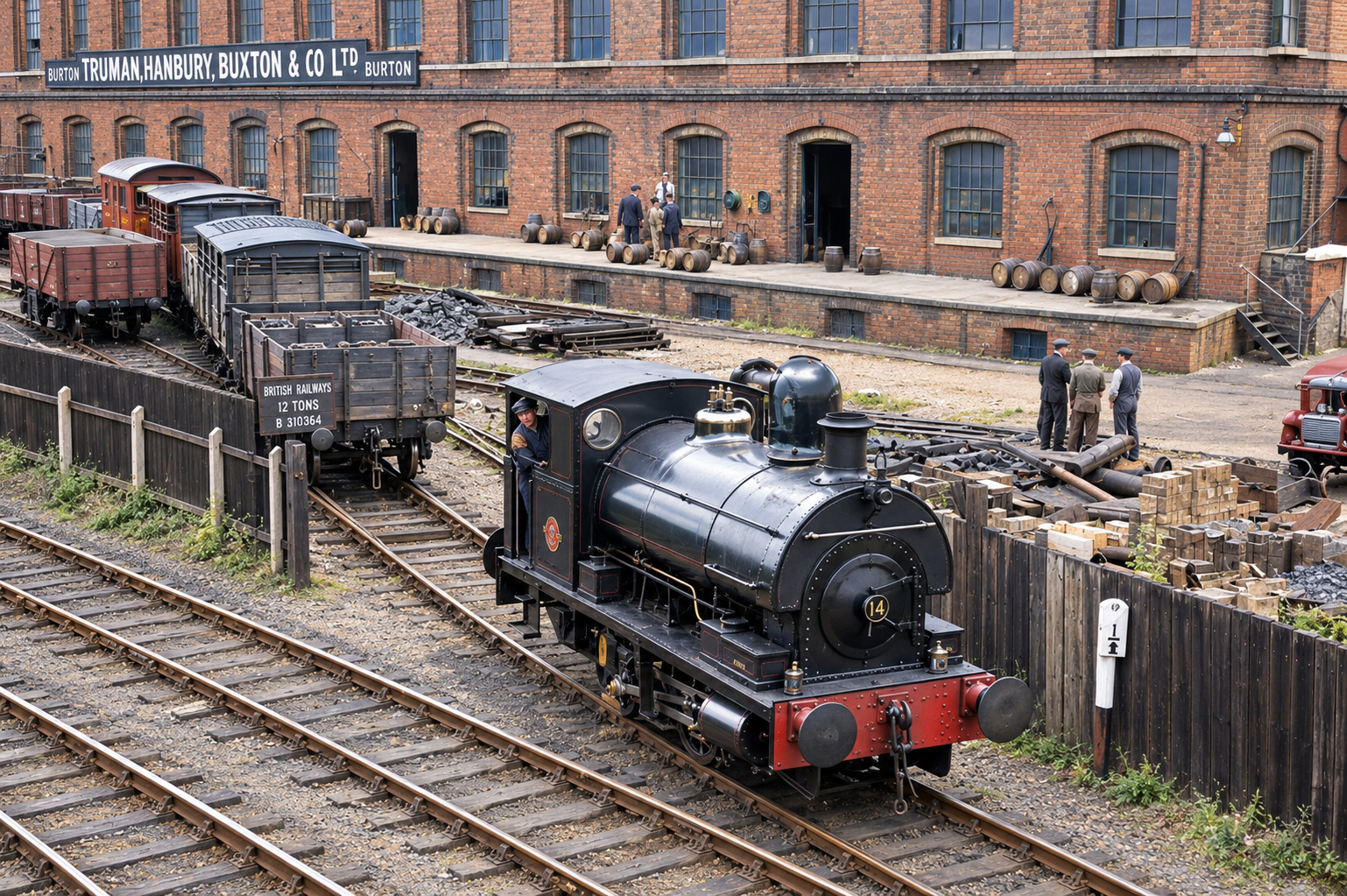
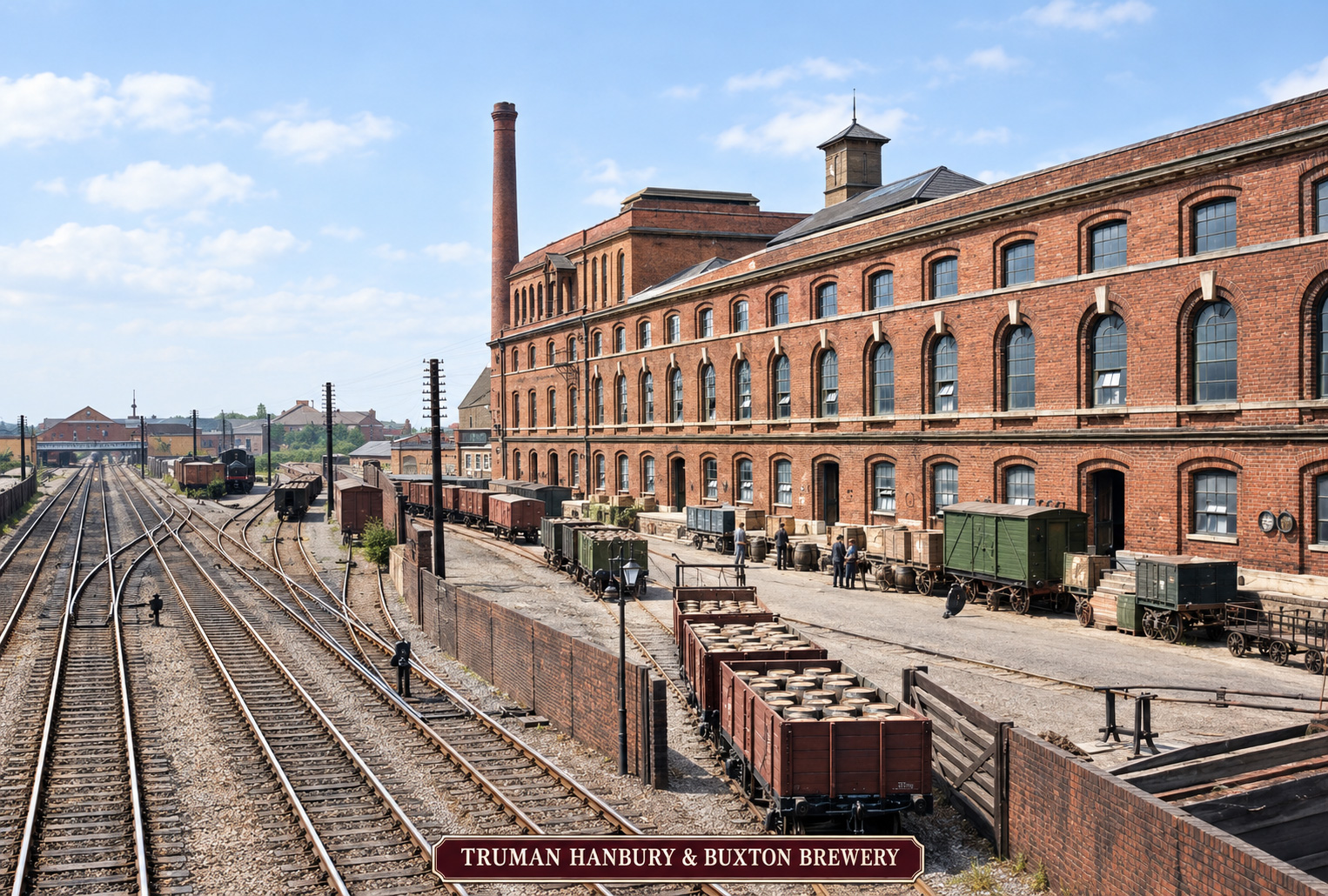
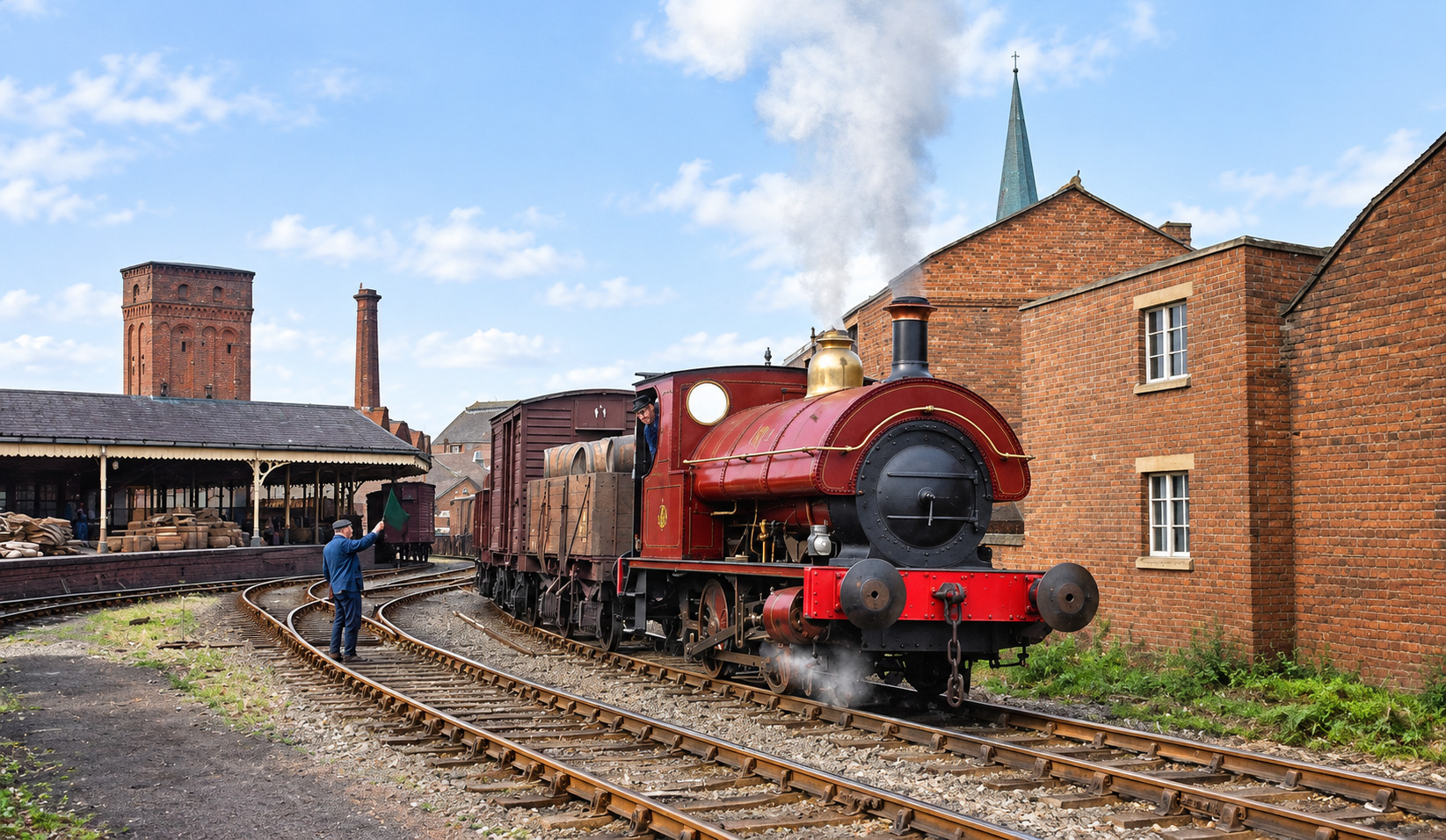
As anticipated, the town’s internal railway had become more infamous than famous with vehicle drivers and pedestrians alike by the time it had reached its peak of 32 railway crossings.
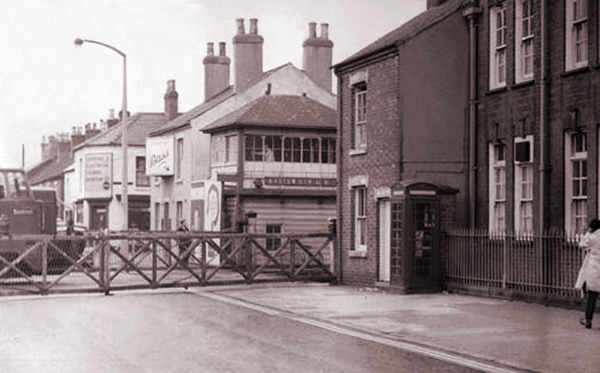
The crossing in New Street with Burton General Hospital in the foreground.
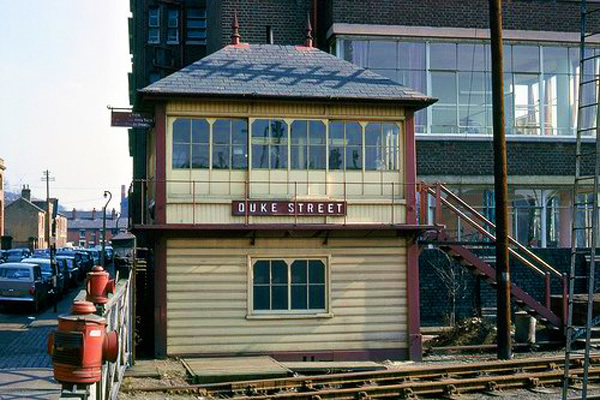
A later photo from a little further down from the New Street Crossing above, this time in Duke Street with the ‘new’ wing of the Burton General Hospital behind.
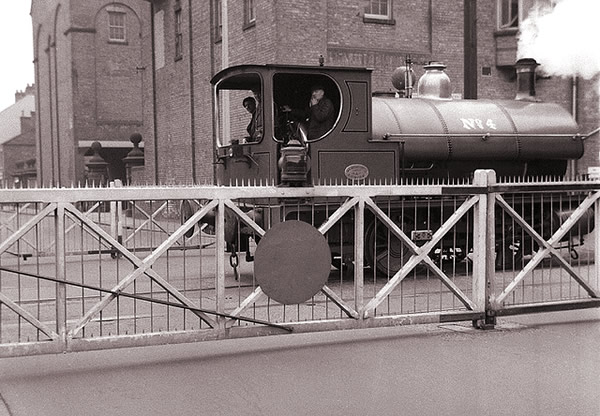
A view of the Station Street crossing in action.
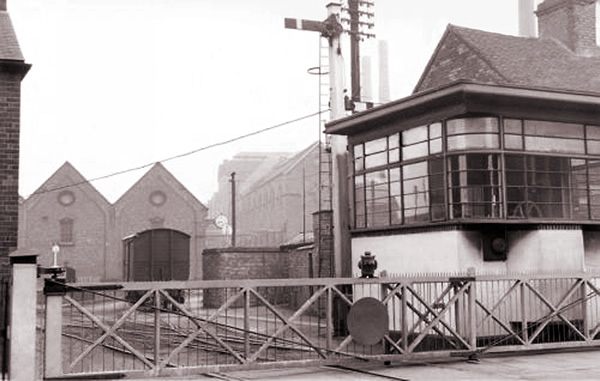
A view of the opposite side of the road reveals one of the more ‘modern’ style of control box.
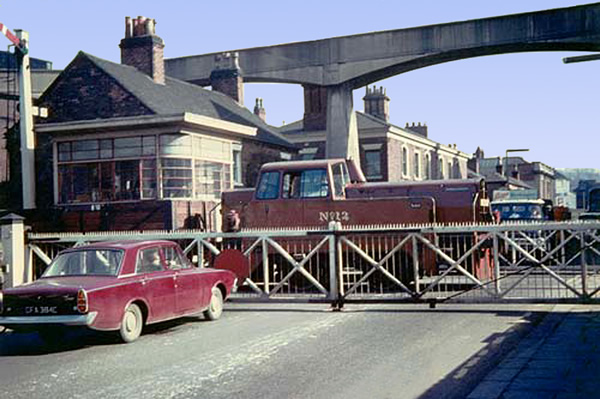
A later view of the same Station Street crossing. I am not too hot on brewery trains but I CAN say that the car waiting is a 1965 Ford Corsair with its distinctive pointed front.
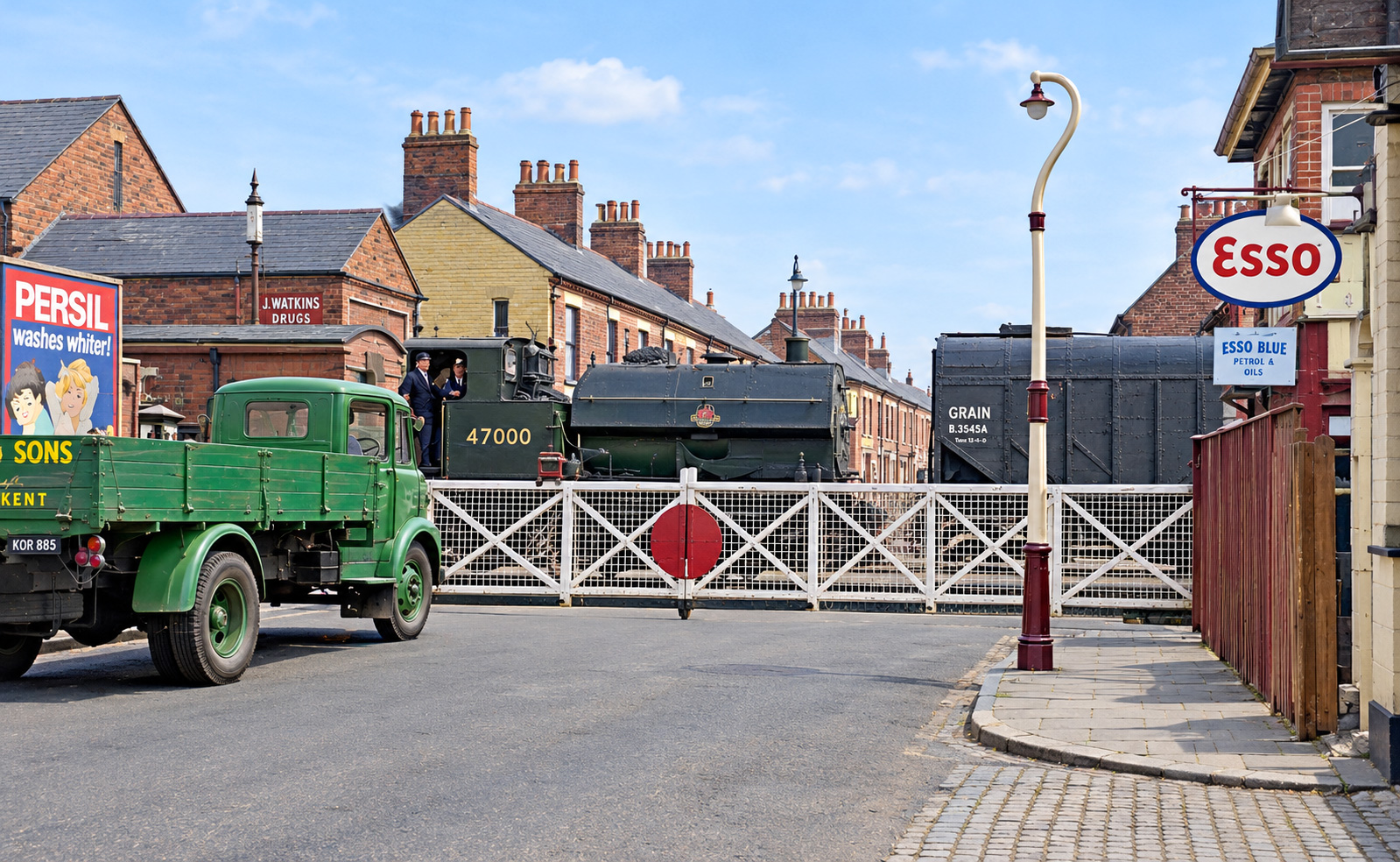
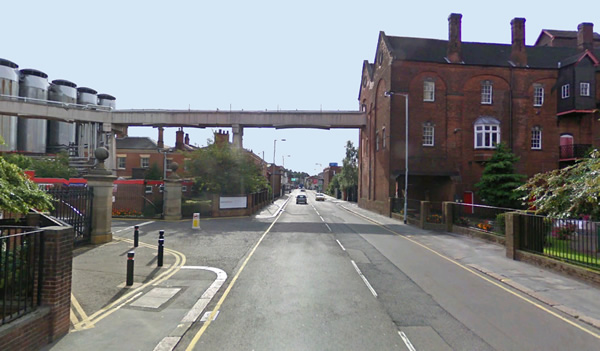
The present day site of the Station Street crossing still has lots of features that can be picked out from the photos above but even still, it is difficult to image trains running back and forth across the road all day.
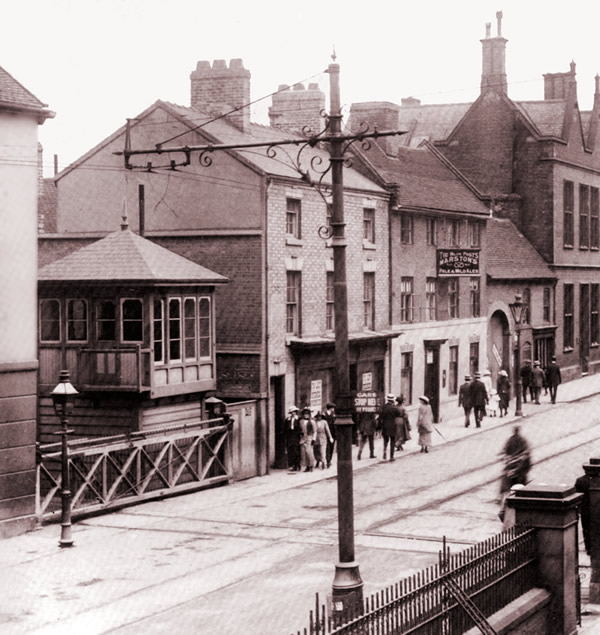
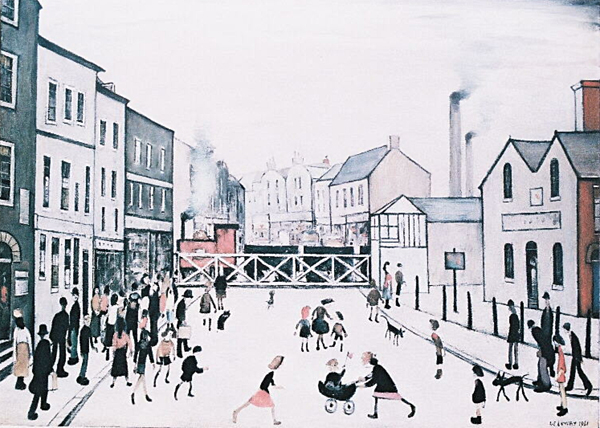
The crossing next to the Blue Posts in High Street was some time later immortalised by being featured in an L.S. Lowry painting, ‘The Crossing’.
The Sinai Park site, due to its elevated strategic position, has a history dating back to Roman times and before. The hilltop site enjoyed commanding views over the Trent Valley in both directions making it an ideal outpost being mid-way on a day’s march from Derby to Lichfield.
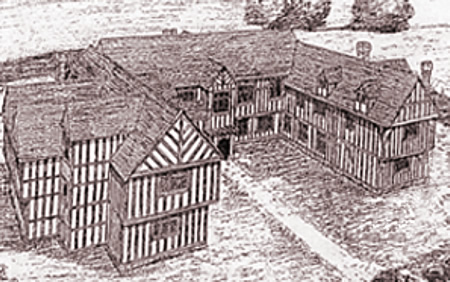
The Saxons also used the location as a stronghold and, in Medieval times, the fortified manor of the de Schobenhale family, dominated the area. A large house preceded the existing one but the most evident feature from this period is the 14th Century moat, dated by one source to 1334, which pre-dates the house and has special importance. The de Schobenhales gave Sinai Park to the monks of Burton Abbey in 1004. At the time, this was one of the most significant monastic seats in England.
In 1334, Abbot William Bromley of Burton Abbey gave five days indulgence from the bloodletting at Schobenhale Park with increased allowance of bread and beer for convalescence and recuperation. The origin of ‘Sinai’ is thought to be ‘saignée’, the French word for bloodletting and nothing to do with the Biblical ‘Mount Sinai’ due to its elevation. On a 1410 map, it is however, marked as ‘Seyne Park’.
Around this time the monks were responsible for establishing two timber houses on the site which would later form the two wings of one large building when the two became joined together by a central section. There has long been a legend of a secret tunnel between Sanai and Burton Abbey but this is pretty clearly nonsense.
Rest and recuperation seems to have gained quite a wide definition by the time of the Dissolution of the Monasteries in the 1530s. By then, the Abbot had his own parlour in the northeast wing, his monks were hunting for deer in the park and engaging in a number of highly frivalous activities, which even resulted in the occasional murder. These were cited in some of the reports back to Henry VIII to re-enforce the need for a dissolution.
As a result of the Dissolution, Sinai was included in the many estates acquired by the William Paget family in 1546. William Paget, one of Henry VIII’s chief ministers, was also installed as the first Baron of Beaudesert. The Paget family would continue to own Sinai for almost 400 years during which time, they would also become earls of Uxbridge and marquises of Anglesey.
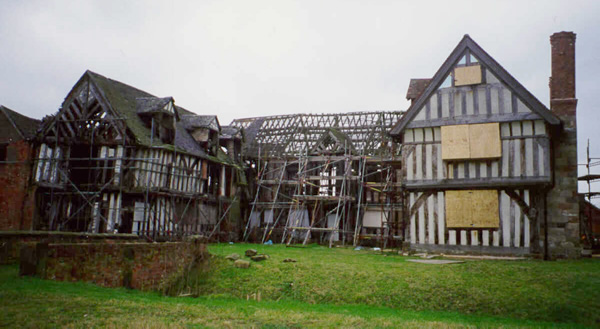
Sinai was never the Pagets’ main house. This was originally their country house at Beaudesert and eventually their grand new home in Anglesey, Plas Newydd, designed in the 18th century by James Wyatt. Even within Burton, the Manor House (now offices close to the Winery) was their preferred residence so Sinai was used principally as a hunting lodge with its own deer park. It did though, enjoy a number of important guests including the earl of Essex during Elizabeth I’s reign.
The main central section which joined the two existing wings together to form a much larger property, was built by the Pagets in 1605 which elevated the house to a much grander status. In the 1700s there was still more building work with large Tudor-style chimneys being erected which added further to its grandeur. Also from this period is what was then a very fashionable plunge pool (waterfall lake), built in the grounds, using as its source the Chalybeate well below the house.
In 1732, a more impressive bridge over the moat was built to replace an existing one on the same site. The original bridge was one of four similar ones and the location of a skirmish between the Paget men and the Bagots of neighbouring Blithfield during the English Civil War.
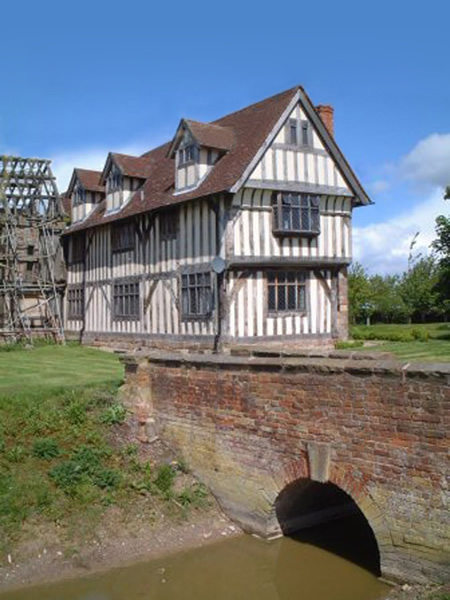
While the architect, James Wyatt, was being commissioned by the Pagets to build a new principal seat, Plas Newydd on the Isle of Anglesey, his brother William became the tenant of Sinai. William’s daughter was married there to John Smith who was working with James Brindley on the new canal network, and his son who took over the tenancy and stewardship of the house but was eventually fired and asked to leave for spending too much unauthorised money on its development.
The last Paget to own Sinai was Henry Cyril Paget, 5th Marquess of Anglesey (1875 – 1905) who was known as ‘Toppy’. The ‘Black Sheep’ of the Paget family; a British Peer notable during his short lifetime for squandering away the Paget inheritance on a lavish social life and amateur theatricals accumulating massive debts.
On the death of his father in 1898, as well as Sinai Park, he inherited the title and family estates which included Beaudesert in Staffordshire, formely the family’s principal residence, Plas Newydd on the Isle of Anglesey and other estates in Derbyshire and Dorset totalling over 30,000 acres and providing an annual income of £110,000. Someone would have to work very hard to make this fail!
He spend very little time at Sinai which, on his death, was one of many parts of the estate that had to be sold as part of the settlement of family debt. After being sold, the house was converted to six ‘cottages’. For a while, it provided a billet accommodation for the RAF. In a gravely deteriorated state, it eventually slumped to becoming a makeshift shelter for pigs, sheep and hens.
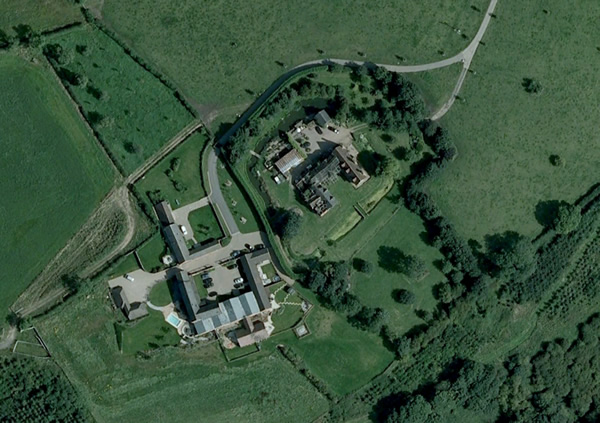
It was described as “The most important house in England to be in such a state”. In recent years, thankfully, it has undergone major restoration with help from the English Hertitage and is listed as a Grade II* listed building. The 13th century moat is separately listed as an ancient monument.
Adjacent to Sinai Park House is the present day farm house and associated buildings.
I was dumbfounded to first learn of the sheer scale of Burton Abbey which occupied a 14 acre site. I remain amazed that I could have lived in Burton for decades before discovering that such a huge structure ever existed. What I had always known as the Abbey was in fact, a relatively small annex which spent at least some of its time as an infirmary. The complete Abbey in fact extended to include all of what is now the Market Hall and Saint Modwen’s church.
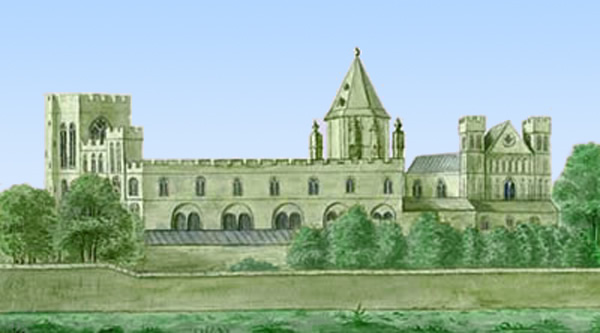
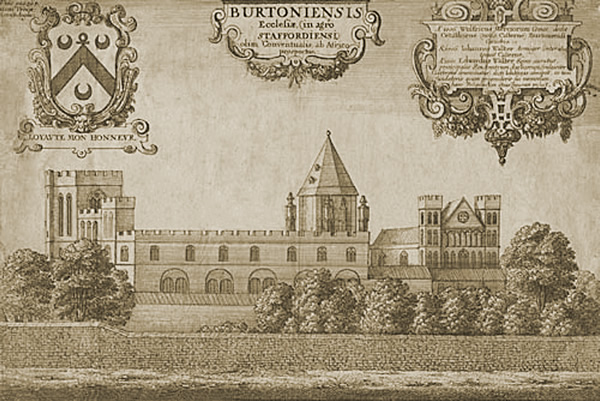
The above picture is my re-creation based on the below 1661 engraving by W. Hollar that appears in numerous sources and can be found on a plaque of the outside wall of the Coopers Shopping Centre close to the ‘Market Entrance’.
Select page to view:
Burton Abbey featured in the Domesday Book in 1086 where it appeared as the abbey of Saint Mary. It was recorded as also controlling lands outside of Burton, included Mickleover, Appleby Magna, Coton in the Elms, Caldwell and Ticknall.
By 1310, the abbey had been reduced to one of the smallest and poorest Benedictine monastery in England, suffering a number of severe financial difficulties often due to mismanagement and outright criminal behaviour. At this time, the number of monks had been reduced to around thirty. Even so, as an abbot, the holder of the position between 1295 and 1322 was summoned to attend the ‘Parliament of England’.
By the 1520s, the number of monks had been reduced to less than twenty but, almost contradictary, the abbey was the most important in Staffordshire and by the 1530s had the highest revenue. The abbot was both a secular lord and, “exercised an independent spiritual jurisdiction”. He was a figure of some standing, regularly serving on papal and royal commissions and acting as a collector of clerical taxes within the diocese.
There have been a number of Royal visits to the abbey. William I came on a visit to the shrine of St. Modwen; Henry II was at Burton in 1155, John in 1200, 1204, and 1208, Henry III in 1235 and 1251, Edward I in 1275 and 1284, and Edward II in 1322 during the campaign against Thomas Plantagenet, earl of Lancaster.
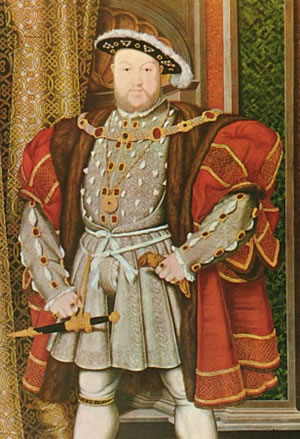
By the early 1530s the abbot was paying procurement fees to the bishop for Burton, Abbots Bromley, and Mickleover as well as for Ilam and Austrey; he also paid similar fees to the archdeacon for Abbots Bromley and to the bishop for visitations of the abbey.
Although there was general fear for the future of major religious establishments as Henry VIII wrangled with the pope over his ‘Great Matter’, this was temporarily overshadowed by the election of a new Burton abbot in 1533 following the promotion of the current Abbot de Bronston to Abbot of Westminster. This caused some excitement because it was the highest office ever attained by any monk of Burton.
Bishop Lee, under instructions from Thomas Cromwell, went to Burton in June with Richard Strete, Archdeacon of Derby, and David Pole, the vicar general, and “so sped the election” that the community agreed to leave the choice of a new abbot to the bishop and the archdeacon, stipulating only that one of themselves should be chosen before the 1st August. Cromwell’s original candidate seems to have been ‘the monk Baylye’, but William Edys, the ‘third prior’, was actually appointed.
By 1536, Henry was installed as Head of the Church of England and had laws, now known as the first dissolution, had been enacted to allow the King to seize any church building with an income of less than £200. Many were confiscated. Some were pillaged and destroyed, other smaller ones were turned into graineries, barns and stables.
Early in 1538 Francis, Lord Hastings, wrote to Thomas Cromwell to point out that Burton Abbey “lay very conveniently” for him, adding that he would have asked for it earlier but for an attack of measles. Later the same year the Crown tried to secure the tithes of Austrey for a royal official, but the abbot replied to Cromwell that the income was “so necessary to our house that we cannot do without it”. The Abbey was the centre of life in Burton; it was also a place of pilgramage to the shrine of Saint Modwen and received around £2 per year in offerings. The suppression of ‘Idolatry’ (worship of false idols) was one of the leverages used by the crown.
Sir William Bassett of Meynell Langley, a manor a few miles to the North-West of Derby, received instructions from Thomas Cromwell at the end of August 1538 “that such images as you know… so abused with pilgrimages or offerings… you shall for avoiding that most detestable offence of Idolatry forthwith take down”. Sir William carried out his task and replied to Cromwell in a letter, as follows:
Right honourable my inespecial good lord, according to my bounden duty and the tenor of your lordship’s letter lately to me directed, I have sent unto your good lordship by this bearer, my brother Francis Bassett, the images of St Anne of Buxton and St Modwen of Burton upon Trent which images I did take from the places where they did stand, and brought them to my own house within 48 hours after contemplation of your said lordship’s letter, in as sober manner as my little and rude wits would serve me. And for that there should no more idolatry and superstition be there used I did not only deface the tabernacles and places, where they stand but also did take away the crutches, shirts and sheets with wax offered, being things that did allure and intice the ignorant people to the said offerings, also giving the keepers of both places admonition and charge that no more offerings should be made in those places till the King’s pleasure and your lordships be further known in that behalf. My lord, I have locked up and sealed the baths and wells at Buxton and none shall enter to wash them till your lordship’s pleasure be further known. Whereof I beseech your lordship that I may be ascertained again at your pleasure and I shall not fail to execute your lordship’s commandment to the uttermost of my little witt and power. And the trust that they did put in those images and the vanity of the things, this bearer, my brother can tell your lordship better at large than I can write for he was with me at the doing of all and in all places, as knoweth good Jesus, whom ever good lordship in his blessed keeping. Written at Langley with the rude and simple hand of your assured and faithful orator and as one ever at your commandment, next unto the King to the uttermost of my little power.
Signed William Bassett (Knight)
William employed his brother, Francis Bassett – a servant to Thomas Cranmer, archbishop of Canterbury, to physically remove the statue. The statue was removed, its receptacle heavily defaced and further pilramages and offerings were outlawed.
On 1st September, Thomas Thacker, Steward to Cromwell, wrote to his Master telling him that Francis Bassett had delivered to Austin Friars (Thomas Cromwell’s main residence) in London, “the image of Saint Modwyn with her red cow and her staff which women labouring of child in those parts were desirous to have with them to lean upon and to walk with“. This is the best available description of the object.
Thomas Cromwell fell from grace a few years later and was arrested being accused of many crimes, most significantly treason. Cromwell was condemned to death without trial and beheaded on Tower Hill on 28 July 1540 (the day of the King Henry VIII’s marriage to Kathryn Howard). Following his death, an inventory was taken of his belongings which showed an extensive collection of treasures that had been confiscated from the church for supposed destruction. It has not been possible to identify the images of St Anne and St Modwen mentioned in the letter from Sir William Bassett.
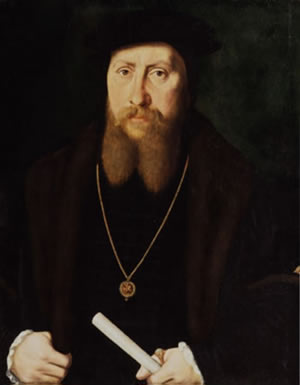 As the Dissolution continued, many great Abbeys such as Glastonbury, Shaftesbury and Canterbury which had flourished as pilgrimage sites were reduced to ruins. Some were gifted to the Kings most ‘loyal subjects’. In 1539, Abbot Edys was finally forced to surrender Burton Abbey. Rather than being destroyed like most abbeys, it was later gifted, together with extensive grants to lands including what is now Cannock Chase, to Sir William Paget (pictured) – a close adviser to Henry VIII who later became 1st Baron Paget of Beaudesert. This fortunate survival left the abbey one of the largest in the country. The abbot’s probate jurisdiction in Burton also passed to the Pagets, who continued to exercise it until 1858.
In February 1539 Dr. John London was at Burton and on 14th November the abbot and community surrendered their house and its possessions to Dr. Thomas Legh. Pensions ranging from £6 13s 4d to £2 were assigned to 7 monks: 5 priests, a deacon, and a novice. The abbot and probably four remaining monks became members of the new college at Burton which was already being planned, though it was not actually founded until 1541. Robert Heathcote, one of the deacons, and Humphrey Cotton, the novice, were recorded as in receipt of their pensions when they died in 1552 and 1563.
The chronology of the dissolution of Burton Abbey was as follows:
A descendent of William Paget became the 1st Marquess of Anglesey in 1815. The title still exists and the current Marquess still has title to most of the land in Burton.