Menu Close

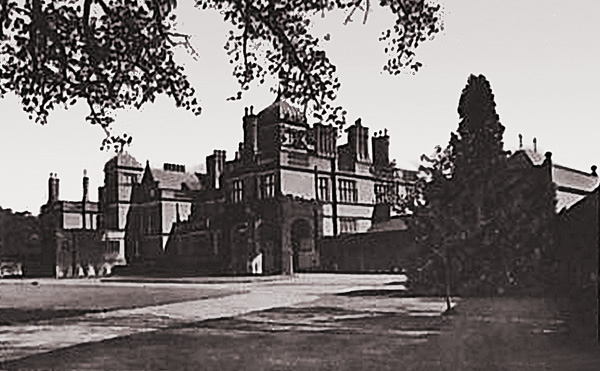
Drakelowe Hall after the Gresleys

DRAKELOW AFTER THE GRESLEYS
The contents of Drakelow Hall were sold in July, 1931, and with the consent of the auctioneers I had the privilege as president-elect of Burton Natural History and Archaeological Society, of taking a party of members around the Hall before the sale took place.

There were many panelled rooms with antique furniture, china, etc., and also a tapestry room. Five oaken beds dated from the reigns of Queen Elizabeth I and James I, while two early 17th century ebony beds were probably brought back from Spain by Walsingham Gresley (1585-1633) who was attached to the British Embassy in Madrid.

There were several pieces of armour and various weapons and a notable exhibit was a contemporary model of a 74-gun ship of the early 18th century, possibly the model of a ship in which Sir Nigel (sixth baronet) served. A valued heirloom was the Gresley Jewel, a fine specimen of the 16th century work in the form of a pendant, presented by Elizabeth I to Catherine Sutton, daughter of Lord Dudley, on the occasion of her marriage to Sir George Gresley, K.B.

There were many family portraits from the 16th century onwards as well as numerous other paintings. Many of these portraits are reproduced in the de-luxe edition of ‘The Gresleys of Drakelow’, by F.C. Madan (1899).

Following the sale of the contents of the Hall, an attempt was made to turn the Hall and park into a country club under the auspices of the Automobile Racing Association. It was proposed to open a “junior” road circuit of about three miles in the park by Whitsuntide, 1932, a further eight-mile circuit to be established later for motor racing.

The Hall was to become an A.R.A. country club house, the existing gardens and woodlands to be preserved in their original state. Tennis courts, a bowling green and a bathing pool were to be constructed while there would be boating and fishing facilities on a two and a half mile stretch of the River Trent with rights over a further one and a half miles of the river, giving a total stretch almost equal in length to the Boat Race course, where races and regattas could be held.

The mansion was to be altered to provide dining rooms, lounges, billiards rooms, card rooms, writing and reading rooms, a cocktail and other bars, tea rooms, dressing rooms, a gymnasium with skilled attendants of both sexes, and hairdressing salons.

There would be residential facilities, for there were already 14 bedrooms and nine bathrooms, in addition to those reserved for the staff.

Some of the stabling was to be retained for use as a riding school and two coach houses would be turned into squash racquet courts. The construction of an indoor lawn tennis court in the stable yard was under consideration and it was proposed to lay out an 18 hole golf course in the park.

For all these facilities ordinary membership would cost £5 5s 0d. p.a., while life membership could be purchased for £52 10s 0d An associate membership however, would cost only £1 1s (one guinea) p.a.

The official opening of the club was arranged to take place on Whit Monday (May 16th) 1932, and the attractions included a motor cycle dirt-track of 1,000 yards on which ‘Cannon Ball’ Baker would set up the first record. A motor cycle gymkhana was to be arranged by the Burton Motor Cycle and Light Car Club, and there were equestrain competitions and a boxing display.

The ground and Hall were open to the public on payment of 1s 3d but Whit Monday, 1932, proved to be a very wet day. The attendance was poor and the scheme proved a failure, the “Country Club Company” being evicted from the premises on 16th July, 1932.

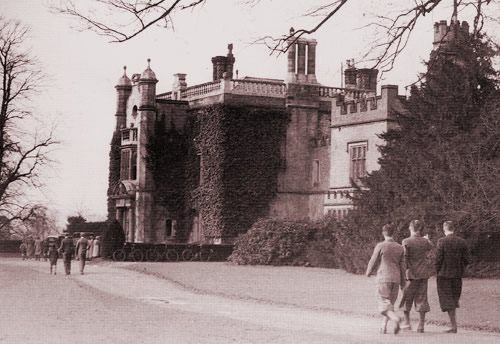
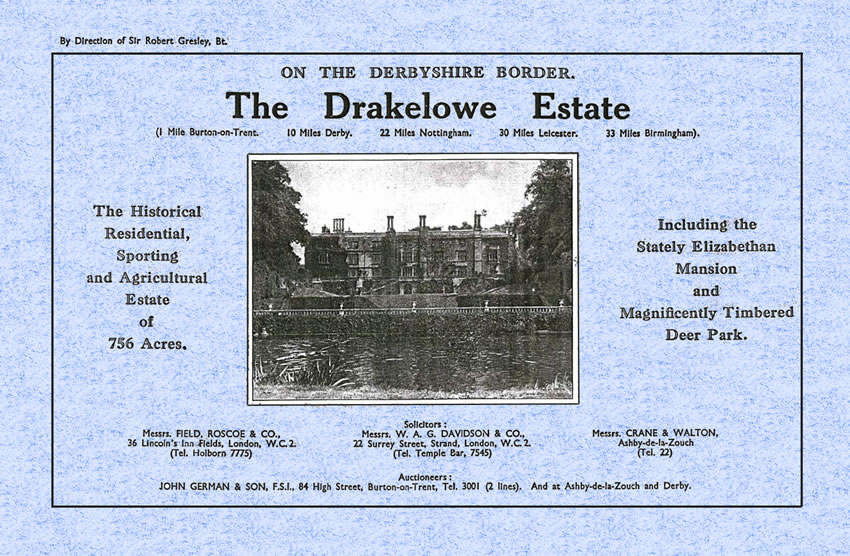
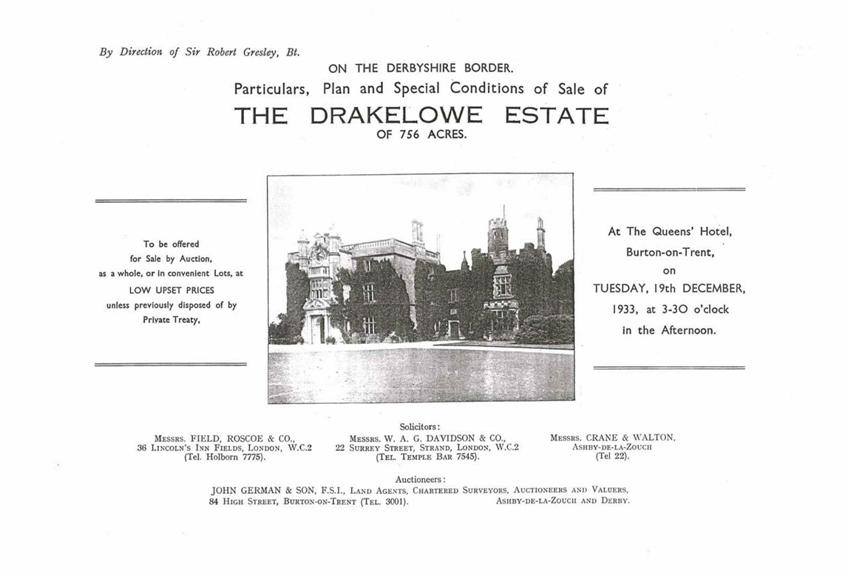
The outlying portions of the Drakelow Estate which covered 707 acres, were sold on 19th January, 1933, and the remainder, including the “stately Elizabethan Mansion and magnificently timbered deer park” was offered for sale at the Queen’s Hotel on December 19th, 1933. The auctioneers stated that the Hall, though mainly Elizabethan in character, had been altered and restored at different periods but never actually rebuilt.

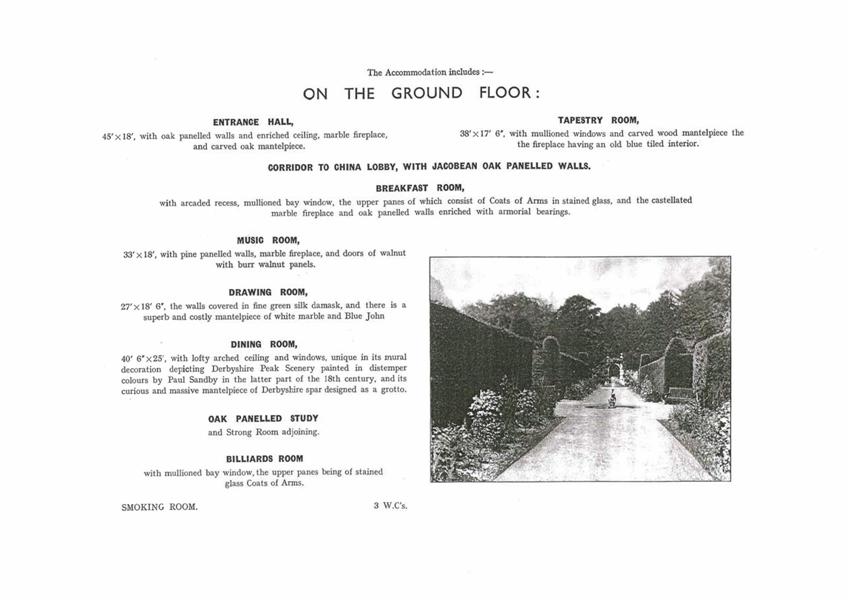
The accommodation on the ground floor included an entrance hall, 45 ft. by 18ft., with oakpanelled walls and a marble fire place, a tapestry room, 38ft. by 17ft. 6ins., with mullioned window and a corridor to a china lobby with Jacobean oak panelled walls. The windows of the breakfast room contained coats of arms in stained glass and the oak panelled walls are enriched with armorial bearings. The music room, 32ft. by 18ft., had pine panelled walls and doors of walnut with walnut burr panels. The walls of the drawing room were covered with fine green silk damask and there was a superb mantel piece of white marble and Blue John. There was also an oak panelled study and billiards room with mullioned bay windows containing glass coats of arms.

The most interesting feature of Drakelow Hall was undoubtedly the dining room known as the ‘Painted Room’. This was a room painted in the 18th century with a continuous landscape to create the illusion that the visitor was not in a room at all but outside, surrounded with picturesque scenery. A cornice was replaced by a coved ceiling which enabled the artist to run his trees up into an open sky, and real trellis work was set around the room and its apertures while the fireplace was disguised as a grotto.

The paintings represented scenery in the Peak district and were attributed to Pauly Sandby. Anna Seward, the ‘Swan of Lichfield’, who visited the Hall in 1794, thus described her impressions:

“Sir Nigel hath adorned one of his rooms with singular happiness. One side is painted with forest scenery whose majestic trees arch over the coved ceiling. The opposite side represents a Peak valley, while the front shows a prospect of more distant country. The chimney piece represents a grotto formed of spars, ores and shells. Read palings, breast high and painted green, are placed a few inches from the walls and increase the deception. In these are little wicket gates that half open, tempt the visitor to ascend the forest banks”.

It is pleasing to add that this room is now preserved in the Victoria and Albert Museum in London.

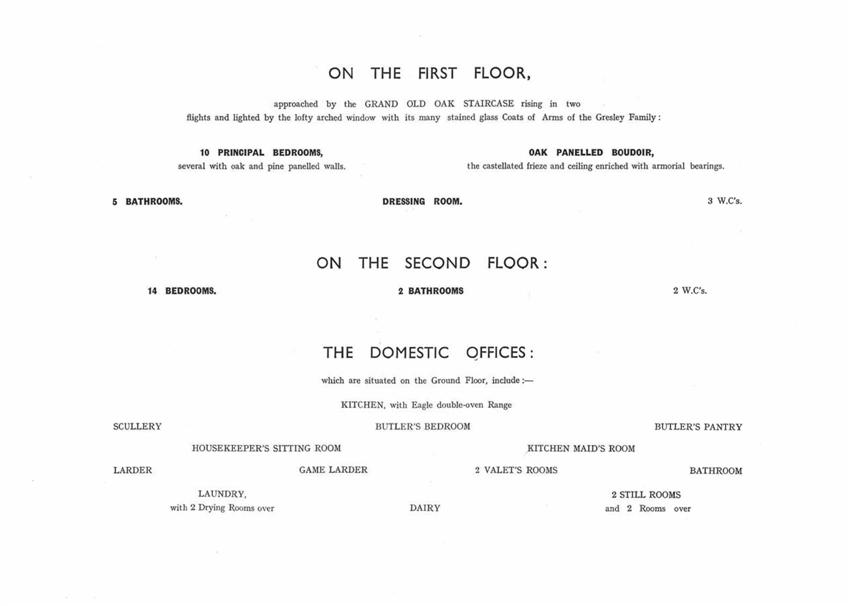
An old oak staircase rising in two flights and lit by a lofty arched window containing stained glass coats of arms of the Gresley family led to ten principal bedrooms, five bathrooms, a boudoir and dressing room, all of which were on the first floor. There were also 14 bedrooms and two bathrooms on the second floor.

The domestic offices on the ground floor included a large kitchen scullery, butler’s pantry, butler’s bedroom, housekeeper’s sitting room, kitchen maid’s room, two valets’ rooms, bathroom, larder, game larder, two still rooms, laundry and dairy.

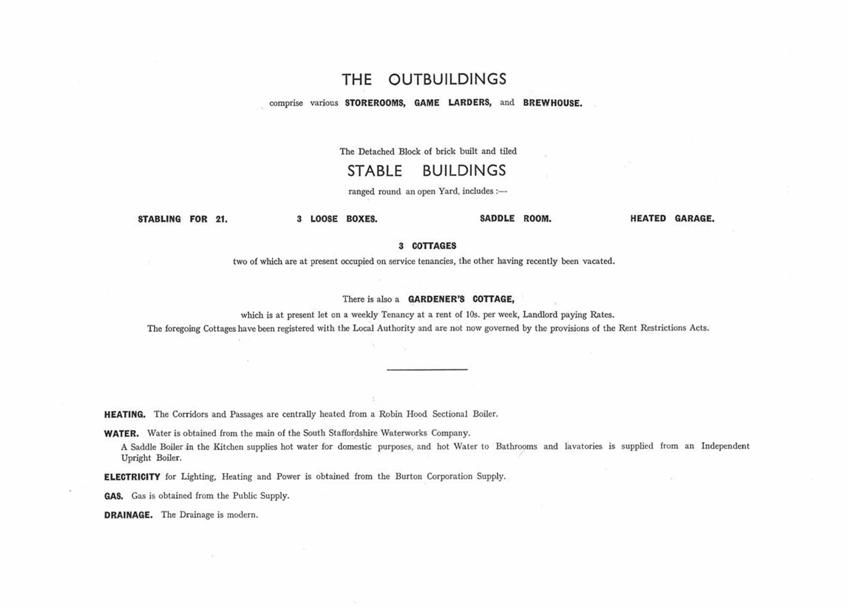
The outbuildings included store rooms, game larders and brewhouse, while a detached block of stable buildings comprised three loose boxes, stabling for 21 horses, a saddle room and a heated garage, together with a gardener’s cottage.

The estate was purchased by Sir Albert Ball, of Nottingham, in conjunction with Messrs, Marshall Bros. (Timber Merchants) Limited, for £12,500.

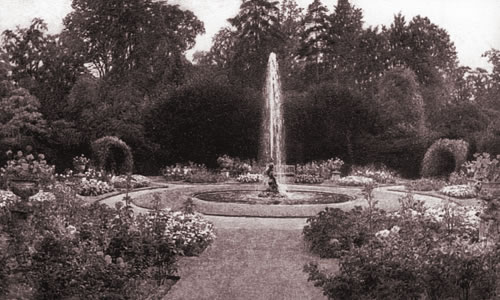
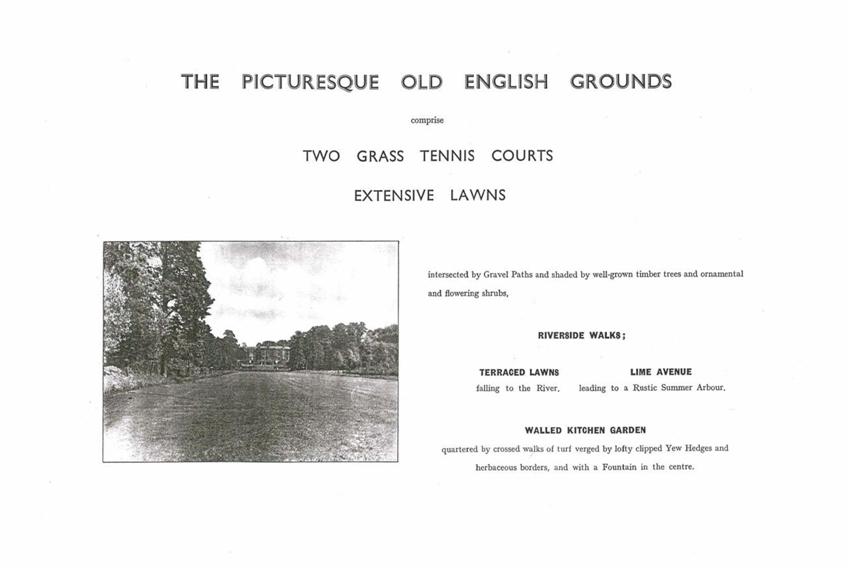
The extensive pleasure grounds adjoining the Hall were surrounded by a protective belt of trees and some of the hollies and yews were trimmed to a height of thirty feet. There were several separate small gardens and pleasaunces which were probably laid out in the 18th century.

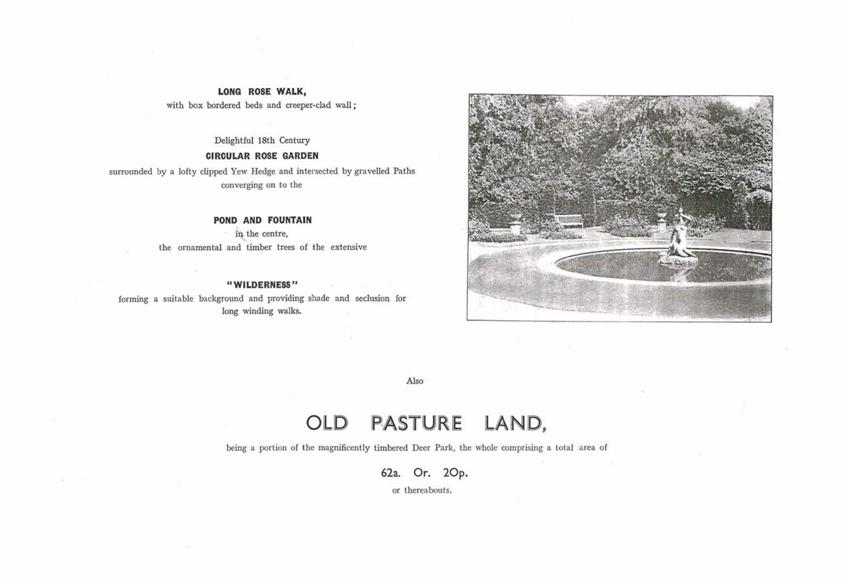
Of these the most notable was the round garden, in the middle of which was a circular stone edged basin with a central fountain in the form of a mermaid blowing water through a conch or shell. This old garden was improved by Sir Robert Gresley (eleventh baronet) who placed the fountain there. There were also several large stone vases filled with flowering plants.

In another garden, four wide grass walks converged upon a small stone basin also ornamented with a fountain. There was also a long box garden and a walled rose garden laid out in the reign of William III. The ‘temple’ at the end of the rose garden was built from the designs of Reginald Bloomfield, author of “The Formal Gardens of England”. Paintings of these gardens by Beatrice Parsons (1905) are still in existence. All the gardens were quite separate and at one time a staff of 30 gardeners was required for their maintenance.

In January, 1934, Drakelow Park and Warren Farm were purchased from Sir Albert Ball and Messrs. Marshall Bros, by Mr. C.F. Gothard of Bearwood House, Burton-on-Trent, who as a boy had been permitted by the Gresley family to ride in the park and fish the river Trent where it passed through the Drakelow estate of which he thus acquired pleasant memories.

The hall was carefully examined to see if any part of it could be modernised and made habitable, but acting upon expert advice it was decided that the mansion would have to be demolished and this was done.

Mr. Gothard also purchased separately the Barn Farm and the Grove Farm with outlying woods and other land, so that with his purchase of the park, Warren Farm and adjacent woodlands, almost the whole of the former Drakelow estate as it stood after the first World War passed into his possession.

Extensive stabling premises and other outbuildings forming the coach yard of the hall were left standing and part of this block, comprising mainly some of the harness rooms, was converted into a farm house by the new owner who was interested in farming, the preservation of wild life and also in game and wildfowl shooting. In course of time he hoped to take up farming on a larger scale, to build a small modern house near the site of the hall, and to beautify the banks of the river with flowering trees and shrubs. He farmed the whole of the park during the 1939-45 Second World War, but unfortunately the prospective development plans did not come to fruition.

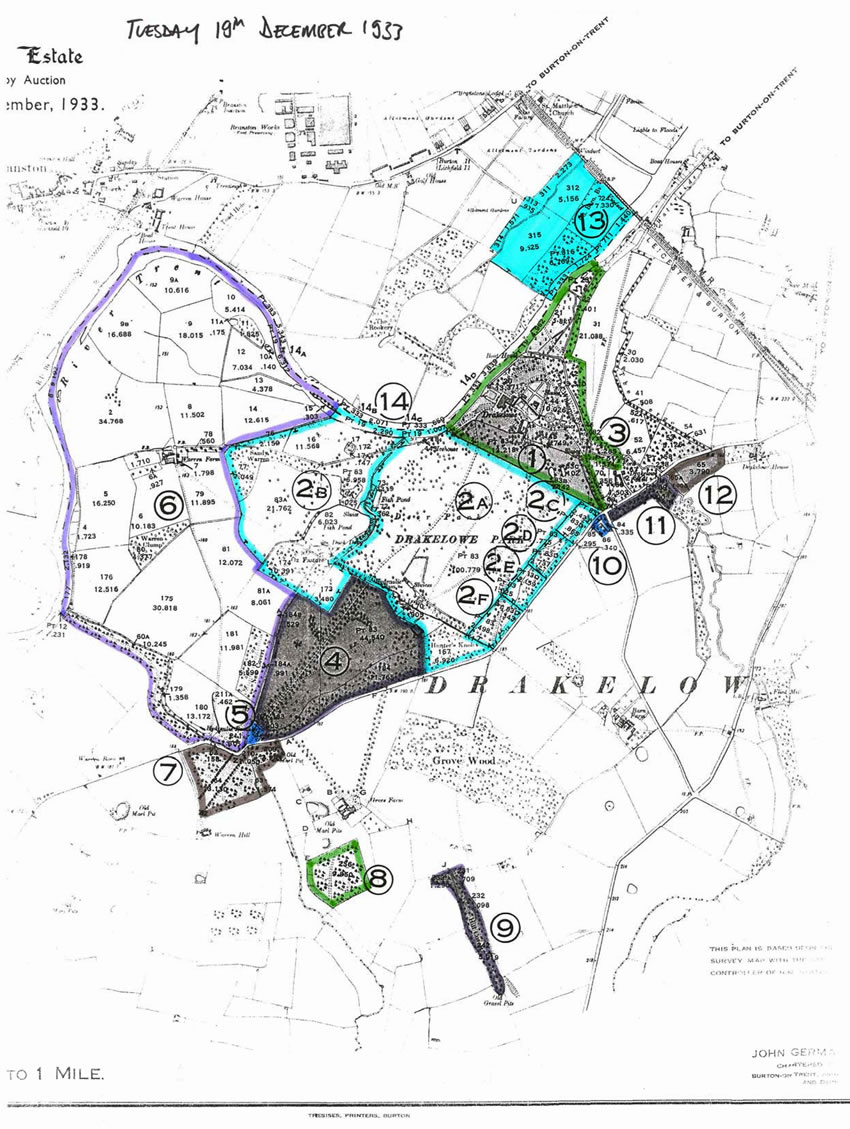
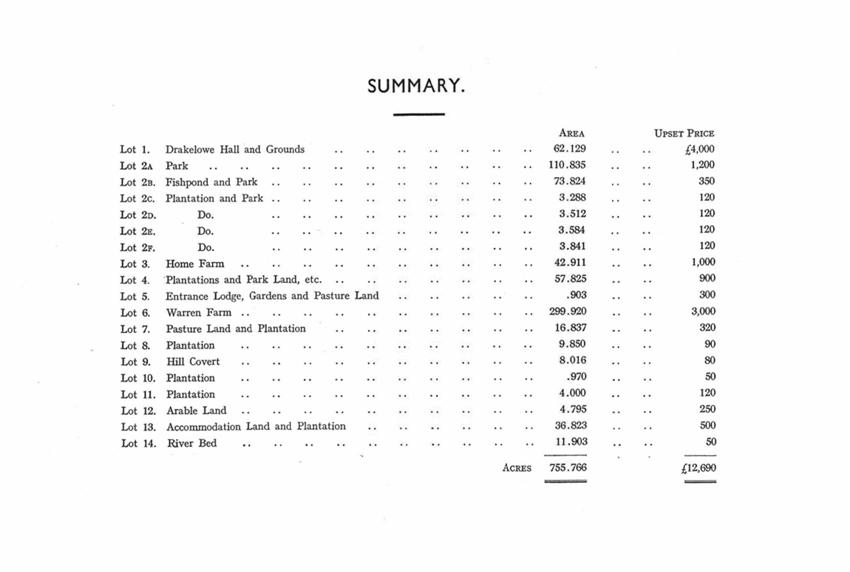
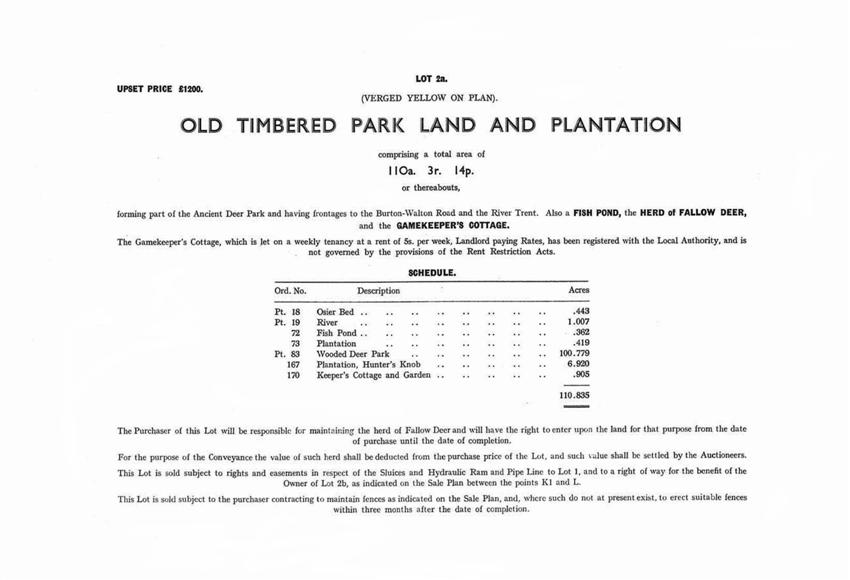
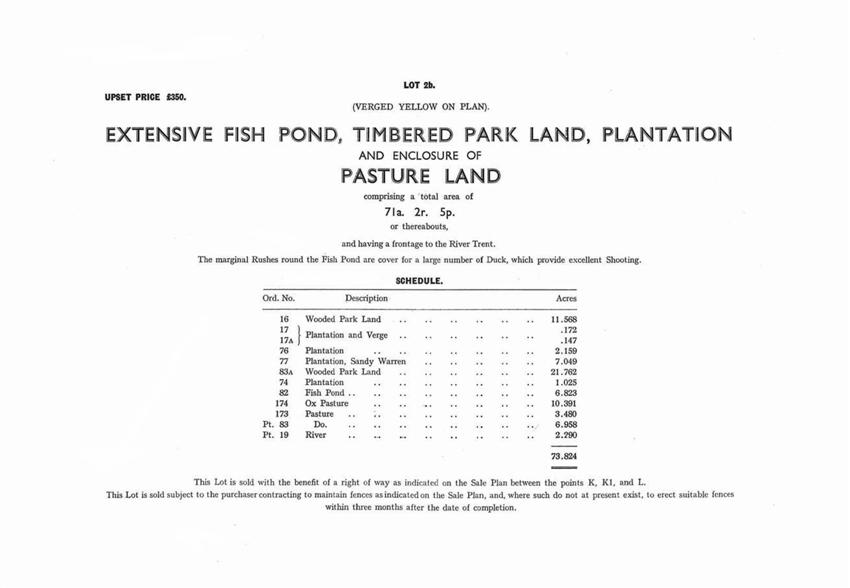
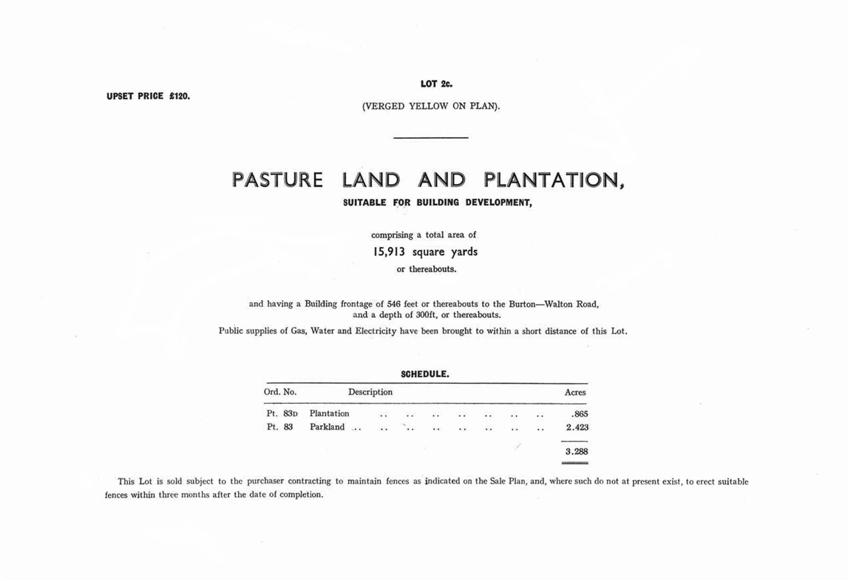
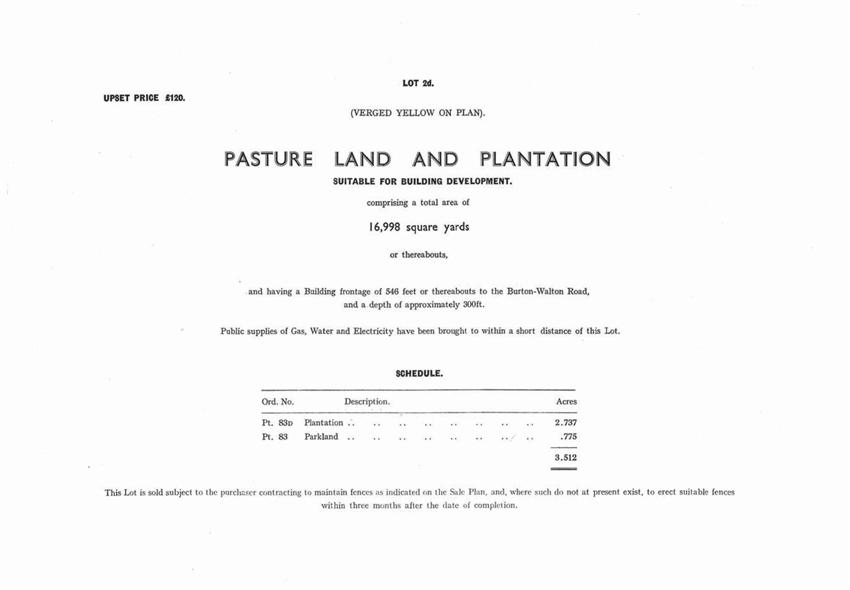
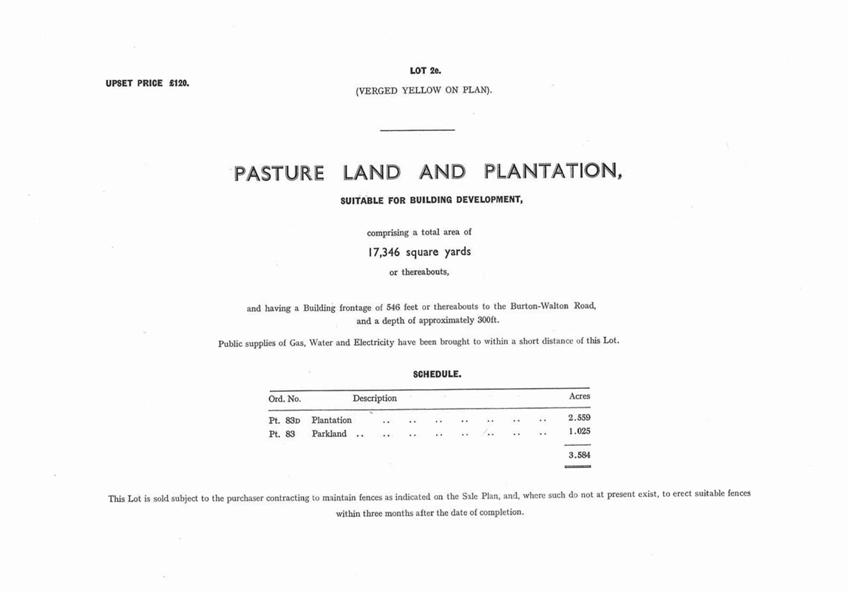
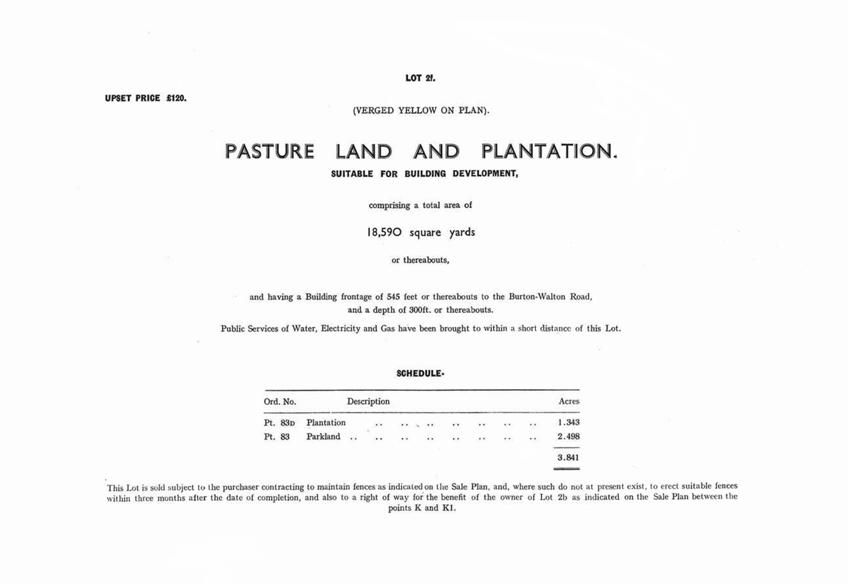
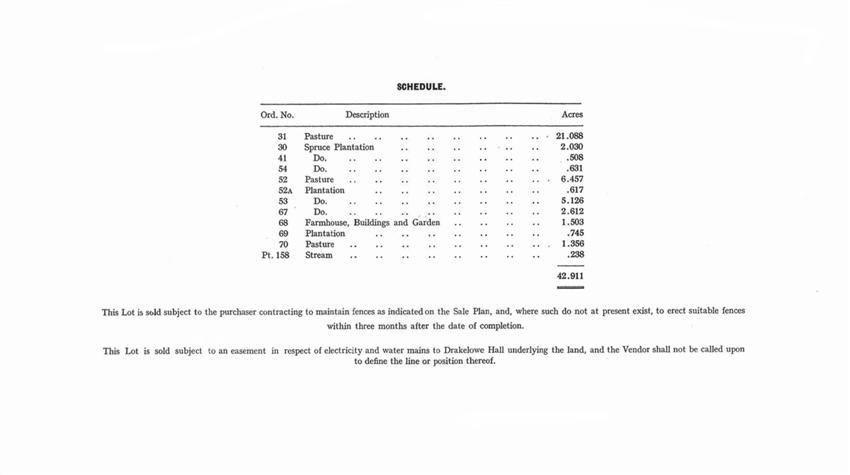
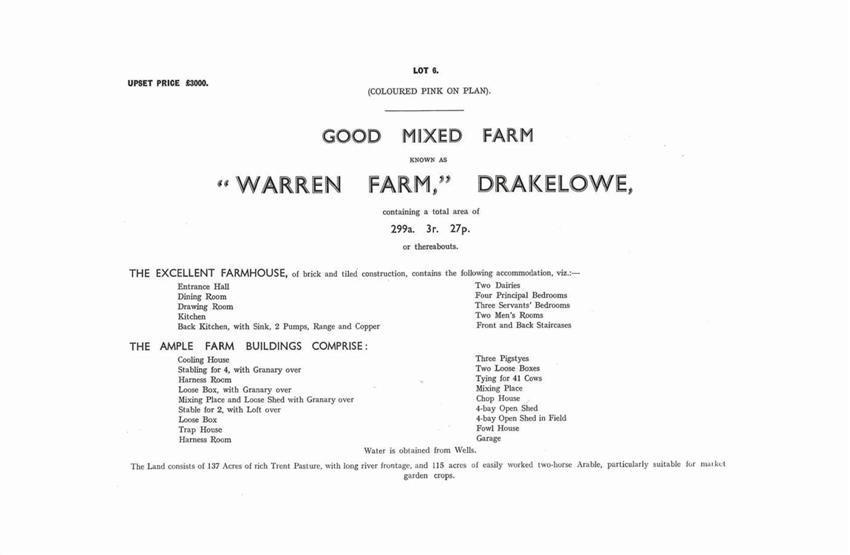
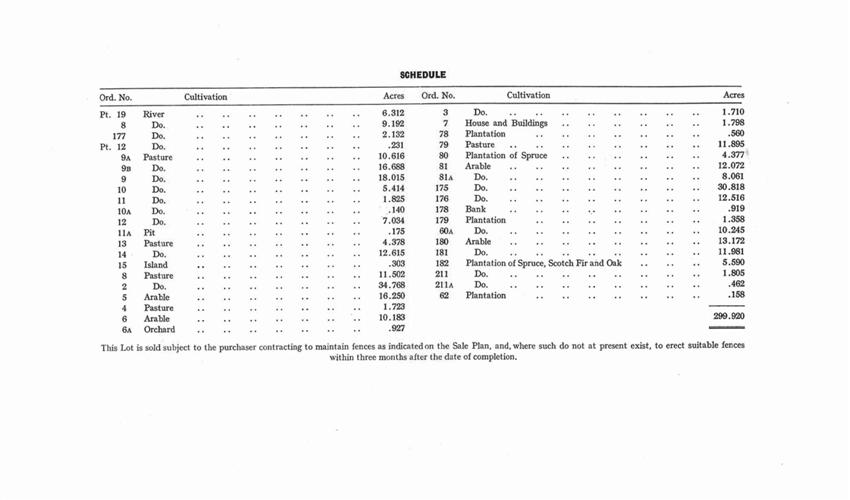
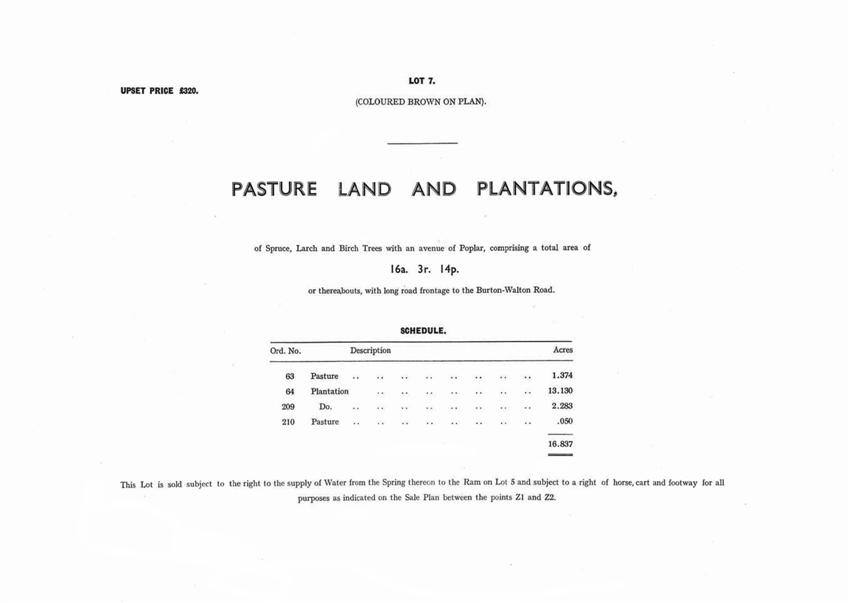
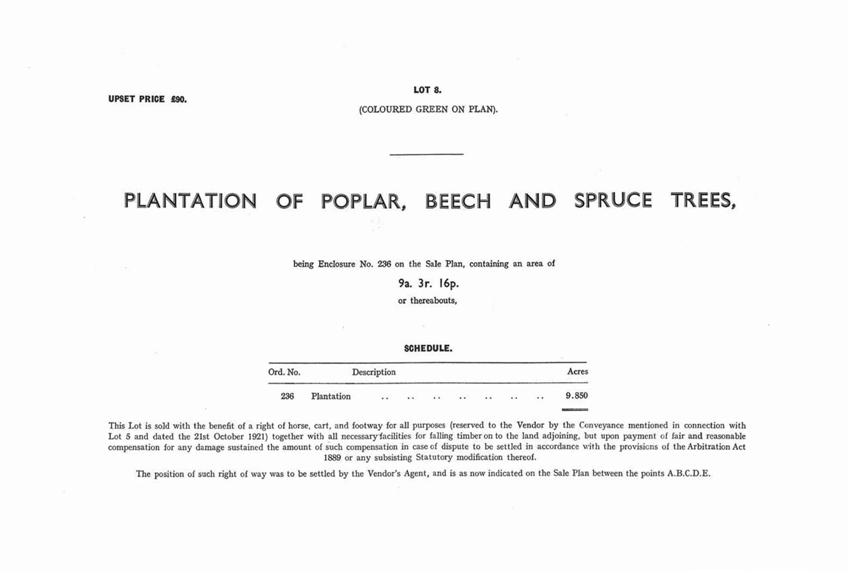
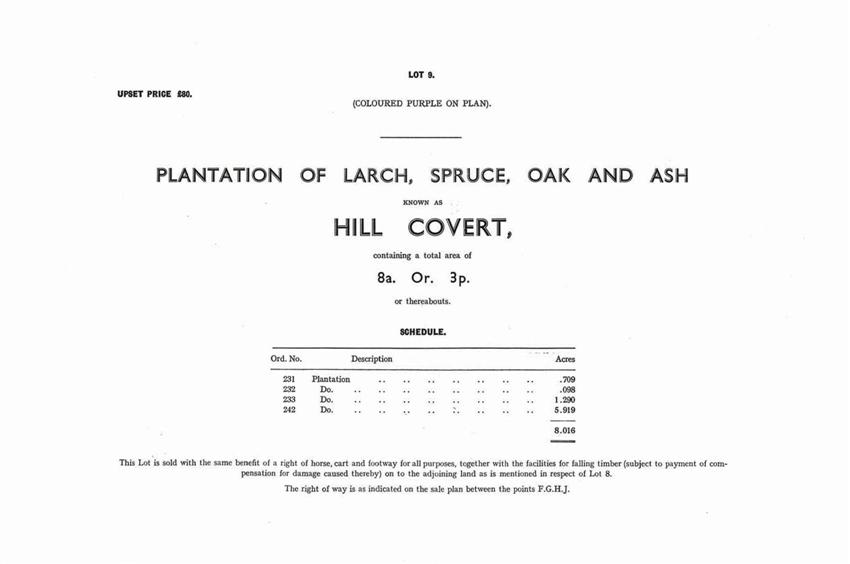
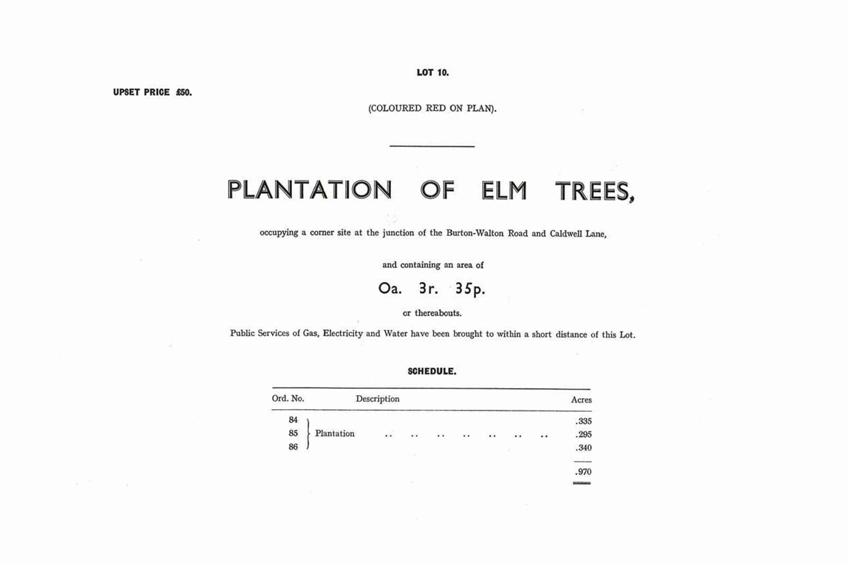
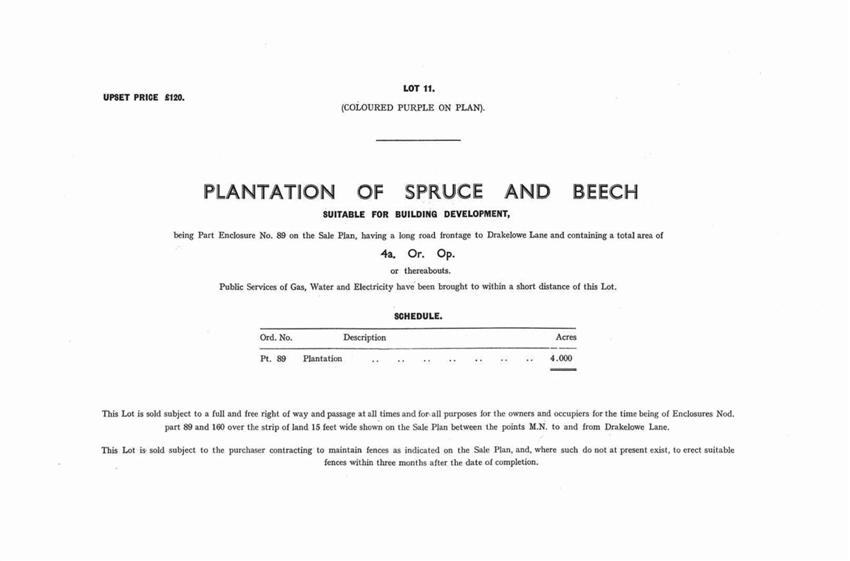
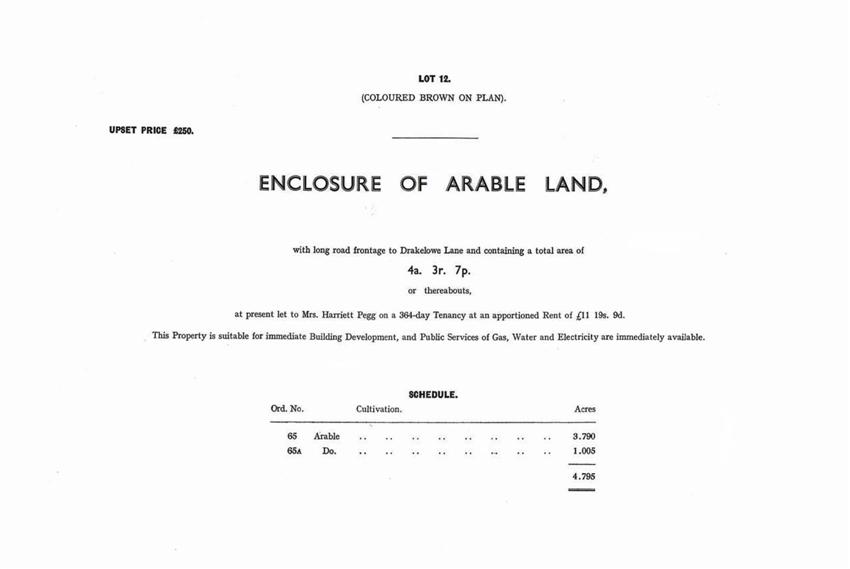
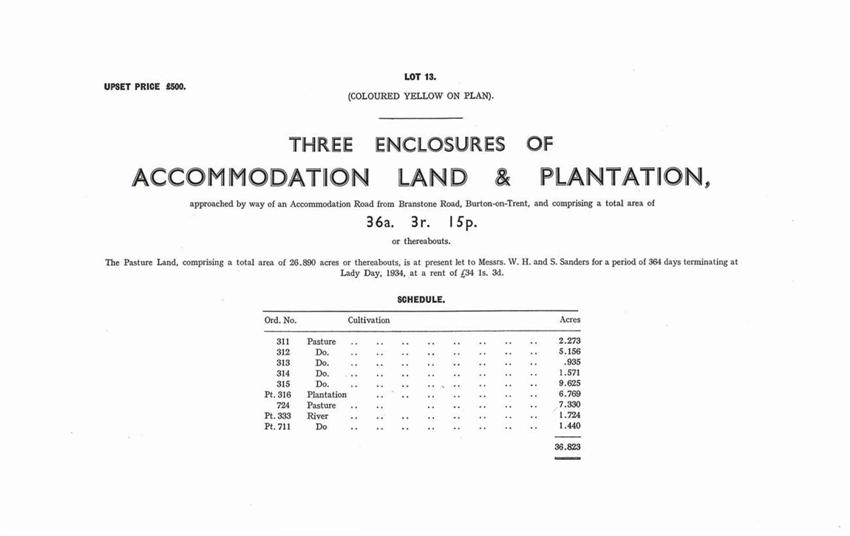
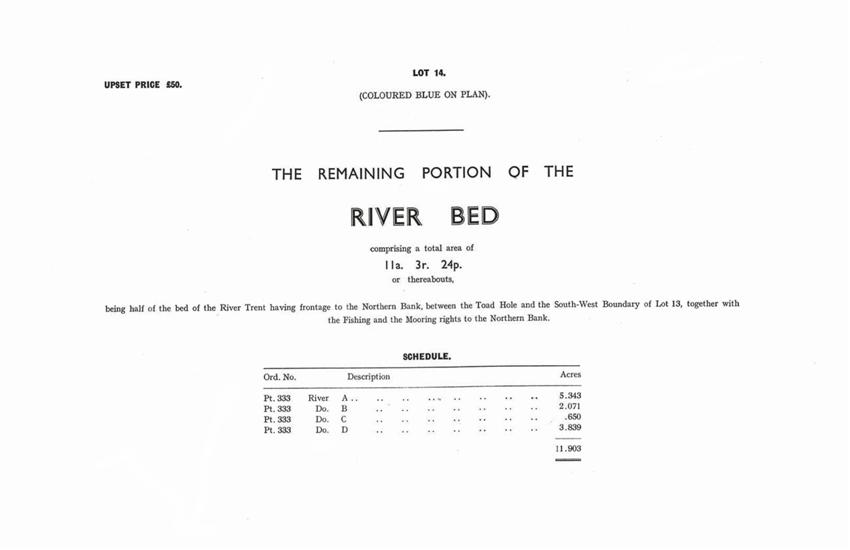
In 1933, there was an attempt to sell Drakelow Hall and its estates as a set of separate lots, the sales brochure of which can be seen in the ‘For Sale’ section, but the sale was unsuccessful. There followed, an unsuccessful attempt to turn it into an exclusive country club. Like many of Burton’s surrounding stately homes, it was demolished shortly afterwards.

Drakelow Park and Warren Farm were eventually acquired by the British Electricity Authority in 1950 to become the site of Drakelow Power Station.

Drakelowe Estate Sale


Transcription of above page:
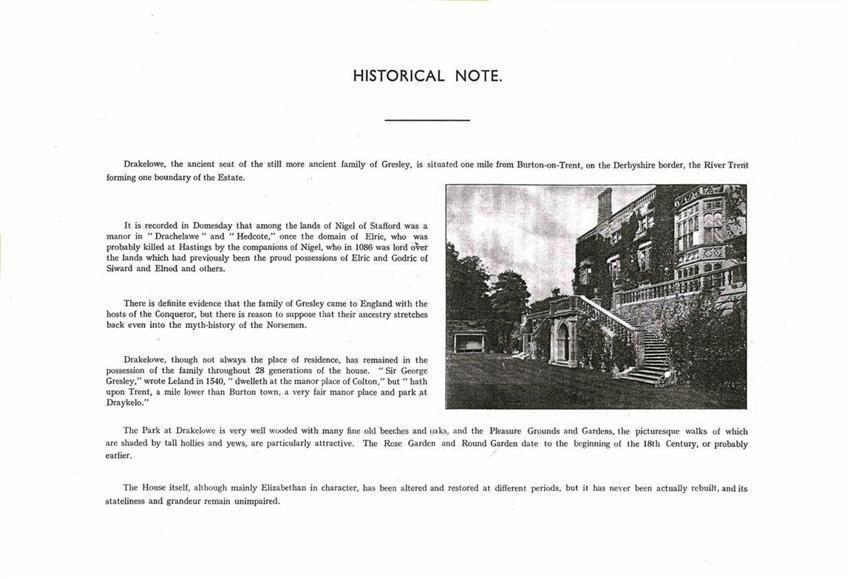
HISTORICAL NOTE.
Drakelowe, the ancient seat of the still more ancient family of Gresley, is situated one mile from Burton-on-Trent, on the Derbyshire border, the River Trent forming one boundary of the Estate.

It is recorded in Domesday that among the lands of Nigel of Stafford was a manor in ” Drachelawe ” and ” Hedcote,” once the domain of Elric, who was probably killed at Hastings by the companions of Nigel, who in 1086 was lord over the lands which had previously been the proud possessions of Elric and Godric of Siward and Elnod and others.

There is definite evidence that the family of Grcsley came to England with the hosts of the Conqueror, but there is reason to suppose that their ancestry stretches back even into the myth-history of the Norsemen.
Drakelowe, though not always the place of residence, has remained in the possession of the family throughout 28 generations of the house. ” Sir George Gresley,” wrote Leland in 1540, ” dwelleth at the manor place of Colton,” but ” hath upon Trent, a mile lower than Burton town, a very fair manor place and park at Draykelo.”

The Park at Drakelowe is very well wooded with many fine old beeches and oaks, and the Pleasure Grounds and Gardens, the picturesque walks of which arc shaded by tall hollies and yews, arc particularly attractive. The Rose Garden and Round Garden date to the beginning of the 18th Century, or probably earlier.

The House itself, although mainly Elizabethan in character, has been altered and restored at different periods, but it has never been actually rebuilt, and its stateliness and grandeur remain unimpaired.


Transcription of above page:
GENERAL REMARKS AND STIPULATIONS.
The Auctioneers wish to draw particular attention to the very reasonable upset prices for the various Lots, which are published in the following Particulars. This course has been adopted in a genuine effort for find Purchasers for the whole of the Property.

1. TENURE. Freehold.

2. INSPECTION. Intending purchasers may inspect the various Lots at any time by permission of the Tenants and upon production of these Particulars or an Order to View from the Auctioneers.

3. PLANS, PARTICULARS and SCHEDULES are prepared for the convenience of intending purchasers, and although believed to be correct are for reference only. The various Lots being open for inspection, the purchasers shall be deemed to have satisfied themselves that the within description sufficiently describes the Lots, and any error, discrepancy, or mis-statement shall neither annul the Sale nor entitle any parties to compensation.

4. CULTIVATION. The cultivations shall be accepted as correct by the purchasers, and no error of description in respect of same shall annul the Sale nor entitle any party to compensation.

5. TENANCIES. The Lots are sold subject to existing Tenancies and the rights of Tenants. The Agreements where existing, or copies of them, may be inspected at the Auctioneers’ Offices, and will be produced in the Sale Room. The customary Tenantright Valuation will be payable by the purchasers of the respective Lots.

6. BUILDINGS. Buildings and Fixtures which are the property of the Vendor will be included in the Sale, with the exception of various Fittings and Fixtures which shall be taken to at Valuation, an Inventory of which will be produced in the Sale Room. In certain cases there are Buildings, Fixtures, Fittings and Erections which are the property of the Tenants, and the Sale of any Lot is subject to the Tenant’s right in that respect, whether the said Buildings, etc., arc specifically mentioned or shown in these Particulars and Plan or not.

7. TIMBER. All growing Timber. Timberlike Trees, Tellars, Pollards. Saplings, and Plantations, and Underwood down to the stub will be included in the Sale. There is, on the Estate, a large quantity of Valuable Timber which may be felled without the destruction of sporting and other amenities.


Transcription of above page:
8. LOTTING. The property situated between the Burton-Walton Road and the River Trent, comprising Lots 1-6 inclusive, will be offered in the following alternative orders:—
(a) Lots 1-6
If not so sold, then
(b) First, Lots 1, 2a-f, and 3. Secondly, Lot 6. Thirdly, Lots 4 and 5.
If not so sold, or Lots remaining unsold, then as follows:
(c) First, Lots 1 and 3. Secondly, Lots 2a and 2c-f. Thirdly, Lots 6 and 2b. Fourthly, Lots 4 and 5.

Should the Property be not so disposed of, the whole or any remaining Lots, together with those Lots not included above, will be offered in the order as lotted.

The Vendor reserves the right to alter the mode of Lotting, to amalgamate any two or more Lots, to withdraw any Lot or Lots before or at the Sale, or to vary the method of offering.

9. EASEMENTS, OUTGOINGS, Etc. The property will be sold subject to all Rights of Way, Water, Light, Drainage or other Easements, and subject to all outgoings affecting the property, whether or not shown and mentioned in these Particulars and Plan and/or Conditions of Sale. Any dispute that may arise with reference to boundaries. Rights of Way, or other like matter connected with this Sale shall be referred to the Auctioneers, whose decision shall be final.

10. APPORTIONMENT OF RENTS. The apportionment of Rents stated in the Particulars shall be binding on purchasers.

11. MINES, MINERALS, Etc. The whole of the Mines and Minerals underlying Lots 13 and 14 are included in the Sale, but in the remainder of the Lots are reserved with the exception of Sand and Gravel.

12. SPORTING RIGHTS. The Estate is well timbered, the Plantations originally having been arranged with a view to improving the sporting amenities of the Estate. The Shooting Rights for the present season are let.


Transcription of above page:
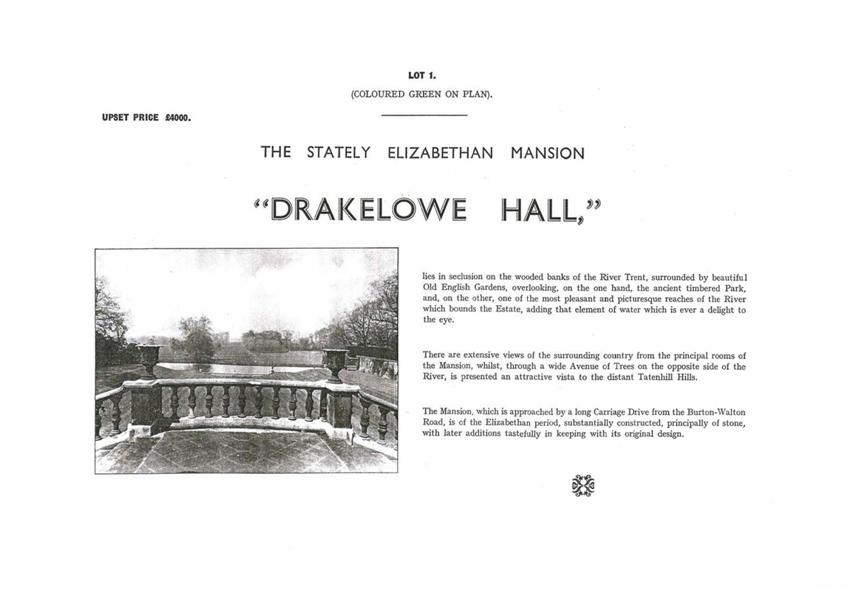
Lies in seclusion on the wooded banks of the River Trent, surrounded by beautiful Old English Gardens, overlooking, on the one hand, the ancient timbered Park, and, on the other, one of the most pleasant and picturesque reaches of the River which bounds the Estate, adding that element of water which is ever a delight to the eye.

There are extensive views of the surrounding country from the principal rooms of the Mansion, whilst, through a wide Avenue of Trees on the opposite side of the River, is presented an attractive vista to the distant Tatenhill Hills.

The Mansion, which is approached by a long Carriage Drive from the Burton-Walton Road, is of the Elizabethan period, substantially constructed, principally of stone, with later additions tastefully in keeping with its original design.


Transcription of above page:
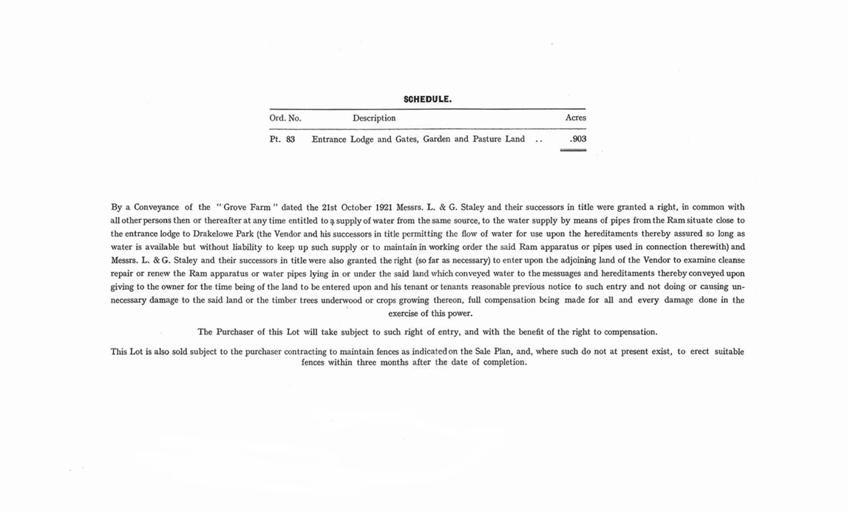
By a Conveyance of the ” Grove Farm ” dated the 21st October 1921 Messrs. L. & G. Staley and their successors in title were granted a right, in common with all other persons then or thereafter at any time entitled to a supply of water from the same source, to the water supply by means of pipes from the Ram situate close to the entrance lodge to Drakelowe Park (the Vendor and his successors in title permitting the flow of water for use upon the hereditaments thereby assured so long as water is available but without liability to keep up such supply or to maintain in working order the said Ram apparatus or pipes used in connection therewith) and Messrs. L. & G. Staley and their successors in title were also granted the right (so far as necessary) to enter upon the adjoining land of the Vendor to examine cleanse repair or renew the Ram apparatus or water pipes lying in or under the said land which conveyed water to the messuages and hereditaments thereby conveyed upon giving to the owner for the time being of the land to be entered upon and his tenant or tenants reasonable previous notice to such entry and not doing or causing unnecessary damage to the said land or the timber trees underwood or crops growing thereon, full compensation being made for all and every damage done in the exercise of this power.

The Purchaser of this Lot will take subject to such right of entry, and with the benefit of the right to compensation.

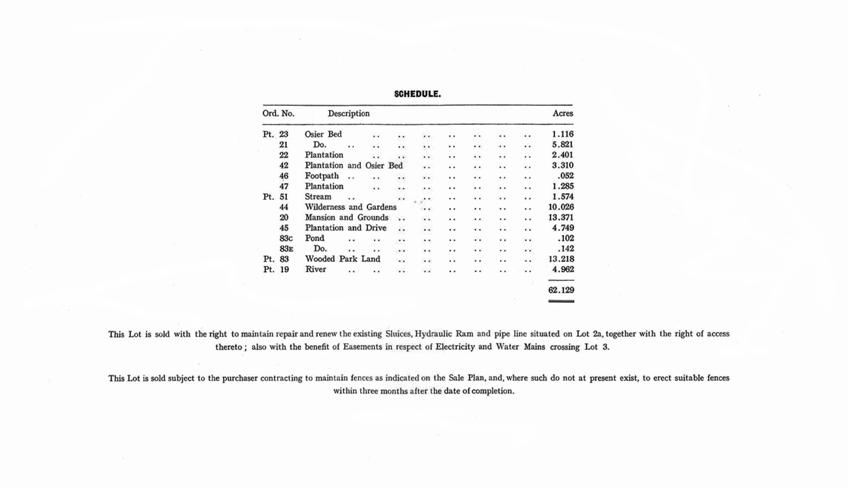
This Lot is also sold subject to the purchaser contracting to maintain fences as indicated on the Sale Plan, and, where such do not at present exist, to erect suitable fences within three months after the date of completion.


Transcription of above page:
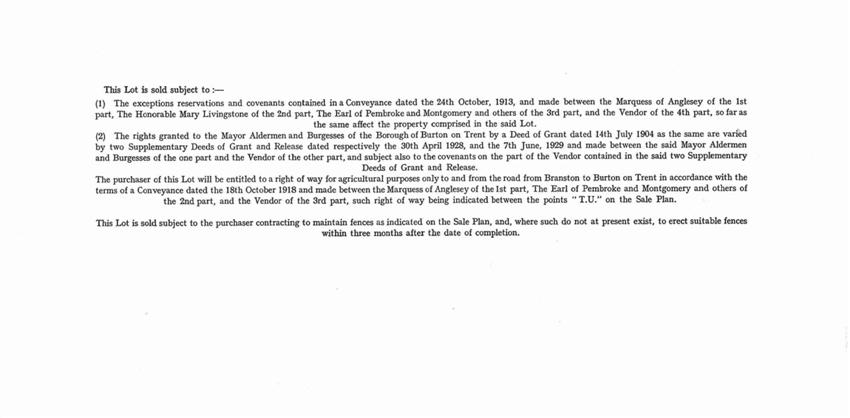
This Lot is sold subject to :—

1) The exceptions reservations and covenants contained in a Conveyance dated the 24th October, 1913, and made between the Marquess of Anglesey of the 1st part. The Honorable Mary Livingstone of the 2nd part, The Earl of Pembroke and Montgomery and others of the 3rd part, and the Vendor of the 4th part, so far as
the same affect the property comprised in the said Lot.

2) The rights granted to the Mayor Aldermen and Burgesses of the Borough of Burton on Trent by a Deed of Grant dated 14th July 1904 as the same are varied by two Supplementary Deeds of Grant and Release dated respectively the 30th April 1928, and the 7th June, 1929 and made between the said Mayor Aldermen and Burgesses of the one part and the Vendor of the other part, and subject also to the covenants on the part of the Vendor contained in the said two Supplementary Deeds of Grant and Release.

The purchaser of this Lot will be entitled to a right of way for agricultural purposes only to and from the road from Branston to Burton on Trent in accordance with the terms of a Conveyance dated the 18th October 1918 and made between the Marquess of Anglesey of the 1st part, The Earl of Pembroke and Montgomery and others of the 2nd part, and the Vendor of the 3rd part, such right of way being indicated between the points ” T.U.” on the Sale Plan.

This Lot is sold subject to the purchaser contracting to maintain fences as indicated on the Sale Plan, and, where such do not at present exist, to erect suitable fences within three months after the date of completion.


Transcription of above page:
This Lot is sold subject to

1) The right of the owners and occupiers for the time being of the land on the north side thereof to the watering of cattle and the withdrawal of water from the River
for agricultural purposes only and to the drainage of surface water from such land.

2) The rights of the owners and occupiers for the lime being of the factory belonging to the Branston Artificial Silk Co. Ltd. to utilise the sewer for the purpose of
effluent discharging into the River and the Vendor shall not be called upon to define such rights.

3) The exceptions reservations and covenants contained in the Conveyance of the 24th October, 1913 (referred to in connection with Lot 8) so far as the same affect the property comprised in this Lot.

The lands adjoining this Lot having been previously sold by the Vendor without any reservation of right of access to the River, no right of access (either express or implied) can therefore be granted to the Purchaser thereof.


Transcription of above page:
SPECIAL CONDITIONS OF SALE.

1. The Property is sold subject to the General Conditions of 1925 (1928 Edition) so far as the same are not varied by or inconsistent with the following special conditions.

2. The vendor’s Solicitors are Messrs. W. A. G. Davidson 6c Co., of 22 Surrey Street, Strand, London, W.C.2; Messrs. Field, Roscoe & Co., of 36 Lincoln’s Inn Fields, London. W.C.2; and Messrs. Crane & Walton, of Ashby-de-la-Zouch.

3. The deposit payable in respect of each Lot shall be 10% of the amount of the purchase price of such Lot, and (except in respect of Lots 13 and 14) shall be paid to Messrs. Field, Roscoe & Co. as agents for the Settled Land Act trustees of the Vendor in accordance with the provisions of Clause 4 of the General Conditions. The deposit in respect of Lois 13 and 14 shall be paid to them as Agents for the Vendor.

4. The date fixed for completion is the 25th day of March, 1934.

5. The vendor is, as to Lots 1 to 12 inclusive, selling under the powers conferred on him by the Settled Land Act 1925, and as to Lots 13 and 14 as beneficial owner. The property comprised in Lots 1 to 12 inclusive consists of property which goes in different ways on the death of the Vendor, and the purchase money of each Lot shall, if the Vendor and the circumstances of the case so require, be apportioned between the different parts of the property in such manner as the Vendor may direct.

6. The title to Lots 1 to 5 and 8 to 12 inclusive, and to those parts of Lots 6 and 7 situate in the parish of Drakclowe in Church Greslcy shall commence with an Indenture of Settlement dated the 1st day of July, 1887, being a voluntary settlement made by the vendor of certain lands described by reference to prior documents and all other the real estate then held by him for an estate of inheritance subject (as to certain of the above mentioned Lots) to the Mortgage hereinafter mentioned and to the jointure rentcharge of a lady who died in the year 1900. The vendor shall not be required to abstract or produce any of the documents under which such jointure arose. By a deed dated the 15th day of December, 1904, a mortgage “debt of £20,502 18s. 4d. secured by prior deeds and the securities for the same were transferred to transferees who paid off the then existing debt, and the Deed of Transfer contains a Schedule and Plan describing and showing the lands comprised in the above mentioned lots (or parts of lots). It shall be assumed (as is believed to be the case) that at the date of the said Settlement the vendor owned all the property comprised in the said lots or parts of lots for an estate in fee simple in possession free from incumbrances except as above mentioned. The title to the said mortgage debt of £20,502 18s. 4d., and to the legal estate in the lands transferred by the said Indenture dated the 15th day of December, 1904, shall commence with that Indenture. The Vendor shall not be required to abstract or to produce any prior document (except the said Settlement of 1887 and a Resettlement dated 5th June, 1893, expressed to be supplemental thereto) referred to in such transfer or to which such transfer or the reconveyance of such mortgage is made supplemental.

7. The title to those parts of Lots 6 and 7 situate in the parish of Walton-on-Trent shall commence with a Mortgage dated 22nd February, 1910.

8. The title to part of Lot 13 shall commence with a Conveyance dated 24th October, 1913; and to the remainder with a Conveyance dated 18th October, 1918. The title to part of Lot 14 shall commence with the same Conveyance of 24th October, 1913, and to the remainder with a Conveyance dated the 15th January, 1919.

Hoar Cross Hall

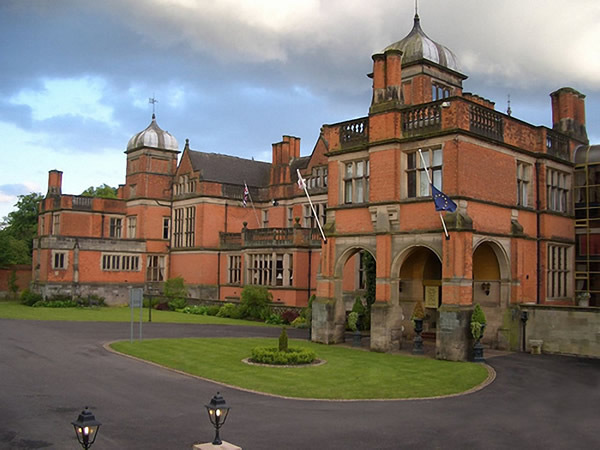
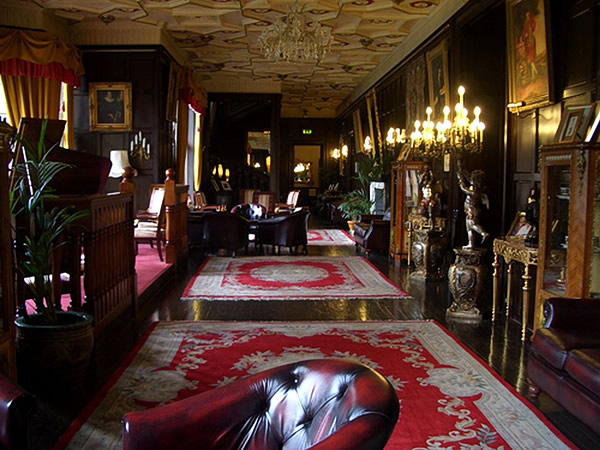
Hoar Cross Hall was, from the early 17th century, the second seat of the Ingram family whose principal residence was Temple Newsam in Yorkshire. In 1661 Henry Ingram was raised as Baron Ingram and Viscount of Irvine. On the death of the 9th Viscount in 1778 the Viscountcy became extinct. The estates descended to his daughters and in 1841 to Hugo Charles Meynell (grandson of Hugo Meynell and son of Sir Hugo Meynell who had married Elizabeth Ingram in 1782). Upon inheritance Meynell incorporated Ingram into his surname to become Meynell Ingram.

The old house was rebuilt in the 1860s in much grander style, most of which comprises the existing Hoar Cross Hall.

His son Hugo Francis Meynell Ingram married Emily Charlotte Wood, daughter of Charles Wood, 1st Viscount Halifax. Meynell Ingram died in 1871 and Emily Charlotte built the church in his memory. She remained in occupation of the Hall until her death in 1904 when her nephew Fredreick George Lindley Wood (later Meynell) inherited the estate.

Hoar Cross Hall has thankfully managed to survive as an hotel and health spa and is a Grade II listed building.

1873 – Rolleston Hall Celebrations

In 1873, just two years after the great fire that almost destroyed it, Rolleston Hall was the site of great festivities. Around one hundred and twenty guests celebrated the superbly restored hall at the occasion of the marriage of Sir Tonman Mosely’s son, Oswald.
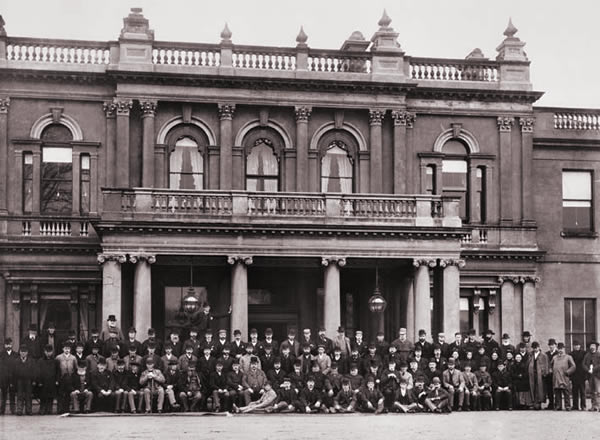
The event was attended and reported by the Derby Mercury and below is a transaction from the detailed report that appeared in an article dated Wednesday, August 20th, 1873.

On Tuesday last the tenantry of Sir Tonman Mosley Bart., were invited to dine at his residence to commemorate the restoration and improvement of the hall; also the marriage of his eldest son, Oswald Mosley Esq. Our readers will undoubtedly remember the serious fire which occurred here almost two years ago. Its owner has now built a noble mansion on the site of the old one, Messrs. Giles and Brookhurst being the architects.

At half past two o’clock on the above day about one hundred and twenty sat down in a commodious marquee which had been beautifully decorated by Mr Buck, head gardener, to a splendid repast. Grace having been said by the Reverend Canon Ram, the dinner commenced in good earnest, under the presidency of their worthy landlord, who was supported on the right by his eldest son, Oswald Mosley Esq., Drs. Belcher and Wolfenden, Messrs Radford, Stretton, M Walker, S Walker, D. Walker, Hodgkinson and Strutt; and on the left by the Rev. Canon Ram and Messrs. Holbrook, Giles, Crump and Pakeman.

The vice chairs were respectively filled by Tonman and Ernald Mosley, Esqs. The bill of fare was a most sumptious one, and we need scarcely add that ample justice was done to it. During the dinner the company were enlivened by Mr Stagg’s efficient quadrille band, which played the following selections in a highly creditable style:

  • Overture ‘Zampa’
  • Valse ‘Blush Rose’
  • Piano Fantasia
  • Quadrille ‘Grand Duchess’
  • Valse ‘Christine’
  • Cornet Solo
  • Galop ‘Cliquot’
  • Viola Solo
  • Valse ‘Beautiful Spring’

On the cloth being drawn, Sir Tonman proposed the healths of the Queen (Victoria), Prince and Princess of Wales and the Royal Family, which was most enthusiastically received.

The next toast was given by the Reverend Canon Ram, who said;- “I hope you will be somewhat forbearing with me this evening, although I shall endeavour to make all hear. I am quite aware that a great strain upon the voice is requisite for such a numerous assemblage, and especially under a tent.

At the same time, the circumstances under which we are met today would make anyone strive to use every effort for the occasion. I do not for one moment expect I can do justice to the toast of the day, which is entrusted to me… Long life, prosperity and happiness to our host (Loud cheers) But permit me to add I am sure it gives us all very great pleasure to see Sir Tonman in his proper place, and that it is at the head of a large and opulent tenantry. Indeed such a sight as the present is a truly English one, for now can be seen at one view the real backbone of our country, viz., the agriculturists and landlords side by side”.

This was drunk most cordially, the band playing’Musical Honours’ and the ‘Fine Old English Gentleman’.

SIR TONMAN MOSLEY then rose and addressed the company as friends, neighbours and tenants, stating that he was much obliged to his friend the Reverend Canon Ram, for the kind manner in which he had proposed his health. He could scarcely find words to express his feelings. The Canon had spoken of him as a proud landlord, and indeed he was proud as anyone could be of such a respectable and honourable tenancy (Cheers) He trusted he would always be proud of his tenancy, but not proud of himself (Cheers) Such gatherings as the present were a source of great pleasure to him. Landlords and tenants to be successful must pull together. Although he wished to avoid politics he could not let the opportunity slip. There had just been an election, and he was proud to see on the present occasion voters of both sides, for he always wished his tenants to vote according to their consciences (Loud cheers)

He would be very sorry to use undue influence with anyone; and he might safely add that when he met a tenant, it never entered his head as to the political opinions of that tenant (Cheers) At the same time he would add that if a tenant were undecided in his political opinions he considered the landlord was the best tutor for him. He would never canvass, and he trusted that now the Ballot Act was passed the old system of canvassing would become a thing of the past. Again, he thought landlords should not endeavour to influence their neighbours’ tenantry in such matters (Cheers)

With respect to the Game Laws, he had faith to believe that tenants would always protect sufficient game for the sons of their landlord.

Landlords had brought the punishment on themselves by binding their tenants under such severe restrictions and having the produce greatly damaged by the game.(Cheers)

Lastly there was a cry for long leases. He was against treating land as a commercial commodity. In such cases the land would be given to the highest bidder under stringent leases, and do away with all the good feeling that had previously existed. He would conclude by proposing all their healths coupled with the name of Mr Holbrook, their esteemed steward (Cheers.) He asked for the latter gentleman to be excused standing as he was suffering from the effect of an accident.

MR HOLBROOK said that he was very pleased to hear Sir Tonman Mosley explain his views with respect to landlord and tenant so clearly. A good understanding put them on a firm footing for years to come(Cheers) He had the honour to propose the healths of Mr and Mrs Mosley, and congratulate them on the occasion of their marriage, and to take the opportunity of presenting him with the offerings of the tenantry of Rolleston, Needwood and Tutbury.

These had taken the form of a beautiful timepiece, silver tankard, and silver tea and coffee service. He concluded by asking the company to drink long live and happineass to Mr. and Mrs. Mosley.

This was immediately followed with musical honours.

OSWALD MOSLEY, Esq. was received with loud cheers. He thanked all of them for the presents they had so kindly given Mrs. Mosley and himself on the event of their marriage. He was sorry that his wife was unable, through illness, to be present that day. His father, however, had given him a cordial invitation to Rolleston Hall, which he should from time to time accept, especially in the hunting season (Cheers)

He was sorry that last year he was not so frequently in the field, but the fact was hunting did not agree with love-making (Cheers) He added that he was not an orator, but they would accept the best thanks of himself and wife for the kind manner in which their health had been proposed and received.(Loud cheers)

The next toast was given by the CHAIRMAN, who said, “Gentlemen, it falls upon my lot to propose the Bishop and Clergy, coupled with the Rev. Canon Ram, our worthy Rector. He was not going too far when he said, that the Canon had, by his assiduous work made himself many friends in Rolleston and neighbourhood (Cheers) He had learned from many sources of the efficacy of the rector’s service among the tenantry, who was in that position that he could serve them both spiritually and temporally. He had known him ever since he could remember, hence he claimed him as one of his oldest friends”.

The above toast was then drunk with cheers and musical honours.

The Rev. CANON RAM responded by stating that he was grateful to Sir Tonman for the kind manner in which he had proposed his health. He went on to say that the baronet had done him justice when he said that ‘best intentions were not wanting in his work’ (Cheers) He referred to his old associations with Rolleston, how that some years before Sir Tonman could remember, he spent many happy hours fishing in Rolleston brook with the late squire, the host’s brother. It was owing to the kindness of Sir Oswald that he now held the position of Rector of Rolleston. Such a position naturally brought pleasant and unpleasant remembrances. During the five years he had been amongst them as their pastor, he trusted he had served them faithfully, and he hoped all good feelings and blessings would continue to crown the hall, church, and yes, and every house in the parish, as proof of God’s mercies to them.(Hear hear). There were persons now- a -day who tried to separate classes, but he considered such meetings as the present one went far to put down their evil attempts, He must, however, conclude, but when once on his feet and among his friends, he was like the Irishman who was asked the secret of being such a good speaker, I put my heart to the tip of my tongue, and then I can’t help it. He must, however, say one word more, and that was something which was very pleasing to them, viz., to propose the health of Lady Mosley (Loud cheers). He knew it would be well received. The tenantry had only to look at her, and then listen, and they might rest assured that her influence with Sir Tonman was always used when required on their behalf. Indeed all of them would be very poor creatures without their wives, daughters and sisters. He then, amidst loud cheers, proposed ‘The health and happiness of the Lady Mosley, as wife and consort of Sir Tonman Mosley, Bart’. (Loud cheers)

After musical honours had been accorded, Sir Tonman rose, and in a short humorous address, thanked them on behalf of his lady, whom he had on this occasion deserted for the first time in her life; she had declined to thank his friends for their good wishes. He trusted she had not made up her mind to desert him altogether (Renewed cheers) he quite agreed with the Canon as to the value of wives, and he trusted that all his friends present who had not entered the matrimonial state would immediately fix their attention on a suitable lady, and get married at once. (Cheers)

Dr. BELCHER then rose, and in a pithy speech proposed ‘The health of Tonman and Ernald Mosley Esqrs,’ the younger sons of their worthy host. He trusted the tenancy would fill their glasses and do their duty by the toast. (cheers and musical honours)

TONMAN MOSLEY Esq., replied as follows; The Reverend Canon Ram has made a pointed remark in his speech which has given me a new and very humble opinion of myself. He said “All men without wives were poor creatures, and still more so if they had no sisters or daughters” Now I have no wife, no sister no daughter, therefore pray pity me, for I must be a very poor creature indeed (Laughter and cheers.)

Again I can assure you I tremble in my shoes, for my father in his speech says thast the sooner men get wives the better for them; and I of course conclude from that he must have someone in his eye for me! I humbly offer you my sincere thanks for myself and my younger brother, and I trust you have all been happy and will spend the remainder of the day in perfect enjoyment. In a short time I hope to be called to the bar, and I ask you after I have so done to get into as many lawsuits as you possibly can and put a corresponding number of guineas into my pocket (Cheers.) One more point;-My ambition may induce me in course of time to become a candidate for your votes as a member of parliament. In that case I have no doubt all of you will give me your support, and place me at the head of the poll. I feel most deeply the honour which has conferred upon me is being entrusted to a toast which ought never to be left out, and is always received with great eclat. My toast, gentlemen is one you will all respond to most heartily, viz.,”The Ladies”(Cheers.) Gentlemen, they are our better halves, but dear me I must beg your pardon, as I ought to have said your better halves. Still I beg to propose the health of your wives, your daughters and your sisters. At the same time I think you will agree with me that an able orator by late reputation, is the fittest person to answer for those whose absence is our loss and whose health we shall drink most heartily (Cheers.) I therefore call upon Mr. Samuel Walker, who is considered an orator in this neighbourhood, to respond.

MR S. WALKER immediately rose and said he wished to contradict Mr. Tonman Mosley upon one point in his speech, viz., that of being an orator; and he thought the compliment of returning thanks might have been placed in abler hands, as he was suffering from overwork, the result of canvassing in company with Messrs. Higgot and Hopkins, when they had had many strange questions put to them relating to the gun tax, tenants rights, school boards, ladies as voters &c. But he must revert to the toast viz., “The Ladies” He had tried housekeeping and bachelorship for five years, but could endure it no longer, so took unto himself his better half, and had no hesitation in stating that it was the best day’s work of his life. He now had his slippers placed for him every evening, and his bed warmed when required, and many things which a bachelor could not expect, and did not deserve. He hoped that Mr Tonman would soon follow his example and so become a useful member of society.

SIR TONMAN next proposed the healths of the master workmen who had been employed at the hall during it’s restoration, coupled with the name of MR GILES, who responded as follows- Gentlemen- this is indeed a very happy gathering through the generosity of Sir Tonman. He has spared no trouble or pains to secure a pleasant afternoon for us, and I can safely add that during the restoration of the hall, it has been his constant endeavour to make all who were employed on the works very comfortable. He (Mr Giles) had never undertaken a work that had given him so much pleasure, and it mainly arose from the frankness and generosity of their noble employer. He begged to offer the best thanks of his co-workers for the manner in which their healths had been proposed and received, and he trusted Sir Tonman and her Ladyship would live for many many years to enjoy it’s beauties, conveniences and pleasures (Loud cheers.)

Music and songs now became the order of the evening, among which we noticed ” The Old English Gentleman” by Messrs. M and S Walker ; Turn of the tide” by Mr. Pakeman; “John Barleycorn” by Mr. G Hanson: “Paddy’s courtship” or “The Whistling thief by Mr. Strutt; Men of Merry England”, by Mr. Hodgkinson; and “Nought else to do” by Mr.Greatorex. The latter was highly amusing and well executed, and caused great laughter.

The company broke up about half past seven o’clock after singing the National Anthem.

We need scarcely add that the afternoon was spent in a most enjoyable manner and nothing was wanting to add to their happiness that money would procure.

The oldest parishioner of Rolleston who was present said that he “had never seen such doings in all his life.” We trust such gatherings may become more frequent, and may we add annual ones. Sir Thomas kindly threw his grounds and gardens open, and was lustily cheered by his tenantry from the marquee to the mansion.

The following day, the workmen, numbering 165, were invited to dinner, which was equally sumptuous to that of the previous day The “Roast Beef of Old England” was punished by a class of men who well know how to do their duty with a knife and fork , accompanied with copious draughts of nut-brown ale , and fine selections of music which on such occasions improve the appetite and assists digestion. No comment is needed as to the justice they did to the good things.
After the cloth was drawn,

SIR TONMAN briefly proposed the healths of the Queen and Royal Family.

THE REVEREND CANON RAM, after a telling speech, proposed the healths of Sit Tonman Mosley, Bart., the Lady Mosley, and |Mr. And Mrs. Mosley, to which the worthy baronet responded, followed by Mr. Mosley and Mr. Tonman Mosley.

On the retirement of Sir Tonman Mosley from the chair, speeches and songs followed in rapid succession. A little momentary unpleasantness was occasioned at times by two or three amateurs endeavouring to give their fellow workmen a specimen of their musical prowess simultaneously . Of course this created much mirth, and the cases had to be referred to the chair, which was now ably filled by Tonman Mosley Esq.

MR BRATT made a speech which will not be easily forgotten by those who had the advantage of listening to his oratory.

The proceedings came to a close by the chairman expressing his best thanks to them for their excellent conduct during the afternoon, and trusted they had all thoroughly enjoyed themselves, leading them to believe this was only the first of similar entertainments. The marquee was momentarily filled with loud cheers and good wishes for their noble master.

On Thursday a large company of visitors were invited to an entertainment, and to witness the sports of the Rolleston, Tutbury and Anslow schools whom the liberality of Sir Tonman Mosley would not permit to be overlooked. The following were amongst the number; Sir Henry Every, The Masters Every, Rev. Rowland and Mrs Mosley and family, the Rev. Canon, Lady Jane and the Misses Ram, Mrs Stone, Mrs.Fox, Miss Isobel Mosley, Miss Penelope Mosley, the Misses Bott (3) Miss Wearg, , Mr/ and Mrs. Willoughby Wood,, Mr. and Mrs Wm. Bott, Mr and Mrs Rumboldt, Mr. and Mrs. N Curzon, and the Masters Ewart.

Also the annexed were among the number as resident at the Hall for the week; Mr. Mosley of Beaumaris, Anglesea, Miss Foster, Miss Halliwell, Miss Rigby, mr & Mrs Campbell, Mr. Lucas Broadhurst, Mr Lindesay Young, &etc.

The Rolleston and Anslow children arrived first, and were conducted through the gardens. At two o’clock the Tutbury children, under the control of the Rev. H. Clunn, Miss Bray and Mr. Parrick, started from their respective schools, the route being by High Street and Burton Street. The youths belonging to the Endowed School halted at the residence of Miss Mosley (Sir Tonman’s sister) and sang “The Red, White and Blue” and “Musical Honours” in a highly creditable style, under the able guidance of their respected master, Mr. Parrick. Many of the inhabitants turned out to listen to the songs and witness the procession of the children who were bent on an afternoon’s pleasure.

Miss Mosley very kindly thanked the master, teachers, and pupils for their courtesy. The girls, who waited in the Burton-street during this show, now proceeded in excellent order towards Rolleston, amidst cheers of the crowd. On approaching the Hall Gardens, it was understood by the excessive “Hurrahs” that it was a gala afternoon at Rolleston. Mr. Buck met them at the reservoir, and led them through most refreshing shady walks through in the garden, and finally to the front of the Hall, explaining, as they proceeded, the various orchard and hot-houses, with their uses. He earned and received many hearty thanks by his thorough and genuine kindness from both teachers and scholars. In about ten minutes they took their places on the croquet ground for singing. The company quickly congregated around the little band to hear the following songs which were executed in such excellent tune and time that praises were awarded in all directions:

  • God Bless The Prince of Wales
  • The Spider and The Fly
  • The Red, White and Blue
  • Work

Musical Honours followed with the words:

Sir Tonman is our faithful friend,
And that we all do know,
He always helps us cheerfully,
Which nobody can deny,
The Lady Mosley we do thank,
For all her kindnesses,
We wish them every happiness,
And so say all of us.

SIR TONMAN MOSLEY expressed his best thanks to Mr. Parrick and gave orders for the pupils to be conducted to the Park , in which the following games were prepared;- Cricket, Football, Bag racing, pole climbing, wheelbarrow races etc., Prizes were awarded by various gentlemen who witnessed the sports. Mr. Tonman Mosley superintended the cricketing, while Mr. Mosley undertook the racing and Mr. Ernald the football.

At five o’clock the bell rang for tea, to which they immediately responded. Mr. White, butler, was exceedingly kind throughout the evening, and most anxious to do everything possible for the enjoyment and comfort of the children. Many thanks are due to him for his attention. Grace having been sung, they set to work in earnest to clear the tables of the tempting eatable commodities, consisting of buns, ginger bread, plum cake, preserves, grapes, currants, gooseberries &c. Half an hour sufficed to see the end of this department.

After the Grace had been sung, Sir Tonman entered the marquee, accompanied by the Lady Mosley and The Rev. Canon Ram.

The Reverend Canon, in speaking to the children assembled asked them whom they had to thank for their tea. Their answer was “God.” The rev. gentleman said it was a very good answer, and he was glad to hear them award the praise to God. He then asked who they were next indebted to. Their answer was “Sir Tonman.” He gave them good advice, in which he cautioned them against bad company, and concluded by asking for three cheers for Sir Tonman and Lady Mosley, which was given in a thoroughly English style. Mr Tonman, in a short address, informed the children of the very great pleasure it afforded Lady Mosley and himself to meet them in such pleasing circumstances. He had invited them to tea and games to commemorate the restoration and improvements to his residence, Rolleston Hall. He had trusted that they would all be good children, not only for that afternoon, but for many future ones. He was glad to see such a goodly number present but was sorry to be obliged to hear that some were absent, not being allowed to come through irregular attendance at school. He went on to show that as a rule the parents were the cause of the irregularity, and it was greatly deplored that in these enlightened times they did not take a far greater interest in the future welfare of their children. A child now-a-days without education was no-where in the world. Again he was proud to refer to the fact that in each of the schools present instructions in the Holy Bible formed part of the daily routine. He remembered well the words of his father to the effect that school instruction was quite valueless without it was based on God’s word and he should use his influence to maintain those principles. “Shut out the Bible from the school and you will undermine it’s true utility.” He thanked the teachers for the excellent discipline which their children exhibited, and concluded by trusting that this meeting was only a fore runner of many similar ones. (Loud cheers.)

The children then sang several songs and dispersed to enjoy the several amusements prepared for them. At a later hour dancing commenced in good earnest, and was kept up till dusk. Mrs. Smythe, the Anslow schoolmistress,collected her little band the first, and they were well attended by the gentry, previous to their departure, with nuts and biscuits. Later on the Tutbury schools were arranged in front of Mr. Stagg’s quadrille band, and after musical honours for their host and hostess, sang the National Anthem. Mr. Parrick addressed the children, and thanked Sir Tonman and Lady Mosley for their great kindness, and trusted Mr. And Mrs. Mosley would follow in their worthy parents’ footsteps especially with regard to the aid they most generously bestowed on the schools . He concluded by calling for cheers for the above. On arriving at Tutbury, they proceeded to the residence of Miss Mosley and sang a song or two, after which the order was given to dismiss. The Rolleston children, under their efficient master and mistress Mr Eley and Miss Ellis, were dispersed later on in the evening. Such a day’s enjoyment has seldom, if ever, been accorded to these schools.

The following evening a ball was given. Through the liberality of Sir Tonman all the servants of the neighbourhood (200) were invited to the hall. Carriages arrived in rapid succession at eight o’clock, and the respective occupants were escorted to the cloak room by Mr. White. Tea and coffee were set out in the smoke room, and all new arrivals were invited to refresh themselves preparatory to the dance. At nine o’clock the strains of Mr. Stagg’s efficient quadrille band were heard, and a general movement was made towards the saloon, which was in itself worthy of a visit. It was illuninated with two sun lights, and as the company arrived in their various coloured costumes the effect was exceedingly pretty. This room was most tastefully decorated with flowers, evergreens. flags and shields under the able superintendence of Mr. Buck.

The motto “Mos Legem Regit” came out most prominently on the North Wall. The floor deserves a word of notice, being of the very best oak, polished, all of which has been grown on the Rolleston Estate. The stewards of the evening were Tonman Mosley, Esq., and Mr. White, who were quite at home with their duties.

At a quarter past nine o’clock the ball was opened by Mr. Kirk and the Lady Mosley, followed by Tonman Mosley, Esq., and Mrs. Stevens. About 150 joined in this, it being the well known country dance “Triumph”. Mr Cornish’s perfect mastership of the cornet deserves special mention.

The next was a Polka in which Mr. Joseoh Barton had the honour of dancing with her Ladyship. The following was the programme which was well carried out, and a Scotch Reel or two were added by special request :-

  • Country dance “Triumph”
  • Polka “Sultan”
  • Country dance “Valse”
  • Schottische “Moldovian”
  • Quadrille “Christmas Echoes”
  • Polka “Jolly Dogs”
  • “Pop Goes the Weasel”
  • Galop “Cliquot”
  • “Spanish Valse”
  • “Patanella”
  • “Scotch Reel”
  • Country dance “Tempete”
  • “Polka”
  • Country dance “Haste to the wedding”
  • “Galop”
  • “Lancers”
  • “Sir Roger de Coverley”

At one o’clock the company sat down to an excellent supper, which was set out in the marquee. The tables were laden with good things, and bore ample proof that the week’s festivities had not drained the vineries. Grace having been sung, about half an hour was occupied with toasts.

Mr. Abby proposed the healths of Sir Tonman, the Lady Mosley, and mr. And Mrs, mosley, which was responded to by Tonman Mosley Esq,.who asked for a little fore bearance as it was the fourth speech he had been credited with in the past few days .

He said that nothing would have given his father greater pleasure than to have been present on this occasion, but lameness prevented him. He hoped they would all thoroughly enjoy themselves and dance to their hearts content, He concluded by proposing the health of all his father’s servants, who had been most severely taxed with over work during the week, coupled with the name of his esteemed friend, Mr. White,

This was drunk most cordially with musical honours, led by Mr. Parrick,

MR. WHITE acknowledged the compliment in an able manner.

After Mr. Stagg had said a few words on behalf of the visitors, the company, like giants refreshed, returned to the charge, and the small hours of the morning smiled on the throng. Slowly and reluctantly the company broke up to return to their homes by the morning light, and to regret the fleeting haste of our old enemy, Time.

On Saturday about 100 of the old parishioners were invited to tea on the lawn. Various amusements were engaged in and the garden and grounds thrown open.
Thus ended a weeks festivities, the like of which has never been seen by the present generation of Rolleston.

We conclude our report by by sincerely wishing that the worthy owner and his lady will live long to enjoy each other’s friendship in their princely mansion.
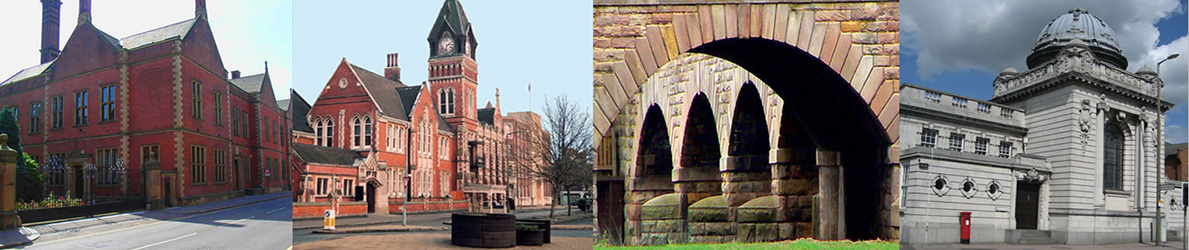
Burton Abbey – Anglo-Saxon History

Burton Abbey

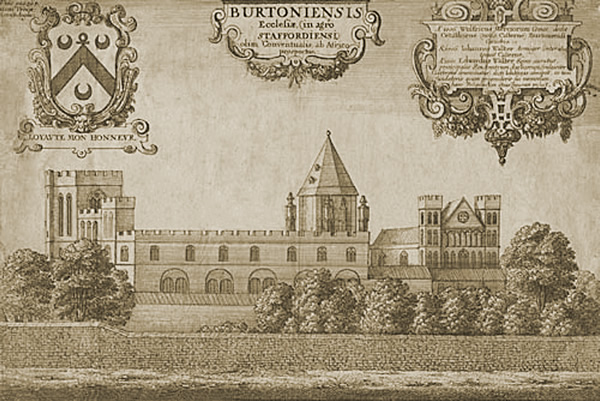
Burton Abbey was founded as a Benedictine abbey in 1002 by Wulfric Spot, the extremely wealthy earl of Mercia thought to be a descendent of King Alfred. In 1004, the abbey received its official confirmation when King Ethelred granted a charter of freedom.

Wulfric Spot died in October 1010 after fighting with with his ranks in support of Ulfrick Ealdorman of East Anglia against the Danes at Ringmere near Ipswich. He was mortally wounded and his body was returned to Burton Abbey where it was buried in the cloister under a stone arch near the door of church next to the body of his wife, Elswitha, who was already buried there. In later times Burton Abbey marked the occasion of his death on 22th October.

In his will Wulfric appointed the king, Aethelred (‘the Unready’), as lord of the abbey and archbishop Alfric and Alfhelm, Wulfric’s brother, as guardians. He also gave estates to senior churchmen and his nephew, Ufegeat, such that they would support the abbey when needed.

The first abbot and monks came from Winchester. This established a long relationship and over the next two hundred years, six of Burton’s abbots would also come from Winchester. The abbey was initially described as the monastery of Saint Benedict and All Saints in royal charters of 1008 and 1012 and appeared in the Domesday Book as the abbey of Saint Mary in 1086. Its dedication to Saint Modwen didn’t actually occur until the 12th century. The abbey was later to include Saint Mary’s chapel.

The surviving will of Wulfic Spot has proved to be an extremely valuable historic document listing in detail the vast estates under his control:

Staffordshire: Burton, Stretton, Bromley, ‘Bedintun’ (in Penkridge), Gailey, Whiston (in Penkridge), Darlaston (in Stone), Rudyard, ‘my little land at Cotwalton [in Stone]’,Leigh, Okeover, Ilam, Calton, Castern, and a hide at Sheen.

Derbyshire: Winshill (now of course, part of the borough of Burton), Sutton-on-the-Hill, Ticknall, Morley, Breadsall, Morton, Pilsley, Ogston, Wingfield, ‘Snodeswic’ (near Morton), ‘Niwantune’ (Newton Solney), and ‘that land at Appleby (Appleby Magna, now in Leicestershire) that I bought with my own money’.

Leicestershire: land at Shangton and Wigston Parva and a hide at Sharnford in Wigston Parva.

Shropshire: Longford, Stirchley, Romsley, Shipley, and ‘Suthtune'(Sutton Maddock);

Warwickshire: Weston-in-Arden, Burton Hastings, and Harbury.

Elsewhere or less certain: ‘Actune’ (probably Acton Round in Shropshire), ‘Halen’ (probably Halesowen,Worcs.), ‘Niwantun at the Wich’ (possibly Newton near Middlewich, Ches.), ‘Tathawyllan’ (possibly Tathwell, Lincs.), ‘Ealdeswyrthe’ (either Awsworth, Notts. or Aldsworth, Glos.), ‘Alfredingtune’ (either Alvington, Glos., or Alfreton, Derbys), and ‘Eccleshale’ (possibly Exhall, Warws., Ecclesall (Yorks or Staffs.), and ‘Waddune’ (possibly Whaddon, Glos.). ‘Waededun’ has not been identified at all.

The abbey was also given a reversionary interest in Elford and Oakley, both in Staffordshire, Wibtoft (Warws.), and ‘Twongan'(either Tong, Salop. or Tonge, Leics.). Half the usufruct of ‘Langandune’ (probably Longdon,Staffs.) was assigned to the monks, and also the enjoyment ‘of meat and of men and of all things’ on the land of the bishop at ‘Bubandune’ (Bupton, Derbys).

Wulfric’s lands between the Ribble and the Mersey and on the Wirral were left to Alfhelm and Wulfage ‘on the condition that when the shad shoals come in, each of them give 3,000 shad to the monastery at Burton’; similarly Conisbrough (Yorks) went to Alfhelm provided that the monks had a third of the fish every year.

Finally, Wulfric left the abbey 100 wild horses and 16 tame geldings ‘and besides this all that I possess in livestock and other goods except those which I have bequeathed’. Most of these lands were mentioned in the royal charter of 1004 confirming Wulfric’s endowment.

Either Wulfric’s intentions were never fully carried out, or else the abbey soon lost much of its original property, perhaps during the Danish Conquest in the early 11th century. Regardless, many of the estates given by Wulfric were not in the abbey’s possession at the end of the Edward the Confessor’s reign, and what remained was confined to Staffordshire and Derbyshire.

In Staffordshire the losses had not been great, and the property there still included Burton, Stretton, Bromley, ‘Bedintun’, Whiston, Darlaston, Leigh, and Okeover; Ilam, Calton, and Castern, though not mentioned in Domesday Book, were held by the abbey in the early 12th century and may have been included under Okeover in the Domesday Survey.

In Derbyshire only Winshill, Sutton, Ticknall, and Appleby remained. Ealdeswyrthe’ and ‘Alfredingtune’ had been exchanged by Abbot Wulfgeat in 1008 with king Aethelred (‘the Unready’) for Rolleston in Staffordshire, but Rolleston too was lost soon after.

Branch Lines

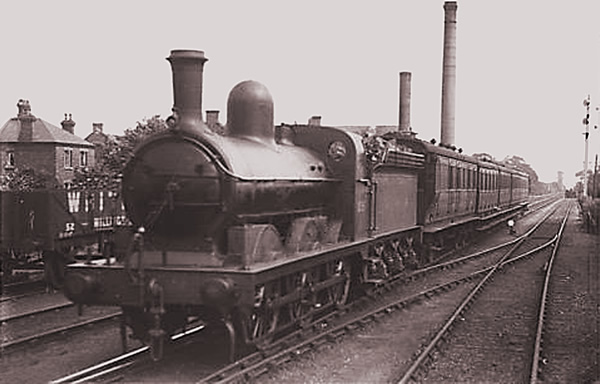
A reminder that much of the out-lying community of Burton made good use of the train.

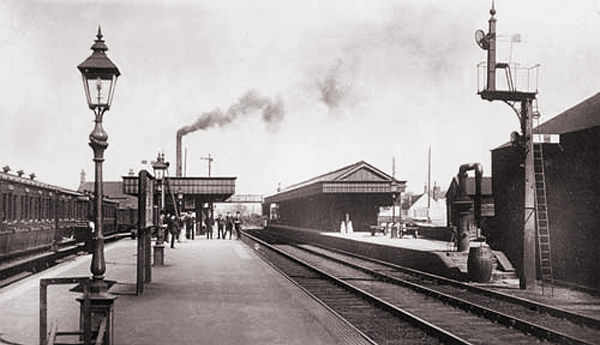
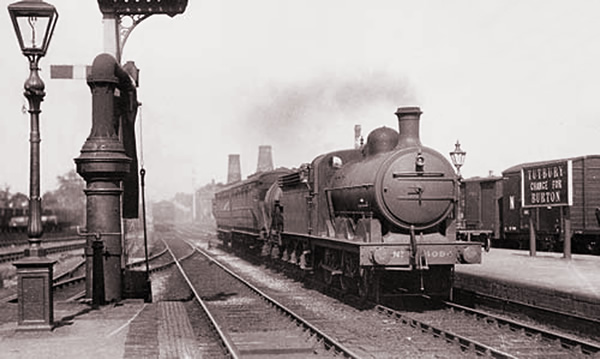
Tutbury Station
Tutbury Station, probably the most famous of Burton’s out-lying stations because of the revered Tutbury Jinny.

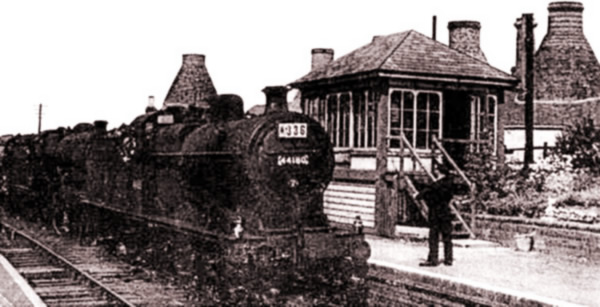
Tutbury Station was built on the Burton upon trent to Uttoxeter branch line and was opened in 1849. The smoking chimney was Nestle on the same site as the existing plant. On the right is a goods shed behind which was a grain warehouse and cattle pen.

In its heydey, the ‘Tutbury Jinnie’ provided eight trains each way on weekdays and two on Sundays. However, as the motor car became more accessible, a survey in 1960 revealed that the service was only carrying an average of twelve passengers and running at a loss of around £7000, which was quite a significant sum at the time. The service managed to survive until it was withdrawn in 1960 when a ceremonious packed last train left Tutbury at 8:12pm on 11th June.

The station was fully closed in 1966 but was re-opened by popular request in 1990 and remains in use today.

Willington Station
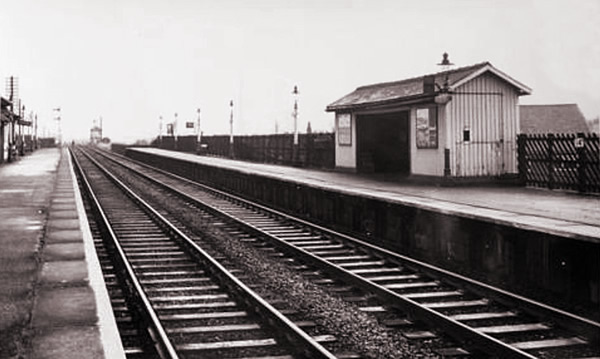
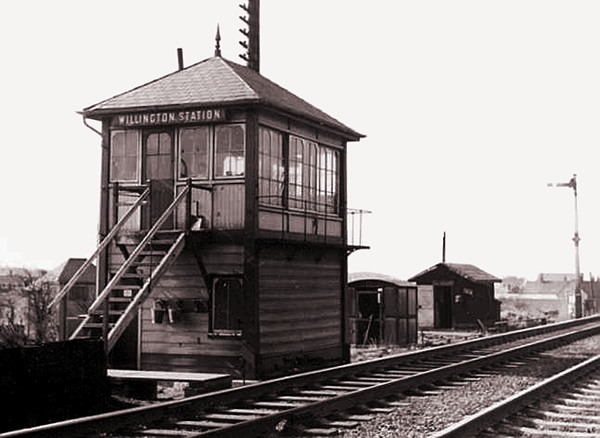
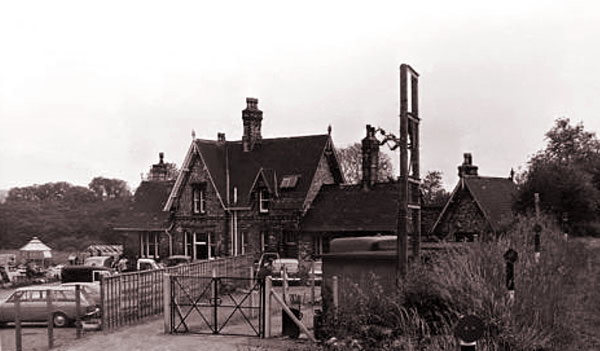
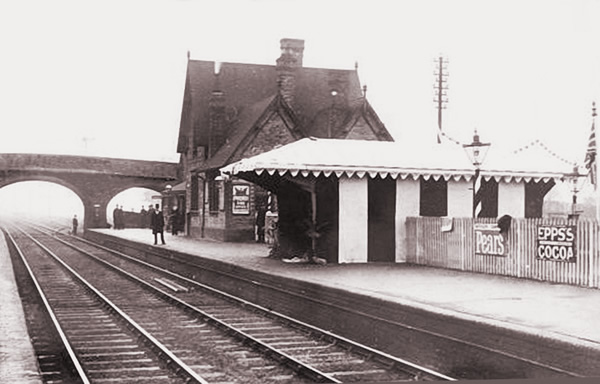
The station at Willington, was built on the Derby line which opened in 1859, has also managed to survive and a station on the same site remains in use today.

Willington signal box has of course, long gone. The main Derby line from Burton still goes over Willington bridge but just before Willington on the Derby side, a branch survives which runs over the modern Willington crossing on its way to Tutbury and Uttoxeter.

Barton and Walton Station
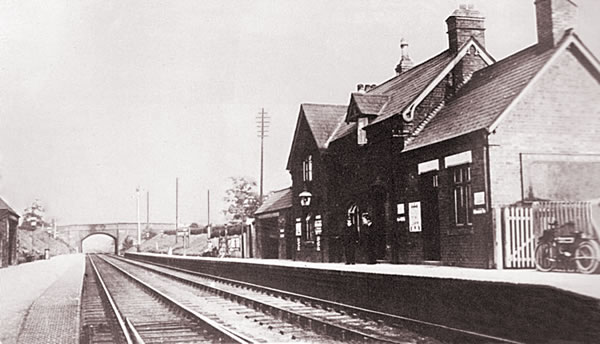
The three following photos show the Barton and Walton Station, opened in 1846 on the Derby to Birmingham line.


It was situated between the villages of Barton under Needwood and Walton-on-Trent. The station was closed in 1958 and is now the site of a railway depot.

Gresley Station
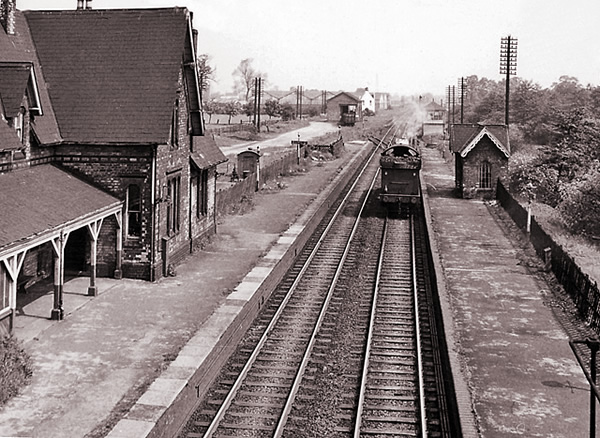
Gresley Station with a name that will always be associated with railways. It was built a Castle Gresely on the Leicester line, which opened in 1849, but there is little evidence left of it today.

The below view towards the end of its life shows its proximity to the bridge that forms part of the A444.

Moira Station
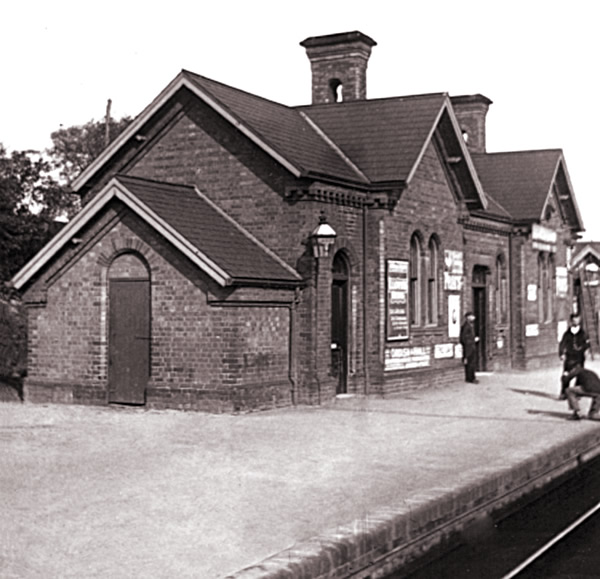
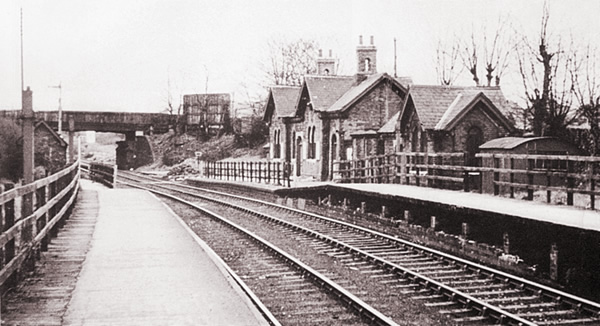
After Gresley on the way to Leicester came Moira (or Overseal and Moira) Station.

The above photo with both platforms empty suggests that a train has recently departed.

The above photo shows the abandoned station, opened in 1850 – closed in 1964. It was eventually sold for convertion to a private residence.

Swadlincote Station
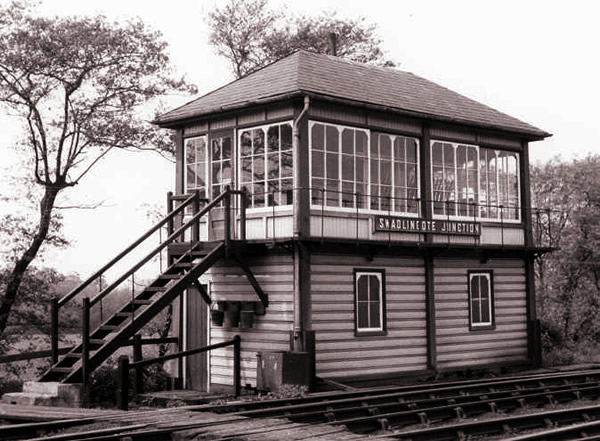
There was a loop off the Burton to Ashby line that some trains used going through both stations as an alternative to going directly to Burton via Gresley. The below photo shows the Swadlincote Junction signal box.

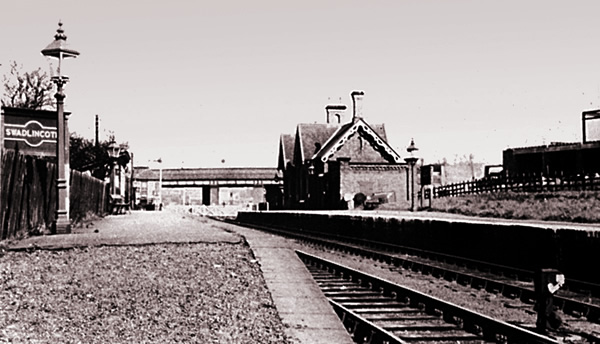
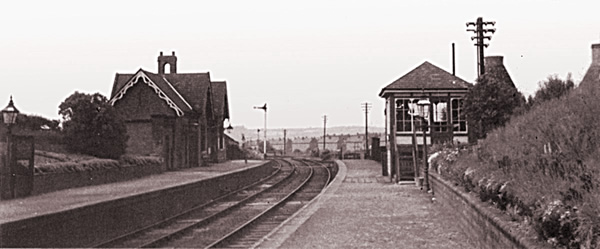
You could be forgiven for thinking that the above and below photos were different angle shots of the same station. In fact, the above photo is Swadlincote Station and below is Woodville Station. Your eyes are not deceiving you however, the two station buildings are identical mirror images of one another. They were both built by the same builder for exactly the same price.

I wonder if anyone ever woke up with a start and jumped off at the wrong station.

Woodville Station
The pottery adds to the confusion because many would deduce that it was Rowley’s Pottery close to Swadlincote Station but in fact, Woodville had its own Mansfield’s pottery.

The road in Woodville is still called Station Road and on Google earth, it is still fairly easy to pick out the loop where the line used to run going back to Swadlincote although it is very difficult to image trains running around there now.

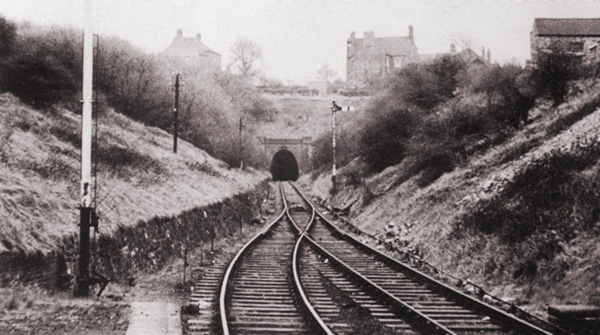
The Woodville Tunnel, seen above, was between Swadlincote and Woodville and went under the main Ashby Road (A511). Although it is easy to pick out the section now, again, it is almost impossible to image steam trains running under the road.

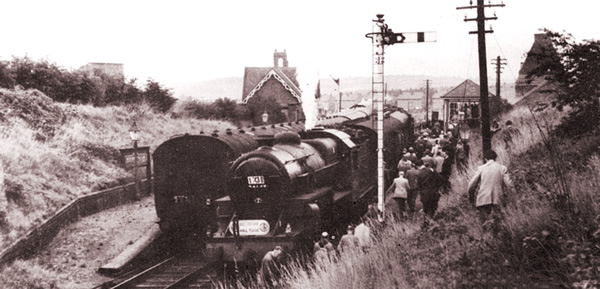
The above shows Woodville station at its busiest. Two trains heading in opposite directions co-incide with both platforms. A regular using his own shortcut has timed his run to perfection to gain one of the few remaining places.

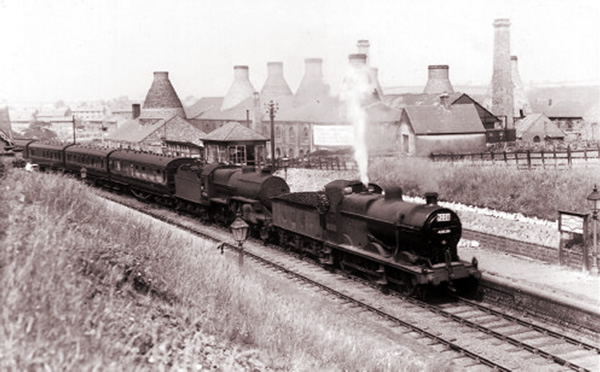
The above wider view gives a better idea of the size and position of the pottery. Because of the gradient between Swadlincote and Woodville, and hence the above shown tunnel, steam engines were often paired together.

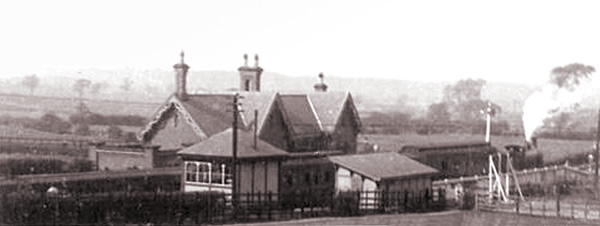
Finally, a wide view from the other side taken patiently as a train builds up steam to depart.

The final photo of Woodville Station is very grainy but is, I think, worth showing. Once again, you can just about make out that there are two steam engines.

Ashby Station
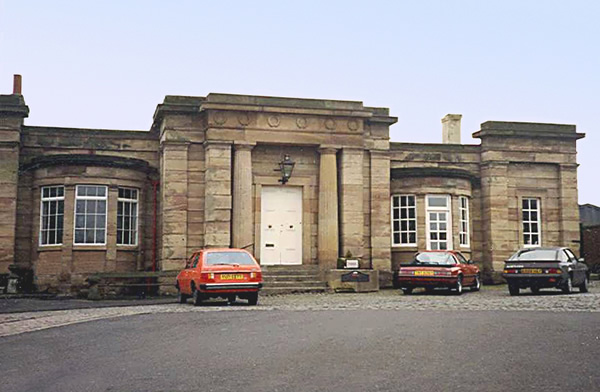
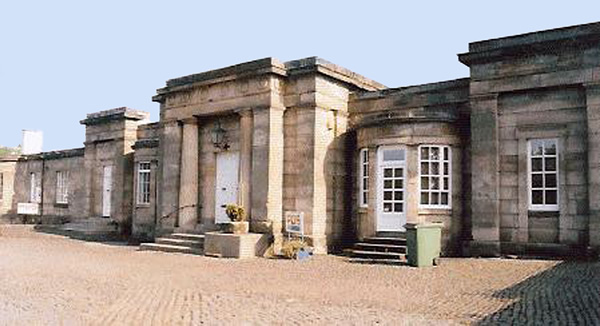
Ashby-de-la-Zouch railway station was too nice a building to fall into disuse. At the time of being built, Ashby was a well-to-do spa town with station to reflect its status.

The Midland Railway opened the station on 1st August 1849 as part of its new line between Swannington and Burton-on-Trent. The station was built partly on the remains of the horse-drawn Ticknall Tramway, which previously connected Ticknall lime quarries with the Ashby Canal.

In 1874 the Midland extended its Derby to Melbourne line to Ashby-de-la-Zouch, partly using the route of the former Ticknall Tramway. The junction with the Leicester to Burton-on-Trent line was just west of Ashby station, so for a time the branch was served by a separate station a short distance from the 1849 building.

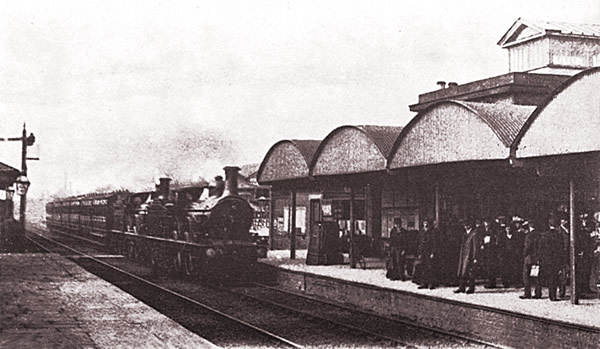
Eventually, the station was consolidated with the main platform being the Leicester line. Apologies for the quality of the above image but it does show that it was bustling in its heyday. The stone block above the platform shelter is the rear of the existing building. I am not sure what the tower on top is.

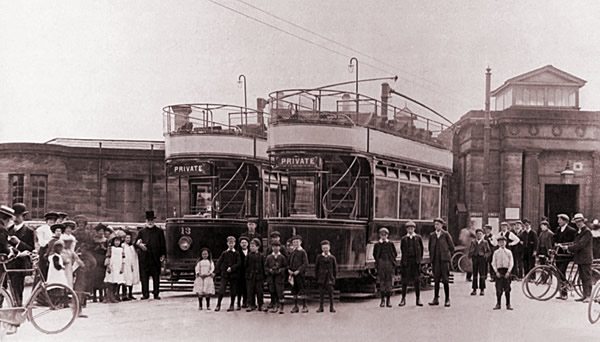
Ashby station forecourt was also a terminus for the 3 ft 6 in gauge Burton and Ashby Light Railway, the tramway between Ashby and Burton upon Trent, built by the MR and closed on 19th February 1927. Tram lines for the Burton and Ashby Light Railway are still visible in the forecourt.

The line became part of the London, Midland and Scottish Railway under the Grouping of 1923. In the nationalisation of transport in Britain in 1948 the line passed to the London Midland Region of British Railways. British Railways withdrew passenger services and closed Ashby station on 7 September 1964.

The building is now Grade II listed.

Drakelow Power Station
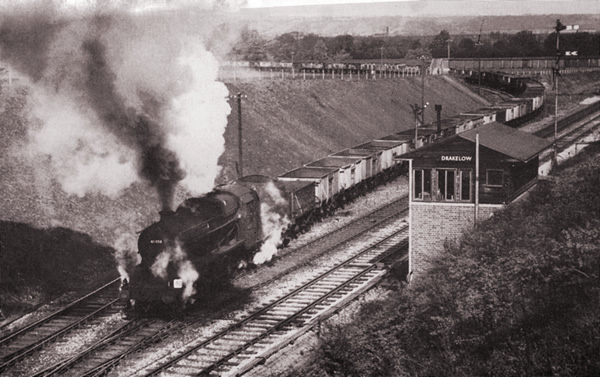
I receive many emails thanking me for memories that were long before my time. But the final photo is for my own sheer indulgence. It shows a coal train joining the Leicester Line at the Drakelow junction.

My Nan and Grandad used to live in an upstairs flat on Rosliston Road close to the Drawelow Bridge. My Grandad worked at the Power Station and he explained to me why they were always going one way full of coal and the other empty. From the window, it was possible to see steam rising in time to race to the bridge and watch the train go under and enjoy being surrounded in steam and taking in the smell.

I could almost have taken this photo myself from the days that waving to the driver might result in a wave back. I had never been on a train and this is my sole recollection of trains from the age of steam.

Map
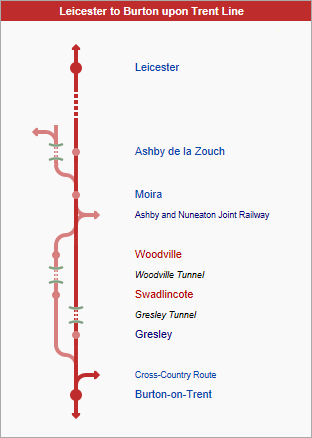
The below map shows the relationship between the local Leicester Line stations. The direct route was through Moira and Gresley to Burton but some trains took a detour between Burton and Moira, missing out Gresley but taking in Swadlincote and Woodville instead,

1612 Last Heretic – Edward Wightman

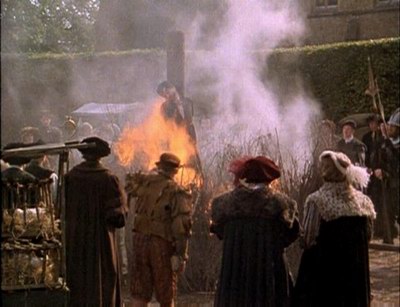
Edward Wightman of Burton-on-Trent was the last person to be executed by burning at the stake for heresy in England in 1612.

Early Life
Edward was born at Burbage, Leicestershire in 1566. He was the son of a schoolteacher and draper (cloth trader) but during his childhood he moved to Burton-on-Trent where he was educated at Burton Grammar School. After initially working in his mother’s drapery business, Edward was apprenticed by a wool cloth trader in Shrewsbury. Edward’s parents were members of the traditional Church of England with no known separatist or puritan leanings but, whilst in Shrewsbury, he became involved with, and strongly influenced by, a group of puritans headed by John Tomkys. The radical brand of Protestantism included the rejection of the trinity and the divinity of Jesus Christ as well as a complete rejection of the institutionalized Church of England. This would have been extremely dangerous in Tudor times, but still pretty thin ice in the times of James I.

In 1590, he was admitted as a master into the Shrewsbury Drapers’ Company, but within a few years, he returned to Burton-on-Trent to start a clothing business. He married Frances Darbye in 1593. They produced 2 sons and 5 daughters.

When Edward returned to Burton, the religious mood had changed quite dramatically from his childhood days there when religion in the town was dominated by the local noble, Lord Paget who still promoted Roman Catholicism.

In 1583, during the interim period, Lord Paget had fled England after ending up on the losing side of some political plotting involving Mary, Queen of Scots. Henry Hastings emerged as the new local noble and political leader, and he was a committed Protestant. Under his leadership, a new evangelical puritanism emerged in Burton. Peter Eccleshall, the Burton curate, was indicted in 1588 for not using the Book of Common Prayer. A puritan evangelist, Philip Stubbes, lived in Burton for a time during the early 1590’s, thus a modest form of puritanism quickly became well-established in Burton.

The clothiers and various influential business people in Burton were very much involved in the religious transformation so Edward’s turn to puritanism was part of a town-wide trend. In 1595, Lord Hastings died, and William Paget, son of the previous noble, was reinstated in the lands of Burton. Despite Paget’s establishment as Baron in 1604, he spent little time in the Burton area so there was no reverse of evangelical puritanism in the town. This paved the way for Edward eventually becoming a radical ‘lay leader’ in the religious community.

Stapenhill Witch
In February 1596, at a time when the country was obsessed with witchcraft, thirteen year old Thomas Darling accused Alice Goodridge of Stapenhill of being a witch and possessed him with a devil. Young Thomas exhibited the classic ‘Exorcist’ symptoms such as vomiting, paralysis, and hallucinations. During his fits of spiritual possession, he would apparently be possessed by the devil one moment and the Holy Spirit the next.

The new puritan minister in Burton, Rev. Arthur Hildersham, became interested in the case, and prayed with Darling, but was unable to exorcise the boy’s demons. Another puritan minister, Rev. John Darrell, who came from nearby Ashby-de-la-Zouch was finally able to exorcise Darling and drive off his possessor.

Alice Goodridge was jailed in Derby and interrogated at Burton town hall in May 1596. Under pressure, she confessed. Many who knew of the Darling case were not convinced of the truth of the boy’s possession. It soon became a symbol in the growing political struggle between the puritan and Anglican communities. The Burton puritans sought to document and prosecute the case aggressively.
Edward Wightman took a strong interest in the Darling case and when Alice Goodridge was interrogated in Burton, Edward was one of five men who ‘examined’ her showing that he was an important and well-respected public figure and religious authority. He was actively involved in documenting the boy’s possession and involved in the ecstatic prayers associated with the boy’s exorcism. The testimonials on the truth of the boy’s claim included the signatures of Edward, Rev. Eccleshall, most of the Burton clothier community, and many established and well-connected local individuals.

The case demonstrates Edward’s highly emotional and spiritual brand of puritanism and his position of authority and leadership despite his relative youth. His involvement in the Darling case proved a turning point in his life, making him entirely amenable to the possibility of unmediated spiritual intervention. Darling claimed not just to be possessed by the devil, but engaged in a series of ‘spiritual wars’ in which both demonic and angelic voices were said to emanate from him.
In the wake of the Darling case, there was a significant backlash against the puritans. Rev. Darrell, the minister who had finally succeeded in exorcising the boy, was convicted of fraud and went into hiding. The practice of group exorcisms was suppressed and soon afterwards died out.

Edward the Radical
Partly through circumstance, Edward was driven to an even more radical separatism. In the late 1590s, England suffered a severe economic downturn after a series of very bad harvests, and several bad aspects of the economy. The cloth trade was particularly badly hit and Edward’s business pursuits failed. By 1603, Edward had purchased an alehouse in Burton and was now a simple tavern keeper, impoverished and deeply in debt. His financial standing had taken a disastrous turn, close to ruin. His swift rise to prominence in Burton society during the 1590s followed by almost as fast a fall fuelled his religious extremism.

Edward was also involved in a court case over a dispute between him and his former apprentice, Samuel Royle, from November 1600 through January 1601. For whatever reason, Edward apparently failed to appear before the court in January 1601, which may have cost him a 40 pound bond. The loss of that sizeable sum might have finished Edward off in the clothing business. The justice who handled the Royle v Wightman dispute was Sir Humphrey Ferrers, and later events suggest that Edward harbored ill feelings toward the noble.

Despite Edward’s legal and financial woes, it is apparent that he retained some degree of significant stature among the new leading puritans in Burton and still closely associated with key figures in Burton’s religious society. They apparently thought well of him and perhaps still looked to him for religious leadership.

The first documented evidence of Edward’s descent into extremism came in early January 1608. Sir Humphrey Ferrers had recently died and Edward was entertaining company in his own home. The conversation turned to Ferrers’ death and Edward’s grudge against him from the 1601 case that may have helped precipitate Edward’s ruin. Edward stated to the assembled company that he believed that the soul does not leave the body upon death, but rather stays with the body until Judgment Day, at which point it either ascends to heaven or descends to hell. Though not too shocking now, this would have been shockingly heretical at the time.

Edward became more vocal about his view of the nature of the soul and death. He continued to argue the point with local clergy. Curate Henry Aberley of Burton opted to use his own pulpit to argue against such heretical ideas, but this apparently led to bitter, and sometimes public, arguments with Edward. As a result, Edward stopped attended the Burton parish church and began worshipping elsewhere.

Despite Edward’s theological split with the established religious community, he was not abandoned by religious leaders. This is consistent with the behavior of other puritanical communities in response to other heresies. Instead of prosecuting or excommunicating the errant individual they would try to reform his views. Chief among those who engaged Edward was Burton puritan minister Rev. Arthur Hildersham, who had probably played a major role in Edward’s ascendance in the religious community a decade earlier.

Hildersham, and Rev. Simon Presse of Egginton, Derbyshire, met with Edward privately and attempted to convince him to change or moderate his view. The obstinate Edward refused and Hildersham ultimately responded by preaching against Edward’s heretical views from his Burton pulpit on March 15, 1609. Hildersham continued to correspond with Edward for a time, but eventually tired of Edward’s stubbornness and cut off the debate. Edward apparently interpreted this as a victory and became all the more convinced of the righteousness of his heterodoxy.

From 1609 to 1611, the process of engaging and attempting to ‘correct’ Edward’s view continued, but Edward became increasingly radicalized and spent his energies writing manuscripts outlining his views. He was a prolific writer, although none of his writings have survived. He was known to never leave home without a number of his books which he read and preached to anyone who would listen. Edward was only ever a ‘lay leader’ in the religious community and never held an official ministerial position. Although enjoying a number of followers for a time, by 1611 he was increasingly avoided and eventually became something of a loner.
King James I Condemnation
England had become a relatively tolerant nation under Elizabeth I but the religious and political situation changed when James I took the throne in 1603. Although King James was tolerant toward Catholics and helped liberalize the Church of England, with the famous English translation of the bible bearing his name, he saw Protestant dissenters, such as Puritans, Baptists, and Quakers, as a major problem and challenge. Among James’ great religious interests was support of catholic orthodoxy, which includes adherence to the major creeds. He took his title of ‘Defender of the Faith’ seriously and since 1607 he had been engaged with Roman Catholics over the ‘Oath of Allegiance’. Edward’s views were therefore, very much opposed to the King’s view.

Wightman set about putting together a compendium of his theology for his upcoming hearing and defense. Perhaps thinking that he would at least be allowed time to plead his case, he delivered copies of it to members of the clergy in an effort to gain support.

Now completely deluded, believing in his own righteousness and persuasiveness, he delivered a manuscript detailing his radical theology (thought to have originally been intended for Anthony Wotton) to King James I despite being fully aware of the King’s religious stance. This was a dubious move to say the least, particularly since the King had recently ordered the execution of Bartholomew Legate for heresy.

The manuscript consisted of eighteen leaves (pages). To give a flavour, it began, “A letter written to a learned man to discover and confute the doctrine of the Nicolaitanes very mightily defended with all the learned of all sorts, and most of all hated and abhorred of God himself, because the whole world is drowned therein: And seeing he hath promised to answer he knew not to what, and least he should also deal with me as the men of that faction have done already…”. The document concluded, “… and say glory be to God alone which dwelleth in the high heavens, whose good will is such towards men that he will now at the last, plant peace on the earth, and let all people say, Amen”. You may be relieved to know that almost the remainder of the document has not survived.

In February 1611, Edward interrupted Lent worship services in Burton with loud outbursts. It took significant effort to get him to quiet down. Finally, the Burton religious community had had enough. The Burton minister involved and others from Burton presented the case against Edward at the ecclesiastical visitation of Bishop Richard Neile of Westminster within a few weeks of Edward’s February 1611 disruptions. In early March 1611, Edward was summoned by Neile to Curborough, near Lichfield. Neile promptly returned to London and reported his findings to King James. The King was set on dealing with this troublesome heretic.
In April 1611, by order of the King, local church authorities issued a warrant for his arrest. The order instructed the church constables of Burton to immediately take him before Bishop Richard Neil at the Consistory Court at Lichfield Cathedral for interrogation of his religious views and for conformation to the established Anglican order. Neile’s Chaplain, who assisted in prosecuting Wightman, was William Laud, the future Archbishop of the Church of England, who was later executed himself!

The Trial
The first day of the trial was held on November 19, 1611. On the second day of the trial on November 26, the crowd was so large that the trial had to be moved to the larger space of the Chapel of the Blessed Virgin. On December 5, Edward was brought before the court for his final appearance. Throughout the trial, Edward did not attempt to defend himself. Instead, he attempted to educate them on the righteousness and intellectual rigor of his arguments, ‘clarifying’ the court’s conception of his heresies.

Sentence was pronounced on December 14, 1611. The charges brought against him included eleven distinct heresies. Part of the charge was that he believed “that the baptizing of infants was an abominable custom; that the doctrine was a total fabrication and that Christ was only a mere man and not the son of God; that the Lord’s Supper and baptism were not to be celebrated; and that Christianity was not wholly professed and preached in the Church of England, but only in part.” Other charges included several equally radical opinions.

After months of being subjected to a series of conferences with ‘learned divines’, Wightman was finally brought before Bishop Neil for the last time. Having refused to change any of his views, he was sentenced to be excommunicated and condemned to be burned at the stake following approval by King James I. Prior to his execution, he was to be placed in a public open place as an example to others who might harbour similar beliefs.

The Execution
When the execution day arrived on March 20, 1612, Edward was tied to a post on the square in Lichfield next to Saint Mary’s church and the fire was lit under him. On feeling the heat, Edward screaming out in recantation and he was pulled down, already badly burned. A written retraction was hurriedly prepared and Edward, in pain and weakness, orally agreement as it was read to him. Later, however, no longer fearing the flames, he refused to sign the retraction and blasphemed louder than before.

King James re-approved his execution and a few weeks later on April 11th, he was once more led to the stake. Once again, on feeling the intense heat of the fire, Wightman cried out in recantation again but this time, the sheriff told him he would cost him no more and commanded more faggots (bundles of thin sticks) to be thrown on to make the flames roar. Edward was burned to ashes.

Conclusion
Seeing that heresy still survived with a number of religious radicals still emerging, King James I lost faith in burning heretics. After the case of Edward Wightman, it was decided that those found guilty of heresy should instead silently and privately waste away in prison rather than excite others with a public execution.

It was not until 1677 that an act of Parliament expressly forbade the burning of heretics, securing once and for all, Wightman’s dubious position in history as ‘The last person in England to be burned at the stake for heresy’.

Ryknield Motor Company

The Ryknield Engine Company was established in 1902 with purpose built factory and offices on Shobnall Road with prominent date-stone on the face of the building. The original intention was simply to build both steam and petrol engines for road vehicles.

The Shobnall Road factory during a vehicle exhibition c1905

Ernest E. Baguley, who had been an apprentice in the rail industry, saw the potential of the motor car and in 1901 he designed a steam-engine for a motor car whilst employed as an engineer with W.G. Bagnall Ltd. They did not share his enthusiasm so he left to join the newly formed Ryknield Engine Company as manager in November 1902.

The first ever Ryknield steam powered car. 1902

However, the company quickly realised that for road vehicles, petrol internal combustion engines was the future and by the end of 1903, they were producing cars like this fine example with the all essential horn mounted on the steering wheel, despite being under 9 horsepower.

Rynield petrol car 1903

Things developed at breakneck speed. No waiting years for the new model, pretty much every car was a further development of the last. There was now room for more than one passenger and the horn was mounted in a much more sensible place.

Rykield car 1904

A year later, the engine power had increased and the driver back support had improved after complaints of discomfort. This example was particularly fetching after the owner had requested sporty (well, different coloured) wheels.

Rynield car 1905

Relatively popular Ryknield light van. This is one of the first to be build and still awaiting its custom livery for its proud business owner.

Ryknield light van

Ryknield Motor Company built the first passenger carrying bus to run in Burton in November 1907. Interestingly, it did not belong to Burton Corporation. It was built and operated by the company itself as an experiment to see if transport available to the fare paying general public could prove to be financially successful.

Ryknield petrol bus. 1907

Ryknield did have a go at building larger commercial vehicles like this one for a Manchester company but without great success because this sector was by now covered by far superior offerings despite this producing a whopping 45 horsepower.

Ryknield commercial vehicle was not a great success. c1910

Ryknield motor company ran into financial difficulties and was taken over by the larger Baguley company whose main operation until then had been steam locomotives but they had an interest in producing motor cars and road vehicles. By the time the business had ceased, it had progressed to making cars such as this beauty made for Messrs. Bass & Co.

Ryknield car built for Mssrs. Bass & Co. 1911

L.S. Lowry

Though I can’t confess to being much of a fan myself, Laurence Stephen Lowry is one of Britain’s best loved and most famous painters, best known for his scenes of life in the industrial districts of Northern England during the early 20th century. He had a distinctive style of painting with human figures often referred to as his “matchstick men”.

The above painting is one of his best known works. The original was painted in 1961 as an oil on canvas measures approximately 21″ x 29″. It is one of a number of pictures that Lowry painted in Burton. The picture shows a brewery engine pulling a beer wagon across a the crossing in High Street, Burton, running past the Blue Posts public house and through the gap which now leads to Burton library.

Lowry often visited Burton while staying with friends. He liked the town and was partial to a pint of Bass which he maintained didn’t taste the same anywhere else. He produced numerous other sketches of Burton which were eventually published as paintings but not quite as famous as this example simply known as ‘The Crossing’.

Thornewill Family

Thomas Thornewill (senior) was baptised in Burton Parish Church on 4th October 1719, the son of Thomas and Elizabeth Thornewill.
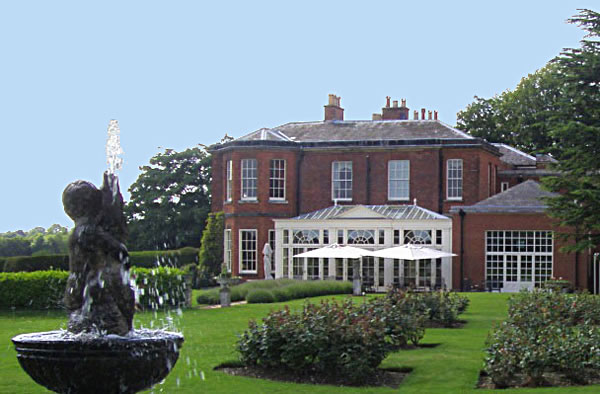
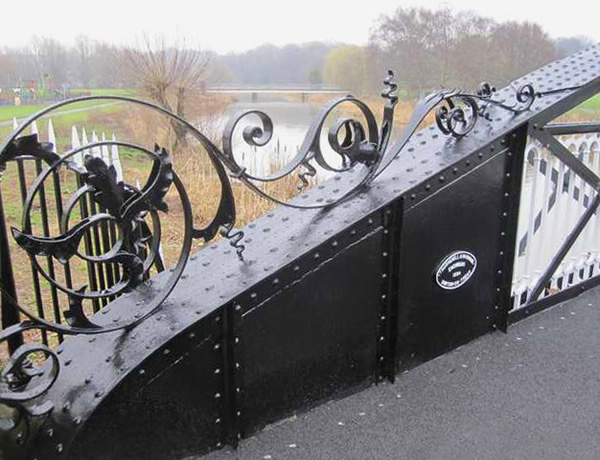
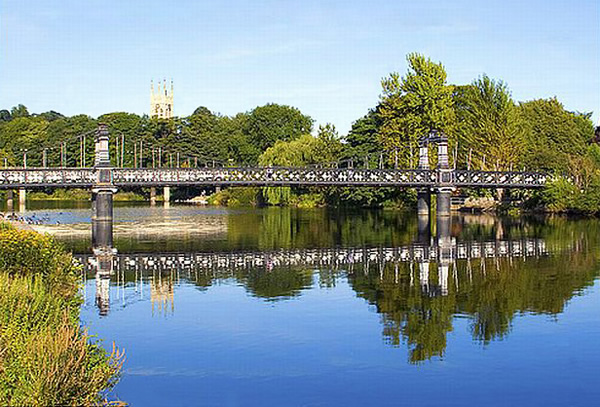
The Thornewill firm dates back to at least 1732 making iron goods. Thomas Thornewill (junior) was apprenticed in that year, at the age of thirteen.

Thomas Thornewill (senior) married Elizabeth Astle on 20th October 1746. She was the widow of Francis Astle, a noted local feltmaker and hatter who had died in 1735. He had left most of his properties to his wife Elizabeth (by a will of 20th May 1735), including a freehold house, on the south side of New Street. She was to have the use of this house for the remainder of her life, and it was then to be sold by Astle’s executors, Thomas Towndrow (gentleman) and John Downes (feltmaker), and the proceeds invested in land worth £5 a year to provide clothing for four poor boys of Richard Allsop’s Charity School in Burton.

Thomas Thornewill of Burton, now listed as ‘Edge Tool maker’ settled the property and its contents to Elizabeth, so that if he died they would pass to her. In 1751, Thomas leased a garden adjoining his freehold property on its eastern side, from William Jordon (cooper) for an annual rent of six shillings. This is significant in that it was the first move towards an expansion of the Thornewill property between New Street and Park Street (which was then known as Pinfold Lane).

Elizabeth, Thomas Thornewill’s wife, died in 1755 and it became the duty of Francis Astle’s executors to dispose of the freehold property in accordance with his will. The freehold property was advertised for sale in the “Derby Mercury”. Thomas Thornewill of Burton and his brother Francis of Clay Mills, both now listed as ‘Edge Tool Makers’ purchased the freehold property in New Street from Thomas Towndrow, the surviving executor or trustee of Francis Astle, for the sum of £140.

By 1760 the Thornewill brothers had established a small business there still making edge tools such as axes, knives and spades. From this time on they began to systematically expand their property in New Street whenever the chance arose. It was not however, their only business interest. A reference to Clay Mills in a 1760 indenture shows that the Thornewills were already in possession of the Forge Mill there. This was sited on the Mill Fleam, a watercourse branching from the River Dove, on or near the site of an old water corn mill. The exact dates when the Thornewills leased the mill and opened the forge are not known, but were probably around the year 1740.

Water power was needed for working the bellows and hammers in the forge and also to operate rolling and slitting mill. The forge usually consisted of a “finery” in which the iron was hammered into blooms and a “chafery” in which the blooms were reheated and beaten into bars. In the rolling and slitting mills the iron was rolled into sheets and then cut into rods ready for the nailers. The Thornewill’s forge may not have had rolling and slitting mills attached in 1760, but it certainly had in 1807 when they purchased the premises outright.

In 1760 about 25,000 tons of iron were imported annually into England (approximately 50% of the requirements) mainly from Russia and Sweden. The Thornewills used this imported iron, which they purchased from the Burton brewers of the time, such as Benjamin Wilson, John Walker Wilson and Samuel Sketchley. The brewers normally accepted some iron, flan or timber as part payment for the beer that they exported along the Trent to the Baltic countries.

Thomas Thornewill (ironmonger and spademaker) leased the White Hart Inn in High Street from the Earl of Uxbridge on 23rd September 1769. Later in the year, he sub-let a house and garden on the north side of New Street (which he previously leased from the Earl of Uxbridge) to John Shorthose (turner). In a property lease of 1770 John Shorthose is described as a spademaker and was an employee at the Thornewill works in New Street.

In March 1772, Thomas and Francis Thornewill leased from the Earl of Uxbridge, two further tenements and a garden to the east of their freehold property, and also a property to the west. Ever expanding, Thomas also leased land at Stretton, including some waste land near the forge.

By 1778 the Thornewill’s business had grown considerably. They were in possession of extensive properties in Burton, particularly in New Street, and at Clay Mills, Stretton. They were purchasing large quantities of imported iron, (for example, in August, 1778 Thomas Thornewill bought 658 iron bars imported by John Walker Wilson from St. Petersburg, Russia, for £273 7 6) and were manufacturing considerable quantities of spades, iron hoops, iron plate and other forms of hardware. They were probably the main suppliers of iron hoops to the Burton brewers of the time, and this was no doubt the way in which the firm developed as brewery engineers.

At the beginning of 1784, Thomas Thornewill made his will, and in this he left his leasehold properties to his daughter Sarah Spiers. After Thomas’s death Sarah sold the property lying to the east of the freehold property, to George Wood for £125, and it was not until 1834 that the Thornewills were able to buy it back from George’s son William. The Wood family, together with William Shorthose, Philip Port and William Smith were also, at this time, eager to acquire land on the south side of New Street, where they operated (approximately 1775 1835) a large screw making works. No doubt the Thornewills supplied this firm with iron.

Thomas Thornewill (senior) died in 1786 and the firm came under the management of Thomas, his son, and Francis, his brother.

In the same vein as his father, in 1801, Thomas Thornewill leased two more properties on the South side of New Street.

Francis Thornewill made his will in 1805 which showed that he was a man of considerable wealth. He left the bulk of his estate to his sons, John and Francis, but he was still able to leave £500 to his daughter Anne; and £200 to his grand daughter Anne Neal. He died just 2 years later in 1807 having done much to build up the business. He had also been one of the Townmasters in 1792 and was a Feoffee in 1794.

In March 1807, Thomas Thornewill (junior) purchased outright for £3,220, extensive properties and rights at Clay Mills from the Earl of Uxbridge. These included:
(a) “Cliffcroft” 7 acres of land containing Dove Cliff House, that was built for him about 1700, gardens, plantations, pleasure grounds, etc.
(b) Clay Mill forge with “all those iron works and all the slitting mills, forges, warehouses, buildings and works belonging thereto”.
(c) A warehouse and tenement near the Grand Trunk Canal in Stretton.

The Grand Trunk Canal had been opened in 1770 and was a considerable improvement on the Trent navigation.

By 1811, Thornewill’s were operating a forge at Wichnor as well as at Clay Mills. At the latter there was also a foundry and an iron casting house.

In the 1818 edition of the Bradshaw & Parsons Directory of Staffordshire, there are two Thornewill listings, the new one being in New Street. These appeared as:

  • J. & F. Thornewill spade manufactures.
  • John Thornewill & Co. merchants.

Although not listed in the Directory, Thornewill & Co. also held the forge at Stretton (Clay Mills) and William Gretton was the iron master there. At the time, there were also recorded living in the area around the works an iron founder, a foundry man, three spade makers, end three nailers, in addition to six patten ring makers and fourteen screw forgers who worked at the nearby screw mill.

By 1834, the Bradshaw & Parsons Directory had pretty much been replaced by The White’s Directory of Staffordshire. The listed had changed slightly to:

  • John & Francis Thornewill Iron and brass founders and spade manufacturers.
  • John Thornewill & Son Iron Merchants.

In 1835/36 the leases for the New Street properties were successfully renewed. By 1837, most of these premises together with the freehold property were in the possession of Robert, John and Francis who were now running the business.

By 1837, Thomas Thornewill made his will. By this time, he was 77 years of age and had taken little part in the running of the business for some time. A few of the main clauses of his will illustrate the considerable wealth that the Thornewill family had acquired since 1760 when Thomas (senior) and Francis (senior) had raised the £140 to buy the freehold premises in New Street. It listed:

  • To Mary, his daughter £3,600.
  • To Ann Fenwick (daughter) £3,700.
  • To Jane (daughter) £3,100.
  •  To Frances Hewitt (daughter) £1,000 q + £2,700 in trust.
  • Residue from the sale of two farms at Yoxall and Hadley End, and other estates; personal effects; and Dove Cliff House, together with the nearby forges, workmen’s houses furnaces rolling and slitting mills, watercourses, weirs, fisheries, and adjoining lands, all to pass to Edward, his son.

During 1839, the New Street premises were further extended and the firm constructed a number of new buildings on its existing land. A large area of land extending to Pinfold Lane was also purchased by Robert Thornewill from Thomas Lambert and in 1840, the date above a new archway marked the alterations.

A large two storied building was built in 1845. Mr. William Jones, the tenant of the neighbouring property, wrote a letter to Robert Thornewill complaining about the number of windows in the upper storey of the new building.

On 1st Feb 1847, Robert Thornewill purchased the leasehold premises, to the west of the freehold property, from Thomas Cooper. These very old premises had, for the previous one hundred and fifty years been used by Francis Astle, Thomas Cooper and others, as a hat factory. At a later date the houses were demolished or extensively modified to form the present offices.

An Indenture of partnership between Robert Thornewill and J.R. Warham (engineer), now described as engineers, ironfounders and iron merchants was signed on 2nd July 1849

Robert Thornewill purchased a piece of land adjoining the west side of the works in Park Street from William Wood in 1852. This meant that the site now occupied a complete 2 acre plot of land between New Street and Park Street.

It was probably about this time also that the business changed considerably in the types of goods that it produced. From its beginning to about 1845 it was little more than a hardware firm making iron, copper, and brass goods for use locally, particularly in the Burton breweries. From 1845 onwards it became an engineering firm in the true sense, and it is significant that Bagshaw, in his Directory of Derbyshire of 1846, lists the firm of Robert Thornewill of New Street iron and brass founders and steam engine makers. These early engines were probably sold mainly to local collieries and breweries.

The 1851 White Directory of Staffordshire, stated that Thornewill and Warham Iron foundry and Engine and Machine Works in New street “employs 75 men and 25 boys”. He also mentioned that Thornewill & Co. had an ironworks at Clay Mills, and that Edward Thornewill lived at Dovecliff House, Rolleston.

Dovecliff House, Rolleston

Robert Thornewill (senior) died in 1858 and his share of the business passed to his wife Martha Hammond Thornewill (neé Wright), in accordance with his Will of 20th Feb 1856.

An article in The Burton Weekly News of 30th March 1860 stated “apart from brewing, the only considerable manufactory now is Messrs Thornewill and Warham’s iron foundry and Engine and Machine Works.”

By this time the firm was producing approximately fifteen to twenty steam engines annually. These consisted of pumping, haulage and winding engines and tank locomotives which were sold mainly to collieries in Derbyshire, Leicestershire, Staffordshire and Warwickshire. A few were sold to Burton breweries and to ironworks and lead mining companies in the Midlands.

On 25th November 1868, the partnership of M. H. Thornewill and J. R. Warham was dissolved to allow Robert Thornewill pictured above (son of Robert Thornewill (senior) who had died in 1858) to enter. At this time the property, stock and other assets of the firm were valued at £43,048 1 6 of which M. H. Thornewill held £27,720 15 7 and John Robson Warham £15,327 5 11.

Under the new partnership agreement J. R. Warham was to control 6/12ths, M. H. Thornewill 5/12ths, and R. Thornewill 1/12th of a total capital of £44,000.

At the end of 1878, Thornewill and Warham purchased a piece of land with a number of properties, on the corner of Lichfield Street and Park Street, from Frederick Gretton, a brewer of Burton, for £2,500. It adjoined John Bell’s brewery on its north east side. In 1879 some of this land was sold to the Midland Railway Co., who built a line through Thornewill and Warham’s premises from the south side of Station Street to the Bond End Railway.

Two years later, in 1880, Thornewill and Warham purchased property on the south side of New Street, to the west of their own premises, from the Trustees of G. R. Bircher. This consisted of premises fronting New Street, originally an inn known as the Old Queen’s Head, and 423 sq. yds. of ground to the rear.

In approximately 1885 Thornewill and Warham exported three engines to Japan to be used for winding and hauling at Taskanna Colliery. After 1885 the number of engines made for export increased considerably the following extracts from the firm’s order book illustrates this:

  • 1886 Two pumping engine for a sewage works at Buenos Aires, Argentina.
  • 1889 Two engines for pumping and winding to the Taeping Colliery Co. in China.
  • 1892 Winding engine for the Dundee Coal Co. in Natal, South Africa
  • 1897 Pumping engine for a Gold Mining Syndicate in British Guiana.
  • 1902 Winding engine sent to the Rajah of Sarawak in Borneo.

Not only did Thornewill and Warham considerably expand the extent of their market, they also greatly extended the range of their manufactures. By 1880 they were producing a full range of brewery equipment, including various types of refrigerators, and indeed were capable of producing all types of machinery and metal goods.

On 26th March 1886, J.R. Warham died, leaving his share of the business to his wife, Anne Jane Warham of Birmingham, and to his son, William Warham (gentleman) of Seaham Harbour, Co. Durham. M.H. and Robert Thornewill purchased these shares and thus the business became an entirely family concern again after a break of 37 years.

In 1889, Thornewill and Warham made the contribution to Burton for which they are best known… having built the Andresey Bridge by special commission, they were commissioned by Michael Arthur Bass (later to become Lord Burton) to build the Ferry Bridge. The Ferry Bridge was opened on 3rd April 1889, and the viaduct linking it to Bond End added a little later at the total cost of just over £10,000. A few weeks later on 24th April 1889 Martha Hammond Thornewill died, and her share of the business passed equally to her three sons, Rev. Charles Francis, Robert and Arthur, in accordance with her will of 1st Feb 1889. Charles Francis sold his share in 1890 and Arthur his in 1893, leaving Robert in control of the business.

Andresey Bridge

Ferry Bridge

By 1895 Thornewill and Warham were manufacturing approximately twenty steam engines a year. Between 1870 and 1895 they made 500 (including locomotives). Of the 329 that can be traced in the engine order book they were installed in the following types of works:

  • Collieries 202
  • Breweries 50 + 16 locomotives in Burton breweries
  • Waterworks 12
  • Ironworks 10
  • Potteries 10
  • Engineering 6
  • Sewage Works 5
  • Railways 4
  • Gasworks 3
  • Quarries 3
  • Lead mines 2
  • Building works, brickworks, canal company, flour mill. dock company and woodworks 1 each.

In 1907, assignment of the business changed from Robert Thornewill Esq. to Thornewill and Warham Ltd. Robert Thornewill died in 1914, leaving two daughters, Ella Violet and Kathleen Hamilton

1919 marked the end of an era when Thornewill and Warham Ltd. went into liquidation and a new company of the same name was formed. This was purchased by S. Briggs & Co. Limited which remains successful today but was moved from the New Street premises to new premises in Derby Street to make way for the Octagon Shopping Centre.