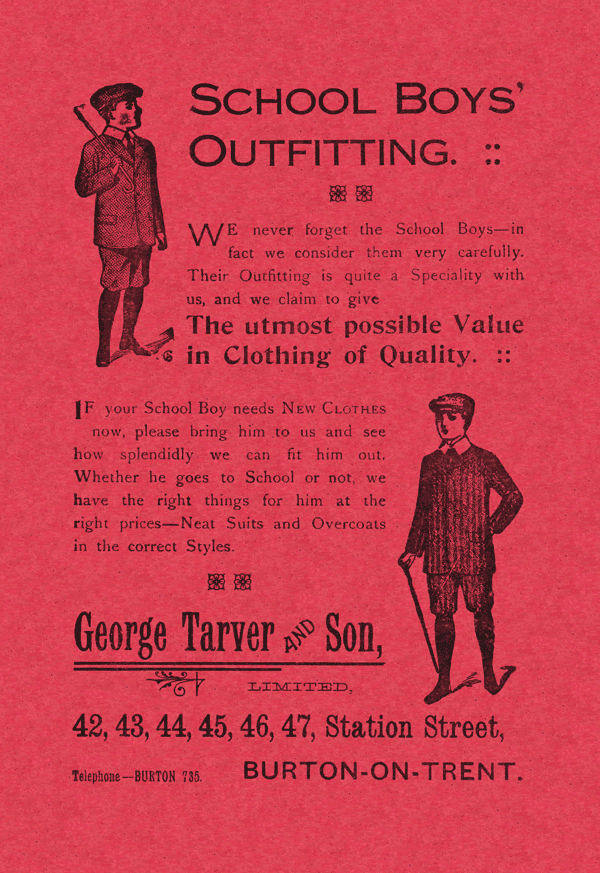
1919 – George Tarver and Son, Gents Outfitters
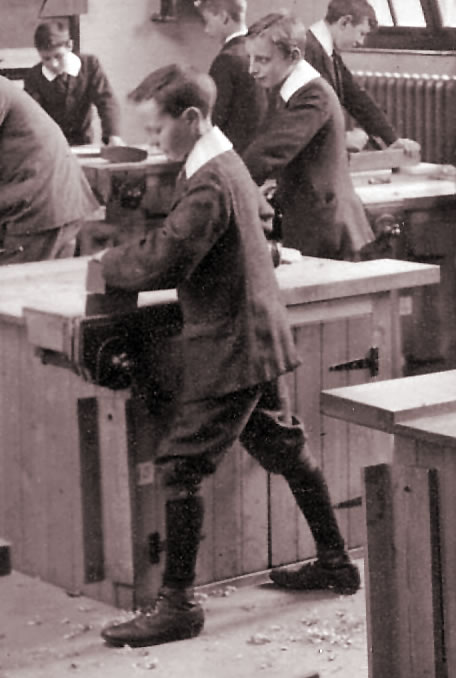
Just in case you have any doubts over whether pupils actually dressed this way… the above picture was taken at Burton Grammar School at around the same time.
1919 – George Tarver and Son, Gents Outfitters
Just in case you have any doubts over whether pupils actually dressed this way… the above picture was taken at Burton Grammar School at around the same time.
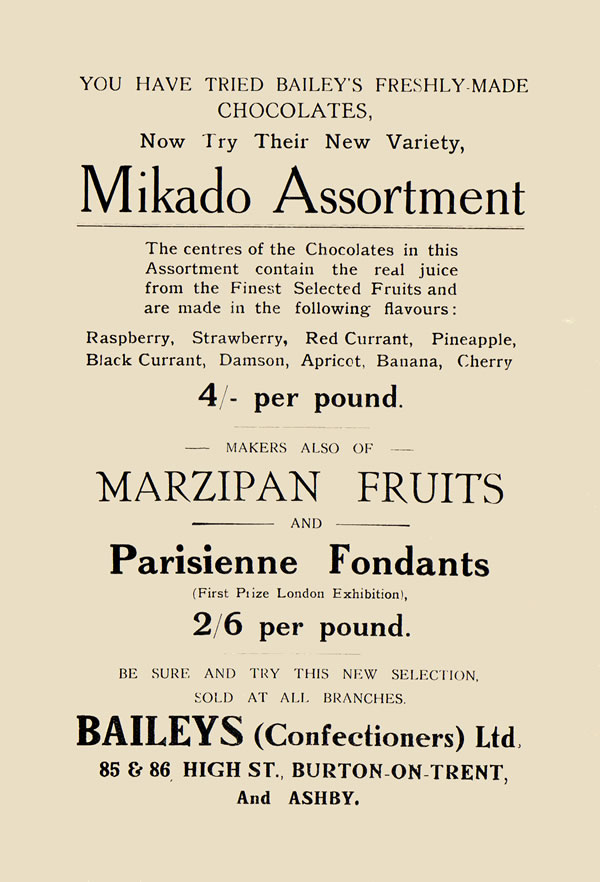
1922 – Baileys Ltd, Confectioner
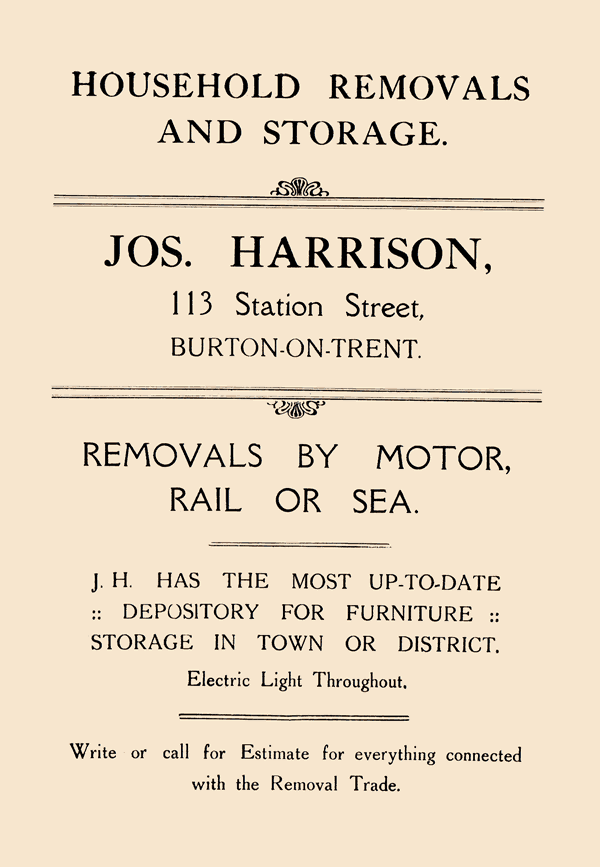
1922 – Joseph Harrison, Household Removals and Storage

1922 – Heape and Company, House Furnishers
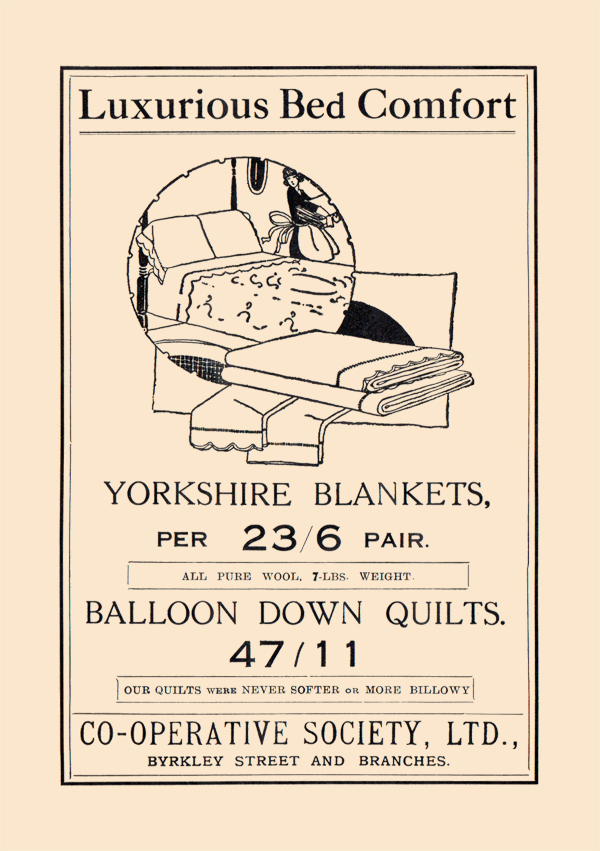
1922 – Co-operative Society Ltd, General Supplies
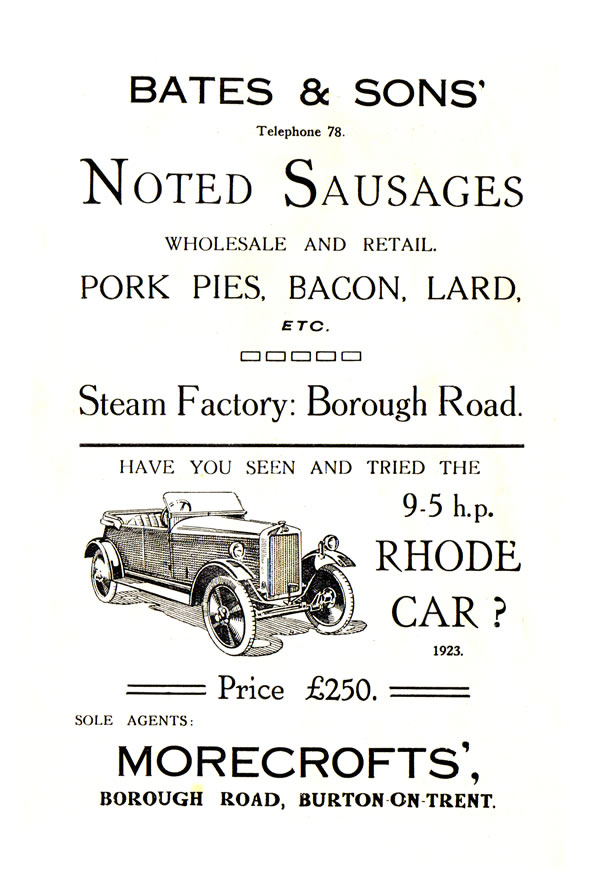
1922- Bates and Sons, Wholesale and Retail
1922 – Morecrofts, Auto sales
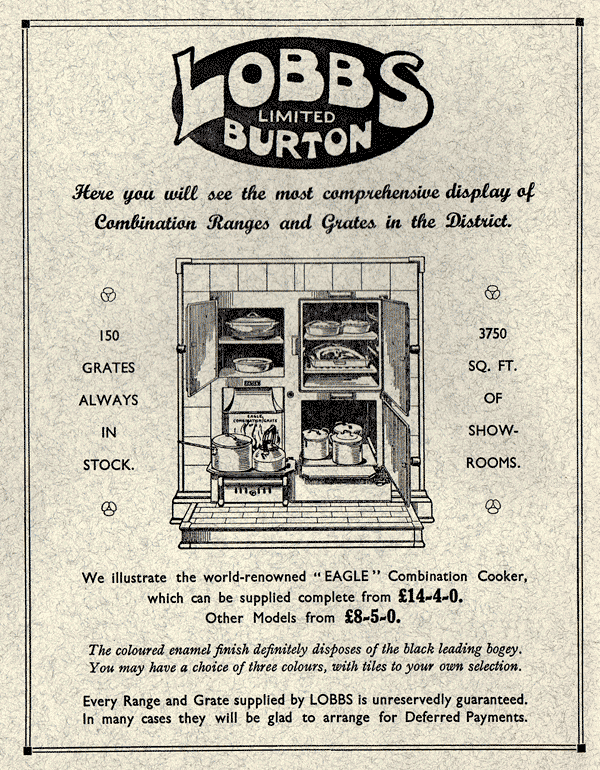
1934 – Lobbs Limited, Ranges and Grates
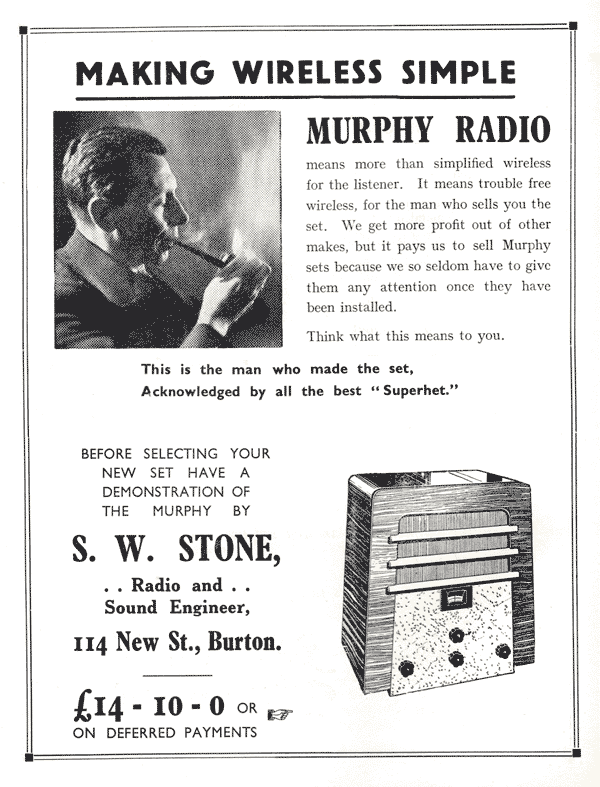
1934 – S.W. Stone, Radio and Sound Engineer
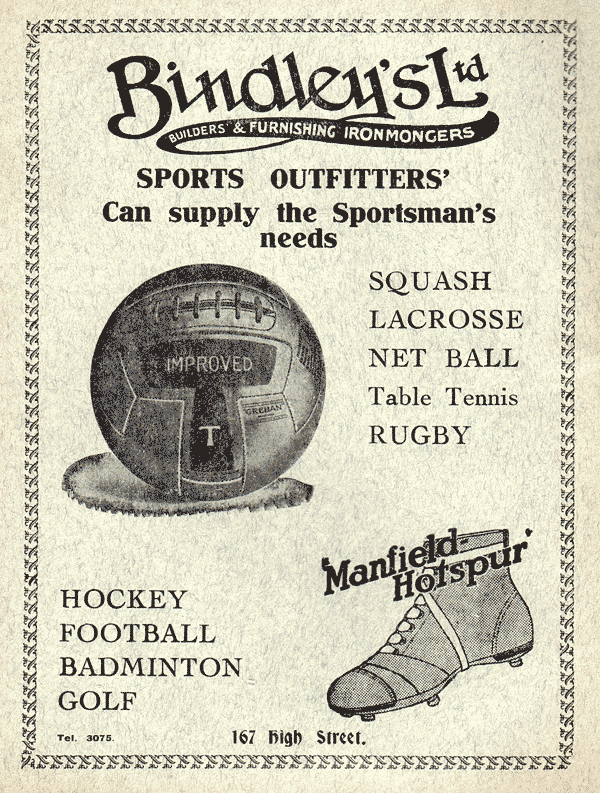
1935 – Bindleys Ltd, Builders and Furnishings Ironmonger / Sports Shop
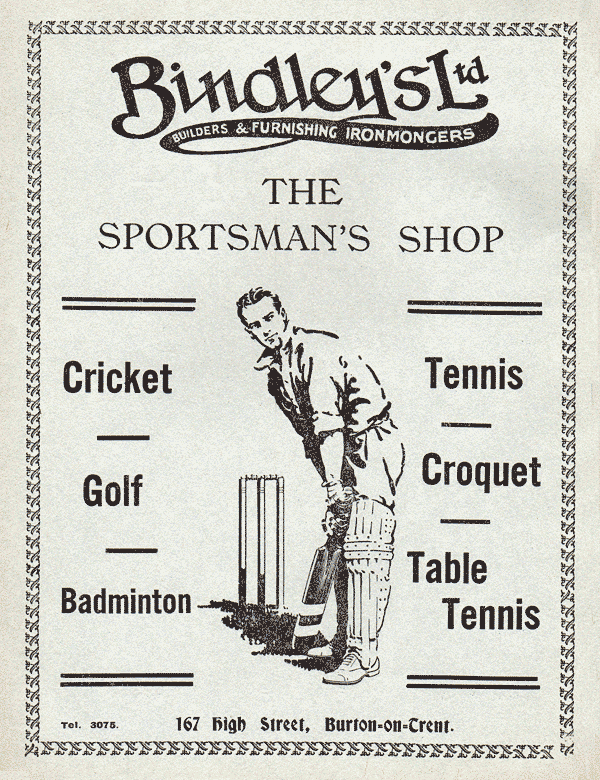
1936 – Bindleys Ltd, Builders and Furnishings Ironmonger / Sports Shop
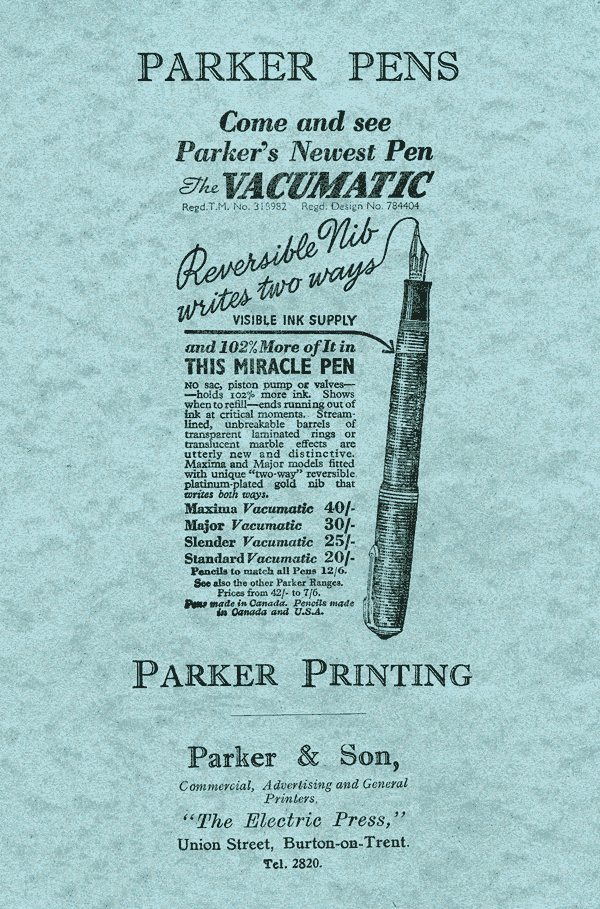
1937 – Parker and Son, Printers and writing supplies
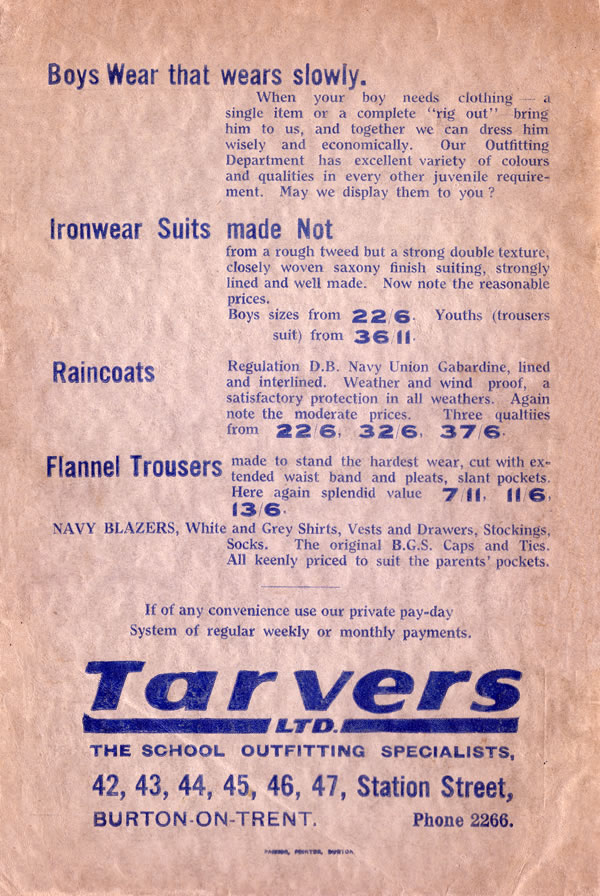
1939 – Tarvers Limited, School Outfitting Specialists
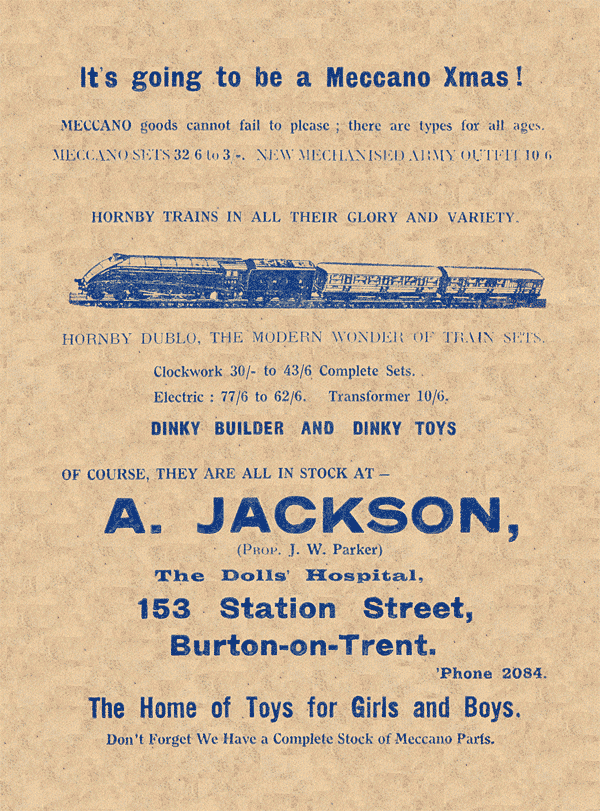
1939 – A. Jackson, Toy Shop
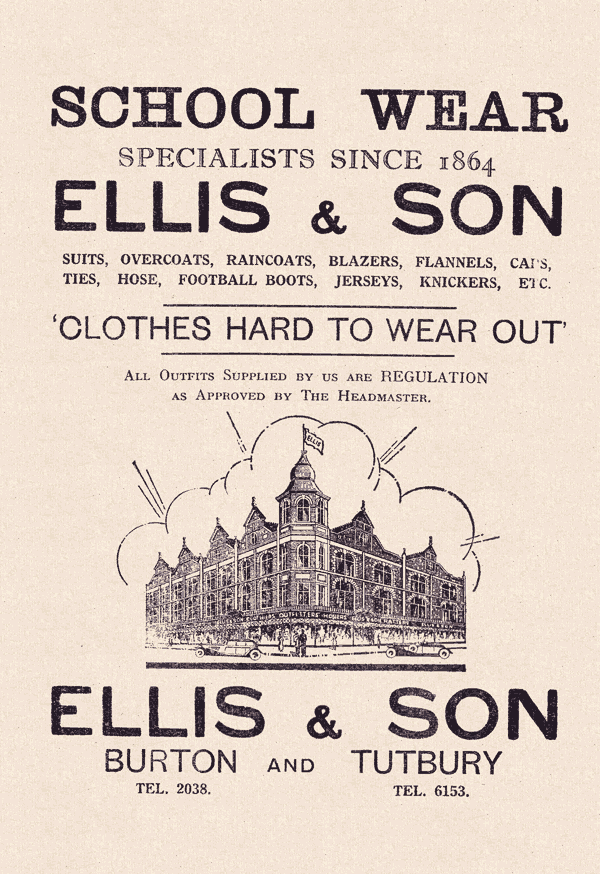
1945 – Ellis and Son, School Wear
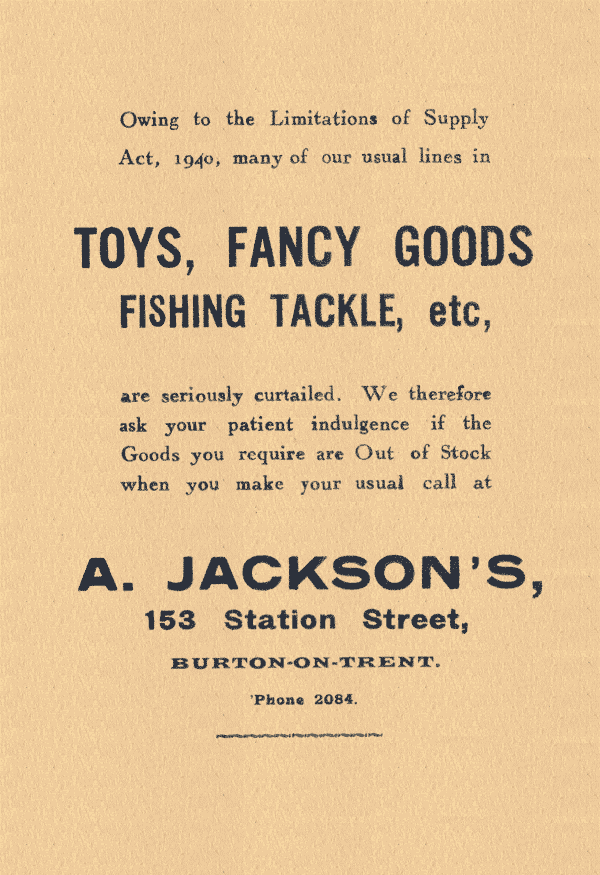
1945 – A. Jackson’s, Toys, Fancy Goods, Fishing Tackle
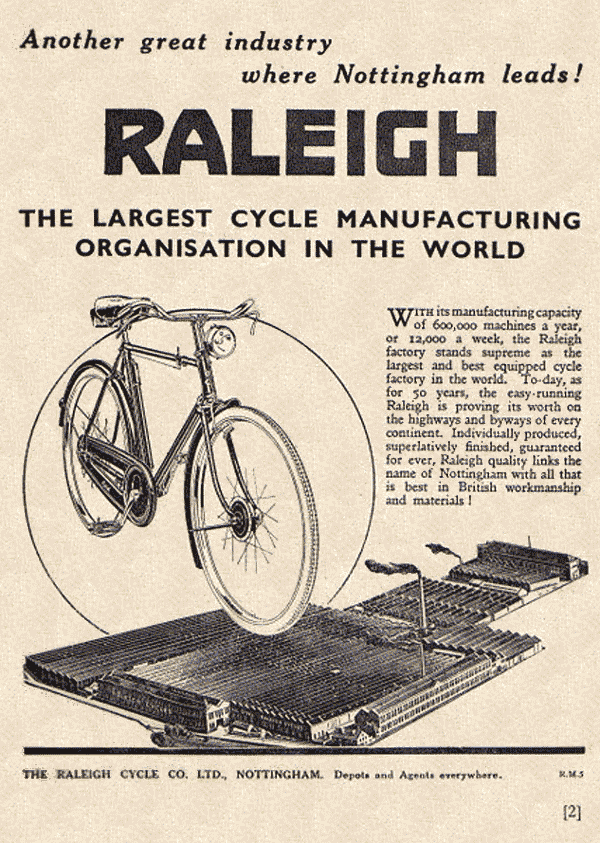
1945 – Raleigh Bicycles, Cycles
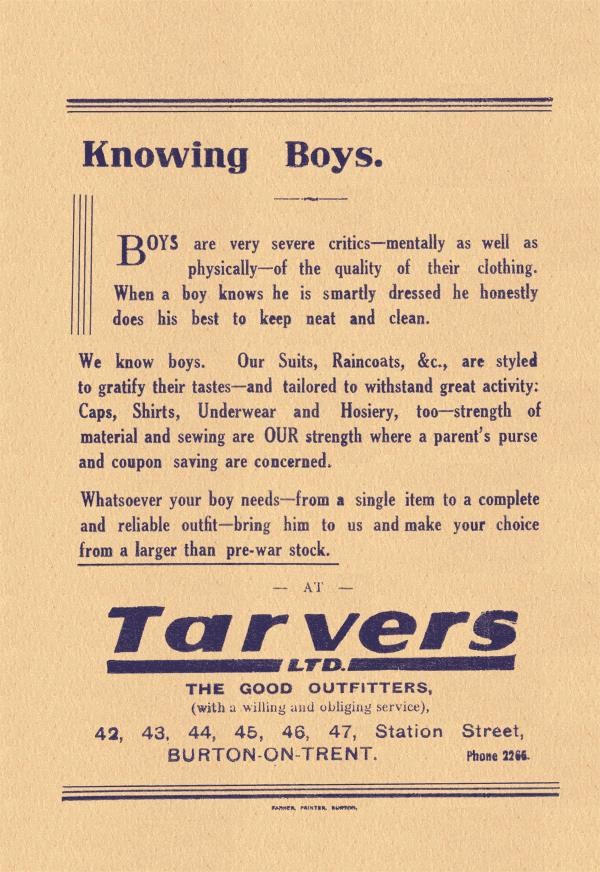
1945 – Tarvers Limited, Gents Outfitters
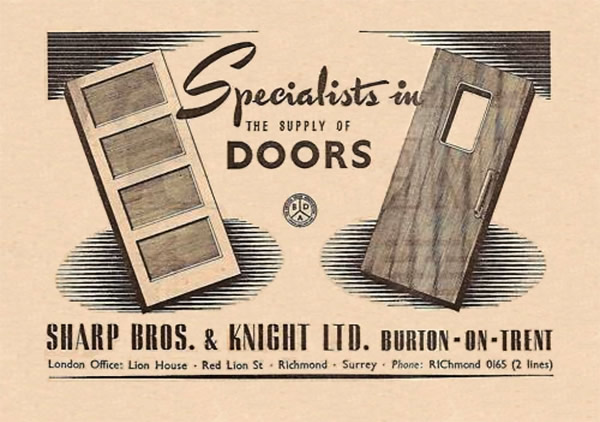
1950 – Sharp Bros. and Knight Ltd, Joinery
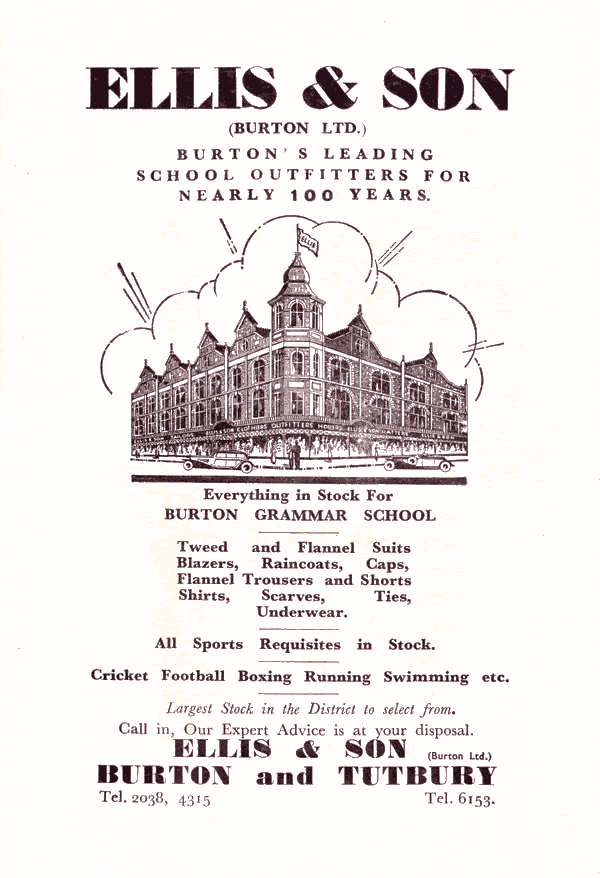
1954 – Ellis and Son, Gents Outfitters
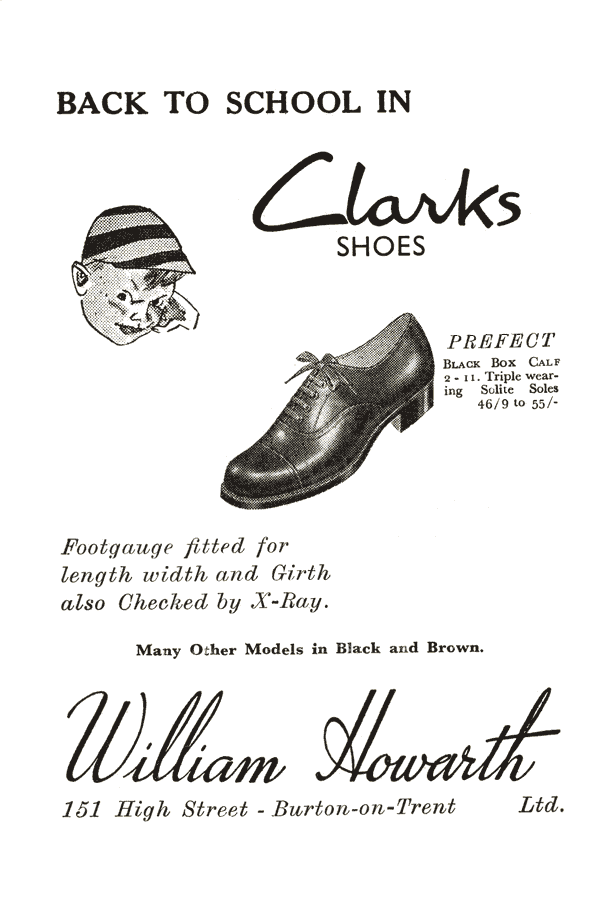
1954 – William Howarth, Shoes
 Bass, founded by William Bass in 1777, is one of the most successful brewing companies of all time. When the London Stock Exchange established the original FT 30 index in 1935, listing the top 30 UK companies, Bass was included in the list.
The company was also a pioneer of International brand marketing. The Bass Red Triangle was the first trademark to be registered under the UK’s Trade Mark Registration Act 1875, as trade mark number 1!
The 1875 Act came into effect on 1 January 1876 and that New Year’s Eve, a Bass employee saw the New Year in by queuing overnight outside the registrar’s office, in order to be the first to register a trademark when the office opened the next morning.
In fact, Bass, Ratcliff & Gretton Limited received the first two registrations, the first being the Bass Red Triangle for their pale ale, and the second the Bass Red Diamond for their strong ale.
It is one of the most distinctive, identifiable and historically significant logos and brands in the World.
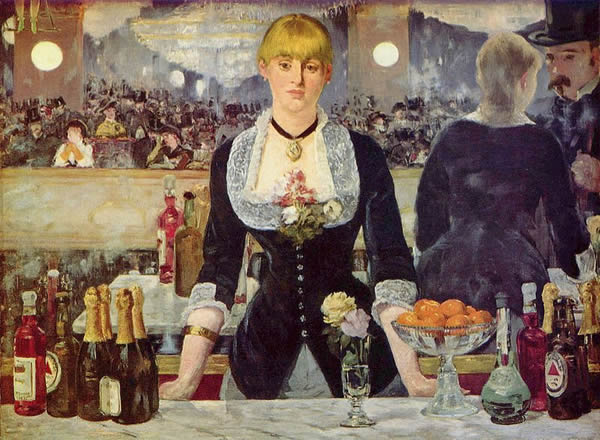
Bottles of Bass with the famous logo have appeared in art and literature, including paintings by Pablo Picasso who must have enjoyed the odd tipple. The above example is an 1881 painting by Manet with the famous red triangle very apparent.
Burton in the English Civil War
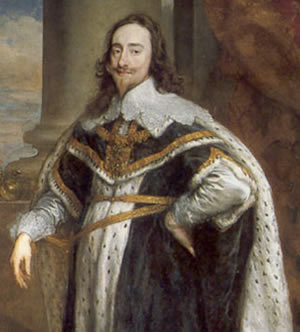 The English Civil War started in 1642 when Charles I (pictured) raised his royal standard in Nottingham. England was split between those that supported the King and those that supported Parliament. In the case of Burton, support was fairly strongly parliamentarian. One of the most prominent Burton paliamentarian was Daniel Watson of Nether Hall. Before the outbreak of the civil war, he was a lawyer but he became a captain of dragoons in the Derbyshire cavalry.
Burton’s allegiance was largely a result of its puritan following. There was some unrest in the town at the outset of the war with rumours of gunpowder being hoarded to support rebellion. Although investigations by Lord Paget concluded that this was unfounded, in 1643, there was a large explosion in Saint Modwen’s church in the Market Place which destroyed the roof and blew out the windows.
Lord Paget, Burton’s most senior figure, was clearly undecided on where his loyalties should lie. Initially, in 1642, he declared support for Parliament but in June of the same year, he switched allegiance to the King. In September 1644, he reverted back to supporting parliament, clearly trying to hedge his bets in his own interest
With its highly strategic river crossing that was noted at the time as “the chief passage from South to the North”, and situated between parliamentary Stafford and Derby and royalist Lichfield, Tutbury, and Ashby-de-la-Zouch, Burton was destined to be fought over throughout the civil war and lacking walls or natural defences, it changed hands many times.
Burton was the rendezvous for the royalist forces of the Earl of Chesterfield and his son Ferdinando Stanhope late in 1642, but the establishment of a parliamentarian garrison at Derby brought Burton to the attention of the conservative parliamentarian Sir John Gell and the rest of the Derbyshire county committee. In February 1643 Gell placed an artillery company in Burton under Major Johannes Molanus, a Dutchman who had actually come to England to assist with drainage projects in Lincolnshire. The garrison withdrew later the same month with orders to support an attack on the royalist stronghold of Newark in Nottinghamshire.
After capturing Lichfield for the king at the end of April 1643, Prince Rupert also placed a garrison at Burton, but it was promptly driven out by the forces of Gell and Lord Grey of Groby, commander-in-chief of the East Midlands Association. They installed Captain Thomas Sanders with a garrison of 200 foot, 60 dragoons, and one cannon drawn from the forces of Derbyshire. Sanders quickly deserted Gell’s command and placed himself and his troops under another parliamentarian officer, Col. Richard Houghton, and the Staffordshire county committee. Sanders was more radical than Gell, and may have feared that his appointment with only a small force in poorly defended Burton was Gell’s way of removing a potential rival.
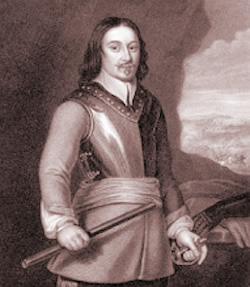 On 4th July, 1643, that garrison was stormed in what was probably the most famous local battle of the war – ‘The Battle of the Bridge’. An army under Queen Henrietta Maria, wife of Charles I, was commanded by Thomas Tyldesley (pictured), a supporter of Charles I and a Royalist commander from Lancashire, at the time having the rank of Colonel, led a cavalry charge across the bridge to attack Burton. It was a very bloody confrontation in which the church was damaged and the town was, according to Gell, “most miserably plundered and destroyed”. At the end of the battle, so much booty was taken that the Queen, who witnessed the battle, recorded that her soldiers “could not well march with their swollen bundles”.
After the battle, Burton became an important Roundhead stronghold and, largely because of the success of this attack against the odds, Thomas Tyldesley was knighted. A plaque to commemorate the event was erected on the replacement (current) bridge by the Burton Civic Society in 1993. It is still there today but goes largely unnoticed.
The royalists remained in control for the next six months and fortified the bridge, but were again driven out by Gell’s troops in January 1644. No garrison appears to have been established, and Burton was soon again under royalist control, although it was attacked and ‘plundered’ in a parliamentarian raid in April 1644.
The King’s forces from Lichfield were quartered in the town in July 1644 but they were driven out by Gell’s troops. A fresh parliamentary garrison of both Derbyshire and Staffordshire troops was installed in the town in November 1644, but by February 1645 Burton was once more under royalist control, and it was there that Charles I made his headquarters briefly at the end of May 1645. It was firmly and finally under parliamentarian control by early 1646, when the town contributed both money and beer to the parliamentarian forces besieging Tutbury and Lichfield.
A later list made in 1662 recorded that 127 former Burton parliamentarians. This was the largest count in Staffordshire with the esception of Stafford.
After the Restoration, Burton was a dissenting centre, with large Presbyterian and Baptist conventicles meeting there with five excluded ministers. This raised some doubt with Anglicans over the loyalty of the town’s population. Nonconformity remained strong in the town until the early 18th century. Within ten years of the passing of the Toleration Act in 1689, six houses were registered for dissenters and there were Presbyterian, Baptist and Quaker meetings in Burton.
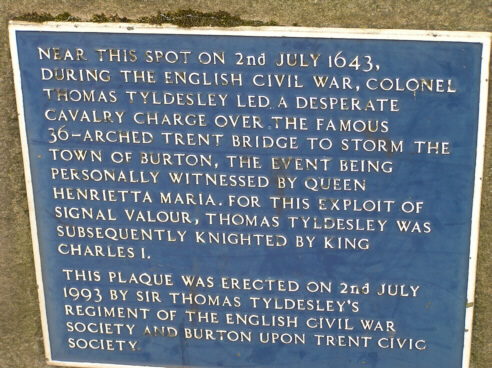
A plaque to commemorate the event, erected by Burton Civic Society in conjunction with Sir Thomas Tyldesley’s regiment of the English Civil War Society, can be found on the current Trent Bridge.
NEAR THIS SPOT ON 2nd JULY 1643, DURING THE ENGLISH CIVIL WAR, COLONEL THOMAS TYLDESLEY LED A DESPERATE CAVALRY CHARGE OVER THE FAMOUS 36-ARCHED TRENT BRIDGE TO STORM THE TOWN OF BURTON, THE EVENT BEING PERSONALLY WITNESSED BY QUEEN MARIA [wife of Charles I]. FOR THIS EXPLOIT OF SIGNAL VALOUR, THOMAS TYLDESLEY WAS SUBSEQUENTLY KNIGHTED BY KING CHARLES I.
THIS PLAQUE WAS ERECTED ON 2nd JULY 1993 BY SIR THOMAS TYLDESLEY’S REGIMENT OF THE ENGLISH CIVIL WAR SOCIETY AND BURTON UPON TRENT CIVIC SOCIETY.
In Brief
The Old Town Hall built in 1772, situated in the market place, was finally demolished in 1883. Burton Borough Council, formed in 1878, had to conduct council meetings in the back room of a public house!
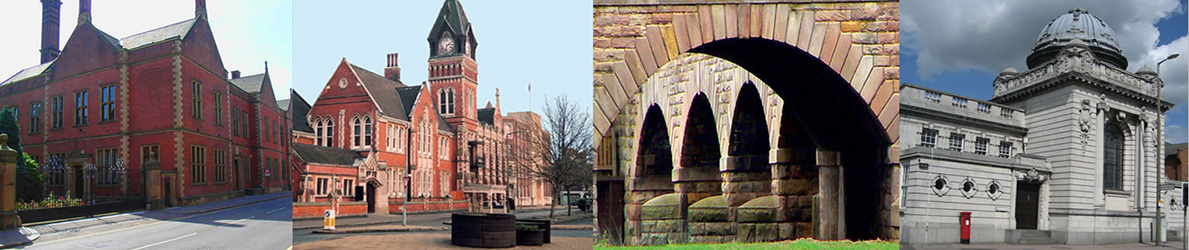
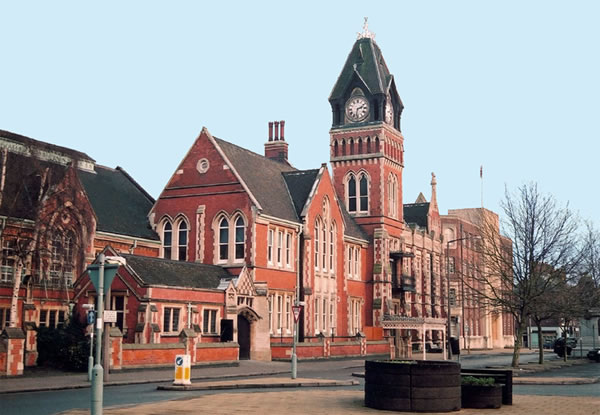
In 1882, Michael Thomas Bass II donated Saint Paul’s Institute and the Liberal Club to the town. His son, Michael Arthur Bass (later Lord Burton), further improved them in 1888. The two adjacent buildings were donated to Burton Borough in 1891 as a much needed Town Hall.
A replacement Institute was built near Saint Paul’s and replacement Liberal Club in George Street were also donated by Lord Burton; both were opened in 1894.
The Town Hall has twice been extended to incorporate civic and council office space.
Select page to view:
The town hall was deemed unsuitable as offices for the town commissioners established in 1779. Nonetheless, after a number of meetings at the close by Angel Inn owned by one of their own, Sydney Evershed, it struggled on until it was in such a state that the Angel Inn became the unofficial Town Hall until 1853 !
I am still trying to find an image of it.
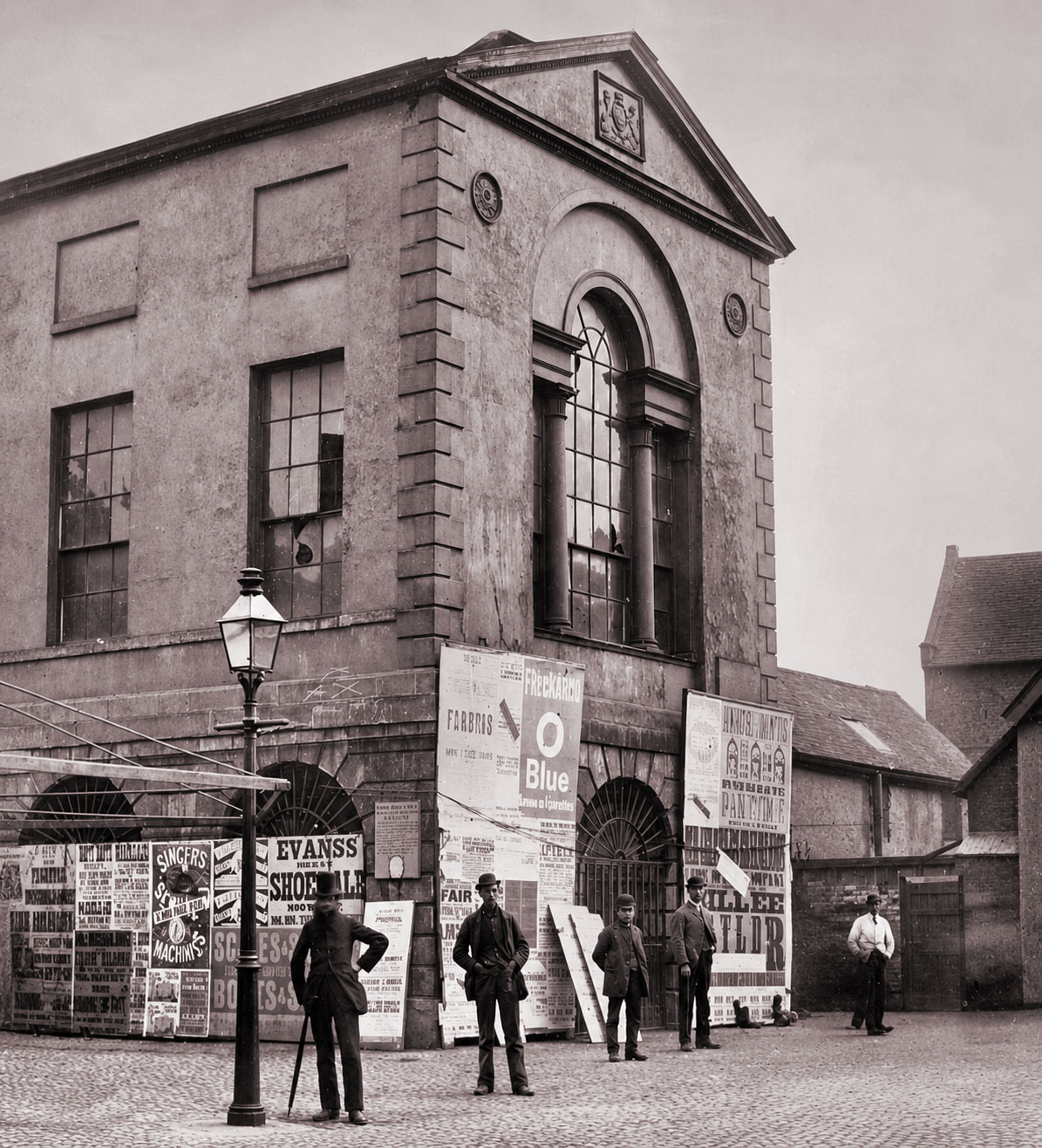
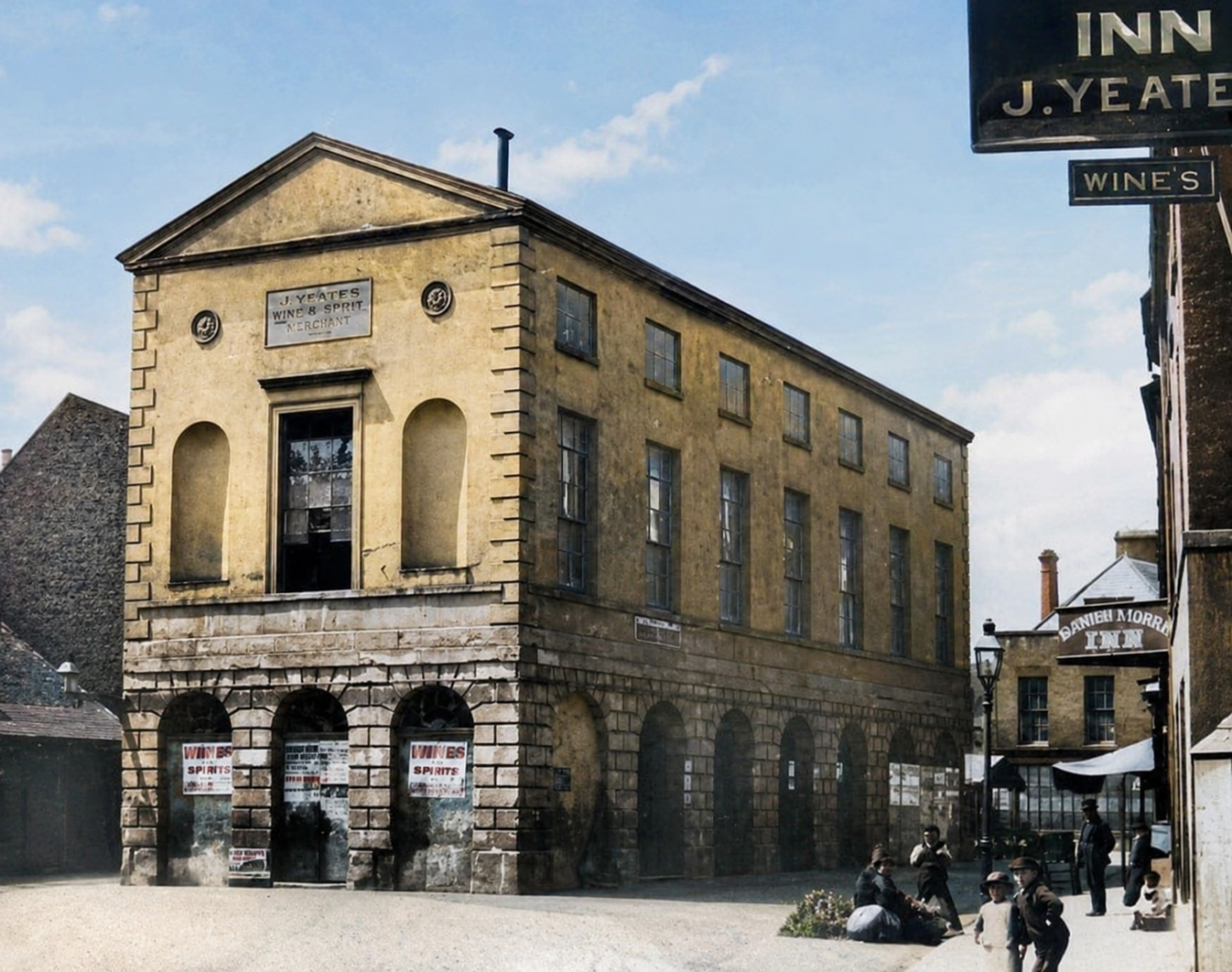
A replacement Town Hall was built in 1771-2 on the same market place site as the original medieval Leet Hall. It was paid for by Lord Paget, designed by local architect James Wyatt and his brother Joseph was involved with the building and masonry.
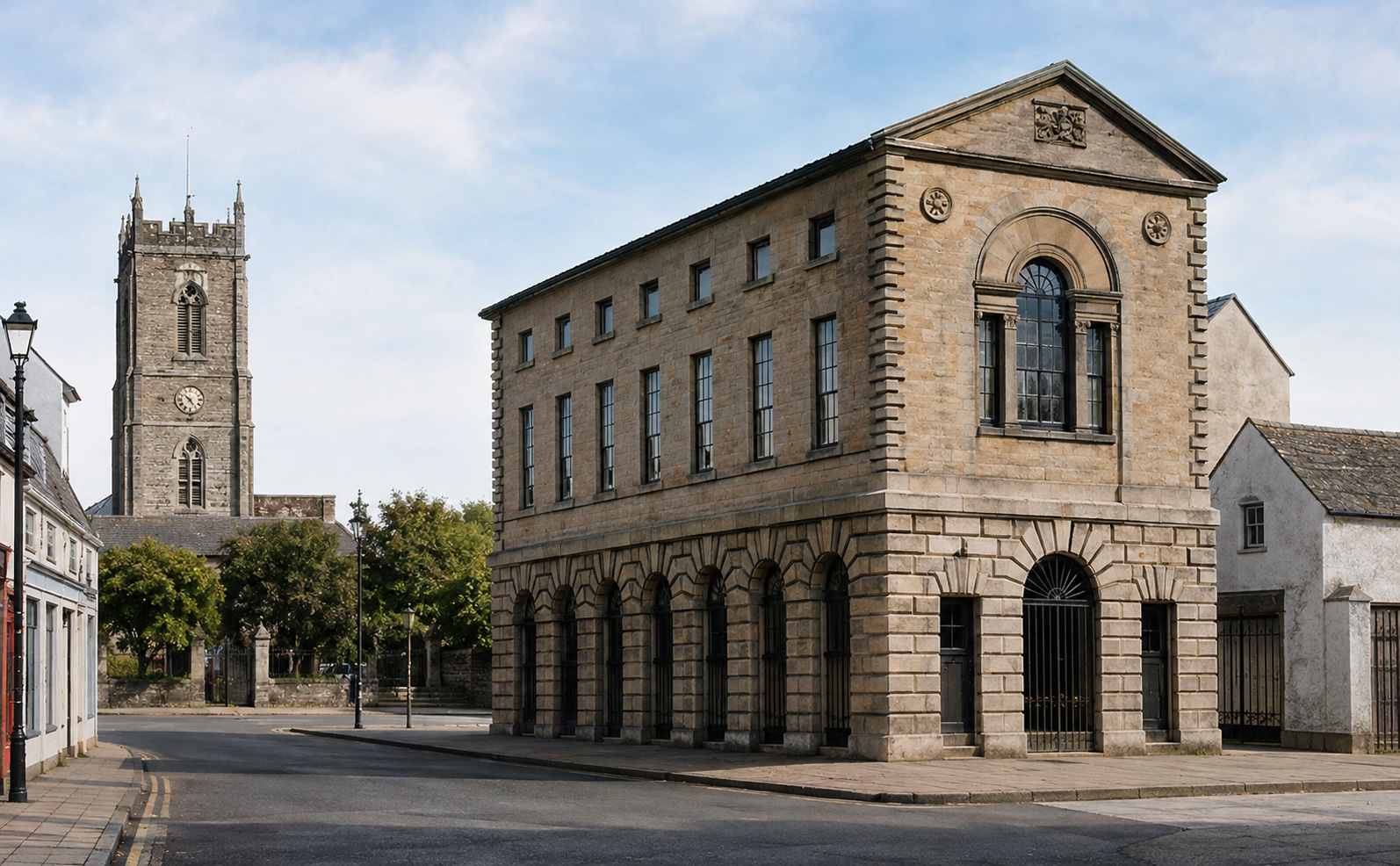
The hall had a very classic style with rusticated ground floor of seven bays, an upper chamber with a Venetian window at the west end, and in the pediment an entablature of the Paget family coat-of-arms made of Coade stone.
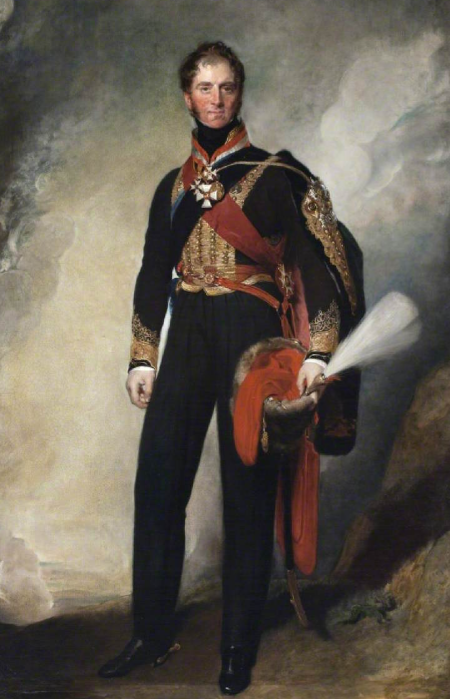
Internally there was a fire-place with a moulded chimney piece at the east end. It was fitted out for sessions of the manor court, and a copy of Sir Thomas Lawrence’s portrait of Field Marshall Sir Henry William Paget, 1st Marquess of Anglesey hung over the chimney piece.
A view from the rear as the building deteriorated.